Namaskar!
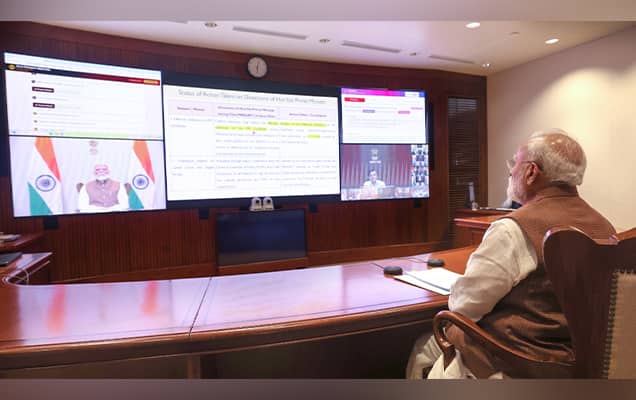
After the budget, your presence in the budget-related webinar is very important. Thank you all for joining this program. This year's budget was the first full budget of the third term of our government. This budget not only shows continuity in our policies, but also shows a new expansion in the vision of a developed India. The inputs and suggestions given by all of you stakeholders before the budget were very useful while preparing the budget. Now in implementing this budget more effectively, in getting the best and quickest outcome, in making all the decisions and policies effective, your role has increased further.
Friends,
India's resolve to move towards the goal of a developed India is very clear. We are all together engaged in building such an India where farmers are prosperous and empowered. Our endeavour is to ensure that no farmer is left behind and every farmer is encouraged to move forward. We have given a place of pride to our Annadatas, considering agriculture as the first engine of development. We are moving together towards two major goals, first- development of the agriculture sector and second- prosperity of our villages.

Friends,
The PM Kisan Nidhi Yojana was implemented 6 years ago. Under this scheme, farmers have received almost 4 lakh crore rupees so far. This amount has been directly transferred to the accounts of nearly 11 crore farmers. With this financial assistance of 6 thousand rupees annually, the rural economy is getting strengthened. We have created a farmer-centric digital infrastructure so that the benefits of this scheme can reach farmers across the country. That is, there is no scope for any middleman to enter or leakage in this, a no-cut company. This is an example of the fact that if experts and visionary people like you cooperate, then the scheme succeeds as soon as possible and gives better results. With your contribution, any scheme can be implemented with full strength and transparency. I would like to appreciate your cooperation in this and your active cooperation always. Now it is necessary that we work together and speedily to implement the announcements of this year's budget. In this also we will get your cooperation as before, but we should get more cooperation and more comprehensive cooperation in every sector.
Friends,
As you now know, today India's agricultural production is at a record level. The agricultural production which was around 265 million tonnes 10-11 years ago has now increased to more than 330 million tonnes. Similarly, the production related to horticulture has increased to more than 350 million tonnes. This is the result of our government's seed to market approach. Agricultural reforms, empowerment of farmers and strong value chain have made this possible. Now we have to reach even bigger targets by making full use of the agricultural potential of the country. In this direction, we have announced the PM Dhan Dhanya Krishi Yojana in the budget, this is a very important scheme for me. Under this, the focus will be on the development of the 100 districts with the lowest agricultural productivity in the country. You all have seen the results of the Aspirational District program on many parameters of development. These districts are getting a lot of benefits of collaboration, governance and healthy competition, and convergence. I would like all of you to study the results obtained from such districts and learn from their learnings and take the PM Dhan Dhanya Krishi Yojana forward at a very fast pace in these 100 districts. This will help in increasing the income of farmers in these 100 districts.

Friends,
In the last few years, due to our efforts, the production of pulses has increased in the country, and I also congratulate the farmers for this. But, still 20 percent of our domestic consumption is dependent on foreign countries, on imports. That means we have to increase our pulses production. We have achieved self-sufficiency in gram and moong. But we have to work more rapidly to increase the production of tur, urad and masoor. To speed up the production of pulses, it is necessary to maintain the supply of improved seeds and promote hybrid varieties. For this, all of you will have to focus on solving challenges like climate change, market uncertainty, and price fluctuations.
Friends,
In the last decade, ICAR has used modern tools and cutting-edge technologies in the breeding program. This has led to the development of more than 2900 new varieties in various crops including cereals, oilseeds, pulses, fodder, sugarcane between 2014 and 2024. You have to ensure that the farmers of our country get these new varieties at affordable rates. We also have to ensure that the farmers' yield is not affected by the fluctuations of the weather. You know that this time in the budget, it has been announced to start a national mission for high yielding seeds. I would especially like to tell the people from the private sector who are present in this program to definitely focus on the dissemination of these seeds. To ensure that these seeds reach small farmers, they will have to be made a part of the seed chain, and it is our job to decide how to become one.
Friends,
You all are seeing that today people have become very aware about nutrition. Therefore, in view of the increasing demand for horticulture, dairy and fishery products, a lot of investment has been made in these sectors. Many programs are being run to increase the production of fruits and vegetables. The formation of Makhana Board in Bihar has also been announced. I urge all of you stakeholders to find new ways to spread diverse nutritional foods. Such nutritional foods should reach every corner of the country and the global market.

Friends,
In 2019, we launched the PM Matsya Sampada Yojana. This was an important step towards strengthening the value chain of this sector, creating infrastructure and modernizing it. This helped in improving production, productivity and post-harvest management in the field of fisheries. In the past years, investment in this sector was also increased through many schemes, the results of which are in front of us today. Today fish production has doubled, our exports have also doubled. Our effort is to promote sustainable fisheries from the Indian Exclusive Economic Zone and the open sea. An action plan will be prepared for this. I would like all of you to brainstorm on ideas that promote Ease of Doing Business in this sector and start working on them as soon as possible. Along with this, we will also have to ensure the protection of the interests of our traditional fishermen.
Friends,
Our government is committed to making the rural economy prosperous. Under the Pradhan Mantri Awas Yojana-Gramin, crores of poor people are being given houses, property owners have got 'Record of Rights' through the Swamitva Yojana. We have increased the economic strength of self-help groups and have increased help to them. Small farmers and businessmen have benefited from the Pradhan Mantri Gram Sadak Yojana. We have set a target of making 3 crore Lakhpati Didis. Due to our efforts, more than 1.25 crore sisters have become Lakhpati Didis. The announcement of rural prosperity and development programs in this budget has created the possibility of many new employment opportunities. Investment in skilling and technology is creating new opportunities. All of you must discuss these topics on how to make the ongoing schemes more effective. Your suggestions and contributions in this direction will definitely yield positive results. Only with the active participation of all of us, villages will be empowered, rural families will be empowered. And I am confident that this webinar will be truly about implementing the budget as soon as possible, in the shortest possible time, and in the best possible manner, and that too with the cooperation and suggestions of all of you. Now it should not happen that in this webinar there is a discussion about making a new budget. Now this budget has been made, now this scheme has come. Now our entire focus should be on action. What are the difficulties in action, what are the shortcomings, what kind of changes are needed, we must pay attention to that. Only then will this webinar be fruitful. Otherwise, if we discuss today the budget that is going to come after a year, then we will not get the benefit of what has happened now. And that is why I request all of you that with the budget that has come, we have to achieve the targets in a year, and in that, not the government alone, but all the stakeholders of this sector should move in one direction, with one opinion, with one goal. With this one expectation, I thank you very much to all of you.