India is a nation of a billion aspirations. With a robust economy, assertive nation-first diplomacy, brave defence forces and a growing soft power, India is being seen by the world with a renewed hope.
It is proving its prowess on the economic front, with managing to remain world’s fastest growing large company. The growth reforms undertaken by the government has strengthened India’s fiscal health. Today, India acquires the distinction of one of the most attractive investment destinations. The GDP growth (in current prices) has increased by 31 per cent between 2013 and 2017, surpassing the increase in Global GDP which stands at 4 per cent.
India’s increasing economic clout is supplemented with improvement in her relations with other nations. It is the result of the government’s diplomatic endeavours that, for the first time, India has secured membership of not one, not two, but three elite groups that include the Missile Technology Control Regime (MTCR), the Wassenaar Arrangement (WA) and the Australia Group (AG). India’s entry into these exclusive non-proliferations groupings would ease the process of acquiring high tech items for our defence and space programmes.
In another first, India has successfully secured representation on the International Tribunal on the Law of the Seas (ITLOS), a body for resolution of international maritime disputes. It comes at a time when many nations are looking towards India to provide a strong leadership to help thwart attempts of anyone trying to lay unwarranted claim on the seas.
The decisiveness shown by the government in areas of national security has firmed up the belief that India’s defence forces are fully capable of answering the enemy in its own language. The precision with which terror targets were taken down on the other side of the border during surgical strikes, demonstrated India’s exemplary military power. The government fully backs nation’s defence forces. It has ensured that the long pending demands of the army including that of ‘one rank, one pension’ are duly fulfilled.
Under Prime Minister Narendra Modi modernisation of the Armed forces has been fast-tracked and critical defence deficiencies in weapons and infrastructure are being met through fast processing of defence procurement agreements.
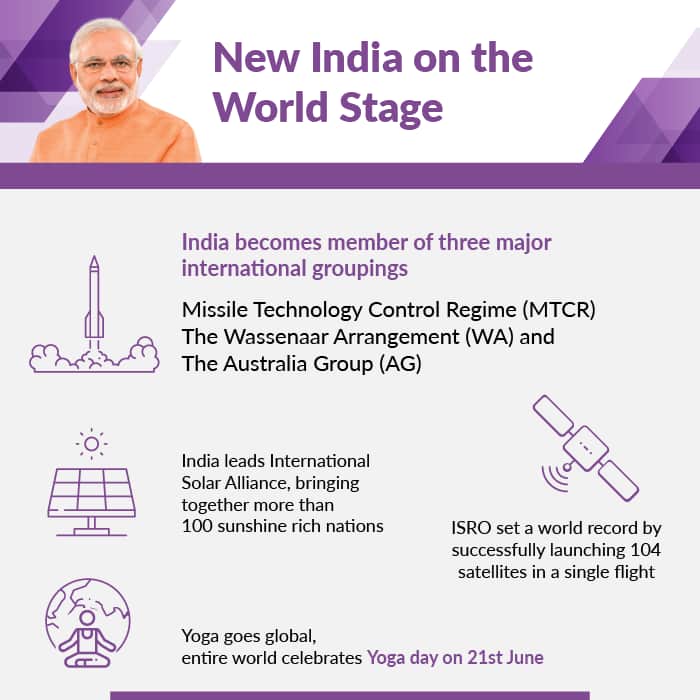
On the soft power front, India is walking on the path of “VasudhaivaKutumbakam” i.e. world isa family. Our outlook to problems concerning the entire world emanates from our belief in harmony and collective participation. One the most pertinent concerns facing the world is the threat of climate change bound to impact the whole of humanity. Other than India taking up a leading role at COP21 in Paris, she has also spearheaded the International Solar Alliance. The unique alliance brings together more than 100 sunshine rich nations to harness the solar power and fulfil future energy needs without harming the planet.
In another instance, of India’s soft power showing the way towards a better planet, Yoga has come to the centre stage of global recognition. Prime Minister Narendra Modi had said:
“When we talk of global peace, there should be peace among nations. That is possible only when there is peace within the society. Only peaceful families can constitute peaceful society. Only peaceful individuals can make peaceful families. Yoga is the way to create such a harmony and peace within individuals, family, society, nation and ultimately all over the world.”
The ancient practice has once again caught world’s attention when 21st June was declared as International Yoga Day. The resolution proposed by Prime Minister Narendra Modi in the U.N. was backed by 173 nations, an unprecedented level of support in the history of U.N. It has also been inscribed in the list of the intangible cultural heritage of Humanity in the UNESCO. World over, people are making Yoga a daily practice for its innumerable health and spiritual benefits. With a consistent institutional support, Yoga has gone global.
Another emerging area, where India is firmly creating a technological niche, is its space programme. With a team of world-class scientists and engineers, it has become a pioneer in space industry. ISRO has set a world record by successfully launching 104 satellites in a single flight, out of which 101 co-passenger satellites carried were international customer satellites from USA, Netherlands, Switzerland, Israel, Kazakhstan and UAE. India’s indigenous global navigation system has been set in place with the successful launch of IRNSS-1G. With this, India has joined the elite list of countries with their own satellite navigation system.
The great strides made by Indians in various fields is helping build a better future for all. With advancements in science, technology, economic growth and development paradigm, we are not only solving the problems at home but creating stories of success that can be replicated in the other parts of the world for the welfare of humanity.