Reforms by Conviction and Incentives

Published By : Admin | June 22, 2021 | 14:46 IST

The Covid-19 pandemic has come with whole new set of challenges to Governments across the world in terms of policy-making. India is no exception. Raising enough resources for public welfare while ensuring sustainability is proving to be one of the biggest challenges.

In this back-drop of financial crunch seen across the world, do you know that Indian states were able to borrow significantly more in 2020-21? It would perhaps pleasantly surprise you that states were able to raise an extra Rs 1.06 lakh crores in 2020-21. This significant increase in availability of resources was made possible by an approach of Centre-State bhagidari. 

When we formulated our economic response to the Covid-19 pandemic, we wanted to ensure that our solutions do not follow a ‘one size fits all’ model. For a federal country of continental dimensions, finding policy instruments at the national level to promote reforms by State Governments is indeed challenging. But, we had faith in the robustness of our federal polity and we moved ahead in the spirit of Centre-State bhagidari. 

In May 2020, as part of the Aatmanirbhar Bharat package, the Government of India announced that State Governments would be allowed enhanced borrowing for 2020-21. An extra 2% of GSDP was allowed, of which 1% was made conditional on the implementation of certain economic reforms. This nudge for reform is rare in Indian public finance. This was a nudge, incentivising the states to adopt progressive policies to avail additional funds. The results of this exercise are not only encouraging but also run contrary to the notion that there are limited takers for sound economic policies.

The four reforms to which additional borrowings were linked (with 0.25% of GDP tied to each one) had two characteristics. Firstly, each of the reforms was linked to improving the Ease of Living to the public and particularly the poor, the vulnerable, and the middle class. Secondly, they also promoted fiscal sustainability.

The first reform under the ‘One Nation One Ration Card’ policy required State Governments to ensure that all ration cards in the State under the National Food Security Act (NFSA) were seeded with the Aadhaar number of all family members and that all Fair Price Shops had Electronic Point of Sale devices. The main benefit from this is that migrant workers can draw their food ration from anywhere in the country. Apart from these benefits to citizens, there is the financial benefit from the elimination of bogus cards & duplicate members. 17 states completed this reform and were granted additional borrowings amounting to Rs. 37,600 crores. 

The second reform, aimed at improving ease of doing business, required states to ensure that renewal of business-related licences under 7 Acts is made automatic, online and non-discretionary on mere payment of fees. Another requirement was implementation of a computerized random inspection system and prior notice of inspection to reduce harassment and corruption under a further 12 Acts. This reform (covering 19 laws) is of particular help to micro and small enterprises, who suffer the most from the burden of the ‘inspector raj'. It also promotes an improved investment climate, greater investment and faster growth. 20 states completed this reform and were allowed additional borrowing of Rs. 39,521 crores. 

The 15th Finance Commission and several academics have emphasised the crucial importance of sound property taxation. The third reform required states to notify floor rates of property tax and of water & sewerage charges, in consonance with stamp duty guideline values for property transactions and current costs respectively, in urban areas. This would enable better quality of services to the urban poor and middle class, support better infrastructure and stimulate growth. Property tax is also progressive in its incidence and thus the poor in urban areas would benefit the most. This reform also benefits municipal staff who often face delay in payment of wages. 11 states completed these reforms and were granted additional borrowing of Rs. 15,957 crores. 

The fourth reform was introduction of Direct Benefit Transfer (DBT) in lieu of free electricity supply to farmers. The requirement was for formulation of a state-wide scheme with actual implementation in one district on a pilot basis by year end. Additional borrowing of 0.15% of GSDP was linked to this. A component was also provided for reduction in technical & commercial losses and another for reducing the gap between revenues and costs (0.05% of GSDP for each). This improves the finances of distribution companies, promotes conservation of water and energy and improves service quality through better financial and technical performance. 13 states implemented at least one component, while 6 states implemented the DBT component. As a result, Rs. 13,201 crore of additional borrowings was permitted. 

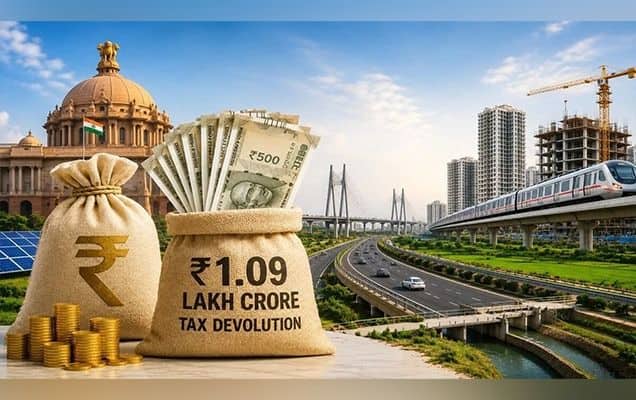
Overall, 23 states availed of additional borrowings of Rs. 1.06 lakh crores out of a potential of Rs. 2.14 lakh crores. As a result, the aggregate borrowing permission granted to states for 2020-21 (conditional and unconditional) was 4.5% of the initially estimated GSDP. 

For a large nation with complex challenges as ours, this was a unique experience. We have often seen that for various reasons, schemes and reforms remain un-operational often for years. This was a pleasant departure from the past where the Centre & States came together to roll out public friendly reforms in a short span of time amidst the pandemic. This was made possible due to our approach of Sabka Saath, Sabka Vikas and Sabka Vishwas. Officials who have been working on these reforms suggest that without this incentive of additional funds, enactment of these policies would have taken years. India has seen a model of ‘reforms by stealth and compulsion’. This is a new model of ‘reforms by conviction and incentives’. I am thankful to all the states who took the lead in ushering in these policies amidst tough times for the betterment of their citizens. We shall continue working together for the rapid progress of 130 crore Indians.

Explore More
শ্ৰী ৰাম জনমভূমি মন্দিৰৰ ধ্বজাৰোহণ উৎসৱত প্ৰধানমন্ত্ৰীৰ সম্বোধনৰ অসমীয়া অনুবাদ

Popular Speeches

শ্ৰী ৰাম জনমভূমি মন্দিৰৰ ধ্বজাৰোহণ উৎসৱত প্ৰধানমন্ত্ৰীৰ সম্বোধনৰ অসমীয়া অনুবাদ
India’s digital economy enters mature phase as video dominates: Nielsen

Media Coverage

India’s digital economy enters mature phase as video dominates: Nielsen
NM on the go

Nm on the go

Always be the first to hear from the PM. Get the App Now!
...
মহাত্মা জ্যোতিৰাও ফুলে: এক জ্যোতি যিয়ে এতিয়াও ভাৰতক পথ প্ৰদৰ্শন কৰে
April 11, 2026

Today, 11th April, is a deeply special day for all of us. It is the birth anniversary of Mahatma Jyotirao Phule, one of India’s greatest social reformers and a guiding light for generations. This year, the occasion carries even greater significance, as it marks the beginning of his 200th birth anniversary celebrations.

Mahatma Phule was a great reformer. In addition to that, his was a life of moral courage, restless enquiry and unshakable commitment to social good. Mahatma Phule is remembered for the institutions he built and the movements he led. At the same time, his contribution to our civilisational journey lies in the hope he aroused, the confidence he instilled and the strength his thoughts continue to give to millions of people across the nation.

Born in the great state of Maharashtra in 1827, Mahatma Phule emerged from modest beginnings. But his initial hardships never stood in the way of his learning, his courage or his commitment to society. This is a trait that remained with him forever: whatever the challenges may be, one must work hard, acquire knowledge and mitigate those challenges instead of doing nothing about it. From his school days, young Jyotirao was deeply curious and became a voracious reader, often reading books far beyond what children his age were expected to engage with. Years later, he said, “The more questions we generate, the more knowledge emerges from them.” Clearly, the spirit of enquiry he was blessed with since his childhood remained constant in his journey.

Throughout his life, learning and education became central to Mahatma Phule’s mission. He recognised with rare clarity that knowledge is not a privilege to be guarded, but a force to be shared. At a time when the joys of learning were denied to many, he opened pioneering schools for girls and for those kept out of formal education. He used to say, “Any improvement that comes in children through mothers is deeply valuable. Therefore, if schools are to be opened, they should first be opened for girls.” He worked to create a new social imagination in which the classroom became an instrument of justice and equality..

His vision for education inspires us greatly. Over the last decade, we have worked to make research and innovation a cornerstone for the youth of India. Efforts are being made to create an ecosystem where young minds are encouraged to question, explore and innovate. By investing in knowledge, skills and opportunity, India is empowering its youth to become problem-solvers and drivers of national progress.

Due to his knowledge and wisdom, Mahatma Phule developed a strong understanding of areas such as agriculture, healthcare and rural development. He often said that injustice towards our farmers and workers weakens our society. He saw how social inequalities manifested themselves in daily life, be it in the farms or in villages. Hence, he immersed himself in ensuring dignity for the poor, the downtrodden and the marginalised. At the same time, he made every possible effort to ensure social harmony was maintained.

Mahatma Phule opined, “जोपर्यंत समाजातील सर्वांना समान अधिकार मिळत नाहीत, तोपर्यंत खरे स्वातंत्र्य मिळत नाही” (True freedom cannot be achieved until everyone in society is granted equal rights). And for that, he built institutions that translated this vision into action, contributing to a just society. The Satyashodhak Samaj, founded by him, was one of the most important social reform movements in modern India. It was at the forefront of social reform, community service and furthering human dignity. It became an effective voice for women, youngsters and those living in villages. This movement reflected Mahatma Phule’s intrinsic belief that society could be strengthened by placing at its core justice, respect for every person and a spirit of collective progress.

His personal life, too, carried lessons in courage. Always working and being among the people took a toll on his health. But even the most serious health challenges did not dim his resolve. After suffering a debilitating stroke, he continued to work and fulfil his vision. Yes, his body had been tested, but his commitment to society had not yielded. For millions today, especially those who draw courage from struggle, this remains one of the most powerful dimensions of his life.

No remembrance of Mahatma Phule can be complete without a respectful mention of Savitribai Phule, who was herself one of the tallest reformers of our nation. As one of India’s pioneering women teachers, she played a defining role in advancing education for girls, thus giving them the opportunity to pursue their dreams. After Mahatma Phule’s passing, Savitribai carried forward that torch and, in 1897, during a plague outbreak, she served victims with such devotion that she herself contracted the disease and lost her own life.

Our land has been blessed, time and again, by great men and women who have strengthened society through thought, sacrifice and action. They did not wait for change to arrive from somewhere else. They became its source. For hundreds of years in our land, the clarion call for social betterment has often risen from within society itself, from those who could see suffering clearly and refused to accept it as fate. Mahatma Jyotirao Phule was one such voice.

I fondly recall my visit to Pune in 2022, when I had offered tributes to Mahatma Phule at his grand statue in the city. As we mark the beginning of his bicentenary year, the most fitting tribute to Mahatma Jyotirao Phule is about renewal. Renewal of our commitment to subjects close to his heart, such as education. Renewal of our sensitivity to injustice. Renewal of our faith that society can improve itself from within. His life tells us that the power of community can achieve miracles in India when joined with moral clarity and public purpose. That is why he still gives strength to millions. That is why his words and work still carry hope. And that is why, nearly two hundred years after his birth, Mahatma Jyotirao Phule remains not a figure of the past, but a guide for India’s future.