Hail Somnath!
Hail Somnath!
Har Har Mahadev!
Gujarat Chief Minister Shri Bhupendra Bhai Patel, Deputy Chief Minister Bhai Harsh Sanghavi Ji, ministers of the Gujarat government, Members of Parliament and legislators, all distinguished guests, ladies and gentlemen,
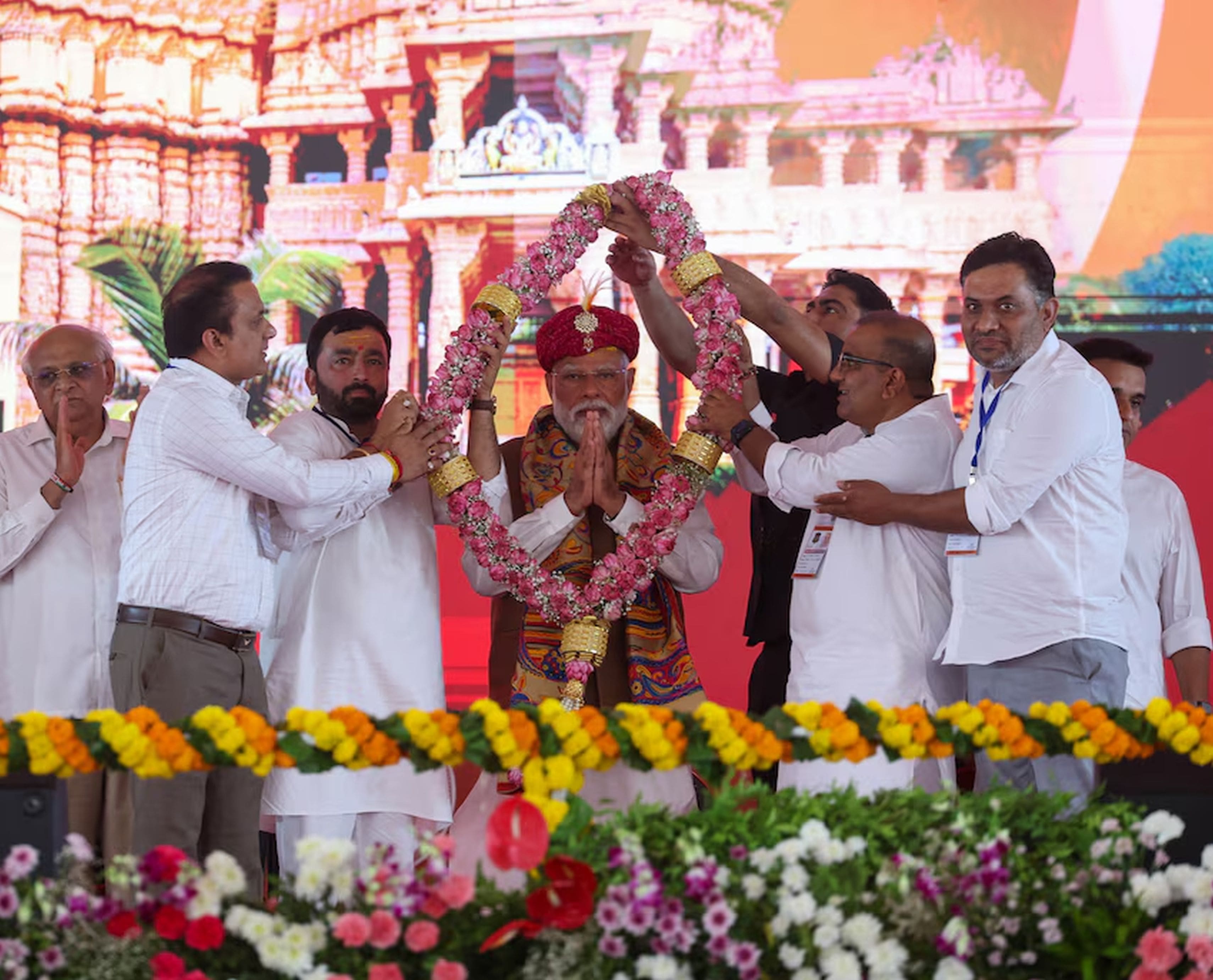
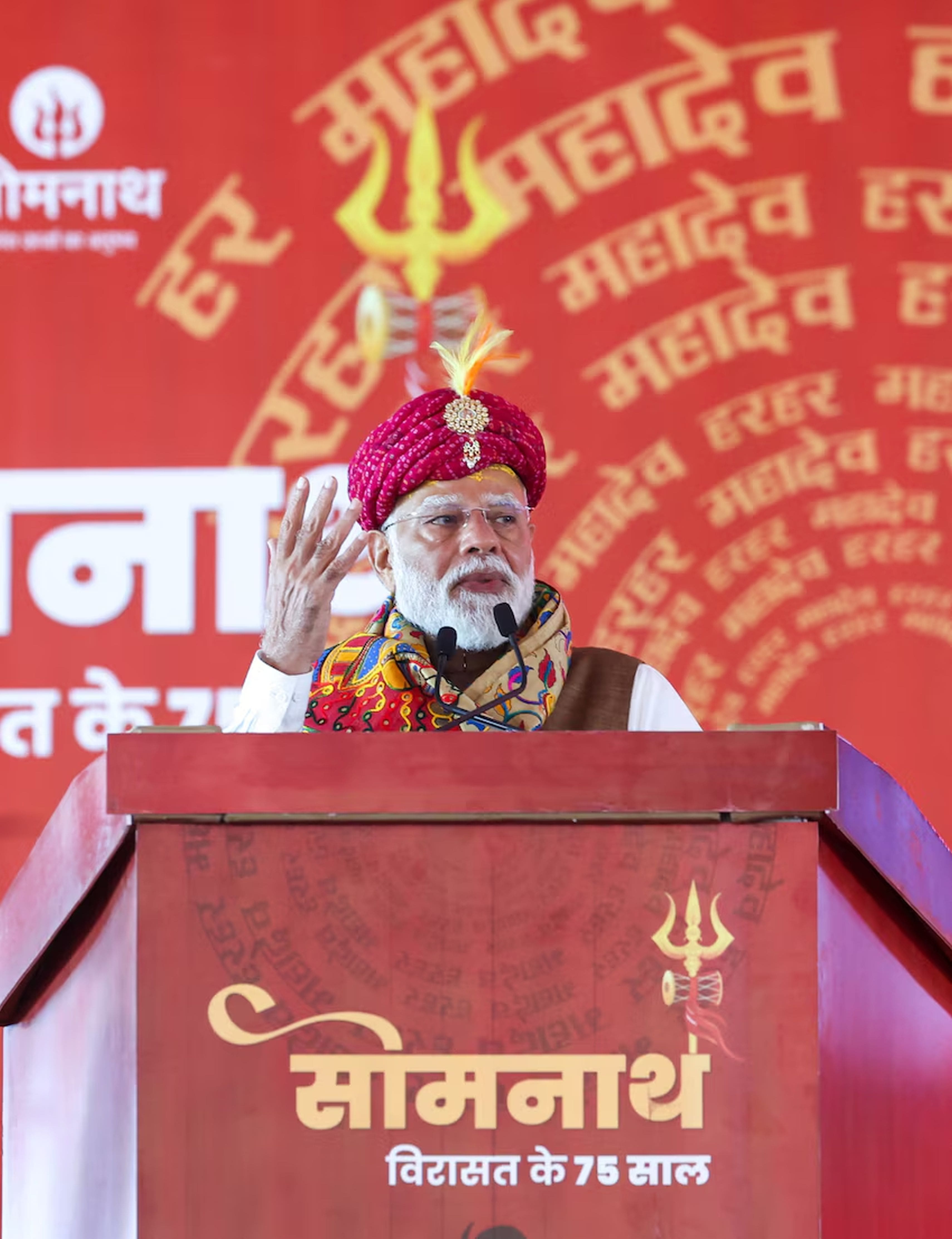
Today, the sacred land of Prabhas Patan is filled with a divine radiance. This vision of Mahadev, this beauty, the shower of flowers from the earth and the sky, the glow of saffron flags, these magnificent presentations of art, music, and dance, the chanting of Vedic hymns, the uninterrupted recitation of the Shiva Panchakshari in the sanctum sanctorum, and along with all this, the roaring chants of the sea waves—it feels as though the entire creation is speaking in one voice: Hail Somnath! Glory to Somnath!
Friends,
Today we are celebrating 75 years of the consecration of the idol of Lord Mahadev, He by whose will time itself manifests, who is eternal, who is the embodiment of time itself. He from whom this universe is created and into whom it dissolves:
“Yato jayate palyate yena vishwam, tamisham bhaje leeyate yatra vishwam.”
Today we are celebrating the reconstruction of His sacred abode. He who drank poison and became Neelkanth—in His refuge, this Somnath Amrit Mahotsav is being celebrated today. All this is but the divine play of Lord Sadashiva.
Friends,
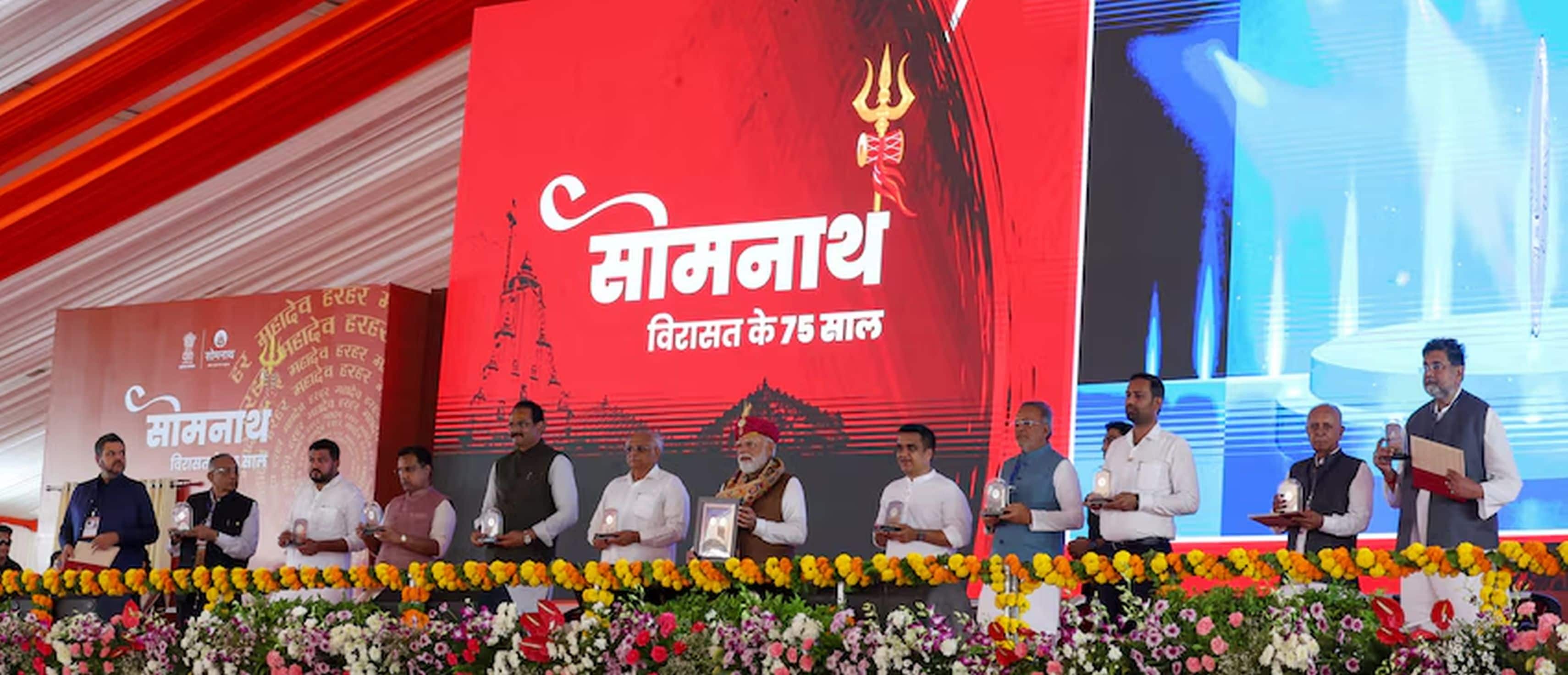
As a devoted worshipper of Somnath Dada, I have come here countless times and bowed before Him many times. But today, while coming here, this journey through time was giving me a unique and blissful feeling. Just a few months ago, I came here when we celebrated the Somnath Swabhiman Parv. Even a thousand years after its first destruction, we celebrated the pride of Somnath’s immortality, and today we mark 75 years of the consecration of this modern form. We are not merely participants in two ceremonies; Lord Shiva has given us the opportunity to experience a thousand-year journey of immortality.
Friends,
Seventy-five years ago, on this very day, the restoration of Somnath Temple was no ordinary event. If India became independent in 1947, then the consecration of Somnath in 1951 proclaimed the awakening of India’s independent spirit. At the time of independence, Sardar Vallabhbhai Patel united more than 500 princely states to shape the modern form of one India. Simultaneously, through the reconstruction of Somnath, he told the world that India had not merely become free—India had also embarked upon the path of reclaiming its ancient glory.
Friends,
Therefore, on this occasion, I am not merely seeing a glimpse of 75 years. Here I see the resolve of creation amid destruction, which Somnath has embodied. Here I see the victory of truth over falsehood, which Prabhas Patan has lived repeatedly. Here I see thousands of years of spiritual consciousness that taught the welfare of all humanity to the world. Here I see that immortal spirit of India which could neither be erased nor defeated despite centuries of malicious attempts. And I see that this Somnath Amrit Mahotsav is not merely a celebration of the past; it is also a grand festival of inspiration for India’s next thousand years. I extend heartfelt congratulations to all citizens of the country and to the millions of devotees of Somnath Dada on this occasion.
Friends,
Today is also special for another reason. On this very day, 11 May 1998, India conducted nuclear tests at Pokhran. On 11 May, the country carried out its first three nuclear tests. Our scientists demonstrated India’s strength and capability before the world, and it created a storm globally. The world reacted angrily—how could India dare conduct nuclear tests? Powerful nations from around the world came forward to pressure India. Various sanctions were imposed. Paths leading to economic stability were blocked. Anyone could have been shaken under such pressure. But we are made of different soil. After 11 May, the world turned against us. The scientists had done their work on 11 May, but on 13 May, two more nuclear tests were conducted, showing the world how resolute India’s political will truly was. Despite global pressure, under Atal Ji’s leadership, the BJP government demonstrated that for us, the nation comes first. No power in the world could bend India or force it into submission.
Friends,
The Pokhran nuclear tests were named “Operation Shakti.” Because the worship of Shakti alongside Shiva has always been part of our tradition. Ardhanarishvara Shiva Himself becomes complete only with Shakti. You may recall that when India’s Chandrayaan mission succeeded, we named the landing site of the rover on the Moon “Shiv Shakti Point.” In our faith, the Moon is associated with Shiva, and Shiva with Shakti. How wonderful it is that this Jyotirlinga itself is called Somnath—linked to Soma, the Moon.
Friends,
The philosophy of our worship of Shiva and Shakti has now become an inspiration for the nation’s scientific progress as well. On this occasion, from the holy feet of Lord Somnath, I extend greetings to all citizens on the anniversary of Operation Shakti.
Friends,
When I came here last time, I had said: How can something that carries “Som,” meaning nectar and immortality, in its very name ever be destroyed? Throughout history, this temple faced numerous invasions. Invaders such as Mahmud Ghazni and Alauddin Khilji tried to erase the grandeur of Somnath. They treated Somnath as merely a physical structure and attacked it repeatedly. Again and again, the temple was destroyed—and every time it rose again. Those who tried to destroy it did not understand the ideological strength of our civilization. We consider the physical body mortal, but we know that the soul within is immortal. And Shiva is the universal soul itself. Therefore, Shiva manifested in the resolve of different people in different eras. Kings like Bhoja, Bhimdev I, Kumarapala, Mahipala I, and Rao Khangar repeatedly rebuilt Somnath Temple. Great thinkers like Lakulish and Som Sharma preserved the heritage of Prabhas Patan and made it a great center of Shaivite philosophy and spiritual practice. Bhava Brihaspati, Pashupata acharyas, and many scholars kept the spiritual traditions of this pilgrimage alive. Personalities like Vishaldeva and Tripurantaka protected the intellectual consciousness of this region.
Friends,
Veer Hamirji Gohil, Veer Vegadji Bhil, Punyashlok Ahilyabai Holkar, the Gaekwads of Baroda, Jam Saheb Maharaja Digvijay Singh Ji—so many great personalities dedicated everything in service of Somnath. Today, I respectfully bow before Sardar Vallabhbhai Patel, Dr. Rajendra Prasad, Shri K. M. Munshi, and all known and unknown noble souls. Their memory inspires us not only to preserve and advance our cultural heritage but also to pass this responsibility on to future generations.
Friends,
Our cultural sites have been India’s identity for thousands of years. We inherited such a rich legacy, yet ironically, for decades we failed to understand its importance. Around the world, there are many examples where foreign invaders destroyed places tied to national identity. But when the people of those nations got the opportunity, they came together to restore and honor those symbols again. In our country, however, even matters of national pride became subjects of politics. Somnath itself is the biggest example of this. One of the first responsibilities after independence should have been the restoration of Somnath Temple. That is why Sardar Vallabhbhai Patel and Dr. Rajendra Prasad made such determined efforts for it. But we all know how much opposition they faced from Nehru Ji. I will not go into details today, but it was Sardar Patel’s determination that despite all opposition, he did not waver. Somnath Temple was rebuilt, and the country erased centuries of humiliation.
Friends,
Unfortunately, even today there are forces in the country for whom appeasement is more important than national pride. We saw this during the construction of the Ram Temple as well, when there was opposition to it. We must remain cautious of such mindsets. We must move beyond such narrow politics. We must progress while taking development and heritage together.
Friends,
In recent years, I have had the opportunity to serve Somnath Dada as the chairman of the Somnath Trust. The historic work carried out for the development of this temple and this region is visible to all of us today. At the same time, this service has also personally benefited me. The opportunity I now have to develop sacred pilgrimage sites across the country is itself the grace of Lord Somnath.
Friends,
Today, after centuries, Kashi Vishwanath Dham has witnessed a grand expansion. Today, in Ujjain, we are witnessing the magnificent Mahakal Mahalok. Kedarnath Dham has also been reconstructed. As I said earlier, the 500-year wait in Ayodhya has finally ended, and Ram Lalla now resides in a grand temple there.
Friends,
There are countless such sacred pilgrimage sites, monasteries, temples, and spiritual regions whose glory we once only heard about in the Puranas, but today we are beginning to witness that rich tradition with our own eyes. And all this has happened within just 10–12 years.
Friends,
The neglect of our cultural centers was a major obstacle to India’s development. Our pilgrimage sites are not only centers of India’s spiritual and social order but also sources of economic progress. Today, projects such as the Char Dham Highway Project, the ropeway from Govindghat to Hemkund Sahib, the Kartarpur Corridor, and the development of the Buddhist Circuit have increased economic activity in pilgrimage regions. The Somnath complex itself is a strong example of this. Hundreds of families are associated with the Somnath Temple Trust today. Thousands of livelihoods are connected to this region. People who come here from across India and the world also travel to other parts of Gujarat. This opens new doors of progress for the state and the country.
Friends,
Our faith also teaches us how to live. We believe:
“Sarvam khalvidam brahma.”
Meaning, every component of creation and nature itself is a manifestation of the divine. Therefore, our faith resides in rivers, in trees. We view forests with reverence. We see sanctity in mountains as well. And today, when the world is returning to natural lifestyles, we too must recognize this strength of ours. Along with developing our pilgrimage sites and temples, we must remain conscious of preserving their dignity. We should adopt lifestyles that protect nature and the environment. At the same time, we should develop our sacred sites as examples for the entire world. We must connect these resolutions with our faith and live by them.
Friends,
When new generations connect with their history, their faith, and their cultural values, the nation’s self-confidence grows stronger. The confidence with which India is progressing today is deeply connected to this cultural continuity. Modernity and heritage are not opposites in India; they move together and strengthen one another. Somnath reminds us that a nation remains strong for a long time only when it stays connected to its roots—when it passes its heritage to future generations with the same faith and devotion. Seventy-five years ago, when the consecration of the rebuilt Somnath Temple took place, India began a new journey of consciousness. Today, 75 years later, that same journey stands before us in a much broader form. We must take it to even greater heights. May the blessings of Somnath Dada always remain with us in fulfilling our resolutions. Once again, I extend heartfelt greetings to all citizens, to everyone who believes in heritage, and to all of you on this occasion.
Say with me—
Hail Somnath!
Hail Somnath!
Har Har Mahadev!