സ്വയംപര്യാപ്തതയോടെ ബഹിരാകാശ ലക്ഷ്യങ്ങൾ പിന്തുടരുന്നതിലാണ് ഇന്ത്യയുടെ വിജയത്തിലേക്കുള്ള പാത നിലനിൽക്കുന്നത്: പ്രധാനമന്ത്രി
ഭാവി ദൗത്യങ്ങൾക്ക് നേതൃത്വം നൽകാൻ സജ്ജരായ 40–50 ബഹിരാകാശയാത്രികരുടെ ഒരു സംഘത്തെ ഇന്ത്യ സൃഷ്ടിക്കേണ്ടതുണ്ട്: പ്രധാനമന്ത്രി
ബഹിരാകാശ നിലയം, ഗഗൻയാൻ എന്നീ രണ്ട് തന്ത്രപരമായ ദൗത്യങ്ങളാണ് ഇപ്പോൾ ഇന്ത്യക്കുള്ളത്: പ്രധാനമന്ത്രി
ബഹിരാകാശയാത്രികൻ ശുക്ലയുടെ യാത്ര ഇന്ത്യയുടെ ബഹിരാകാശ അഭിലാഷങ്ങളിലെ ആദ്യപടി മാത്രമാണ്: പ്രധാനമന്ത്രി

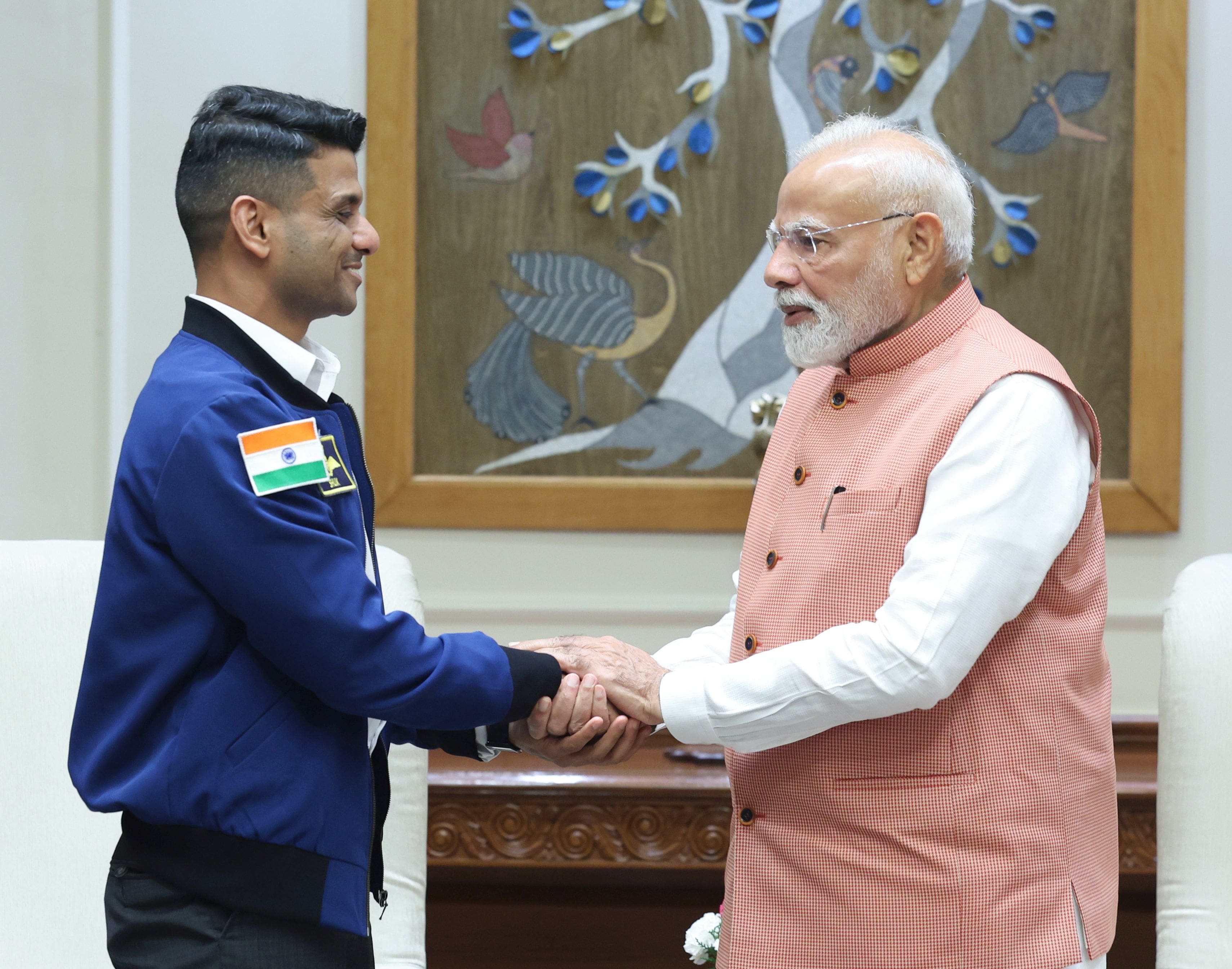
The Prime Minister Shri Narendra Modi interacted with Astronaut Shubhanshu Shukla in New Delhi yesterday. Reflecting on the transformative experience of space travel, the Prime Minister remarked that after undertaking such a significant journey, one must feel a change and he sought to understand how astronauts perceive and experience this transformation. Responding to the Prime Minister, Shubhanshu Shukla stated that the environment in space is distinctly different, with the absence of gravity being a key factor.
 

The Prime Minister asked whether the seating arrangement remains the same during the journey. Shukla confirmed this, saying, “Yes sir, it remains the same.” Shri Modi further noted that astronauts have to spend 23–24 hours in the same setup. Shukla affirmed this and added that once in space, astronauts can unfasten their seats and harnesses, and move freely within the capsule.

Continuing the interaction with astronaut Shubhanshu Shukla, delving into the physical and psychological impact of space travel, the Prime Minister inquired whether the capsule offered sufficient space. Shubhanshu Shukla responded that while it wasn’t very spacious, there was some room available. The Prime Minister remarked that the capsule seemed more comfortable than a fighter jet cockpit. Shukla affirmed, “It is even better than that, sir.”

Further, Shri Modi was briefed on the physiological changes that occur upon reaching space. Shukla highlighted that the heart rate slows down significantly, and the body undergoes several adjustments. However, within four to five days, the body acclimatizes and normalizes in the space environment. Shukla further explained that upon returning to Earth, the body experiences the same set of changes again. Regardless of one’s fitness level, walking becomes difficult initially. He shared his personal experience, stating that although he felt fine, he stumbled while taking his first steps and had to be supported by others. Even though one knows how to walk, the brain takes time to reorient and understand the new environment. The Prime Minister emphasized that space travel requires not just physical training but mental conditioning as well. Shukla agreed, stating that while the body and muscles possess strength, the brain requires rewiring to comprehend the new environment and recalibrate the effort needed to walk and function normally.

Discussing the exploration of the duration of space missions, Shri Modi inquired about the longest duration astronauts have spent in space. Shubhanshu Shukla informed that currently, individuals are staying up to eight months at a time, a milestone initiated with the present mission. The Prime Minister asked about the astronauts Shukla met during his mission. Shukla confirmed that some of them are scheduled to return in December.
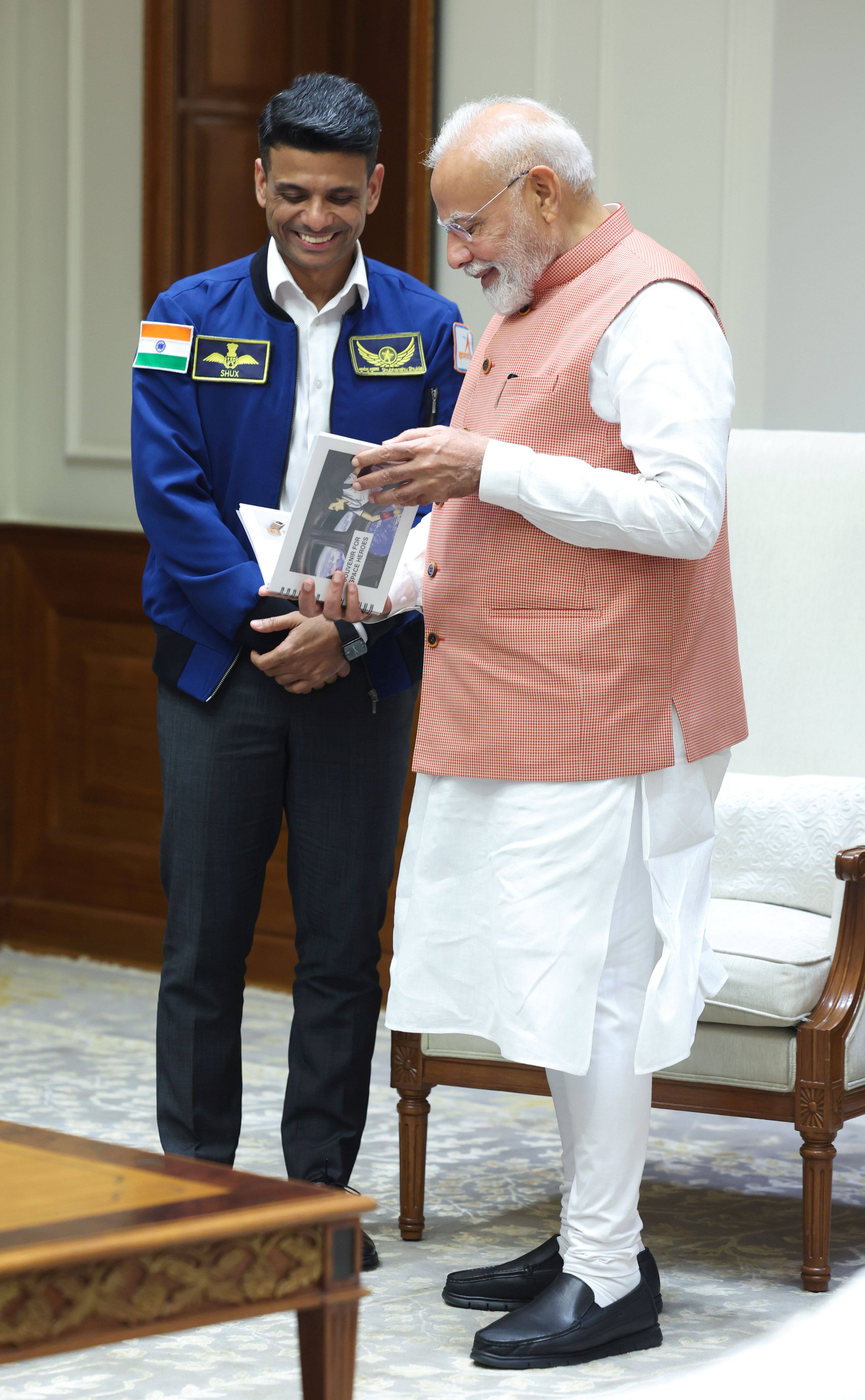
 

Shri Modi sought insights into the significance of Shukla’s experiments on growing Moong and Methi aboard the space station. Shukla expressed surprise that many people were unaware of certain developments. He highlighted that food remains a major challenge aboard space stations due to limited space and expensive cargo. The focus is on packing maximum calories and nutrition in minimal space. He explained that various experiments are underway, and growing certain foods is remarkably simple in space. Using minimal resources, such as a small dish and a bit of water, sprouts began emerging within eight days—an experiment Shukla personally witnessed aboard the station. Shukla emphasized that India’s unique agricultural innovations are now reaching microgravity research platforms. He noted the potential of these experiments to address food security challenges—not only for astronauts but also for vulnerable populations on Earth.

The Prime Minister asked how international astronauts reacted upon meeting an Indian astronaut. Shukla shared that over the past year, wherever he went, people were genuinely happy and excited to meet him. They frequently asked about India’s space activities and were well-informed about the country’s progress. Many were particularly enthusiastic about the Gaganyaan mission, inquiring about its timeline. Shukla’s crewmates even requested signed notes, expressing their desire to be invited to the launch and to travel aboard India’s spacecraft.

Shri Modi further asked why others referred to Shukla as a genius. Shukla humbly responded that people were kind in their remarks. He attributed their appreciation to his rigorous training—first in the Indian Air Force and later as a space pilot. Initially believing that academic study would be minimal, Shukla discovered that the path required extensive learning. Becoming a space pilot, he explained, is akin to mastering an engineering discipline. He underwent years of training under Indian scientists and felt well-prepared for the mission.


Prime Minister Shri Narendra Modi reviewed the progress of the “homework” he had earlier assigned to astronaut Shubhanshu Shukla. Shukla reported that the progress has been excellent. He affirmed that the task was indeed given and was very important, stating that his journey itself was meant to create awareness. He emphasized that while the mission was successful and the team returned safely, it was not the end—it was only the beginning. The Prime Minister reiterated that this was the first step. Shukla echoed the sentiment, saying, “Yes sir, it is the first step.” He emphasized that the core objective of this initiative was to learn as much as possible and bring those insights back.

The Prime Minister highlighted the need to build a large pool of astronauts in India, suggesting that 40–50 individuals should be ready for such missions. He noted that until now, very few children may have considered becoming astronauts, but Shukla’s journey would likely inspire greater belief and interest.

Shukla reflected on his childhood, recalling that when Rakesh Sharma went to space in 1984, the idea of becoming an astronaut never occurred to him due to the absence of a national program. However, during his recent mission, he interacted with children on three occasions—once through a live event and twice via radio. In each of these events, at least one child asked him, “Sir, how can I become an astronaut?”. Astronaut Shukla stated that this achievement is a major success for the country, emphasizing that today’s India no longer needs to merely dream—it knows that spaceflight is possible, that options exist, and that becoming an astronaut is achievable. “Representing India in space was a great opportunity, and now it is his responsibility to help more people reach this milestone”, added Shukla.

Prime Minister Shri Narendra Modi remarked that India now has two major missions ahead—Space Station and Gaganyaan and highlighted that Shukla’s experience would be of great value in these upcoming endeavours.
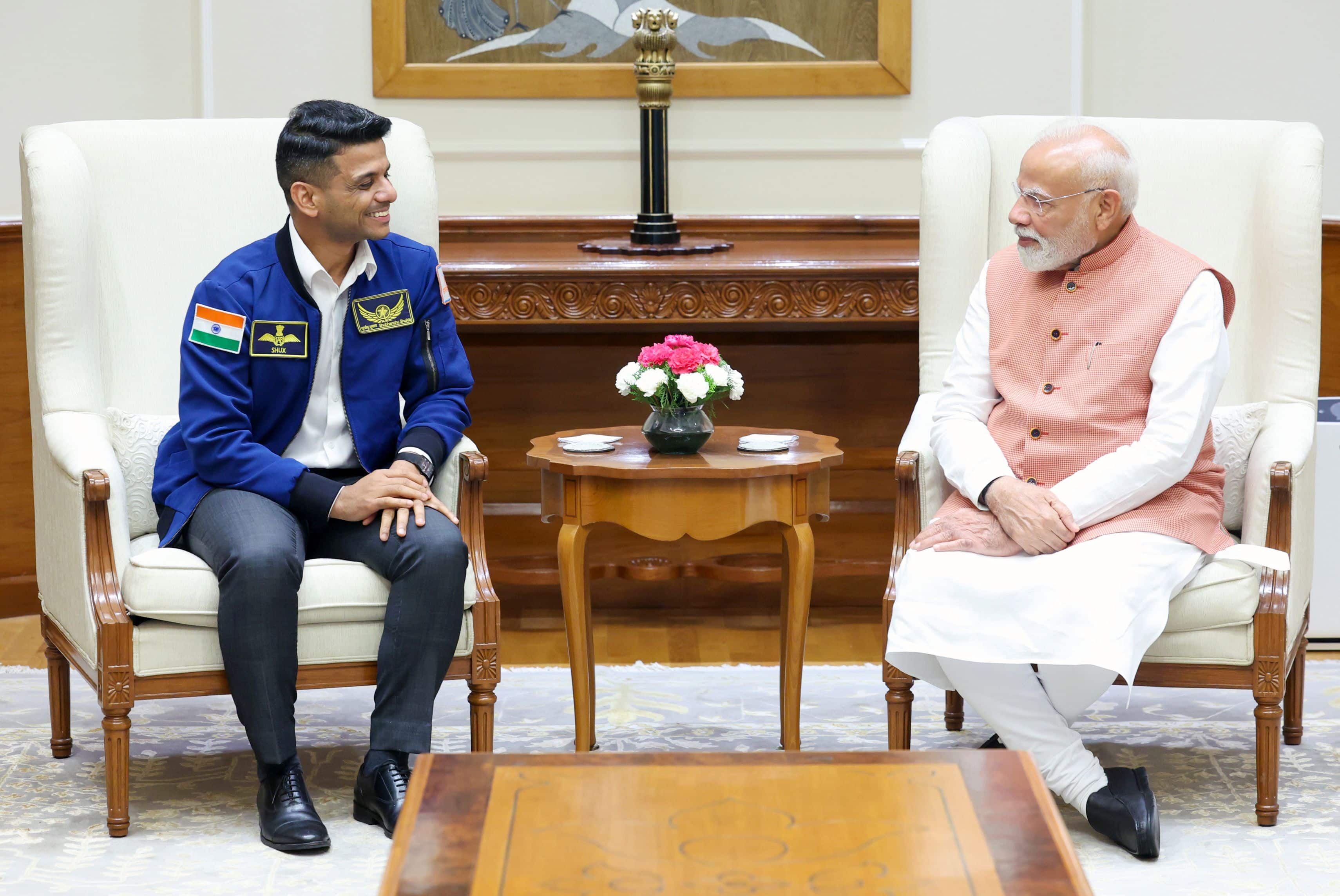
 

Shukla responded affirmatively, noting that this is a major opportunity for the country, especially given the sustained commitment of the Government under Prime Minister Modi’s leadership. He pointed out that despite setbacks such as Chandrayaan-2 not being successful, the Government continued to support the space program with consistent budgeting, leading to the success of Chandrayaan-3. He emphasized that such support, even after failures, is being observed globally and reflects India’s capability and positioning in the space domain. Shukla stated that India can acquire a leadership role and that a space station led by Bharat, with participation from other nations, would be a powerful tool.

Shukla further referred to the Prime Minister’s remarks on Independence day on Atmanirbharta in space manufacturing and said that all these elements are interconnected—the vision for Gaganyaan, the Space station, and the moon landing—forming a vast and ambitious dream. Prime Minister Modi affirmed that if India pursues these goals with self-reliance, it will succeed.


പൂർണ്ണ പ്രസംഗം വായിക്കാൻ ഇവിടെ ക്ലിക്ക് ചെയ്യുക

Explore More
ശ്രീരാമജന്മഭൂമി ക്ഷേത്രത്തിലെ പതാക ഉയർത്തൽ ഉത്സവത്തിനിടെ പ്രധാനമന്ത്രി നടത്തിയ പ്രസം​ഗം

ജനപ്രിയ പ്രസംഗങ്ങൾ

ശ്രീരാമജന്മഭൂമി ക്ഷേത്രത്തിലെ പതാക ഉയർത്തൽ ഉത്സവത്തിനിടെ പ്രധാനമന്ത്രി നടത്തിയ പ്രസം​ഗം
Republic Day sales see fastest growth in five years on GST cuts, wedding demand

Media Coverage

Republic Day sales see fastest growth in five years on GST cuts, wedding demand
NM on the go

Nm on the go

Always be the first to hear from the PM. Get the App Now!
...
Towards 2030: A Joint India-European Union Comprehensive Strategic Agenda
January 27, 2026

This Joint India-EU Comprehensive Strategic Agenda, endorsed at the 16th India-EU Summit held on 27 January 2026 in New Delhi, aims to further reinforce the strategic partnership by broadening, deepening and better coordinating EU-India cooperation to deliver mutually beneficial, concrete and transformative outcomes for both partners and for the wider world.

The strategic agenda covers key areas: prosperity and sustainability, technology and innovation, security and defence, connectivity and global issues, reinforced by enablers across pillars. Building on more than 20 years of strategic partnership, it is a forward-looking action plan that reflects the commitment of both sides to work together in an increasingly complex geopolitical environment as trusted, predictable and like-minded partners.

PROSPERITY AND SUSTAINABILITY

Boosting Trade and Investment

Recognizing that trade and economic ties continue to shape the foundation of the India-EU bilateral partnership, the two sides reaffirm commitment to this vital pillar to strengthen trade linkages, investment avenues, and enhance global supply and value chains.

Hailing the India-EU Free Trade Agreement as a historic milestone in the strategic partnership, call for its timely implementation to further unlock immense opportunities as a driver of shared prosperity and resilience.

Conclude an Investment Protection Agreement to provide high, predictable standards of protection for investors on both sides, and promote investment in selected high-growth and future-oriented sectors.

Conclude an Agreement on Geographical Indications to ensure effective protection of iconic products and boost trade opportunities.

Following the conclusion of a Memorandum of Understanding on supervisory cooperation between the European Securities and Market Authorities and the Reserve Bank of India, enhance regulatory cooperation on financial services, includingestablishing a structured Regulatory Dialogue on Financial Services.

Deepen and broaden EU-India customs cooperation.

Strengthen the bilateral EU-India Macroeconomic Dialogue.

Scale up Team Europe Global Gateway investments in and with India,with the European Investment Bank (EIB) as a key partner.

Strengthening supply chains and economic security

Jointly assess external vulnerabilities and strategic trade opportunities, and expand collaboration in strategic value chains.

Engage in discussions on Blue Valleys for selected strategic value chains to accelerate private sector engagement through investment facilitation, standard alignment, and structured business collaboration.

Broaden discussions on economic security within the Trade and Technology Council (TTC) to issues such as research security and protection of sensitive technologies.

Implement the EU-India Semiconductor Memorandum of Understanding, strengthen the resilience of semiconductor supply chains and promote mutually beneficial collaboration in research and development for chip design, heterogeneous integration, sustainable semiconductor technologies and technology development for semi-conductor manufacturing.

Develop further cooperation to scale up climate action in the light of national circumstances, including in all relevant energy sectors.

Deepen collaboration, including through a joint reflection paper, on early warning systems for active pharmaceutical ingredients, contingency planning in agrifood supply chains, and to advance bio-manufacturing and other areas of biotechnology.

Cooperate with the aim of developing resilient, secure and diversified critical minerals supply chains for energy transition and sustainable industrial ecosystems.

Advancing the clean transition and resilience

Strengthen cooperation under the India-EU Clean Energy and Climate Partnership, including through energy technologies, smart grids, storage, electricity sector regulation, energy and climate diplomacy.

Reactivate the Joint Working Group on Energy Security under the India-EU Energy Panel which would inter-alia focus on dialogue on diversifying reliable and, affordable energy sources and strengthen co-operation to promote energy efficiency improvement across sectors.

Organise an India-EU Wind Business Summit to foster business and expert exchanges on wind energy technologies, know-how, auction design, tendering, investment and financing, research and innovation, and testing and demonstration facilities.

Operationalise the India-EU Task Force on Green Hydrogen to foster cooperation on hydrogen production, storage, and distribution to support efforts to decarbonise hard-to-abate sectors.

Explore further cooperation in sustainable mobility including Sustainable Aviation Fuels (SAF), Compressed Biogas (CBG), as well as on vehicles’ energy certification methodologies, e-mobility, and electric vehicle charging standards.

Pursue cooperation in the railway sector for the adoption of advanced rail standards focusing on High Speed, decarbonisation, digitalisation and automation of operation and Maintenance activities.

Pursue cooperation to support sustainable ship recycling activities, especially through the Hong Kong Convention for the Safe and Environmentally Sound Recycling of Ships and inclusion of Indian ship recycling yards which comply with the European Union Regulation on Ship Recycling in its list of ship recycling facilities.

Deepen cooperation under the India-EU Partnership on Smart and Sustainable Urbanisation including by furthering city-to-city cooperation and exchanges as well as investments.

Advance collaboration on sustainable finance instruments and corporate sustainability, including under the EU’s Global Green Bonds Initiative.

Work together to make power markets stronger, using tools such as contracts for difference, smart meter insights, and offtake agreements. Team up to make offtake deals easier and share know-how on technologies like electrolysers, fuel cells, and energy storage.

Cooperate on efforts towards industrial decarbonisation of heavy hard to abate energy intensive industries, including through exchanging best practices on low-carbon materials definitions such as steel and cement, while ensuring a level playing field.

Work towards sharing experiences on the design and implementation of India’s Carbon Credit Trading Scheme (CCTS), and the EU’s Emissions Trading Scheme (ETS) and exploring further cooperation.

Deepen cooperation on climate adaptation and resilience for preventing and reducing climate risks, improving disaster preparedness and response capabilities, and strengthening infrastructure resilience, including through the Coalition for Disaster Resilient Infrastructure (CDRI).

Deepen collaboration on water resilience and security within the India–EU Water Partnership through organisation of regular EU-India Joint Working Group on Water Cooperation.

Reinforce the Resource Efficiency & Circular Economy Partnership, including by establishing an India-EU Joint Working Group on Circular Economy.

Further strengthen exchanges through the bilateral Dialogue on Environment and explore options to resume the India-EU Environmental Forum to facilitate exchanges between government and business stakeholders.

Support sustainable agriculture and foster sustainable agrifood systems including through establishment of an Agrifood Policy Partnership Dialogue.

Advance bilateral cooperation on health including disease prevention, vaccines, preparedness, sharing of epidemic intelligence, wastewater surveillance, information and knowledge sharing and responsible data-sharing; enhance collaboration between disease control centres; and support sustainable and resilient health systems.

Implement the Administrative Arrangement on cooperation in disaster risk management to strengthen cooperation through policy dialogue, technical engagement, knowledge sharing, early-warning and emergency response.

TECHNOLOGY AND INNOVATION

Supporting critical emerging technologies

Promote collaborative research focused on artificial intelligence (AI), quantum, advanced semiconductors, clean tech and biotech.

Set up India-EU Innovation Hubs, to support dialogue, knowledge exchange, and joint projects in critical emerging technologies, by bringing together policymakers, industry leaders, startups, investors, as well as civil society experts to identify shared priorities and catalyse innovation.

Advance promising technologies from early-stage collaboration to promote industrial deployment and accelerate private-sector engagement.

Establish an India-EU Startup Partnership in collaboration with the European Innovation Council, Start-up India, and Member States, to promote cross-border investment, co-creation, and deep-tech scale-ups between European and Indian SMEs, incubators and start-ups.

Cooperate on mutually beneficial research and development, reciprocal talent exchanges, and technological development of advanced semiconductors, focusing on design and prototyping for AI applications, leveraging inter alia Indian design strengths and EU research infrastructures.

Cooperate on strategic AI domains, including large language models, multilingual natural language processing datasets, AI training datasets, and AI solutions for public goods such as healthcare, agriculture, and climate action.

Develop trustworthy, sustainable, human-centric AI, including by strengthening collaboration between the European AI Office and India’s National AI Mission and India AI Safety Institute to expand AI safety, testing, and evaluation.

Expand joint activities under the India-EU Intent of Cooperation (IoC) on High-Performance Computing (HPC) to include reciprocal access to facilities, common benchmarking standards, co-developed applications in simulation, optimisation, and machine learning, researcher exchanges, joint doctoral programmes, and co-funding to accelerate hybrid workflows from proof-of-concept to production.

Deepen cooperation, through the India-EU Space Dialogue, in space technology including on earth observation, satellite navigation, space surveillance, and communication and advance collaboration including on space security.

Jointly undertake robust measures to protect critical technologies.

Pursue the ongoing dialogue on harmonising charging infrastructure for electric vehicles.

Advancing a conducive digital environment

Deepen cooperation to create a trustworthy, secure, fair, and interoperable digital ecosystem, including by strengthened regulatory collaboration.

Strengthen engagements on robust data protection frameworks.

Promote fair digital markets, secure e-commerce, online privacy, legal certainty, product safety, corporate sustainability, and child protection, while combating illegal content and systemic risks in compliance with applicable national and international laws.

Strengthen mutual experience sharing on universal, meaningful, robust and secure digital infrastructure and collaborate to develop and promote secure and trusted telecommunications ecosystems including under the Memorandum of Understanding between India’s Bharat 6G alliance and the EU’s 6G Smart Networks and Services Industry Association.

Establish structured mechanisms for capacity building cooperation, knowledge sharing, and expert exchange programmes aimed at fostering innovation, standardisation, and inclusive digital growth.

Collaborate on digital public infrastructure (DPI), leveraging experience in e-Governance solutions, policies and standards and large-scale platforms to support financial inclusion, digital identity, and efficient public service delivery, and promote deployment of joint DPI solutions in third countries.

Explore technical interoperability, such as between the European Digital Wallet and India’s Digital Wallet, to facilitate cross-border trade, travel and data exchanges.

Implement the Administrative Arrangement on Advanced Electronic Signatures and Seals.

Promoting research cooperation

Deepen cooperation under the EU research and innovation programme Horizon Europe, including in the fields of digital, energy, water, agrifood, health, semiconductors, biotech, advanced materials, particularly through mechanisms such as co-funding and coordinated calls.

Explore options for association of India to Horizon Europe to enable Indian researchers and institutions to participate on an equal footing with European partners in collaborative projects across the wide range of fields covered by the programme.

Promote collaboration on the peaceful uses of nuclear energy under the India-Euratom agreement on research and development activities in nuclear science and technology, advanced materials for detectors, radiation safety, nuclear security, non-power applications of atomic energy including cooperation on radio-pharmaceuticals and strengthen cooperation in the International Thermonuclear Experimental Reactor.

Establish and implement a comprehensive semiconductor collaboration framework encompassing joint research and development, reciprocal talent and skill exchanges, advanced semiconductor manufacturing and packaging, and strategic partnerships for resilient supply chain, thereby strengthening global ecosystem for advanced semiconductors focusing on design and prototyping for AI applications.

SECURITY AND DEFENCE

Bilateral cooperation

Implement the India-EU Security and Defence Partnership (SDP) to strengthen dialogue and cooperation in security and defence, including maritime security, defence industry and technology, cyber and hybrid threats, space and counterterrorism.

Enhance the existing Security and Defence Consultations to an annual EU-India Security and Defence Dialogue through the SDP.

Conclude an India-EU Security of Information Agreement to facilitate exchanges of classified information and stronger security and defence cooperation.

Defence industrial cooperation

Consult on respective defence initiatives, including through exchanges on defence industry-related matters. Explore, where there are mutual interest and alignment of security priorities, possibilities for India’s participation in relevant EU defence initiatives, as appropriate, in line with respective legal frameworks.

Set up an industry-led India - EU Defence Industry Forum to bring together businesses from both sides, with official participation as observers and associating EU Member States, for further focused discussions on defence industry to explore opportunities.

Deepening engagement on regional security

Enhance cooperation to promote a free, open, peaceful and prosperous Indo-Pacific built on international law and mutual respect for sovereignty, territorial integrity and peaceful resolution of disputes, underpinned by effective regional institutions and reflective of inter-regional linkages.

Pursue engagement through the EU’s participation in the Indo-Pacific Oceans Initiative (IPOI), the India Ocean Rim Association (IORA), as a dialogue partner and in the Indian Ocean Commission (IOC).

Launch India-EU Consultations on the Indo-Pacific and explore cooperation through projects in third countries.

Intensify engagement and regular exchanges on regional and global issues, including on efforts towards a comprehensive, just and lasting peace in Ukraine.

Countering traditional and hybrid threats

Enhance cooperation to counter terrorism, in all its forms and manifestations including cross-border terrorism, counter radicalisation and violent extremism, combat financing of terrorism, promote internationally agreed anti-money laundering standards, prevent exploitation of new and emerging technologies for terrorist purposes, and tackle terrorist recruitment, including by building counter measures against terrorist propaganda and online radicalisation.

Enhance exchanges on hybrid threats and share best practices in developing strategies and policies to counter these threats.

Strengthen law enforcement cooperation through the implementation of the Working Arrangement between the Indian Central Bureau of Investigation (CBI) and Europol, including both India’s connection to Europol’s Secure Information Exchange Network Application (SIENA) and the deployment of an Indian liaison officer at Europol’s HQ.

Explore cooperation between relevant Indian authorities and Eurojust and the European Public Prosecutor’s Office (EPPO).

Enhance cooperation to dismantle illicit drug production and enhance coordination to prevent drug trafficking.

CONNECTIVITY AND GLOBAL ISSUES

Strengthening regional connectivity

Strengthen connectivity between Europe, India, and the wider world, upholding high standards while unlocking new commercial opportunities for Indian and EU businesses. Further implement the 2021 EU–India Connectivity Partnership including through Global Gateway and India’s MAHASAGAR, focusing on energy connectivity, transport and digital.

Deepen strategic collaboration under the India-Middle East-Europe Economic Corridor (IMEC) to diversify trade routes, reduce strategic dependencies, promote regional integration, and future-proof supply chains, including support to infrastructure development, maritime, rail, digital, and energy.

Advance the EU-Africa-India Digital Corridor within the framework of IMEC including through the Blue Raman submarine cable system to provide ultra-high-speed, secure, and diversified data connectivity resilient to disruptions caused by natural disasters or acts of sabotage.

Develop Green Shipping Corridors to strengthen sustainable maritime connectivity, reduce dependency on carbon-intensive shipping fuels and work together to achieve consensus based global low carbon maritime transport standards as well as work towards sustainable maritime transport solutions and joint development of green shipping shipbuilding ecosystem in India.

Establish a regular Dialogue on Aviation to explore ways to deepen market cooperation, expand direct connectivity, and strengthen sustainability cooperation in green aviation, and with a view to a possible Comprehensive Air Transport Agreement. The Dialogue will also include cooperation on aviation safety with a view to a possible Bilateral Aviation Safety Agreement.

Promoting cooperation in third countries

Implement trilateral cooperation projects under the India–EU Administrative Arrangement on Trilateral Cooperation, in areas such as energy, climate resilience, green mobility, and digitalisation.

Strengthen cooperation on resilient clean energy technologies and supply chains in third countries, leverage ongoing collaboration under the International Solar Alliance towards making solar energy technology more accessible and affordable worldwide.

Strengthen engagement with the Coalition for Disaster Resilient Infrastructure through respective support to CDRI initiatives aiming at promoting Disaster Risk Reduction, building infrastructure systems, in cooperation with existing initiatives to maximise efficiency, such as the Early Warnings for All, especially in Small Island Developing States (SIDS) and Least Developed Countries (LDCs).

Enhance India–EU cooperation on Humanitarian Assistance founded on mutually recognised humanitarian principles to ensure better coordination on the ground.

Shaping effective global governance

Enhance coordination, close cooperation and joint action in multilateral fora, including in the United Nations (UN) and the G20.

Engage on reform of multilateral institutions including the UN to make them more representative and reflective of contemporary geopolitical realities.

Work together towards meaningful reform and strengthening of the World Trade Organisation (WTO) to establish effective governance and an updated trade agenda.

Collaborate to build an inclusive and efficient international financial architecture, mobilise resources, advance Multilateral Development Bank reforms, and implement the Sevilla Commitment action plan.

Cooperate to effectively implement the Paris Agreement, the successive Conference of the Parties’ (COP) outcomes, and respective Nationally Determined Contributions.

Work towards effective implementation of the Kunming–Montreal Global Biodiversity Framework; and advance the Global Water Agenda; constructively engage in the ongoing negotiations to develop an internationally legally binding instrument on plastic pollution with a view to reaching consensus;and cooperate to attain global consensus on the adoption and further implementation of the International Maritime Organization Net-Zero Framework and collaborate with India in its Maritime Amrit Kaal Vision 2047.

Strengthen the resilience of health systems, including by supporting primary health care and universal health coverage, enhancing regulatory cooperation and health security capacities, applying a One Health approach, and leveraging digital solutions.

Establish India-EU Ocean and Fisheries Dialogue, for enhanced cooperation on ocean governance, including sustainable fisheries management, and protection of marine biodiversity.

Coordinate in UN and other multilateral AI discourses on governance towards a responsible, human-centric AI approach, among others,including by working together for a successful AI Impact Summit in New Delhi in February 2026.

Continue to engage on human rights in a bilateral and multilateral context, including through the regular EU-India human rights dialogue and on the sidelines of the UN General Assembly and the UN Human Rights Council (UNHRC).

Work together, respecting international rules, for a resilient global health architecture where relevant actors work in partnership, focusing on their core mandates and avoiding duplication, based on strong multilateral cooperation with a reformed World Health Organisation (WHO).

ENABLERS

Expanding skills mobility

Support mutually beneficial skills and talent mobility while managing migration issues effectively including countering irregular migration, migrant smuggling and trafficking in human beings, and cooperating on effective and timely return and readmission of irregular migrants,as outlined in the EU-India Common Agenda on Migration and Mobility.

Launch the first pilot European Legal Gateway Office in India as a one-stop hub to provide information and support the movement of workers to the EU, starting with the ICT sector.

Implement the EU-India Comprehensive Framework of Cooperation on Mobility, involving interested Member States,in line with the national competences of EU Member States and the legislation of both Parties, support skills development and compare skills and qualification frameworks. Make full use of the EU Talent Pool IT platform, when available, to facilitate the recruitment of workers in shortage occupations.

Further modernise and simplify Schengen visa procedures through the upcoming digitalisation of visa procedures, once it enters into operation, while jointly addressing the challenges of visa fraud and document verification.

Strengthen mobility exchanges of students, academics and researchers through initiatives such as the Union of Skills, Erasmus+, including Erasmus Mundus Joint Master Programmes, and Marie Skłodowska-Curie Actions (MSCA), along with Indian funding programmes, such as the Scheme for Promotion of Academic and Research Collaboration (SPARC).

Initiate high-level Education and Skills Dialogueto bring together policymakers, quality assurance authorities, education institutions, and training providers, promoting a seamless flow of talent.

Facilitate recognition of qualifications and learning periods abroad to support systemic collaboration in higher and vocational education, enabling joint programmes, satellite campuses, and language training in India.

Facilitate Indian institutions joining Erasmus+ Centres of Vocational Excellence as associated partners and EU participants gaining easier access to India’s mobility, scholarship, and education programmes and experience sharing on apprenticeships.

Strengthen cooperation in the tourism sector aimed at boosting two-way sustainable tourism cooperation, including by sharing best practices.

Support skills development and technical qualifications across EU and India in critical tech areas and support mobility schemes under Horizon Europe and Indian fellowship programmes.

Both sides will work towards promoting equal opportunities for both women and men and achieving gender-balance across all pillars.

Promoting mutual understanding

Promote research on contemporary India in Europe and on the EU in India to help deepen knowledge, inform better decision-making and strengthen public awareness including through establishing a new dedicated Jean Monnet network for India under the Erasmus+ programme.

Create collaborative platforms to pair leading think tanks and academic institutions covering both regions to provide structured opportunities for dialogue with regular high-level participation from both sides in Track 1.5 dialogues, including strengthening the existing Track 1.5 Strategic Dialogue.

Promote two way cultural and language exchanges to increase mutual understanding between the EU and India. Expand initiatives such as Film and Literature Festivals featuring authors, artists, and interactive two-way cultural exchanges.

Strengthen professional expertise on India and the EU through exchanges between early career diplomats and contact between emerging leaders and young professionals.

Involving business communities

Promote cooperation among business associations focused on the development of trade and investment between the EU and India.

Establish an EU-India Business Forum to meet regularly to provide valuable business perspectives to inform policymaking and deepen industry input across TTC work strands.

Reinforcing institutional architecture

Endeavour to hold EU-India Summits annually and increase bilateral contacts through new dialogues and on the sidelines of international fora.

Further strengthen the profile and purview of the TTC including through incorporating a business dimension.

Review progress on implementation of this Joint Strategic Agenda through the India-EU TTC for the pillars of prosperity and sustainability, technology and innovation and through the India - EU Strategic Dialogue at the Ministerial level for the pillars of security and defence, connectivity and global issues. The Strategic Partnership Review (SPR) meeting could act as the joint implementation committee to monitor progress at senior officials’ level and report to the aforesaid ministerial fora.