The NDA Government under PM Narendra Modi has put unprecedented focus on agriculture. Numerous initiatives to improve productivity, safeguard farmers and augment their incomes and improve their overall well-being have been taken.
PM Narendra Modi’s government has set a goal of doubling farm incomes by 2022 and is working with multi-modal focus towards achieving the same. From seeds and soil to access to markets, the focus has been on reforms across the agricultural cycle. There is also a renewed focus on allied activities, to aid incomes of farmers.
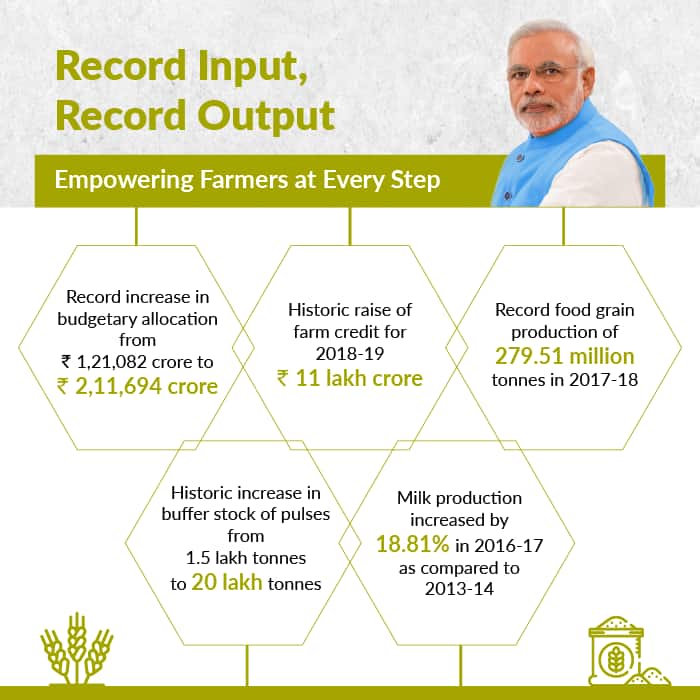
To begin with, there is the record budgetary allocation for agriculture and farmer welfare under the NDA government. Compared to the previous government tenure of 2009 to 2014 which saw an allocation of Rs 1,21,082 crore, PM Narendra Modi’s government has allocated Rs 2,11,694 crore in the period 2014-19. This is almost double.
Helping farmers during production
To ensure that the farmer reaps good yields, focus on strengthening sowing-related activities is imperative. The government has taken various steps in this regard.
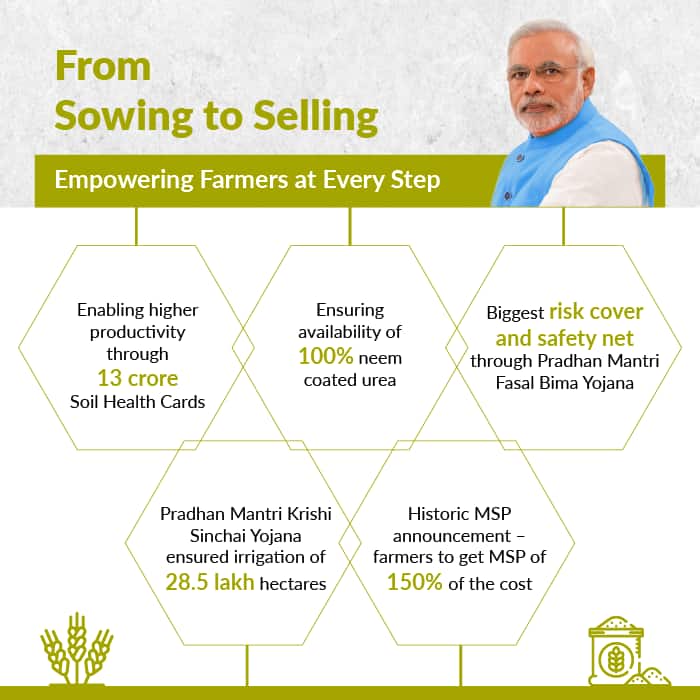
Considering that the health of the soil plays a fundamental role in agriculture, the government has dispatched more than 13 crore soil health cards from 2015 to 2018. Soil Health Cards carry crop-specific recommendations for nutrients and fertilizers to help farmers improve their productivity.
There are hardly any complaints from the states with regard to fertilizer distribution. The reason being the significant increase in the Urea production as the government has revived the defunct fertilizer plants and also set up new plants. Since the government has implemented 100% neem coating of Urea, it not only resulted in improving the soil quality but also prevented the diversion of fertilizers to other purposes. There is a special arrangement of Rs 10,000 crore to clear fertilizer subsidy due.
Pradhan Mantri Krishi Sinchai Yojana is in place to ensure ‘more crop per drop’ which will cover 28.5 lakh hectare area under irrigation. Rs 50,000 crore earmarked for ensuring that every farm gets water. Rs 5,000 crore fund for micro-irrigation made available while there has been an encouragement for farmers to install solar pumps for irrigation.
Credit for farmers
The Modi Government has taken important policy initiatives to address the issue of farm credit and save farmers from being exploited in the hands of informal credit sources such as moneylenders.
Pradhan Mantri Fasal Bima Yojana is the biggest risk cover and safety net provided by the government.
Under interest subvention scheme short-term crop loans up to 3 lakh with the interest rate of 7% per annum up to one year made available.
Marketing the farmers produce
The government’s policy follows the next logical step after supporting the farmer at sowing time, which is to help farmers to get right price for their produce. In July 2018, government approved the historic MSP hike for Kharif crops to 1.5 times the cost, which will provide farmers a profit margin of 50% over the cost of production.
National Agriculture Market scheme known as e-NAM has integrated 585 markets across 16 states and 2 Union territories. More than 164.53 lakh tonnes of farm commodities have been transacted on e-NAM and more than 87 lakh farmers have been registered. Thus, it is cutting down the middlemen in agriculture trading to facilitate farmer with his due.
22,000 rural haats will turn into Gramin Agriculture Market which will benefit 86% small farmers.
Large investment in warehousing and cold chains to prevent post-harvest crop losses and value addition through food processing also giving the farmers the essential edge on the market.
To address the price volatility of perishable items like tomato, potato and onion ‘Operation Greens’ has been put in place.
Focus on allied sectors
As noted earlier, the focus has been laid on allied agriculture activities to boost farmers income. Corpus of Rs 10,000 crore set up to create infrastructure in fisheries, aquaculture and animal husbandry.
Integrated Development & Management of Fisheries with an outlay of Rs 3000 crore, the establishment of 20 Gokul Grams are some of the examples in this regard.
Growth in production
There are ample indications to suggest that PM Narendra Modi’s agriculture policy implementation has been yielding results. Agriculture production has touched a new high in 2017-18 with 279.51 million tonnes of food grain production.
The extent of the buffer stock of pulses increased from 1.5 lakh tonnes to 20 lakh tonnes. Milk production has increased by 18.81% in 2016-17 as compared to 2013-14.
True to the spirit of PM Narendra Modi’smotto- Beej se le ke Bazaar tak- government has been pursuing a holistic approach in agriculture and the positive results have started shining on the ground.