Visit of the Prime Minister of Canada to India

Published By : Admin | February 26, 2026 | 10:40 IST

At the invitation of Prime Minister Shri Narendra Modi, the Prime Minister of Canada, The Right Honourable Mark Carney, will pay an official visit to India from 27 February to 2 March 2026. This will be Prime Minister Carney’s first official visit to India.

On 27 February, Prime Minister Carney will arrive in Mumbai. Over the next two days, he will participate in separate business engagements, interact with Indian and Canadian CEOs, industry and financial experts, innovators, educators as well as Canadian Pension Funds based in India.

Prime Minister Carney will arrive in New Delhi on 1st March. On 2nd March, the two Prime Ministers will hold delegation-level talks at Hyderabad House. Both leaders will review the progress achieved till date across diverse areas of the India – Canada Strategic Partnership, building on their earlier meetings in Kananaskis (June 2025) and Johannesburg (November 2025). They will also take stock of ongoing cooperation in key pillars including trade and investment; energy; critical minerals; agriculture; education, research, and innovation; and people-to-people ties. The two leaders will also exchange views on regional and global developments.

Prime Minister Modi and Prime Minister Carney will also attend the India–Canada CEOs Forum scheduled later in the day.

The visit comes at an important juncture in normalization of India-Canada bilateral relations. The two Prime Ministers have earlier agreed to pursue a constructive and balanced partnership grounded in mutual respect for each other’s concerns and sensitivities, strong people-to-people ties, and growing economic complementarities. The forthcoming meeting between the leaders will provide an opportunity to reaffirm the positive momentum and shared vision of India and Canada in building a forward-looking partnership.

Explore More
Today, the entire country and entire world is filled with the spirit of Bhagwan Shri Ram: PM Modi at Dhwajarohan Utsav in Ayodhya

Popular Speeches

Today, the entire country and entire world is filled with the spirit of Bhagwan Shri Ram: PM Modi at Dhwajarohan Utsav in Ayodhya
UPI — an eventful journey

Media Coverage

UPI — an eventful journey
NM on the go

Nm on the go

Always be the first to hear from the PM. Get the App Now!
...
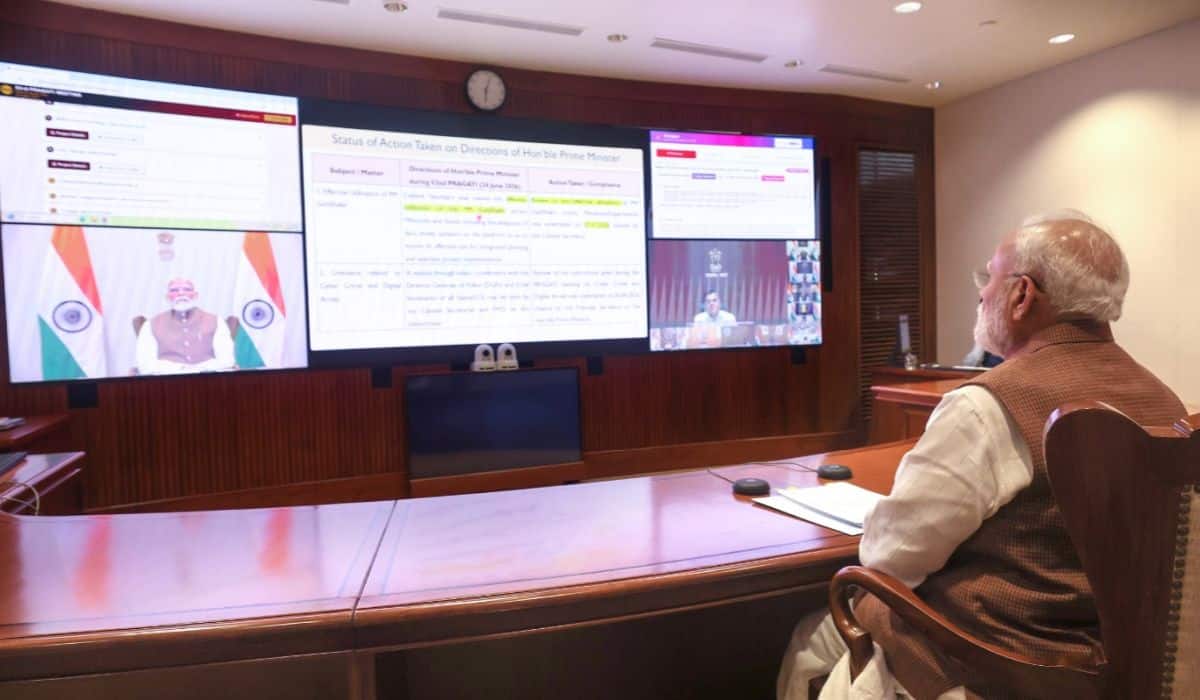
PM chairs 53rd PRAGATI Meeting
August 25, 2026
PM reviews six key infrastructure projects across the Railway, Road and Power sectors
Projects reviewed span across 9 States with cumulative investment of more than ₹30,000 crore
PM says Infrastructure projects should be viewed as an integrated whole, rather than as individual sections or packages
PM calls for continuous reforms across all stages of project implementation and a proactive work culture across Ministries and States
PM says Speed must go hand-in-hand with quality
While reviewing AgriStack, PM emphasises the need to leverage the latest digital technologies including AI to derive greater value from agricultural data
On cyber fraud and ‘digital arrest’, PM stresses training, public awareness, cyber-safety education and coordinated action

Prime Minister Shri Narendra Modi chaired the 53rd meeting of PRAGATI, the ICT-enabled, multi-modal platform for Pro-Active Governance and Timely Implementation, at Seva Teerth earlier today.

During the meeting, Prime Minister reviewed six key infrastructure projects across the Railway, Road and Power sectors, spanning nine States with a cumulative cost of more than ₹30,000 crore. The projects, significant for strengthening connectivity, supporting industrial and economic activity and improving public services, were reviewed with particular emphasis on adherence to timelines, inter-agency coordination, resolution of pending issues and expeditious completion.

Prime Minister emphasised that delays in infrastructure projects have consequences beyond cost escalation, as they also postpone the benefits intended for citizens, businesses and the economy. He said that infrastructure projects should be viewed and monitored as an integrated whole, rather than as isolated sections, stretches or packages. He noted that progress in individual packages should ultimately translate into timely completion and operationalisation of the entire project. Ministries and States were therefore asked to adopt an end-to-end approach, and address critical gaps that could delay the overall commissioning and delivery of benefits. He called for fostering a proactive work culture across Ministries and State Governments, with greater ownership at every level of project implementation.

Prime Minister stressed the need to explore common utility corridors for infrastructure services, wherever feasible, particularly while planning major transport and infrastructure projects. He called upon Ministries and States to examine such integrated approaches at the planning stage itself, keeping in view their technical and economic feasibility.

Prime Minister said that speed of execution must be accompanied by uncompromising quality. He called upon Ministries, States and implementing agencies to adopt modern technologies and strengthen quality assurance and supervision at every stage.

While reviewing AgriStack under the Digital Agriculture Mission, Prime Minister emphasised the need to leverage the latest digital technologies, including Artificial Intelligence, to derive greater value from agricultural data. He stressed that the data ecosystem should be effectively utilised across the agricultural value chain, from input planning to processing, enabling more informed interventions, better targeting and data-driven decision-making. He appreciated the efforts of the States and the Central Government in building the AgriStack ecosystem and called for further strengthening its use for delivering better outcomes for farmers.

During the review of cyber fraud cases, including incidents of digital arrest, Prime Minister said that prevention must be strengthened through a sustained focus on training, awareness and education. He stressed the need for continuous and targeted public-awareness campaigns, particularly for senior citizens, youth and other vulnerable sections, to familiarise them with common fraud techniques, warning signs and safe digital practices. He also called for regular capacity-building of personnel involved so that emerging modes of cyber fraud are identified and acted upon swiftly.