India now ranks amongst the top five countries when it comes to 45 of the 64 technologies as per the ASPI Critical Technology Tracker. The study tracks the development of critical technologies, including the race for scientific and research breakthroughs, and the ability to retain global talent. The study also documents crucial ingredients that underpin the development and control of the world’s most important technologies, and how it measures up to a country’s economic prowess.

Ashwini Vaishnaw, Union Minister for Railways, Information & Broadcasting and Electronics & IT responding to the findings, stated, “This is a testament to the progress India has made in the last ten years on the manufacturing front.. When it comes to vaccine and medical countermeasure technologies, India ranks fifth, while on advanced aircraft engines, we are ranked ahead of France and the United Kingdom, at number three. On a high-specification machining process and biofuels, we are rated higher than the United States of America even, and second only to China”, Vaishnaw elaborated.

“The government has delivered a big push for manufacturing in the last ten years, even when many in the opposition have opposed it. These technologies must not be viewed in manufacturing alone but from a supply chain perspective as well. In the years to come, these industries will create a significant number of employment opportunities for our youth population as well. Take this for example. In protective cybertechnologies, advanced data analytics, machine learning, and distributed ledgers, India ranks at number three, ahead of its European Counterparts. This shows how our sustained focus, both on the manufacturing and services sector, is beginning to show results’, Vaishnaw commented.

The Australian Strategic Policy Institute (ASPI), established in 2001, operates as an independent and non-partisan think tank. ASPI plays a crucial role in educating the public on various strategic matters, fostering new ideas for governmental policies, and engaging with global strategic thought.

Explore More
شری رام جنم بھومی مندر دھوجاروہن اتسو کے دوران وزیر اعظم کی تقریر کا متن

Popular Speeches

شری رام جنم بھومی مندر دھوجاروہن اتسو کے دوران وزیر اعظم کی تقریر کا متن
UPI — an eventful journey

Media Coverage

UPI — an eventful journey
NM on the go

Nm on the go

Always be the first to hear from the PM. Get the App Now!
...
PM chairs 53rd PRAGATI Meeting
August 25, 2026
PM reviews six key infrastructure projects across the Railway, Road and Power sectors
Projects reviewed span across 9 States with cumulative investment of more than ₹30,000 crore
PM says Infrastructure projects should be viewed as an integrated whole, rather than as individual sections or packages
PM calls for continuous reforms across all stages of project implementation and a proactive work culture across Ministries and States
PM says Speed must go hand-in-hand with quality
While reviewing AgriStack, PM emphasises the need to leverage the latest digital technologies including AI to derive greater value from agricultural data
On cyber fraud and ‘digital arrest’, PM stresses training, public awareness, cyber-safety education and coordinated action

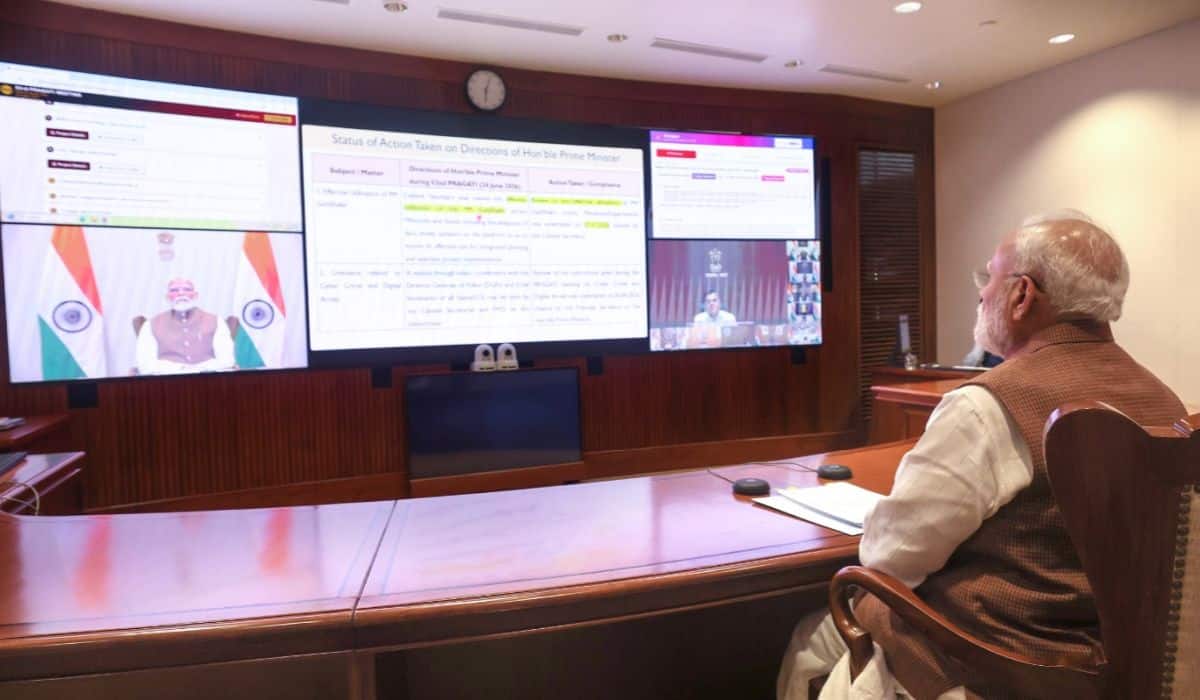
Prime Minister Shri Narendra Modi chaired the 53rd meeting of PRAGATI, the ICT-enabled, multi-modal platform for Pro-Active Governance and Timely Implementation, at Seva Teerth earlier today.

During the meeting, Prime Minister reviewed six key infrastructure projects across the Railway, Road and Power sectors, spanning nine States with a cumulative cost of more than ₹30,000 crore. The projects, significant for strengthening connectivity, supporting industrial and economic activity and improving public services, were reviewed with particular emphasis on adherence to timelines, inter-agency coordination, resolution of pending issues and expeditious completion.

Prime Minister emphasised that delays in infrastructure projects have consequences beyond cost escalation, as they also postpone the benefits intended for citizens, businesses and the economy. He said that infrastructure projects should be viewed and monitored as an integrated whole, rather than as isolated sections, stretches or packages. He noted that progress in individual packages should ultimately translate into timely completion and operationalisation of the entire project. Ministries and States were therefore asked to adopt an end-to-end approach, and address critical gaps that could delay the overall commissioning and delivery of benefits. He called for fostering a proactive work culture across Ministries and State Governments, with greater ownership at every level of project implementation.

Prime Minister stressed the need to explore common utility corridors for infrastructure services, wherever feasible, particularly while planning major transport and infrastructure projects. He called upon Ministries and States to examine such integrated approaches at the planning stage itself, keeping in view their technical and economic feasibility.

Prime Minister said that speed of execution must be accompanied by uncompromising quality. He called upon Ministries, States and implementing agencies to adopt modern technologies and strengthen quality assurance and supervision at every stage.

While reviewing AgriStack under the Digital Agriculture Mission, Prime Minister emphasised the need to leverage the latest digital technologies, including Artificial Intelligence, to derive greater value from agricultural data. He stressed that the data ecosystem should be effectively utilised across the agricultural value chain, from input planning to processing, enabling more informed interventions, better targeting and data-driven decision-making. He appreciated the efforts of the States and the Central Government in building the AgriStack ecosystem and called for further strengthening its use for delivering better outcomes for farmers.

During the review of cyber fraud cases, including incidents of digital arrest, Prime Minister said that prevention must be strengthened through a sustained focus on training, awareness and education. He stressed the need for continuous and targeted public-awareness campaigns, particularly for senior citizens, youth and other vulnerable sections, to familiarise them with common fraud techniques, warning signs and safe digital practices. He also called for regular capacity-building of personnel involved so that emerging modes of cyber fraud are identified and acted upon swiftly.