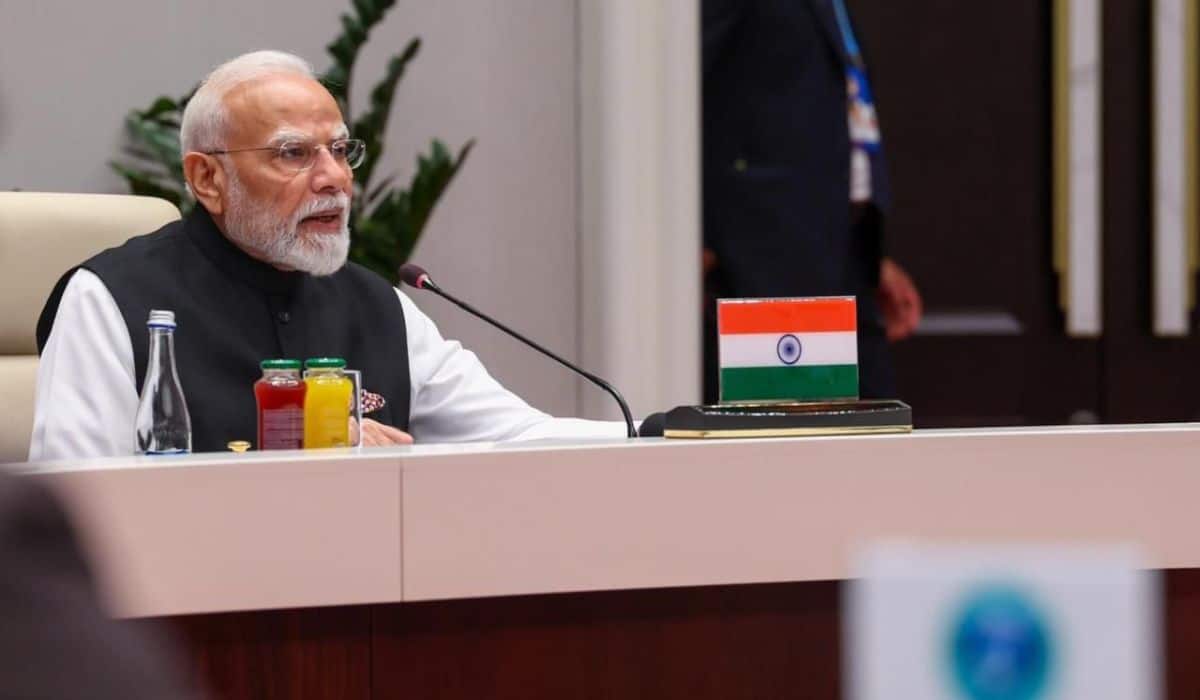
PM Modi, President Rahmon hold wide-ranging talks on bilateral, regional and international issues
India, Tajikistan agree to combat terrorism and extremism collectively
PM Modi reiterates India’s commitment to supporting the development of Tajikistan’s defence capacities to enhance stability and security
PM Modi thanks Tajikistan for its support in declaring June 21 as International Day of Yoga in the United Nations
PM thanks Tajikistan for support to India’s membership to the Shanghai Cooperation Organization (SCO)
The Prime Minister of the Republic of India, His Excellency Mr. Narendra Modi paid a State visit to the Republic of Tajikistan from 12 to 13 July 2015 at the invitation of the President of the Republic of Tajikistan, His Excellency Mr. Emomali Rahmon.

- The President and the Prime Minister held wide-ranging talks on bilateral, regional and international issues. The discussions between the Leaders were warm and cordial and the outcomes of the visit reflected the mutual trust that exists between the two countries.
- President and Prime Minister expressed satisfaction at the excellent relations between India and Tajikistan. They noted that ties between their countries are based on shared history and cultural affinities between their people. The two leaders reaffirmed their commitment to take all necessary steps to transform bilateral relations into a multi-faceted strategic partnership for the mutual benefit of the people of both their countries.
- The two leaders welcomed continuing exchanges at Ministerial and senior official levels, which serve to cement bilateral ties. They noted the existing broad legal framework for development of cooperation between the two countries and called for an enhanced focus on implementation of outcomes envisaged under bilateral agreements/MoUs in various areas.
- The two leaders noted the rising trend of extremism and terrorism in many parts of the world and in their immediate neighbourhood, posing a threat to India and Tajikistan as well as the region. Both sides further emphasized the need for adoption of the "Comprehensive Convention on International Terrorism" by the UN General Assembly.
The leaders underlined the importance of a stable and secure environment for economic development and prosperity of their countries. They agreed to continue their active engagement and cooperation in the fight against terrorism and extremism, and reaffirmed their determination to act resolutely against organizations and agencies that support terrorism.
Prime Minister Modi expressed appreciation at Tajikistan’s efforts at curbing extremism and radicalism and to ensure secular governance, which is a common ideal of both the countries. - The Leaders decided to reinvigorate official-level interactions in the framework of the Joint Working Group (JWG) on Counter Terrorism for strengthening cooperation in the fight against terrorism and instructed that the JWG meet at an early date. They emphasized the need for continued cooperation between their security agencies including information sharing mechanisms to counter the growing menace of extremism and terrorism.
- The Leaders expressed satisfaction at ongoing defence cooperation, which remains one of the main pillars of partnership between the two countries. The Prime Minister reiterated India’s commitment to supporting the development of Tajikistan’s defence capacities to enhance stability and security. The President of Tajikistan welcomed India's assistance in capacity building of the Tajik defence forces.
- Despite being close neighboring countries, the Leaders noted that that trade and economic linkages between India and Tajikistan are not in keeping with their potential. They highlighted the importance of trade and investments in developing a balanced and sustainable bilateral relationship and committed to work together to overcome structural and functional issues hampering economic relations between the two countries. The Leaders mandated the 8th session of the India-Tajikistan Joint Commission on Trade, Economic, Scientific and Technical Cooperation (JCM), to meet in Dushanbe this year and draw up a concise strategy to deepen trade and investment relations and identify specific steps to facilitate exchanges between the business communities.
- The Leaders underscored the importance of improving connectivity in the region to realize the full potential of trade and commerce. The two leaders discussed ways and means to explore possibilities of developing an alternate surface route in cooperation with other countries of the region. Tajikistan reiterated its support to the International North South Transport Corridor (INSTC) which will considerably reduce transit time and cost for transportation of goods between India and Central Asia and beyond and welcomed recent measures to speed up its implementation.
- Both Leaders recognized that the proposed Pakistan, Afghanistan and Tajikistan Trilateral Transit Trade Agreement (PATTTTA) would facilitate trade between Tajikistan and the countries of the South Asian region. They decided that further consultations would be held on the inclusion of India to this arrangement.
- The Leaders stressed the importance of enhanced air connectivity between the two countries to facilitate trade and economic linkages as well as tourism and greater people-to-people interactions. They called upon relevant authorities in both countries to find constructive ways and means to increase the frequency of flights on the Delhi-Dushanbe sector, including the provision of Fifth Freedom rights for carriers.
- Underling the importance of agriculture in the economies of both the countries and given India’s expertise in the agricultural sector, including research, development and processing of agricultural products, the Leaders agreed to deepen cooperation in agriculture. Tajikistan expressed its intention to facilitate agricultural cooperation with India, and in particular welcomed greater involvement of Indian companies in the agricultural sector in Tajikistan. The Leaders noted that a Workshop on Agriculture was being held in connection with the visit involving officials, experts from research institutions and organisations, private enterprises and business leaders of both the countries. They called for early implementation of the outcomes and agreements reached at the Workshop.
- The Leaders noted the centrality of energy security for rapid economic development. Tajikistan thanked India for successful up gradation and modernisation of the Varzob-1 Hydro Power Station through the Bharat Heavy Electricals Limited (BHEL) and National Hydroelectric Power Corporation (NHPC) as well as various training programmes organised for experts from Tajikistan in the field of hydropower. Highlighting the vast untapped hydropower potential, the President of Tajikistan sought greater Indian engagement in the field of hydropower generation in Tajikistan.
- The Leaders noted that health sector is an important area of bilateral cooperation. Acknowledging the growing number of people from Tajikistan visiting India for medical treatment, they agreed to expand cooperation in the field of health for the benefit of the people of the two countries. Tajikistan welcomed India’s proposal to implement a tele-medicine project in Tajikistan by connecting reputed multi-speciality hospitals in India with hospitals in Dushanbe and other regions of Tajikistan for offering medical consultation and education.
- The Leaders stressed the importance of education and human resource development in nation building and agreed to enhance cooperation in the education sector through greater exchanges between educational institutions of the two countries. The Leaders also highlighted the importance of better utilization of scholarships offered under the Indian Technical & Economic Cooperation (ITEC) and by the Indian Council for Cultural Relations (ICCR) for capacity building in Tajikistan.
- The Leaders identified cooperation in food processing, mining, pharmaceuticals, textiles, skill development, science & technology, Information Technology, culture and tourism as promising areas for further cooperation. The leaders underlined the importance of closer interactions between the business bodies and investment promotion agencies of the two countries for enhancement of economic engagements.
- The Leaders emphasized the centrality of cultural interactions in further deepening the close bonds between the peoples of India and Tajikistan. They called for active implementation of the Programme of Cooperation between India and Tajikistan on Art and Culture for the period 2016-18 and agreed that relevant organisations hold "Days of Culture" in each other's country.
- Prime Minister Modi thanked Tajikistan for its support in declaring June 21 as International Day of Yoga in the United Nations and for successful organisation of events to mark the occasion on 21 June, 2015 in Dushanbe and various regions of Tajikistan. The Leaders noted the role of Yoga and its health benefits and agreed to cooperate further in promotion of Yoga in Tajikistan. They welcomed the proposed AYUSH information cell at the Embassy of India, Dushanbe for sharing information about Yoga and other traditional Indian medical practices in Tajikistan.
- Prime Minister Modi thanked Tajikistan for installation of a bust of renowned Indian poet Rabindranath Tagore in Dushanbe. The Leaders acknowledged the contemporary relevance of Tagore’s writings and agreed that the symbolic presence of Tagore in Tajikistan will promote harmony between cultures.
- Considering the huge popularity of Indian cinema in Tajikistan, the Leaders agreed thatcooperation in the field of television and radio-broadcasting would further enhance people to people contacts and cultural understanding.
- Underlining the importance of greater cooperation and more people-to-people interaction, the Leaders instructed their officials to hold Consular Consultations at an early date to discuss liberalization of the existing visa regime.
- The Leaders noted that Afghanistan occupies a central position in Asia and reaffirmed their support for peace and security in Afghanistan through an Afghan-led and Afghan-owned process.
- The Leaders expressed satisfaction at the excellent cooperation between the two countries on multilateral issues and mutual support for their initiatives in the United Nations and other international forums. The Leaders underscored the need to deepen such interaction on issues of interest to both countries and for developing countries as a whole. Tajikistanreiterated its support for India’s candidature for permanent membership of an expanded UN Security Council.
- Prime Minister Modi thanked Tajikistan for support to India’s membership to the Shanghai Cooperation Organization (SCO). The Leaders agreed to work together within the framework of SCO for economic development, security and stability of the region.
- The Leaders emphasised that the outcomes and understandings reached during the visit undoubtedly mark a milestone in the development of a long-term strategic partnership between the two countries. The two leaders applauded the deep trust and confidence between the countries and underlined that the strategic partnership between India and Tajikistan is of mutual benefit to their two countries as well as for greater regional stability.
- Prime Minister Modi expressed deep gratitude to President Rahmon for the warm welcome and the gracious hospitality extended during his visit to Tajikistan. Prime Minister extended an invitation to the President of the Republic of Tajikistan to visit India at an early date. The invitation was accepted with pleasure.