The Prime Minister, Shri Narendra Modi laid the foundation stone and dedicated to the nation multiple development projects worth about Rs 4200 crore in sectors including rural development, road, power, irrigation, drinking water, horticulture, education, health and disaster management, among others in Pithoragarh, Uttarakhand today.
Addressing the gathering, the Prime Minister expressed gratitude for the unprecedented love and affection and countless blessings of the people of Uttarakhand on his visit and said, “It was like a Ganga of Affection flowing through”. Shri Modi bowed before the land of spirituality and valor, especially the courageous mothers. He emphasized that the zeal and enthusiasm of the soldiers of Garhwal Rifles soars with the proclamation of Jai Badri Vishal at Baidyanath Dham, and the tolling of the bells at the Kali Mandir at Gangolihat infuse new courage into the soldiers of Kumaon regiment. In Manaskhand, the Prime Minister mentioned Baidyanath, Nandadevi, Poorangiri, Kasardevi, Kainchidham, Katarmal, Nanakmatta, Reetha Sahib and other countless shrines that make for the grandeur and heritage of the land. “I always feel blessed when I am in Uttarakhand amongst you”, the Prime Minister remarked.

Earlier, the Prime Minister performed pooja and darshan at the Parvati Kund. “I prayed for the good health of every Indian and the strengthening of the resolution of Viksit Bharat. I asked for blessings so that all the aspirations of the people of Uttrakhand get fulfilled.
The Prime Minister also mentioned his meetings with the soldiers, artists and self-help groups and expressed happiness about meeting pillars of security, prosperity and culture. The Prime Minister reiterated that this decade is going to be a decade of Uttarakhand. “Our government is working with full dedication and integrity to work for the progress and ease of life of the people of Uttarakhand”, he said. The Prime Minister recalled his long association and closeness with Uttarakhand. Talking about the Narishakti Vandan Adhiniyam, the Prime Minister mentioned the support and response he received from the state.
The Prime Minister narrated about the development strides made by India. “The world is recognizing India and the contribution of Indians”, he said. Recalling the despondency of the past, the Prime Minister Modi noted the strong voice of India at the global stage that is beset with challenges. He mentioned India’s global appreciation for the G20 presidency and the organization of the summit. The Prime Minister credited the people for the success of the country as they chose a stable and strong government at the center after a long gap. He said he carries the trust and confidence of 140 crore Indians in his global presence.
The Prime Minister informed that more than 13.5 crore Indians came out of poverty in the last 5 years and credited the all-inclusive approach of the Government where those in the remotest of places also receive government benefits. “The world is amazed”, Shri Modi emphasized as he explained that among the 13.5 crore people are those who dwell in remote and hilly regions. He emphasized that these 13.5 crore people are an example that India can uproot the nation’s poverty on its own.

Prime Minister Modi pointed out that even though the previous governments introduced slogans of ‘Garibi Hatao’ it is ‘Modi’ who says that poverty can be uprooted by taking ownership and responsibility. “Together we can eradicate poverty”, he emphasized. He mentioned India’s Chandrayan which managed to land successfully on the south pole of the moon and achieve what no nation could do so far. “The place where Chandrayan landed has been named Shiv Shakti and the identity of Uttarakhand is now on the moon ”, the Prime Minister said. He said that Shiva Shakti Yog can be witnessed at every step in Uttarakhand.
The Prime underlined India’s sporting prowess and talked about the joy of the all-time high medal tally in the country. Uttarakhand sent 8 athletes in the contingent and teams of Lakshya Sen and Vandana Kataria won medals. On the call of the Prime Minister, the audience cheered the achievement by the raised flashlights of their mobile phones. The Prime Minister said that the government is providing full support to athletes for their training and infrastructure. Today foundation stones were laid for the hockey ground in Haldwani and the velodrome in Rudrapur. The Prime Minister extended his wishes to the state government and the Chief Minister for wholehearted preparation for the national games.
“Every village in Uttarakhand has produced those who protect India’s borders”, the Prime Minister said as he mentioned that it is the present government that fulfilled their decade-old demand of One Rank One Pension. So far, the Prime Minister informed that more than Rs 70,000 crores have already been transferred to former soldiers under the One Rank One Pension scheme which has hugely benefited more than 75,000 families of former soldiers. “One of the priority areas of the Government is the development of border areas”, he said as he stated that the development of new services is taking place at a fast pace here. Pointing out the lack of development in border areas during the previous governments, the Prime Minister spoke about their fear of land being usurped by neighboring nations with the infrastructural developments. “Neither New India fears anything, nor does it induce fear in others”, the Prime Minister remarked as he spoke about the infrastructure developments taking place in border areas. He informed that more than 4,200 km of roads, 250 bridges and 22 tunnels have been built in border areas in the last 9 years. Mentioning the projects of today, the Prime Minister stated that plans are underway to bring the railways to the border areas

The Prime Minister said that the Vibrant Village scheme has turned the last villages into the first villages of the country. “Our effort is to bring back people who have left these villages. We want to increase tourism in these villages”, said the Prime Minister. He said due to wrong policies of the past with regard to water, medicine, roads, education and medical facilities, people had to leave their homes. He said new facilities and infrastructure are coming up in Uttrakhand in these areas. He said apple farming will benefit from the roads and irrigation facilities and the polyhouse scheme launched today. 1100 crore rupees will be spent on these projects. “So much money is being spent to improve the lives of our small farmers of Uttarakhand. Under PM Kisan Samman Nidhi, farmers of Uttarakhand have so far received more than Rs 2200 crore”, he said.
The Prime Minister touched upon Shri Anna which has been grown in Uttarakhand for many generations and highlighted the government’s efforts to take it across the world. He mentioned that a campaign has been started across the country which will hugely benefit the small farmers of Uttarakhand.
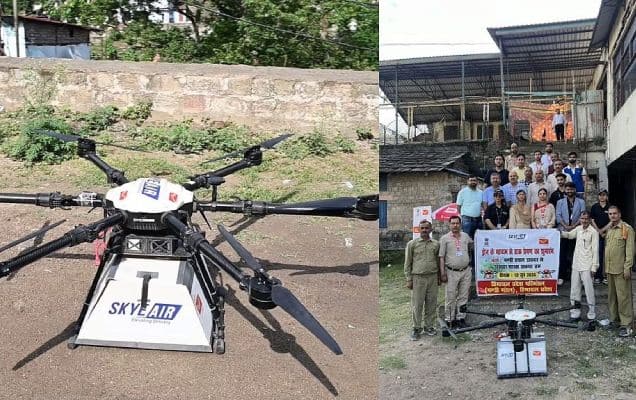
Talking about the steps to ensure women-led development, the Prime Minister said “Our government is committed to removing every difficulty and every inconvenience of mothers and sisters. That's why our government gave permanent houses to the poor sisters. We built toilets for our sisters and daughters, gave them gas connections, opened bank accounts, arranged for free treatment and free ration. Under the Har Ghar Jal Yojana, sisters of 11 lakh families in Uttarakhand have got the facility of piped water.” He also mentioned the scheme for providing drones to the women's self-help groups that he announced from the ramparts of the Red Fort. These drones will help in agriculture and even in the transportation of the produce. “Drones provided to women self-help groups are going to take Uttarakhand to new heights of modernity”, the Prime Minister emphasized.
“In Uttarakhand, there is Ganga and Gangotri in every village. Lord Shiva and Nanda reside on the snow peaks here”, the Prime Minister remarked. He mentioned the fairs, Kauthig, Thaul, songs, music and food of Uttarakhand have their own unique identity and the land is enriched with cultural events like Pandav dance, Chholiya dance, Mangal Geet, Phuldei, Harela, Bagwal and Ramman. He also touched upon various delicacies of the land and mentioned Aarse, Jhangore ki Kheer, Kafuli, Pakodas, Raita, Almora's Bal Mithai, and Singori. The Prime Minister also recalled his lifelong connections with the land of Kali Ganga and the Advaita Ashram located in Champawat. He also expressed his desire to spend time at Advaita Ashram in Champawat soon.

The Prime Minister said that the efforts of the double-engine government related to the development of tourism and pilgrimage in Uttarakhand are now bearing fruit. This year the number of devotees coming for Char Dham Yatra in Uttarakhand is reaching around 50 lakhs. With the blessings of Baba Kedar, the first phase related to the reconstruction of Kedarnath Dham has been completed. Many works are also being done in Shri Badrinath Dham at a cost of hundreds of crores of rupees.” He mentioned the ease that will ensue after the completion of ropeways in Kedarnath Dham and Hemkunt Sahib. Underlining the focus on connectivity between Kedarnath and Manaskhand, the Prime Minister said the Manaskhand Mandir Mala Mission that started today will ease access to many temples in the Kumaon region and encourage the devotees to come to these temples.
The Prime Minister emphasized that the expanding connectivity of Uttarakhand is going to take the development of the state to new heights. He mentioned the Chardham Mega Project and All Weather Road as well as Rishikesh-Karnprayag rail project. Speaking about the UDAN scheme, the Prime Minister said that affordable air services are also being expanded in this entire region. He also touched upon today’s projects including roads from Bageshwar to Kanalichina, from Gangolihat to Almora and from Tanakpur Ghat to Pithoragarh and said that it will not only provide convenience to the common people but will also increase the earning opportunities from tourism. Referring to the tourism sector as an area of maximum employment, Shri Modi expressed happiness about the government encouraging homestays. “The tourism sector is going to expand a lot in the coming times. Because the whole world wants to come to India today. And anyone who wants to see India will definitely want to come to Uttarakhand”, he added.

Acknowledging the calamity-prone nature of Uttrakhand the Prime Minister said that in the coming 4-5 years 4000 crore rupees will be spent on projects to prepare to deal with natural disasters. “Such facilities will be built in Uttarakhand so that in case of disaster, relief and rescue work can be done quickly”, he said.
Concluding the address, the Prime Minister said that this is India's Amrit Kaal. He said, “This is the time to connect every region and every section of the country with facilities, respect and prosperity. He expressed confidence that with the blessings of Baba Kedar and Badri Vishal, the nation will be able to achieve its resolutions quickly.
Chief Minister of Uttarakhand, Shri Pushkar Singh Dhami was present on the occasion among other Ministers from Government of Uttarakhand.
Background
The projects that were inaugurated and dedicated to the nation by the Prime Minister include 76 rural roads and 25 bridges built in rural areas under PMGSY; 15 buildings of BDO offices in 9 districts; upgradation of three roads built under central road fund viz Kausani Bageshwar road, Dhari-Dauba-Giricheena road and Nagala-Kiccha road; upgradation of two roads on National Highways viz Almora Petshal - Panuwanaula - Danya (NH 309B) and Tanakpur - Chalthi (NH 125); three projects related to Drinking water viz 38 Pumping drinking water schemes, 419 Gravity based water supply schemes and three tube wells based water supply schemes; Tharkot artificial lake in Pithoragarh; 132 KV Pithoragarh-Lohaghat (Champawat) Power Transmission Line; 39 bridges across Uttarakhand and Uttarakhand State Disaster Management Authority (USDMA) building in Dehradun built under the World Bank funded Uttrakhand Disaster Recovery Project.

The projects whose foundation stone were laid include a scheme for construction of 21,398 poly-house, which will help in increasing the production of flowers and vegetables and improving their quality; a scheme for cultivation of high-density intensive apple orchards; five projects for NH road upgradation; Multiple steps for disaster preparedness and resilience in the state viz construction of bridges, upgradation of State emergency Operation Center in Dehradun, steps for prevention of landslide in Balianala, Nainital and improvement in other infrastructure related to fire, health and forest; development of hostels and computer labs in 20 model degree college across state; 100 bedded sub district hospital at Someshwar, Almora; 50 bedded Hospital block in Champawat; Astroturf Hockey Ground at Haldwani Stadium, Nainital; Velodrome Stadium at Rudrapur; Manaskhand Mandir Mala Mission Scheme for infrastructure development in temples including Jageshwar Dham (Almora), Haat Kalika (Pithoragarh) and Naina Devi (Nainital) temples.
Today, India is moving towards new heights of development. pic.twitter.com/reS0wTOoTb
— PMO India (@PMOIndia) October 12, 2023
आज हर क्षेत्र, हर मैदान में हमारा तिरंगा ऊंचे से ऊंचा लहरा रहा है। pic.twitter.com/LMGecaBQaW
— PMO India (@PMOIndia) October 12, 2023
उत्तराखंड के हर गांव में देश के रक्षक हैं। pic.twitter.com/zr0HsWOE6z
— PMO India (@PMOIndia) October 12, 2023
Under the Vibrant Village Programme, border villages are being developed. pic.twitter.com/fpMoQrsugH
— PMO India (@PMOIndia) October 12, 2023
ये देश के हर क्षेत्र, हर वर्ग को सुविधा, सम्मान और समृद्धि से जोड़ने का अमृतकाल है। pic.twitter.com/V8gFbzXM0g
— PMO India (@PMOIndia) October 12, 2023