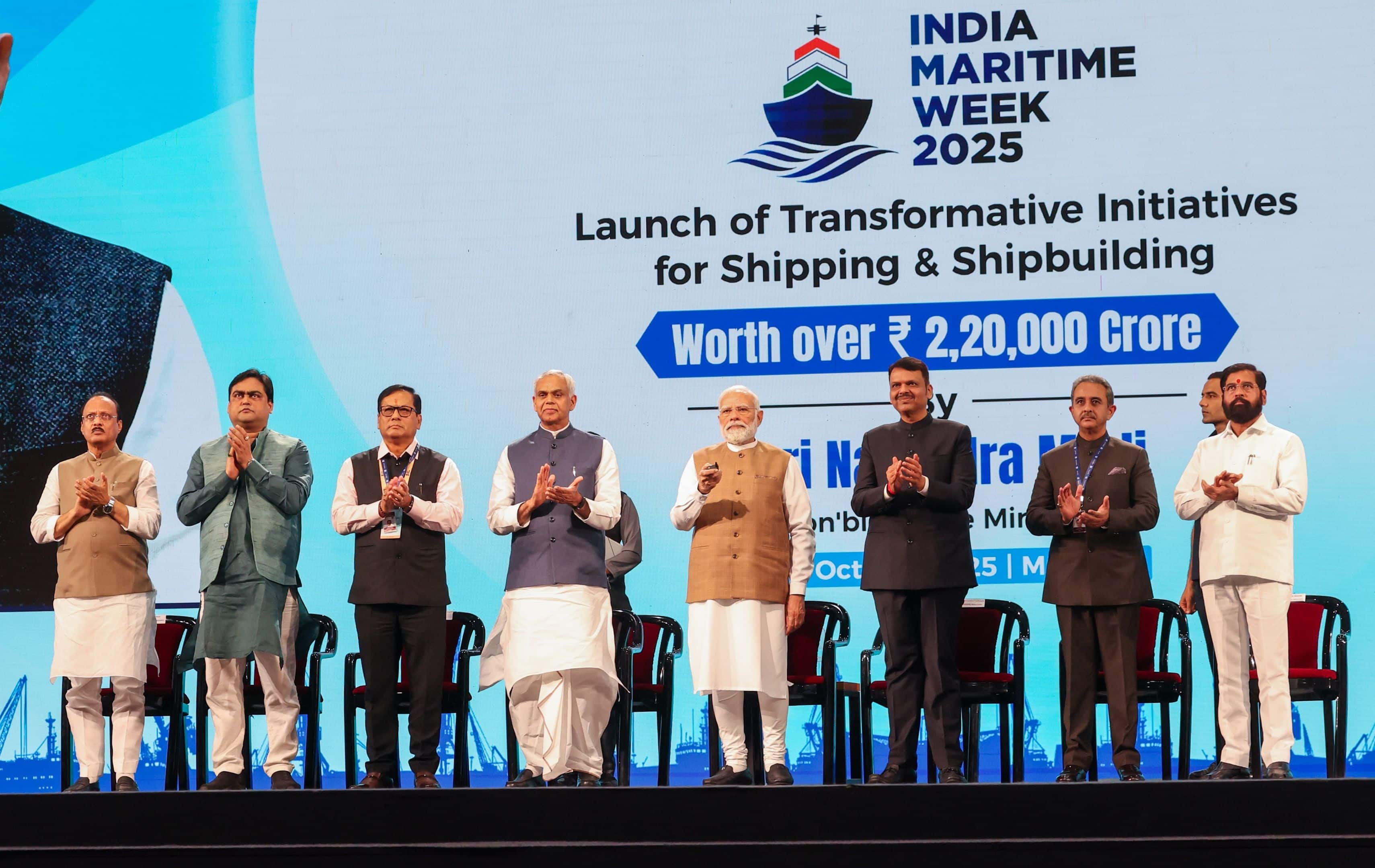
Governor of Maharashtra, Acharya Devvrat ji, Chief Minister of Maharashtra, Devendra Fadnavis ji, my colleagues from the Union Cabinet, Sarbananda Sonowal ji, Shantanu Thakur ji and Kirti Vardhan Singh ji, Deputy Chief Ministers of Maharashtra, Eknath Shinde ji and Ajit Pawar ji, leaders from the shipping and other industries, other distinguished guests, ladies and gentlemen,
Friends,
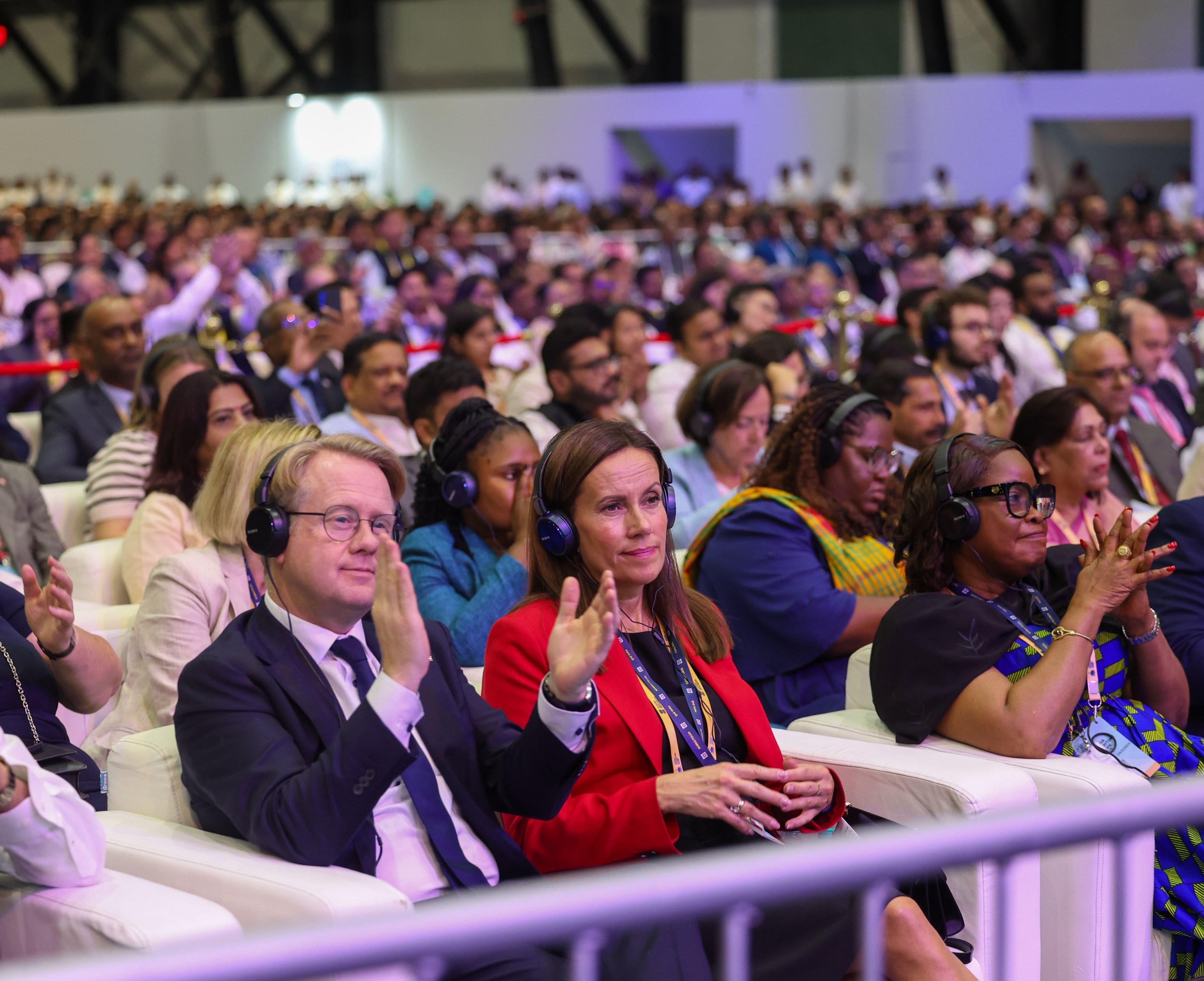
I extend a warm welcome to all of you at the Global Maritime Leaders Conclave. This event began in Mumbai in 2016, and it is a matter of great pride for all of us that today, this summit has evolved into a truly global event. The participation of representatives from over 85 countries in this program sends a powerful message in itself. From CEOs of shipping giants to start-ups, and from policymakers to investors, everyone is present here today. Representatives from small island nations are also in attendance. Your collective vision has enhanced both the synergy and the energy of this summit.

Friends,
Several important projects related to the shipping sector have been inaugurated today. MoUs worth hundreds of thousands of crores of rupees have also been signed in the shipping sector. This clearly demonstrates the world’s growing trust in Bharat’s maritime potential. Your presence at this event is a reflection of our shared commitment to this vision.
Friends,
In this era of the 21st century, Bharat’s maritime sector is moving forward with great speed and vitality. In particular, the year 2025 has been a landmark year for Bharat’s maritime industry. I would like to highlight some key achievements of this year. Bharat’s first deep-water international transshipment hub at Vizhinjam Port has now become operational. Recently, the world’s largest container vessel arrived there, which was a moment of immense pride for every Indian. In 2024–25, Bharat’s major ports have set a new record by handling the highest-ever cargo volume. Besides, an Indian port has launched a megawatt-scale indigenous green hydrogen facility for the first time and this has been achieved by our Kandla Port. Another major milestone has been achieved at JNPT (Jawaharlal Nehru Port Trust), where Phase 2 of the Bharat Mumbai Container Terminal has been inaugurated. This has doubled the handling capacity of the terminal, making it Bharat’s largest container port. This has been made possible thanks to the largest-ever FDI in Bharat’s port infrastructure, and for this, I express my special gratitude to our partners from Singapore.
Friends,
This year, Bharat has also taken major steps toward next-generation reforms in the maritime sector. We have repealed over a century-old colonial shipping laws and replaced them with modern, futuristic 21st-century legislation. These new laws empower State Maritime Boards, emphasize safety and sustainability, and expand the digitalization of port management.
Friends,
Under the Merchant Shipping Act, we have aligned Indian maritime laws with international conventions. This alignment has strengthened safety assurance, enhanced ease of doing business, and reduced government intervention. I am confident that these efforts will further boost the confidence of investors and all stakeholders.
Friends,
The Coastal Shipping Act has been designed to make trade smoother and easier. It enhances supply chain security and ensures balanced development along Bharat’s long coastline. Similarly, the One Nation – One Port Process will standardize port-related procedures and significantly reduce documentation work.
Friends,
These reforms in the shipping sector are, in a way, a continuation of our decade-long reform journey. If we look back over the last ten to eleven years, the transformation in Bharat’s maritime sector has been truly historic. Under the Maritime India Vision, more than 150 new initiatives have been launched. As a result, the capacity of major ports has nearly doubled, turnaround time has been significantly reduced, cruise tourism has gained new momentum, cargo movement on inland waterways has grown by over 700%, the number of operational waterways has increased from 3 to 32, and the net annual surplus of our ports has increased ninefold in just one decade.

Friends,
It is a matter of pride that today Bharat’s ports are counted among the most efficient in the developing world, and in many aspects, they outperform even ports in the developed world. Let me share a few more figures: The average container dwell time in Bharat has come down to less than three days, which is better than in several developed nations. The average vessel turnaround time has reduced from 96 hours to just 48 hours. These improvements have made Indian ports far more competitive and attractive to global shipping lines. Bharat has also shown remarkable improvement in the World Bank’s Logistics Performance Index.
And friends,
Bharat is also making its mark globally in the human resource aspect of the shipping sector. The number of Indian seafarers has risen from 1.25 lakh to over 3 lakh in the past decade. No matter which coastline you visit around the world, you will surely find a ship with Indian seafarers on board. Today, Bharat ranks among the top three countries in the world in terms of the number of seafarers.
Friends,
A quarter of the 21st century has already passed. The next 25 years of this century are going to be even more crucial. That’s why our focus is on the Blue Economy, on Sustainable Coastal Development. We are placing strong emphasis on Green Logistics, Port Connectivity, and Coastal Industrial Clusters.

Friends,
Shipbuilding is also among Bharat’s top priorities today. There was a time when Bharat was one of the major shipbuilding centres of the world. Not far from here are the Ajanta Caves, where you can see a sixth-century painting depicting a three-masted ship design. You can imagine, a sixth-century artwork showing such an advanced three-masted ship design, which other countries adopted only centuries later. There was a gap of several centuries.
Friends,
Ships built in Bharat once played a vital role in global trade. Later, we also advanced in the field of ship-breaking. Now, Bharat is once again accelerating its efforts to reach new heights in ship-making. Bharat has now granted large ships the status of infrastructure assets. This policy decision will open new avenues for all shipbuilders present here. It will provide new financing options, reduce interest costs, and improve access to credit facilities.
And friends,
To further accelerate this reform, the government will invest nearly 70,000 crore rupees. This will enhance domestic capacity, promote long-term financing, lead to the development of greenfield and brownfield shipyards, help create advanced maritime skills, and generate millions of jobs for our youth. It will also open new investment opportunities for all of you.

Friends,
This is the land of Chhatrapati Shivaji Maharaj. Chhatrapati Shivaji Maharaj not only laid the foundation of maritime security but also showcased Bharat’s strength along the trade routes of the Arabian Sea. His vision taught us that the seas are not just boundaries, but they are also gateways to opportunity. Today, Bharat is moving forward with the same spirit and vision.
Friends,
Bharat aims to strengthen global supply chain resilience. We are developing world-class mega ports, and right here in Vadhavan, Maharashtra, a new port worth 76,000 crore rupees is being built. We are working to quadruple the capacity of our major ports. We also want to increase Bharat’s share in containerized cargo, and in achieving all these goals, you are our key partners. We welcome your ideas, innovations, and investments. As you know, Bharat allows 100% FDI in ports and shipping. Public–private partnerships are growing rapidly. Under the vision of “Make in India, Make for the World,” we are offering various incentives. We are also encouraging state governments to attract investments. Therefore, for investors from different countries, this is the right time, the perfect time, to engage and expand in Bharat’s shipping sector.
Friends,
Another great strength of Bharat is our vibrant democracy and reliability. When the global seas are rough, the world looks for a steady lighthouse and Bharat can play that lighthouse role with great strength. Amid global tensions, trade disruptions, and shifting supply chains, Bharat stands as a symbol of strategic autonomy, peace, and inclusive growth. Our maritime and trade initiatives are part of this broader vision. One shining example of this is the India–Middle East–Europe Economic Corridor, which will redefine global trade routes, and promote clean energy and smart logistics.
Friends,
Today our focus is also on inclusive maritime development. This can only be achieved when Small Island Developing States and Least Developed Countries are empowered through technology, training, and infrastructure. Together, we must address the challenges of climate change, supply chain disruptions, economic uncertainty, and maritime security.
Friends,
Let us all come together to advance peace, progress, and prosperity, and build a sustainable future for the world. Once again, I extend my best wishes and congratulations to all of you for being part of this summit.
Thank you