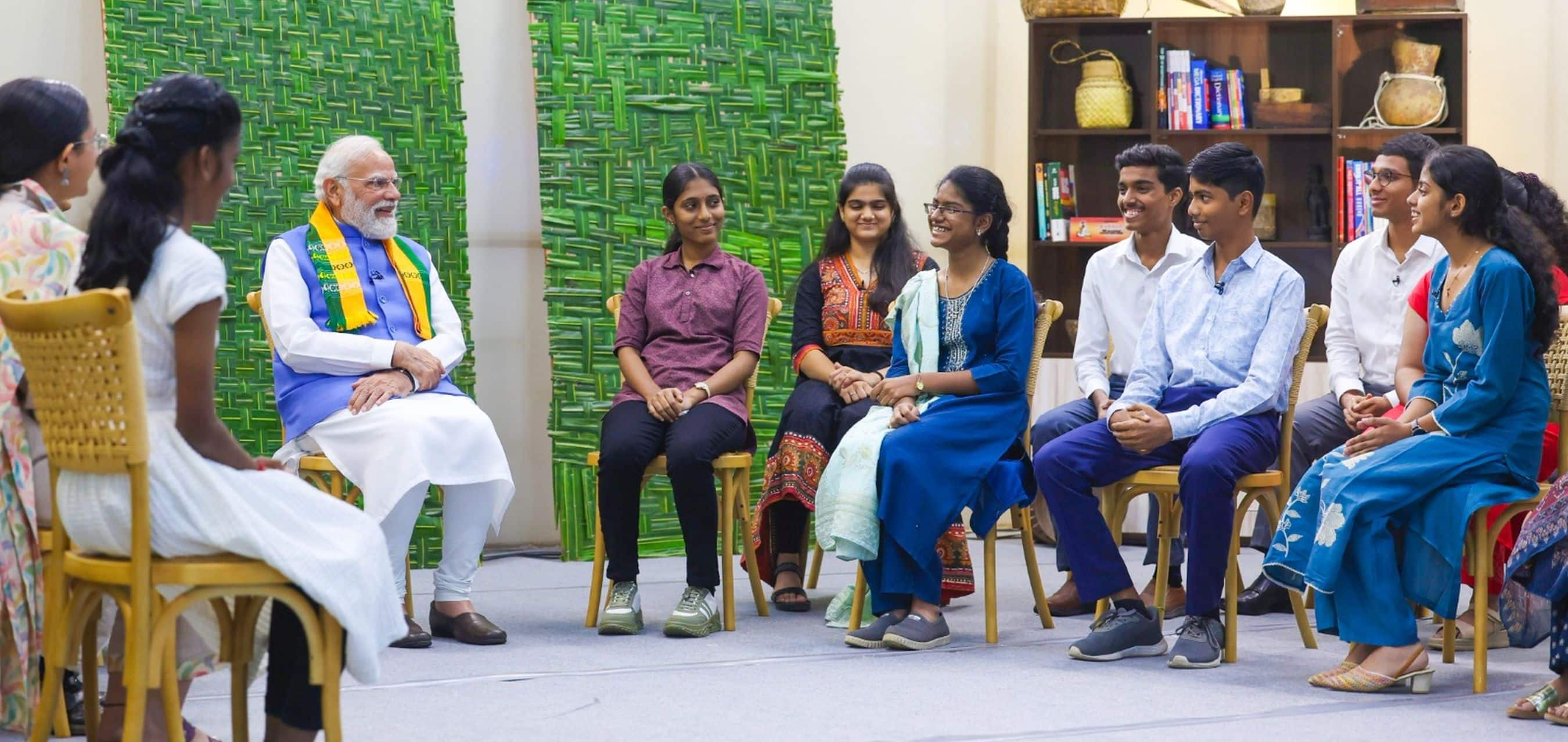


The Prime Minister, Shri Narendra Modi interacted with students today in continuation of 9th edition of Pariksha Pe Charcha (PPC) 2026. The Prime Minister had an informal interaction with Exam Warriors from Coimbatore, Raipur, Devmogra and Guwahati during the second episode of PPC 2026. Welcoming students to the special edition of ‘Pariksha Pe Charcha’, Shri Modi noted that this time the programme was held across different parts of the country. Starting off the Coimbatore edition, PM remarked that the energy and curiosity of Tamil Nadu’s students had deeply impressed him. Greeting them with “Vanakkam,” he engaged in light conversation. Students expressed their excitement, saying they couldn’t believe their eyes when they saw him, expecting a dramatic entry but finding him simple, humble, and down to earth. One student shared that his arrival gave them goosebumps.
Startups & PM’s mantra to study
The Prime Minister highlighted that for many years he has been interacting with 10th and 12th grade students through ‘Pariksha Pe Charcha’, emphasizing that it is a learning programme for him, not a teaching one, and invited students to share their thoughts. Responding to a student’s query on startups, he remarked that the first focus should be on what one wants to do, whether innovation in technology or practical solutions like drones or electricity systems. He advised forming small teams with friends skilled in technology or finance. He highlighted that there is no age requirement for starting a venture, and even small startups can be impactful. He remarked that if there is genuine interest, it is a very good thing. He suggested visiting existing startups, preparing a project report, and presenting it honestly as a school project, which would encourage guidance and support. He concluded that gradually, valuable knowledge will be gained on how to proceed..
Addressing another student’s concern about balancing studies and passion, Shri Modi highlighted that both are useful and can complement each other. He illustrated with an example of combining art with science experiments, saying creativity can help in learning and reduce fatigue, recommending dedicating daily or weekly time to personal interests while ensuring education remains a priority.
Youth contribution to Viksit Bharat & Vocal for Local
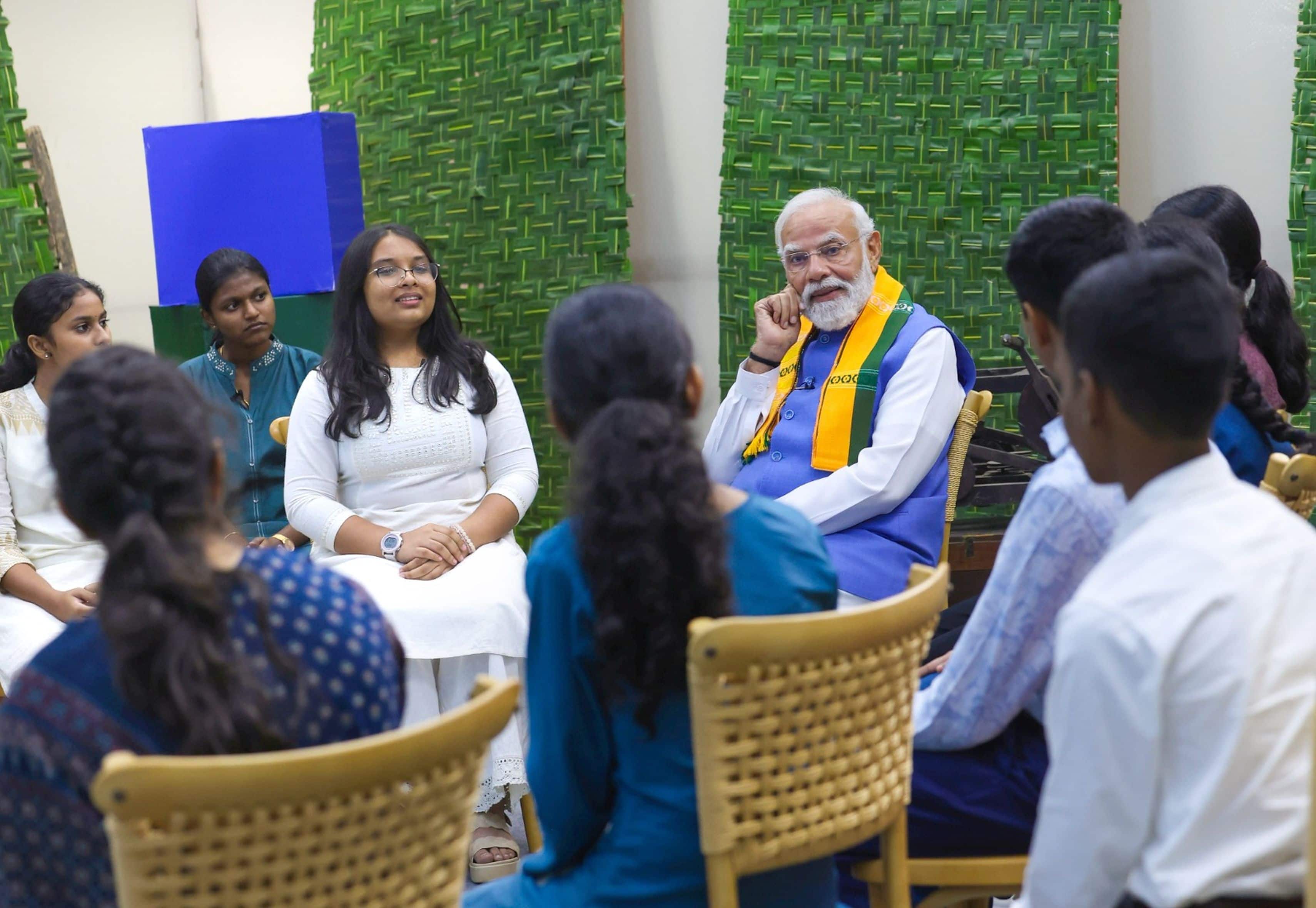
When asked about India becoming a developed nation by 2047, the Prime Minister expressed happiness that even young students share this dream. He cited Singapore’s transformation from a fishing village, quoting Lee Kuan Yew’s emphasis on adopting disciplined habits of developed nations. He remarked that small steps like not littering, following traffic rules, avoiding food wastage, and supporting local products contribute significantly to national progress. He stressed being “vocal for local” and choosing to celebrate events like weddings in India rather than abroad, underlining that every citizen’s small actions collectively help build a developed India. Students noted with surprise that he emphasized small steps over large ones, reinforcing that these matter most.
Motivation or discipline?
Prime Minister Shri Narendra Modi, responding to a student’s query on whether motivation or discipline is more important for success, remarked that both are essential in life. He explained that without discipline, inspiration alone is of little use, citing the example of a farmer who feels inspired by his neighbor’s success but fails to prepare his field before the rains, leading to poor results. He highlighted that discipline is indispensable, while inspiration adds value like “gold with ornamentation,” and without discipline, inspiration becomes a burden and creates despair. A student expressed feeling honoured to receive clarity on a question that had been troubling for years.
Rise of AI & its proper uses
Addressing another question on Artificial Intelligence, the Prime Minister remarked that every era has faced concerns with new technologies, whether computers or mobile phones, but fear is unnecessary. He emphasized that technology must not become the master of human life, cautioning against becoming enslaved to devices. He stated firmly, “I will not become a slave,” and advised that AI should be used for guidance and value addition, not as a substitute for learning. He noted that the nature of jobs will always evolve, just as transport shifted from bullock carts to airplanes, but life continues. He highlighted that understanding technology, expanding one’s own capabilities, and integrating its strengths into work ensures progress without fear.
Resolution towards a Viksit Bharat
Students shared their emotions, saying they felt overwhelmed, honoured, and that the Prime Minister seemed like family more than a leader. Concluding his interaction with students in Coimbatore, Prime Minister Modi remarked that the youth of Coimbatore are highly aware of AI, startups, and future technologies, and affirmed that this reflects the youthful thinking of India, which is giving new strength to the resolve of a developed India by 2047.
Continuing the spirit of ‘Pariksha Pe Charcha’ as a dialogue and mutual learning, he highlighted that the discussion later moved from Coimbatore to Raipur, Chhattisgarh, where he had engaging conversations with students and also enjoyed local delicacies.
PM’s guide to travel & staying focussed
Greeting them with “Jai Johar,” he asked about the food traditions and local delicacies. He then invited questions, responding to a query on vacation travel by advising students to first explore their own tehsil, district, and state before venturing further, stressing that tourism is most enjoyable when experienced as a student, traveling by train, carrying food, and learning from the diversity of India.
On a question about exam stress and revision, Shri Modi remarked that students should trust their preparation, remain calm, and focus on subject mastery. He compared learning to sports, noting that consistent practice, discipline, and competition build strength. He suggested a practical technique of making friends with those who struggle in studies and help them learn.
Balancing studies & sports
Addressing a student aspiring to balance sports and studies, Prime Minister remarked that education is essential not only for personal life but also for social life, and it must never be underestimated. He cautioned against the mistake of believing that excellence in sports alone eliminates the need for studies, while also clarifying that education alone is not everything. He emphasized that talent must be developed, and while playing is necessary to become a sportsperson, having play in life itself is equally important. He stated that life must include play to remain balanced, remarking, “If I play, I will flourish.” He highlighted that one must study as well, so that others do not dismiss them as someone who only stays on the field without knowledge. He concluded by affirming that true strength lies in being powerful both in academics and in sports. Students expressed that they would implement his advice in their lives and shared their overwhelming gratitude for the experience.
Protecting the environment
Prime Minister Modi, responding to a student’s question on contributing to environmental protection, remarked that conserving natural resources must become part of our nature. He emphasized that small rules in daily life bring big change, citing the example of turning off water while brushing and using it only when needed. He shared an inspiring story of a teacher who collected oil cans from petrol pumps and asked children to bring leftover water from their homes in bottles, which was then used to water plants. With vegetable scraps acting as fertilizer, the entire school became green, showing how one teacher’s initiative transformed the environment. He highlighted that human behavior can spark such change and that small, simple actions are enough to protect the environment.
Leadership Insights
When asked what qualities he expects from the future generation as leaders, the Prime Minister remarked that the first quality is to be fearless. He advised that leadership begins when one decides to act without waiting for others, giving the example of picking up litter which inspires others to follow. He clarified that leadership is not about elections or speeches but about the ability to explain and convince others, stressing that true leaders first understand people before guiding them. Students expressed admiration, describing the experience as a dream, feeling lucky and honored to meet the Prime Minister.
Wrapping up the Raipur interaction, Prime Minister Modi remarked that exam preparation, stress, and expectations are recurring themes in ‘Pariksha Pe Charcha’, and the purpose of the programme is to allow youth to openly discuss these issues. He emphasized that the discussions are not limited to board exam preparations but touch upon many aspects of life, reflecting the thoughts running in young minds. He added that the next part of the interaction would take place in Gujarat, where tribal students posed questions that truly surprised him.
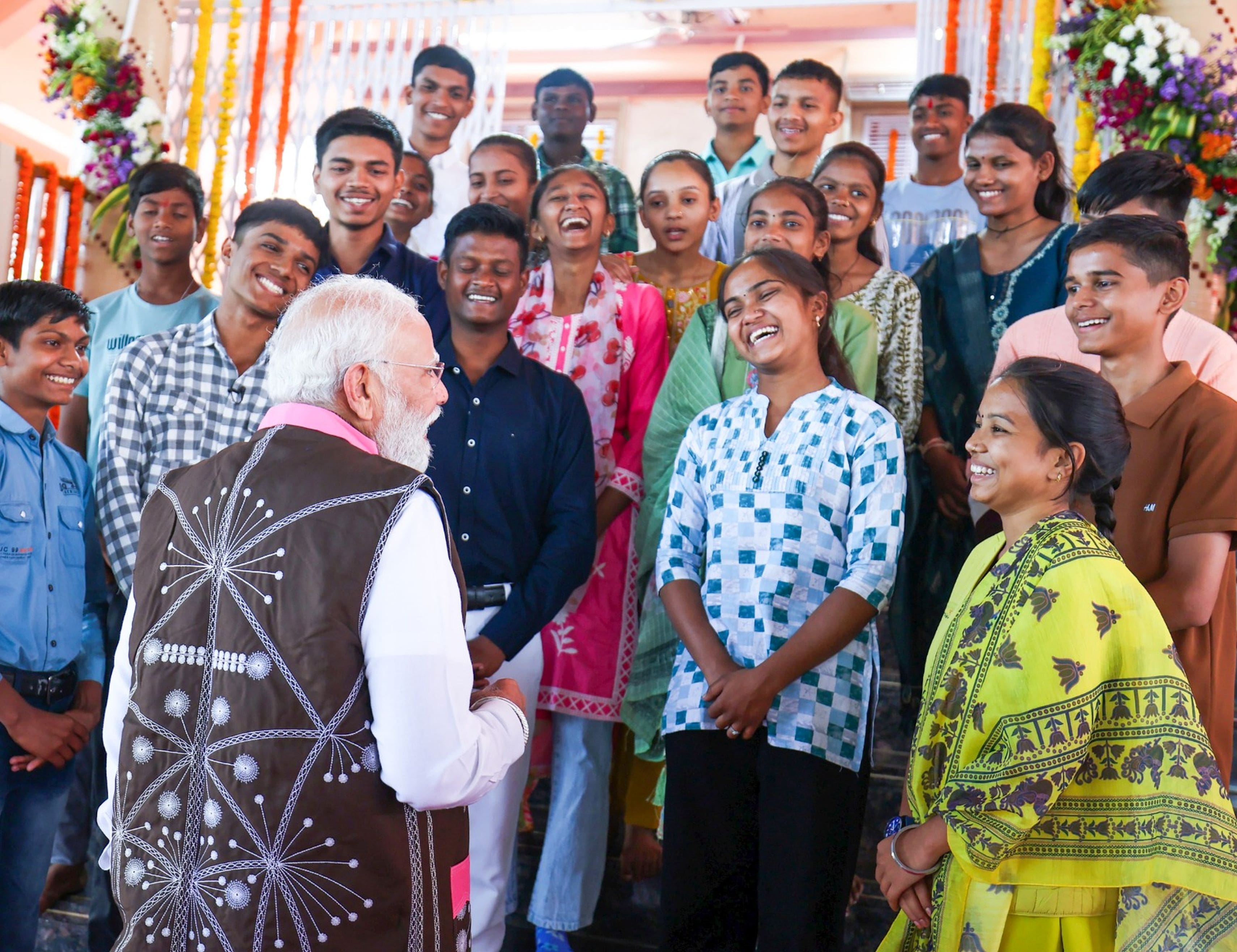
Interacting with students in Devmogra, Gujarat, the Prime Minister asked about their background, lauded their artwork and also recognized some familiar faces from earlier meetings, appreciating their courage.
Development of Gujarat’s tribal areas
Responding to a question about his inspiration for working in tribal areas, Shri Modi recalled the historic Palchetaria incident where the tribal community fought a major freedom struggle, and also the severe famine during which he stayed in the region and felt the need to focus on education. He remarked that when he became Chief Minister, he prioritized education, noting that there was once not a single science school from Umargam to Ambaji, but now there are universities, science schools, engineering institutes, and ITIs, bringing significant change and benefits. He highlighted the creation of the PM Janman Yojana to support tribal communities who remain further behind, explaining that separate schemes and budgets were required. He emphasized that education accelerates development and also pointed to infrastructure projects like the Umargam–Ambaji highway, remarking that connectivity is vital for progress and has been a key area of focus.
Prime Minister Modi, responding to a student’s question on handling stress during critical national moments responding to a student’s question on how he handled stress during critical national moments such as the aftermath of the Pahalgam attack and Operation Sindoor, remarked that students often feel exam stress but later realize it was temporary once the exam is over. He emphasized that the best way to overcome exam tension is to develop the habit of solving papers and writing regularly, rather than only reading. He added that consistent practice prevents stress. He highlighted the importance of laughter and, most significantly, proper sleep, noting that sound rest keeps the mind fresh, ideas flowing, and spirits uplifted.
The right career path
On career choices, the Prime Minister advised that constantly changing aspirations confuses families, but it is natural to feel inspired by successful people. He stressed that one should not only look at their achievements but also at the effort and discipline behind them. He gave the example of a cricketer waking up at 4 a.m. to cycle to practice, remarking that dreams must be matched with hard work and routine. He said that true success makes its own noise, and when one becomes number one, the whole school, village, and community will recognize it.
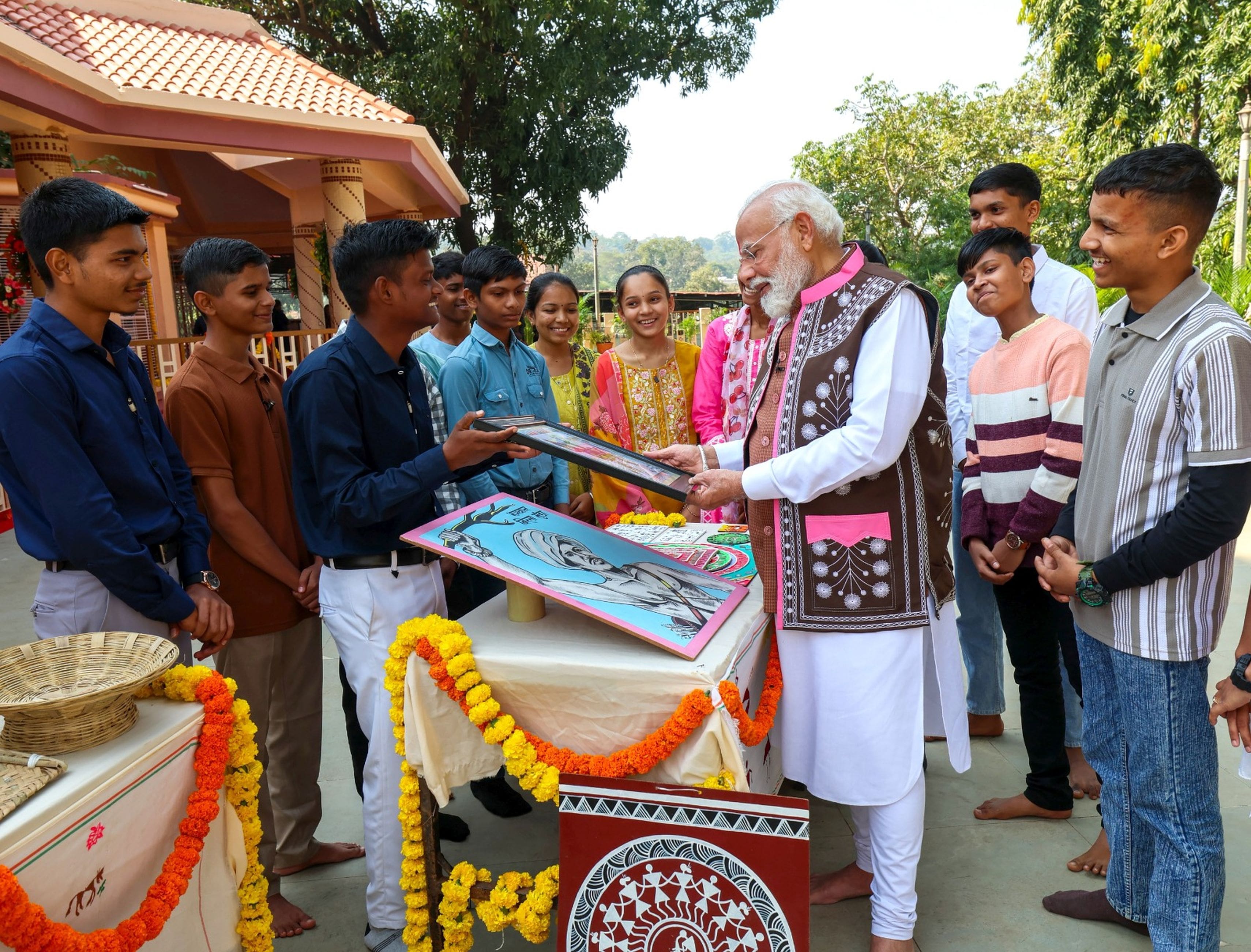
Students then showcased cultural artworks including Warli, Lipan, and Pithora art, explaining their traditions. The Prime Minister admired their creations, asking if they had made them by hand, and praised their talent, saying “You have become a great artist.” He expressed delight at receiving the paintings, noting their cultural depth and creativity. Students shared their joy, saying it felt as though they were speaking with a friend, and expressed pride that the Prime Minister personally appreciated their work.
Role of teachers & tribal youth
Prime Minister Modi, responding to a student’s question on the role of teachers in his life, remarked that they played a very significant role. He recalled how his teacher encouraged him daily to visit the library, read the editorial line in The Times of India, write it down, and discuss it the next day, which instilled discipline and curiosity. He shared memories of Parmar Sir from his primary school days, who was insistent on physical fitness, teaching him yoga and mallakhamb, which helped him understand the importance of health even though he did not become a professional player. He emphasized that in the life of every great personality, two influences are always acknowledged—their mother and their teacher.
When asked about the contribution of tribal communities to India’s progress, the Prime Minister remarked that the country has advanced significantly because of them. He highlighted that India’s environment is preserved due to the tribal society’s devotion to nature, as they worship and protect it. He noted that a large number of sons and daughters from tribal communities serve in the armed forces, and that there should be no distinction in opportunities across sectors. He pointed out that tribal youth excel in sports, citing the example of Kranti Goud from Madhya Pradesh, a tribal daughter who earned recognition in cricket, along with many other tribal athletes who have brought glory to the nation. He remarked that tribal communities possess immense talent and, if combined with technology, their potential would grow even further. He stressed that life should not be lived merely for jobs, but with dreams of building a meaningful life, which brings true benefit.
Shri Modi then listened to the students’ collective song dedicated to Mogi Mata, which described where she lives and how she lives, appreciating the cultural expression embedded in it. The students shared that their conversation with him touched on how to remain happy in life, how to remove stress, manage time effectively, and prepare for exams without fear. They expressed their amazement at meeting the Prime Minister in person, saying they could hardly believe their eyes and that time passed unnoticed during the interaction
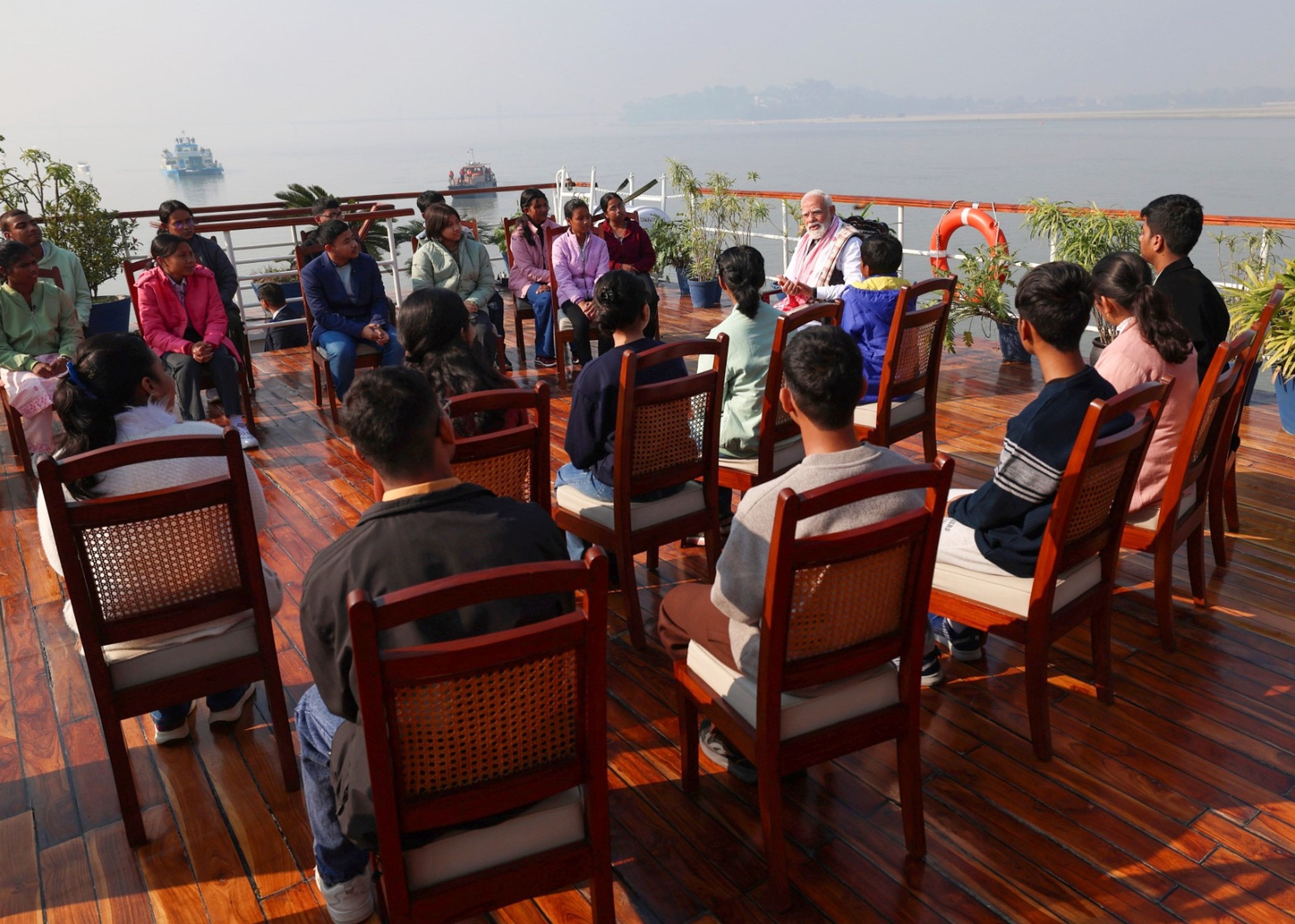
Prime Minister Modi remarked that the journey of Pariksha Pe Charcha reached the Ashtalakshmi region, the North East, with discussions held in Guwahati amidst the flowing Brahmaputra. He was welcomed with a traditional gamosa, noting that in Assam such a gesture is essential. Students expressed that his presence was calming and helped ease their anxiety. The Prime Minister asked if they had seen the programme earlier on television or read his book Exam Warrior, and students shared that it reduced their fear of exams, teaching them to celebrate exams like a festival. He observed that often it is family members who instill fear by questioning marks lost, and emphasized that satisfaction must never halt progress. He reiterated his mantra that competition should be with oneself, not others, and that self-improvement must be continuous.
A healthy diet & lifestyle
Responding to a question on diet & lifestyle, the Prime Minister remarked that he follows no fixed system, recalling his days of eating vegetarian meals in different households and cooking simple dishes like khichdi himself. He advised that diet should be based on personal preference, not treated like medicine, and one should decide whether to eat to fill the stomach or to satisfy the mind. He highlighted that while people eat grains to fill their stomachs, they often neglect breathing deeply to fill their chest, stressing that the reverse should be practiced. He encouraged students to prioritize their bodies, to make habits like watching the sunrise, and to give health the highest priority, as these practices bring freshness and energy.
Dealing with the pressure of comparison
Prime Minister Modi, responding to a student’s concern about parental comparisons with siblings and friends, remarked that such situations should be approached positively. He explained that if parents praise a sibling’s handwriting, the right response is to ask that sibling to teach, rather than feeling neglected. He emphasized that children should learn from the strengths of their brothers or sisters and tell parents, “You pointed out a good quality, now guide me on how to develop it.” He advised that parents should avoid excessive praise of one child in front of others, as it can create imbalance. He highlighted that if someone close excels in something, one should silently consider them a guru, without telling them, and ask for guidance, which fosters equality and respect.
Believing in oneself
On the issue of stage fear and confidence, the Prime Minister explained that self-confidence comes from the two words “atma” and “vishwas,” meaning faith in oneself. He remarked that those who trust themselves never fear, and they study situations carefully before acting. He recalled Swami Vivekananda’s famous Chicago speech, noting that Vivekananda initially felt nervous but prayed to Maa Saraswati for strength, and when he began with “Sisters and Brothers of America,” the audience applauded for minutes, which became a turning point. He emphasized that even great speakers and players face setbacks, citing Sachin Tendulkar’s dismissals at zero, but they never lose confidence. He urged students to observe situations, accept challenges, and rely on their inner strength.
Students then presented a song by Bharat Ratna Dr. Bhupen Hazarika, which the Prime Minister appreciated. A student shared her family’s connection to tea gardens and offered him tea leaves, to which he responded warmly, sending his respects to her mother. Students expressed disbelief and joy at meeting him, saying they felt understood despite the generation gap.
Concluding, the Prime Minister remarked that Pariksha Pe Charcha included not only exam discussions but also local music and Assam’s tea, making it a memorable experience. He emphasized that exams are an opportunity, and healthy competition enhances preparation. He noted that while locations, students, and experiences varied, the purpose of every discussion remained the same—to listen, to understand, and to learn together—and extended his best wishes to all students.