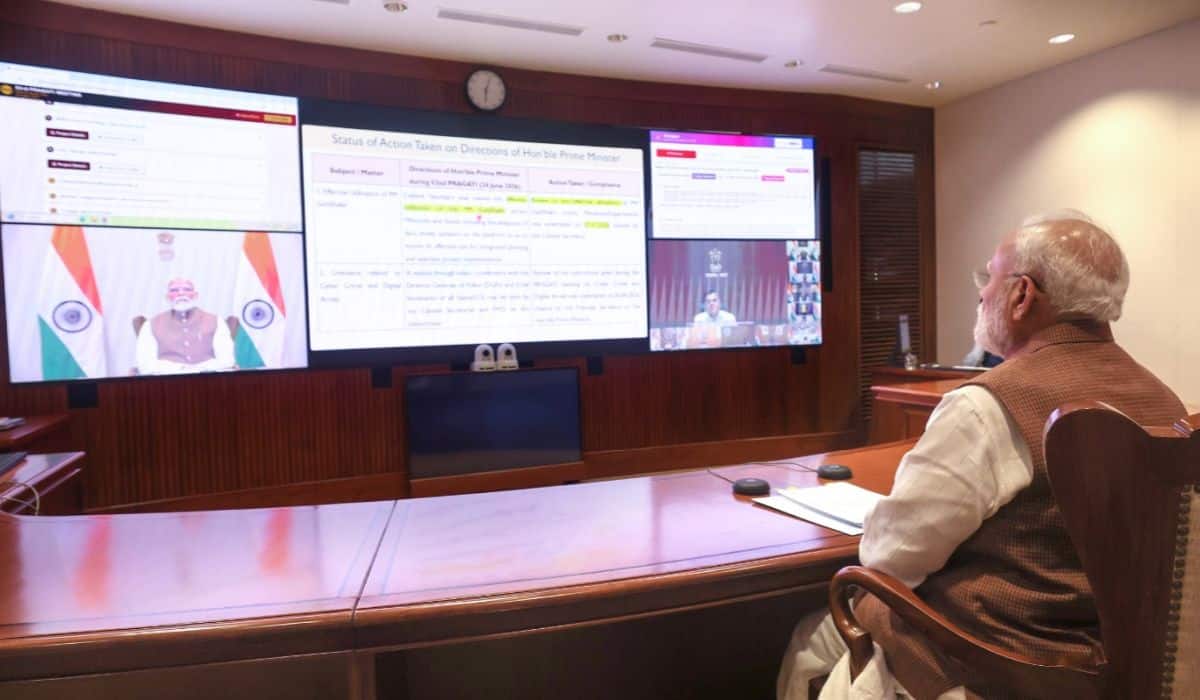
The Prime Minister, Shri Narendra Modi, today interacted with citizens from villages across the country which has been electrified since 2014. The interaction covered the beneficiaries of Pradhan Mantri Sahaj Bijli Har Ghar Yojana - 'Saubhagya' scheme, through video bridge. This is the tenth interaction in the series by the Prime Minister through video conference with the beneficiaries of various Government schemes.
Expressing delight in interacting with the villagers from the recently electrified 18000 villages, Prime Minister said “People who have not seen darkness, don't understand the meaning of illumination. Those who have not spent their lives in the darkness don't realise the value of light. ”
Prime Minister during the interaction said that thousands of villages have been electrified since NDA government has taken over. He added that unlike the false promises given by the previous government, the present government has walked the talk of electrifying every village. The Government not only focused on electrification, but also reformed the distribution systems across the country, Prime Minister added.
These 18000 villages which were not electrified even after 70 years of independence were electrified in the last four years.The last one electrified was Leisang village of Manipur in the North east Sector on April 28, 2018. Narendra Modi said that it was difficult to electrify the last 18000 villages, as most were in remote areas, hilly areas and areas with poor connectivity. He added that despite all the difficulties, a dedicated team of people worked hard to ensure that the dream of electrifying every village is achieved.
Prime Minister pointed out that the government has changed the situation in Eastern India which had 14,582non- electrified villages out of 18,000 and out of which 5790 villages were in the North East. He added that the Government accords priority to the development of Eastern India and with complete electrification, now Eastern India can play an even bigger role in India's development journey.
Prime Minister said that Pradhan Mantri Sahaj Bijli Har Ghar Yojana has been started with the objective of electrifying each and every house in the country. More than 86 lakh household has been electrified through the Yojana so far. The Yojana is in mission mode and will ensure electric connection to around four crore households.
Interacting with the Prime Minister, beneficiaries from far away villages explained electricity has transformed their lives forever. From completing work before the sunset and forcing children to study with kerosene lamps, electrification has made life very easily. Most beneficiaries said that the there has been an overall improvement in the quality of life. Beneficiaries also thanked the Prime Minister for bringing light into their houses.
It has been 70 years since we attained Independence but 18,000 villages did not have electricity connections. This was quite unfortunate: PM @narendramodi #PoweringIndia https://t.co/hitpQjiwy5
— PMO India (@PMOIndia) July 19, 2018
In 2005, the then Government promised to electrify every village by 2009. The then President of the ruling party went a step ahead & said we will bring electricity to every home. Needless to say, none of that happened during their long tenure: PM @narendramodi #PoweringIndia
— PMO India (@PMOIndia) July 19, 2018
From the ramparts of the Red Fort I announced that every village will be electrified. We walked the talk and went to every village. We not only focussed on electrification but also reformed the distribution systems across the country: PM @narendramodi #PoweringIndia
— PMO India (@PMOIndia) July 19, 2018
PM @narendramodi interacts with people from Leisang village in Manipur, which was the last among the 18,000 villages electrified. Watch. https://t.co/hitpQjiwy5
— PMO India (@PMOIndia) July 19, 2018
Now that we have electricity, we can see TV. We can also purchase heaters and our children can study better: People from Tawang in Arunachal Pradesh tell PM @narendramodi https://t.co/hitpQjiwy5
— PMO India (@PMOIndia) July 19, 2018
The coming of electricity made our children particularly happy. We could buy fans as well, which help us during the summers: People from Tripua's Dhalai tell PM @narendramodi
— PMO India (@PMOIndia) July 19, 2018
We had to go very far for work such as photocopying. The coming of electricity has enhanced convenience. When the time to pay bills came, we got very less time. Now we also pay our bill online: People from Sonitpur district in Assam tell PM @narendramodi #PoweringIndia
— PMO India (@PMOIndia) July 19, 2018
Most of the 18,000 villages were in remote areas, hilly areas, areas with poor connectivity. It was not easy to reach those villages but a dedicated team of people did it: PM @narendramodi #PoweringIndia
— PMO India (@PMOIndia) July 19, 2018
Our village, Roro in West Singhbhum District was not very well connected. We had to complete all our work before sunset. The coming of electricity changed that. Now, we also have access to water supply: People from Roro tell PM @narendramodi
— PMO India (@PMOIndia) July 19, 2018
Anita Devi from Palamu in Jharkhand tells PM that her village and home have got electricity in 2016. This changed her life forever. Hear her experiences. https://t.co/hitpQjiwy5
— PMO India (@PMOIndia) July 19, 2018
Children from our village had never seen what electricity is. Now we have access to so many facilities: Lalita Nayak, Narayan Nayak from Rayagada in Odisha tell PM @narendramodi #PoweringIndia
— PMO India (@PMOIndia) July 19, 2018
One of the priorities for us is the development of Eastern India. About 14,500 villages out of 18,000 villages not electrified were in Eastern India. We have changed that.
— PMO India (@PMOIndia) July 19, 2018
Eastern India can play an even bigger role in India's development journey: PM @narendramodi #PoweringIndia
For the first time we got a PM who cares for us and electrified our village. We had to walk so much for kerosene. We could not study. All this has changed: Aarti Sharma from Jammu and Kashmir tells PM @narendramodi #PoweringIndia
— PMO India (@PMOIndia) July 19, 2018
During Diwali in 2016 we got electricity. It felt like a double celebration. Before electrification, I had no employment but now I got a job as a Bank Mitra in my own village: a citizen from Tehri Garhwal tells PM @narendramodi #PoweringIndia
— PMO India (@PMOIndia) July 19, 2018