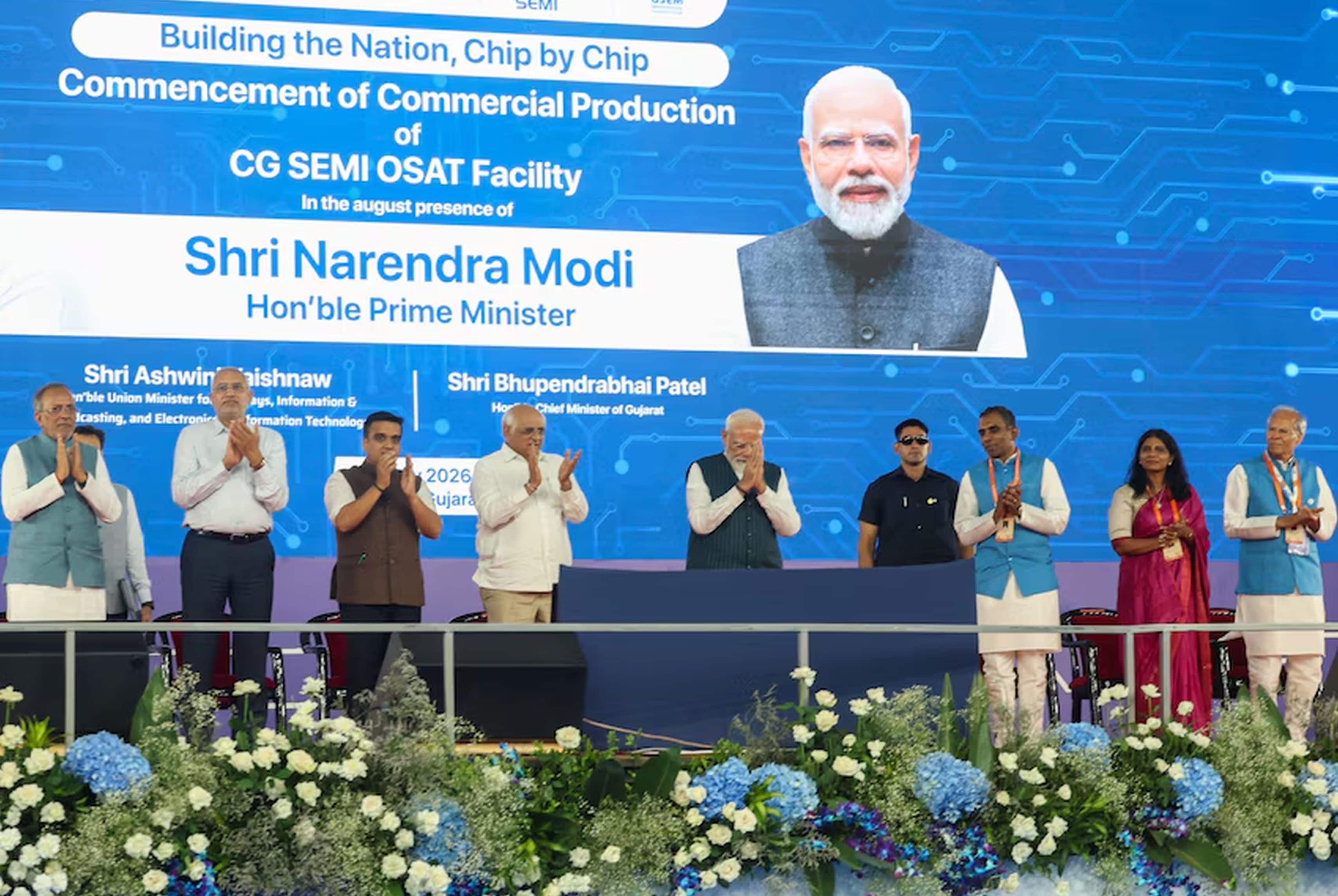
How are you all, doing well? Gujarat’s popular Chief Minister Bhupendra Bhai Patel, my colleague in the Union Cabinet Ashwini Vaishnaw, the energetic Deputy Chief Minister Harsh Sanghvi, ministers of the Gujarat government, MPs and MLAs, CG Power Chairman Vellayan Subbaiah ji, Renesas Electronics President Malini ji, CG Semi Chairman Girish ji, other industry leaders present here, ladies and gentlemen!
Today’s program is proof that whatever India resolves to do, India achieves. Five years ago, India pledged to make the nation a semiconductor hub. We moved forward with the mantra of Design in India, Make in India. And today, commercial production of chip packaging has begun at the country’s third semiconductor plant.
Friends,
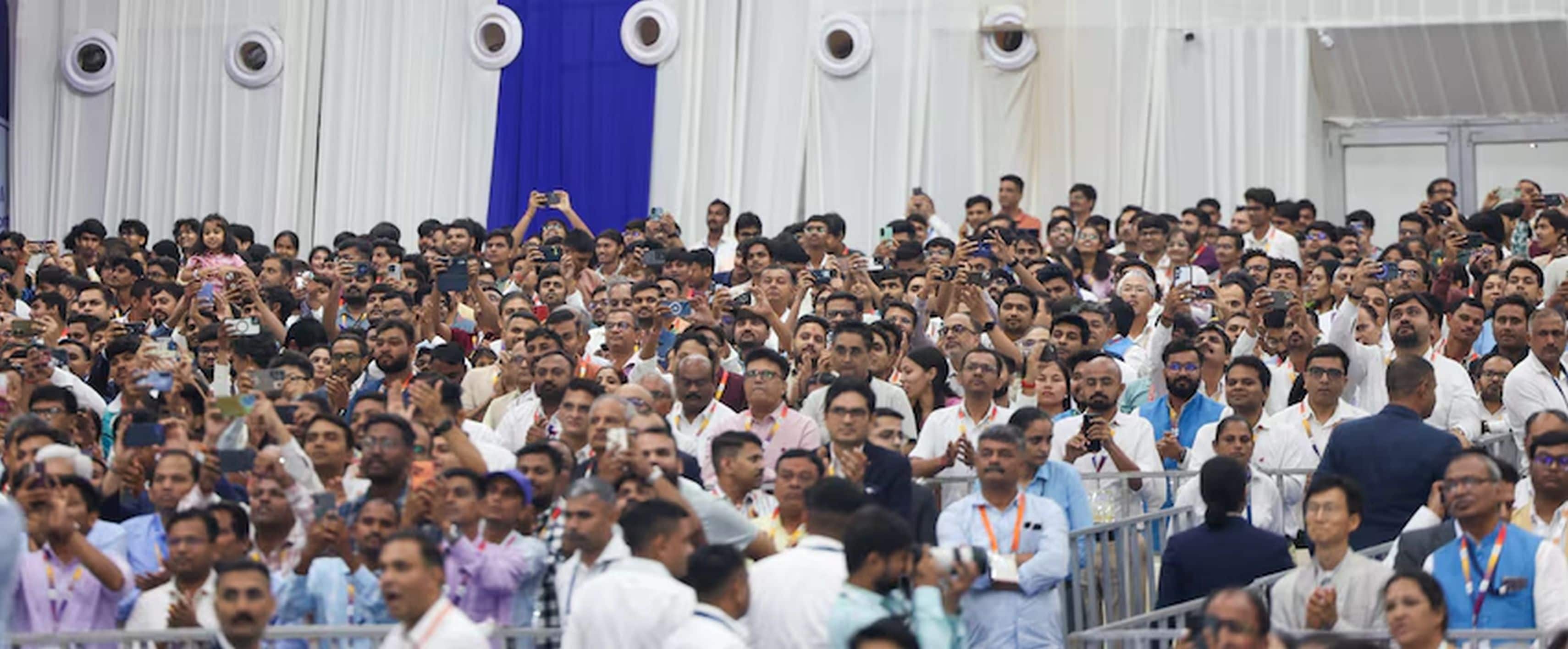
In 2024, I had the opportunity to lay the foundation stone of this plant. By August 2025, chip testing work had begun here, and today, this plant has been inaugurated. The journey from foundation to production is undoubtedly the result of the hard work of many colleagues, and the leadership of people like Subbaiah ji. Before coming on stage, I had the chance to interact with many associated with this project. It felt as though a mini India resides in this campus - people of every language, attire, and cuisine. During my exhibition visit, I also spoke with many young boys and girls. And one thing I must proudly mention is their confidence level. The conviction with which they spoke, their faith in technology - I was truly impressed.
Friends,
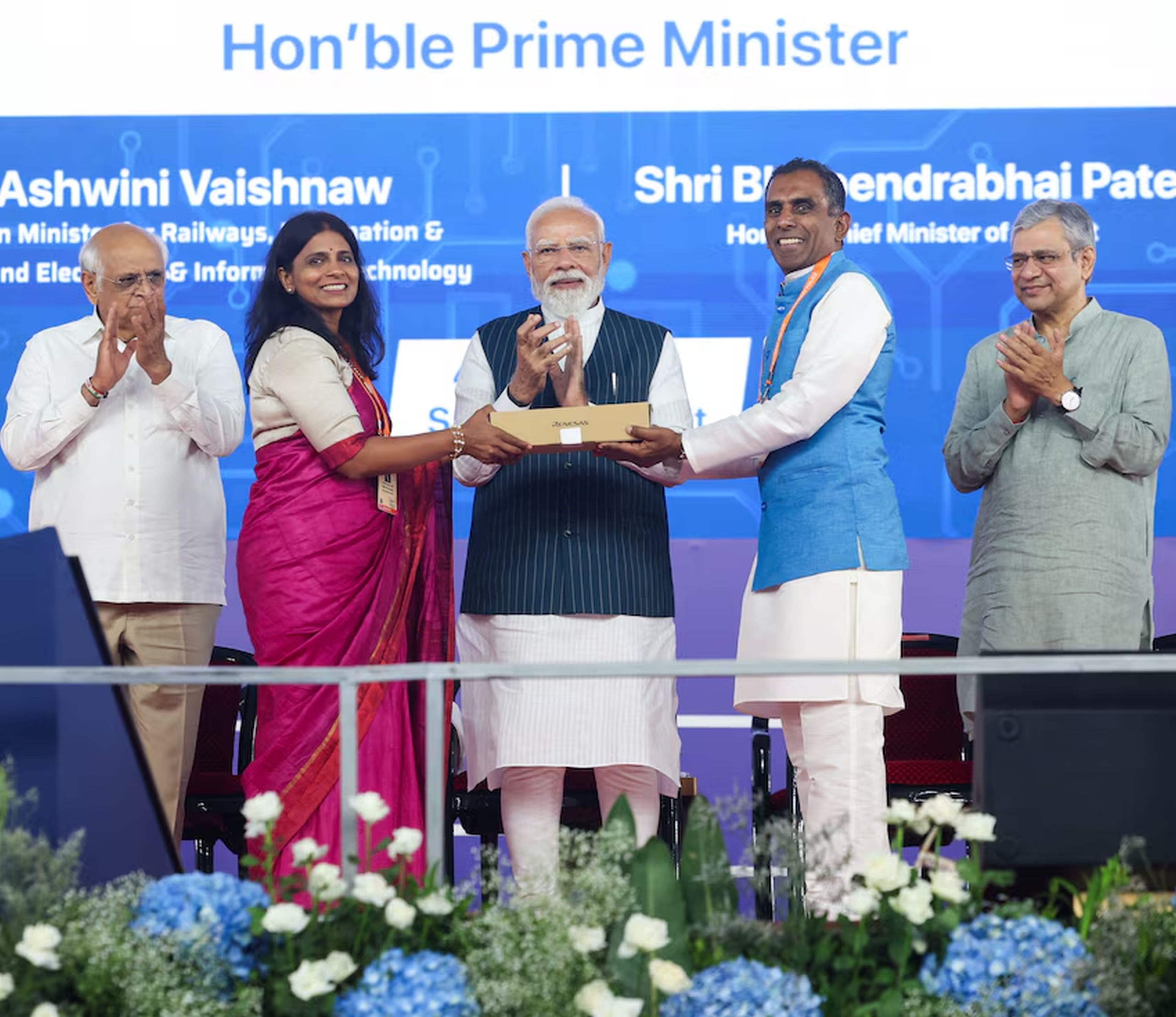
This CG Semi plant is also a symbol of the joint efforts of our industry partners from India, Japan, and Thailand. It is not just a business venture, but a model of technology, trust, and partnership that will accelerate India’s semiconductor journey. In just over two years, you have built this facility from scratch to scale. Today, we are beginning its commercial production. I am told that 200 million chips will be produced here annually. Not 20 lakh, but 20 crore. And I am told you will not stop here. You have set a target of 5 billion chips annually - more than 15 million chips every single day. I am confident you will achieve this soon. This is further proof that the Semicon India Program is gaining momentum - step by step, brick by brick, and now chip by chip. I extend my heartfelt congratulations to the entire CG Semi team, the state government, and the nation.
Friends,
I feel a special joy today. You may wonder why. The reason is that twenty years ago - perhaps even earlier - I had prepared plans to set up a semiconductor plant in Gujarat. Near Gandhinagar and Prantij, we had earmarked 350–400 acres of land. We even held talks with some companies. At that time, the Government of India was making big statements, and some companies came forward for discussions. But somehow, the government then seemed shackled, and the matter did not move forward. Today, when I see this happening, I feel the deepest happiness within me. It is the fulfillment of a dream I had 20–22 years ago. Back then, no one even discussed these subjects in the country. When I spoke about them, the media mocked me. It did not happen then, but today, as it is happening, I feel immense satisfaction. Just a few weeks ago, there was news that surprised me - and I was surprised the media did not give it the attention it deserved. The C295 aircraft, made in Vadodara, was built in India and took flight. There was a time when even the arrival of a bicycle factory was celebrated with sweets. Today, India is building airplanes.
Friends,
All of you here are knowledgeable, and I see many young colleagues present. If we look at the industrial history of the world, one thing is clear: no global industrial power was built by a single factory. The foundation of industrial power lies in clusters. America’s Silicon Valley, Taiwan’s Hsinchu Science Park, Japan’s Silicon Island, Tsukuba Science City - all demonstrate the importance of clusters. Today, Sanand too is moving in that direction.
Friends,
Within just a few months, Micron, Kaynes, and CG Semi have started production here. A semiconductor cluster is being born in India. Today, chip packaging is happening here. Tomorrow, specialized companies will come, chemicals will be produced, new testing labs will be built, industries servicing machines will emerge, design centers will open, and startups will be born. This is the strength of clusters. One industry gives birth to hundreds. Hundreds of industries create millions of jobs. And millions of jobs transform the economy of an entire region. And this is not happening only in Sanand - semiconductor clusters are emerging in many states across India.
Friends,
Today, the rise of the semiconductor sector in India has everyone excited. It is being discussed across the country and the world. Many people see it in isolation, but that is not the case. The expansion of semiconductors in India is not sudden - it is the next step in the electronics revolution that has unfolded here over the past decade.
Friends,
We began with mobile phone manufacturing. There was a time when India imported most of its smartphones, even more than its own domestic needs. Today, mobile phone production in India has increased 33 times compared to earlier. Before 2014, India was importing phones. After you sent me from Gujarat to Delhi, India began exporting them. Today, India is the world’s second-largest mobile manufacturer and the second-largest mobile exporter.
Friends,
In recent years, we have strengthened the entire electronics manufacturing ecosystem. India’s total electronics production has increased nearly sevenfold compared to 2014. Electronics exports have grown nearly elevenfold.
Friends,
Our effort is not limited to self-reliance in final products. We are also moving towards self-reliance in components. That is why India’s next step is clear. We will not only make mobiles, not only electronics, but also the chips that power the entire electronics world. This is our strategy - first products, then components, and now semiconductors. The entire electronics value chain will be in India. This is the roadmap for a developed India. This is the next phase of Make in India.
Friends,
The next step in the semiconductor ecosystem is self-reliance in critical minerals and high-tech materials. Just now, Subbaiah ji spoke in Gujarati and shared a proverb: Missing the mark is forgivable, but aiming low is not. That is my nature too - I do not set small targets, I do not think small. If I build a statue, I make it the largest in the world. As Subbaiah ji said, work speaks louder than words. The progress we see today, the achievements we celebrate, must be matched by strengthening the supply chain. That too is our goal. Today, India is making broad efforts in this direction. Our aim is to develop the entire ecosystem in India - from chip design to fabrication to packaging. India will not only make chips, but India’s youth will drive the next technological revolution - in AI, robotics, and next-gen tech - powered by Made in India chips. I have unwavering faith in the youth of India, in their talent and their strength. My complete trust lies in the power of my nation’s young people.
Friends,
On this occasion, I want to say something directly to the youth of our nation. Whenever a new industrial revolution comes to the world, the greatest opportunities are created for young people. When the IT revolution came, millions of Indian youth got the chance to show their talent. Then came the era of smartphones and electronics manufacturing, which also created millions of new opportunities. Now this era of the semiconductor revolution and AI revolution is bringing countless opportunities. From research and design to startup innovation and supply chain management, opportunities are everywhere.
Friends,
What is needed are new skills and new ideas. What matters now is whether you have a new idea, whether you have the passion to learn and to do something new. Today I met daughters from Jharkhand, Balaghat, Madhya Pradesh, Kerala, Chhattisgarh - and our conversation began with “Jai Johar.” Because I have lived in that region, I know it well. The speed with which these daughters have learned, and the way they were conducting things there, fills me with pride in the youth power of my country.
Friends,
In the coming times, AI will open up an entire world of new skills and new expertise before you. That is why India’s youth must not miss this opportunity. And I say to the young people - the idea is yours, the support is mine.
Friends,
This facility, this project, is also proof of how India’s youth are connecting with new possibilities. The sisters and daughters working here - as I said, from Jharkhand, Chhattisgarh, Madhya Pradesh, the entire tribal belt - showed me the factory. With great enthusiasm, they explained every detail. Ordinary families, ordinary schools, ITI education. In our country, when someone joins ITI, parents often don’t even tell others, they feel embarrassed. But times have changed - this is the era of ITI graduates. Their education may be from ITI, but their dreams are extraordinary. Many of these daughters’ families had never even made a passport, never seen one. Some had never even been to Delhi or Mumbai, let alone abroad. Yet these same daughters went to Malaysia for training, learned the world’s most advanced semiconductor technology, and today they are part of the Made in India chip manufacturing process. I remember when Subbaiah ji once showed me a video in Delhi - a three-minute film about these daughters’ lives. How they lived in forests, studied sitting on cots, and then stood at the airport for check-in, clearing immigration to fly to Malaysia. I immediately told him that whenever I came to Gujarat, I would invite these daughters to the Governor’s House and talk to them. I could not do it then, but today I got that opportunity. Thank you, Subbaiah ji. I congratulate all these daughters and their families.
Friends,
Today’s occasion is also proof of how impatient we are to make India developed. At the beginning of this year, I had said that by 2026, four semiconductor facilities would start. And today my minister has said - not four, but five. And I am happy that in just six months, production has already begun in three projects. This shows that today’s India not only sets big goals but also achieves them on time. This is the confidence India gives to the whole world, to every investor. Our policies are stable, our decisions are clear, and our execution is fast. I assure the management of CG Semi and other investors - the path of reforms that India has chosen, the Reform Express we have boarded, will only accelerate further. Today’s India is fully committed to ease of doing business. With this commitment, 1.4 billion Indians will make India developed by 2047. And today’s 18–20-year-olds - I work hard so that when you are 40–45, when your children are growing up, you will raise them in a developed India. That is why I dedicate my life - for the future of your children.
Friends,
We have set out on the path of development. We are reaching new heights of progress. And in this journey, the semiconductor sector is becoming a great strength, creating new confidence. I extend my best wishes to all of you. Move forward with high goals. If we miss the mark, we will see, but we must march ahead. My heartfelt congratulations and thanks to all of you.