The Cabinet Committee on Economic Affairs, chaired by the Prime Minister Shri Narendra Modi, yesterday has approved a project for construction of 4-lane sections of Dhamasiya–Bitada/ Movi (47.46 km) and Nasarpore–Malotha (60.21 km) in Gujarat on HAM Mode with a Total Project length of 107.67 km and Total Capital Cost of Rs.4583.64 crore.

The project is a part of NH-56 which starts at Nimbahera in state of Rajasthan and traverses through Dahod District in Gujarat, Alirajpur District in the State of Madhya Pradesh and then re-enters Gujarat near Chhota Udepur District, terminating at its junction with NH-48 near Vapi.

Approved projects pass through Aspirational District of Narmada and will improve connectivity to tribal areas in Dahod, Chhota Udepur, Tapi and Bharuch thereby helping in economic growth and development of the region. The project will also improve connectivity to the Statue of Unity, a prominent national tourist destination located in Kevadia village at a distance of about 11 km from NH-56.

The project is designed for 100 km/h, enabling 70 km/h average speed which will cut travel time by 40% - from 2.5 to 1.5 hours.

The approved project with 107.67 km will generate about 19.38 lakh man-days of direct employment and 22.82 lakh man-days of indirect employment. The project will also induce additional employment opportunities due to increase in economic activity in the vicinity of the proposed corridor.

The Ministry of Road Transport and Highways, through National Highways Authority of India (NHAI), has taken up the upgradation of congested Jambugam (Bodeli)-Malotha section of NH-56 (175 km) to four-lane configuration under four packages. The stretches from Jambugam (Bodeli) to Dhamasiya and from Movi to Nasarpore have already been awarded and construction work has already commenced in Nov. 2025 with target completion period of 2 years. On completion of instant project packages a continuous 4-lane connectivity from Bodeli to Malotha will be established, thus easing congestion on NH-56 and enhancing further connectivity to NH-53, NH - 48 and the Delhi–Mumbai Expressway (NE - 4).

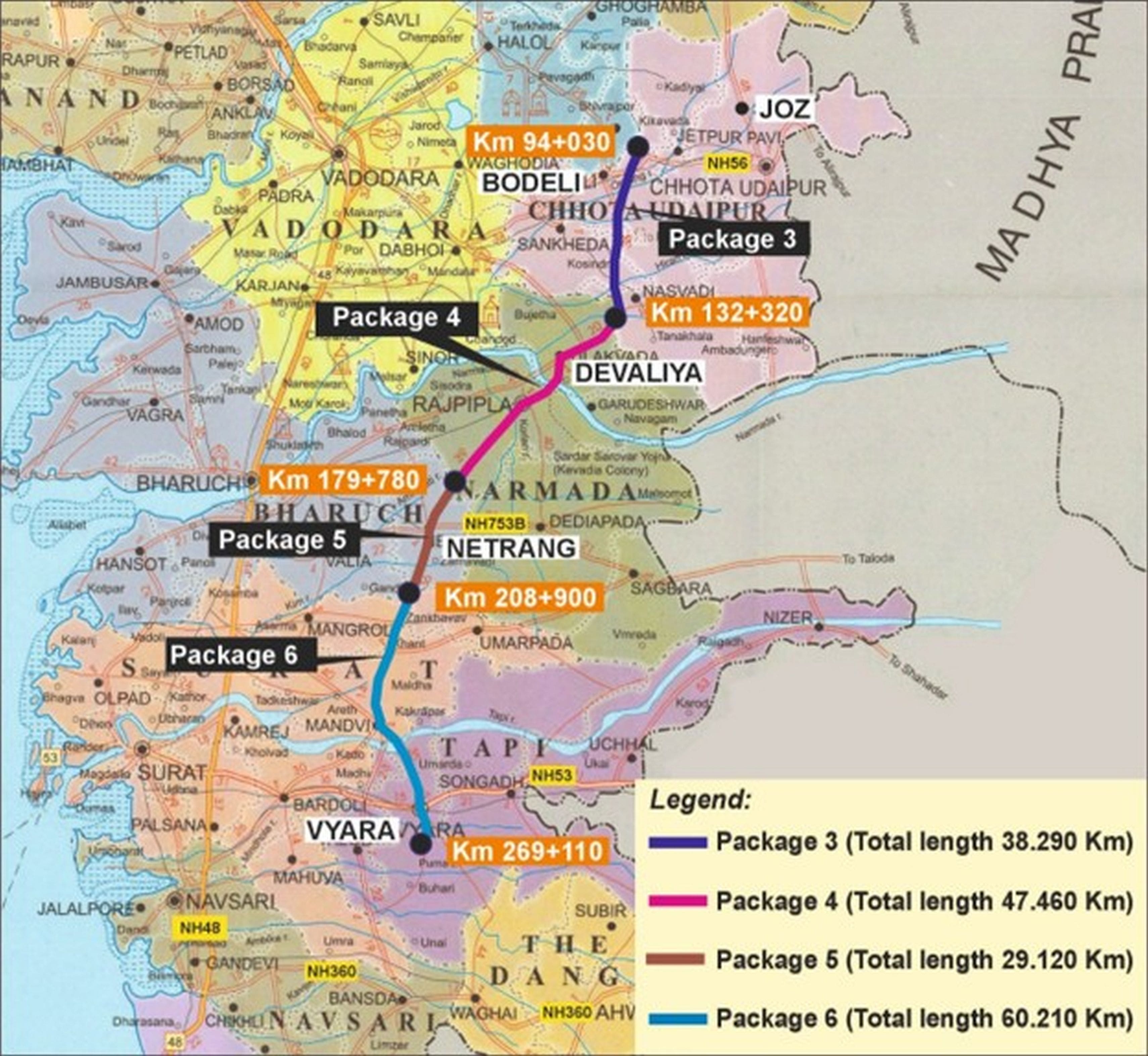
Project Alignment Map for Dhamasiya–Bitada/ Movi (47.46 km) and Nasarpore–Malotha (60.21 km) on NH-56
Explore More
ശ്രീരാമജന്മഭൂമി ക്ഷേത്രത്തിലെ പതാക ഉയർത്തൽ ഉത്സവത്തിനിടെ പ്രധാനമന്ത്രി നടത്തിയ പ്രസം​ഗം

ജനപ്രിയ പ്രസംഗങ്ങൾ

ശ്രീരാമജന്മഭൂമി ക്ഷേത്രത്തിലെ പതാക ഉയർത്തൽ ഉത്സവത്തിനിടെ പ്രധാനമന്ത്രി നടത്തിയ പ്രസം​ഗം
Pyaaz Khaate Hai, Dimaag Nahi': PM Modi's Jhalmuri Video Breaks The Internet With 100M+ Views

Media Coverage

Pyaaz Khaate Hai, Dimaag Nahi': PM Modi's Jhalmuri Video Breaks The Internet With 100M+ Views
NM on the go

Nm on the go

Always be the first to hear from the PM. Get the App Now!
...
India - Republic of Korea Joint Statement on Cooperation in the field of Sustainability
April 20, 2026

The Republic of India and the Republic of Korea, hereafter referred to as "the two sides,” agreed to strengthen bilateral cooperation to address global sustainability challenges through practical collaboration in climate change, maritime and Arctic issues.

As environmentally responsible nations, the two sides reaffirmed their commitment to fulfill the 2030 Agenda for Sustainable Development with respect to environment in an integrated manner. To achieve this, the two sides decided to promote cooperation on environmental matters and climate change, including the sustainable management of natural resources including land, air, water, biodiversity, and wastes.

Climate Change Cooperation

Reaffirming their support for the rules-based international order and their commitment to the Paris Agreement, the two sides recognised the critical importance of enhancing climate action to address the unprecedented climate crisis that threatens sustainability of humanity and nature.

In this context, the two sides welcomed the conclusion of an MOC under Article 6.2 of the Paris Agreement, which establishes a cooperative approach for investment-driven mitigation projects, advances the achievement of their respective Nationally Determined Contributions, and further strengthens their strategic partnership in the area of climate action. The two sides will promote cooperation on climate change issues including carbon market, the Article 6.2 cooperative approach, renewable energy and low-carbon technologies.

Environmental Cooperation and Sustainable Development

As environmentally responsible nations, India and the ROK decided to pursue institutional cooperation through an MOU on Cooperation in the Field of Climate and the Environment. The Indian side welcomed the ROK joining as a member of International Solar Alliance (ISA). The ROK side welcomed India joining as a member of the Global Green Growth Institute (GGGI).

Oceans and Marine Sustainability

Recognising the importance of the oceans for economic development, ecological balance, and food security, the two sides agreed to expand cooperation in marine science, sustainable fisheries, coastal ecosystem protection, and marine pollution prevention.

The two sides will enhance collaboration in the blue economy and promote closer exchanges between scientific institutions and maritime agencies in both countries.

Arctic Research and Polar Cooperation

India and the ROK noted their growing engagement in Arctic research and scientific cooperation. The two sides recognised the Arctic as an important region for advancing understanding of climate change and agreed to expand cooperation in the Arctic, including Arctic science and Arctic shipping.

The two sides will promote closer collaboration between their respective Arctic research institutions and explore opportunities for joint research initiatives, scientific exchanges, and participation in international polar research programmes.

Way Forward

The two sides reaffirmed their commitment to advancing practical cooperation that contributes to sustainable development and climate action.

India and the ROK expressed confidence that the expanded cooperation outlined in this joint statement will contribute to the development of innovative and scalable solutions that can support sustainable development in the Indo-Pacific region and beyond.