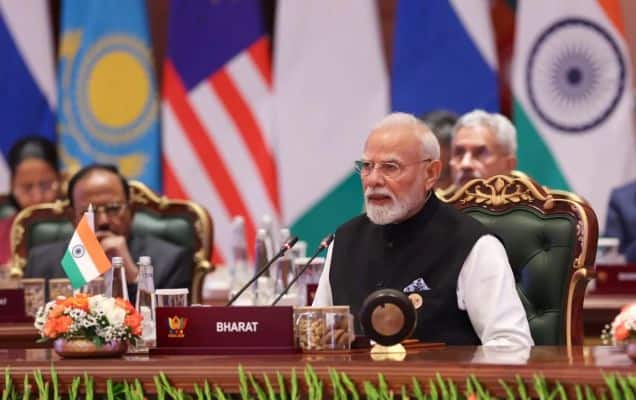
Inclusivity has been at the heart of India's G20 Presidency: PM Modi

Published By : Admin | November 30, 2023 | 09:52 IST

During G20 presidency, New Delhi revitalised multilateralism, amplified Global South’s voice, championed development, and fought for the empowerment of women

Today marks 365 days since India assumed the G20 presidency. It is a moment to reflect, recommit, and rejuvenate the spirit of “Vasudhaiva Kutumbakam” (OneEarth, One Family, One Future). As we undertook this responsibility last year, the global landscape grappled with multifaceted challenges— recovery from the Covid-19 pandemic, looming climate threats, financial instability, and debt distress in developing nations, all amid declining multilateralism. In the midst of conflicts and competition, development cooperation suffered, impeding progress.

Assuming the G20 Chair, India sought to offer the world an alternative to the status quo, a shift from GDP-centric to human-centric progress. India aimed to remind the world of what unites us, rather than what divides us. Finally, the global conversation had to evolve the interests of the few had to give way to the aspirations of the many. This required a fundamental reform of multilateralism as we knew it.

Inclusive, ambitious, action-oriented and decisive —these four words define our approach as G20 president, and the New Delhi Leaders’ Declaration (NDLD), unanimously adopted by all G20 members, is testimony to our commitment to deliver on these principles. Inclusivity has been at the heart of our presidency. The inclusion of the African Union(AU) as a permanent member of the G20 integrated 55 African nations into the forum, expanding it to encompass 80% of the global population. This proactive stance has fostered a more comprehensive dialogue on global challenges and opportunities.

The first-of-its-kind “Voice of the Global South Summit”, convened by India in two editions, heralded a new dawn of multilateralism. India main-streamed the Global South’s concerns in international discourse and has ushered in an era where developing countries take their rightful place in shaping the global narrative. Inclusivity also infused India’s domestic approach to G20, making it a people’s presidency that befits the world’s largest democracy. Through “Jan Bhagidari”(people's participation) events, G20 reached 1.4 billion citizens, involving all states and Union Territories (UTs) as partners, On substantive elements, India ensured that international attention was directed to broader developmental aims, aligning with G20's mandate.

At the critical midpoint of the 2030 Agenda, India delivered the G20 2023 Action Plan to Accelerate Progress on the Sustainable Development Goals (SDGs), taking a cross-cutting, action-oriented approach to interconnected issues, including health, education, gender equality and environmental sustainability. A key area driving this progress is robust Digital Public Infrastructure (DPI). Here, India was decisive in its recommendations, having witnessed the revolutionary impact of digital innovations like Aadhaar, UPI, and Digilockerfirst-hand. Through G20, we completed the Digital Public Infrastructure Repository, a significant stride in global technological collaboration. This repository, featuring over 50 DPIs from 16 countries, will help the Global South build, adopt, and scale DPI to unlock the power of inclusive growth.

For our One Earth, we introduced ambitious and inclusive aims to create urgent, lasting, and equitable change. The Declaration’s “Green DevelopmentPact” addresses the challenges of choosing between combating hunger and protecting the planet, by outlining a comprehensive roadmap where employment and ecosystems are complimentary, consumption is climate-conscious, and production is planet-friendly.

In tandem, the G20 Declaration calls for an ambitious tripling of global renewable energy capacity by 2030. Coupled with the establishment of the Global Biofuels Alliance and a concerted push for Green Hydrogen, the G20’s ambition to build a cleaner, greener world is undeniable. This has always been India’s ethos, and through Lifestyle for Environment (LiFE), the world can benefit from our age-old sustainable traditions.

Further, the Declaration underscores our commitment to climate justice and equity, urging substantial financial and technological support from the Global North. For the first time, there was a recognition of the quantum jump needed in the magnitude of development financing, moving from billions to trillions of dollars. The G20 acknowledged that developing countries require $5.9 trillion to fulfil their Nationally Determined Contributions (NDCs) by 2030. Given the monumental resources required, the G20 emphasised the importance of better, larger, and more effective Multilateral Development Banks. Concurrently, India is taking a leading role in UN reforms, especially in the restructuring of principal organs like the UN Security Council, that will ensure a more equitable global order.

Gender equality took centre stage in the Declaration, culminating in the formation of a dedicated Working Group on the Empowerment of Women next year. India’s Women’s Reservation Bill 2023, reserving one-third of India's Parliament and state legislative assembly seats for women, epitomises our commitment to women-led development.

The New Delhi Declaration embodies a renewed spirit of collaboration across these key priorities, focusing on policy coherence, reliable trade, and ambitious climate action. It is a matter of pride that during our Presidency, the G20 achieved 87 outcomes and 18 adopted documents, a marked rise from the past.

During our G20 presidency, India led deliberations on geopolitical issues and their impact on economic growth and development. Terrorism and the senseless killing of civilians are unacceptable, and we must address it with a policy of zero tolerance. We must embody humanitarianism over hostility and reiterate that this is not an era of war.

I am delighted that during our Presidency India achieved the extraordinary: It revitalised multilateralism, amplified the voice of the Global South, championed development, and fought for the empowerment of women, everywhere.

As we hand over the G20 Presidency to Brazil, we do so with the conviction that our collective steps for people, planet, peace, and prosperity, will resonate for years to come.

Explore More
Today, the entire country and entire world is filled with the spirit of Bhagwan Shri Ram: PM Modi at Dhwajarohan Utsav in Ayodhya

Popular Speeches

Today, the entire country and entire world is filled with the spirit of Bhagwan Shri Ram: PM Modi at Dhwajarohan Utsav in Ayodhya
A big deal: The India-EU partnership will open up new opportunities

Media Coverage

A big deal: The India-EU partnership will open up new opportunities
NM on the go

Nm on the go

Always be the first to hear from the PM. Get the App Now!
...
Kashi-Tamil Sangamam and a tribute to Ek Bharat, Shreshtha Bharat
January 15, 2026

A few days ago, I was in the sacred land of Somnath to be part of the Somnath Swabhiman Parv, marking a thousand years since the first attack on Somnath, which took place in 1026. People from all across India had come to be part of this moment of remembrance, united by a shared reverence for history, culture and the enduring spirit of the people of India. During the programme, I met a few people who had previously come to Somnath during the Saurashtra-Tamil Sangamam and had been to Kashi during the Kashi-Tamil Sangamam. Their words of appreciation for such platforms touched me and so, I thought of sharing a few thoughts on this subject.

During one of the Mann Ki Baat programmes, I had said that not learning Tamil is a major regret of my life. Fortunately, over the last few years, our Government has had several opportunities to further popularise Tamil culture across India and to deepen the spirit of ‘Ek Bharat, Shreshtha Bharat.’ A prime example of such an effort is the Kashi-Tamil Sangamam. In our ethos, Sangam or confluence has a special place. Seen in this light, the Kashi-Tamil Sangamam stands out as a truly distinctive initiative, one that celebrates the living unity of India’s many traditions while honouring their unique identities.

And what can be a better place than Kashi to host such a Sangamam. The same Kashi, which has remained a civilisational anchor from time immemorial… where, for thousands of years, people from all over have come in search of knowledge, meaning and Moksha.

Kashi’s connection with Tamil people and culture is very deep. It is in Kashi that Baba Vishwanath resides, while Tamil Nadu has Rameswaram. Tenkasi in Tamil Nadu is known as Kashi of the south or Dakshin Kashi. Saint Kumaraguruparar Swamigal forged a lasting link between Kashi and Tamil Nadu through his spirituality, scholarship and institution-building. Mahakavi Subramania Bharati, one of Tamil Nadu’s greatest sons, found in Kashi a space of intellectual growth and spiritual awakening. It was here that his nationalism deepened, his poetry sharpened and his vision of a free, united India took clearer shape. There are several such instances that highlight this close bond.

The first edition of Kashi-Tamil Sangamam took place in 2022. I recall attending the inauguration programme. Scholars, artisans, students, farmers, writers, professionals and many others from Tamil Nadu travelled to Kashi, Prayagraj and Ayodhya.

Subsequent editions expanded the scale and depth of this effort. The aim was to keep introducing fresh themes, innovative formats and deeper engagement, thus ensuring that the Sangamam continued to evolve while remaining rooted in its core spirit. In the second edition in 2023, technology was used on a larger scale to ensure that language does not become a barrier for people. In the third edition, the focus was on Indian knowledge systems. At the same time, academic discussions, cultural performances, exhibitions and interactions witnessed greater participation. Thousands of people have taken part in these events.

The fourth edition of the Kashi Tamil Sangamam commenced on 2nd December 2025. The theme picked was very interesting- Tamil Karkalam - Learn Tamil. It presented a unique opportunity for people in Kashi and other parts to learn the beautiful Tamil language. Teachers came from Tamil Nadu and the students of Kashi had a very memorable experience!

There were many other special events this time.

Tholkappiyam, the ancient Tamil literary classic, was translated into 4 Indian languages and 6 foreign languages.

A unique event, Sage Agasthya Vehicle Expedition (SAVE), was undertaken from Tenkasi to Kashi. On the way, various initiatives such as eye camps, health awareness camps, digital literacy camps, among other things, were held. The expedition paid homage to King Adi Veera Parakrama Pandiyan, the great Pandya ruler who spread the message of cultural oneness. There were exhibitions at Namo Ghat, academic sessions at Banaras Hindu University, as well as cultural programmes.

One of the things that makes me most happy about the Kashi-Tamil Sangamam is the participation of thousands of youngsters. It illustrates the passion among our Yuva Shakti to deepen their connect with our roots. It is a brilliant platform for them to showcase their talent and creativity during the various cultural programmes.

In addition to the Sangamam, efforts have been made to make the journey to Kashi memorable for the participants. The Indian Railways operated special trains to take people from Tamil Nadu to Uttar Pradesh. In many railway stations, particularly in Tamil Nadu, they were cheered, and the train journey was marked by melodious songs and conversations.

Here, I would also like to appreciate my sisters and brothers of Kashi and Uttar Pradesh for their warmth and hospitality shown to the delegates of the various Kashi-Tamil Sangamams. Several people opened the doors of their homes for the guests from Tamil Nadu. The local administration worked round the clock to ensure the guests had a seamless experience. As the MP from Varanasi, I could not be prouder!

This time, the valedictory function of the Kashi-Tamil Sangamam was held in Rameswaram and it was graced by the Vice President of India, Thiru CP Radhakrishnan Ji, who is himself a proud son of Tamil Nadu. He delivered a very inspiring address, emphasising India’s spiritual greatness and how such platforms deepen national integration.

The Kashi Tamil Sangamam has delivered meaningful outcomes like strengthening cultural understanding, fostering academic and people-to-people exchanges and creating lasting bonds between parts of the country that share a civilisational ethos. In the coming times, we want to make this platform even more vibrant. Most importantly, it has furthered the spirit of ‘Ek Bharat, Shreshtha Bharat.’ This spirit has flourished for centuries through our festivals, literature, music, art, cuisine, architecture, systems of knowledge and more.

This time of the year is very auspicious for people across the length and breadth of India. People are enthusiastically marking various festivals like Sankranti, Uttarayan, Pongal, Magh Bihu, which are, among other things, associated with the Sun, nature and farming. These festivals bring people together and deepen the spirit of harmony in our society. I convey my best wishes for these festivals and hope they continue to inspire us to deepen national unity through our shared heritage and collective participation.