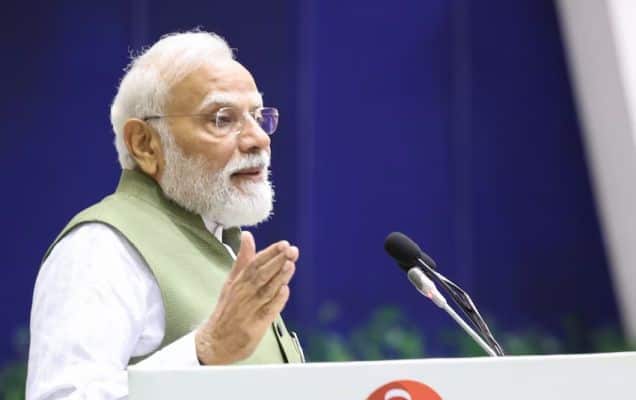
Collective efforts of the Centre and States will lead to realizing the vision of Viksit Bharat@2047: PM
PM said that the vision of Viksit Bharat can be realized through Viksit States; Each State and District should create a vision for 2047 so as to realise Viksit Bharat @ 2047
PM directed NITI Aayog to prepare an ‘Investment-friendly Charter’ for attracting investments
PM encouraged the creation of River Grids at State level for effective utilization of water resources
PM encouraged States to initiate Demographic Management Plans to address the issues of population ageing in future
PM emphasised skilling and training of youth to make them employment ready
We must target Zero Poverty as a priority for a Viksit Bharat : PM
PM directed NITI Aayog to study the suggestions of States and UTs made during the meeting
Meeting was attended by 20 States and 6 UTs

Prime Minister Shri Narendra Modi chaired the 9th Governing Council Meeting of NITI Aayog earlier today. The Meeting was held at the Rashtrapati Bhavan Cultural Centre, New Delhi. It was attended by Chief Ministers/Lt.Governors representing 20 States and 6 UTs.

Prime Minister emphasised on cooperation and collective effort of all States and the Centre to work together in order to achieve the vision of Viksit Bharat @2047.

Prime Minister observed that India has achieved steady growth in the past ten years. Indian economy, which was ranked 10th largest economy in the world in 2014, has risen to become the 5th largest economy by 2024. He added that now the collective aim of the government and all citizens is to become the third largest economy in the world.

Prime Minister stressed that our country has already made a lot of progress in the past ten years by strengthening social and economic infrastructure. From being a predominantly import-driven country, India now exports many products to the world. The country has made its mark on the world stage in wide ranging sectors like defence, space, start-ups and sports. He appreciated the confidence and enthusiasm of 140 crore citizens, which is the driving force behind the progress of our country.

Prime Minister said that this is the decade of change which brings a lot of opportunities across sectors. He encouraged States to utilise these opportunities and make policies and initiate governance programmes that are conducive for development through innovative approaches in policy making and execution.

He observed that the vision of Viksit Bharat can be realized through Viksit States, and that the aspiration of Viksit Bharat should reach the grassroot level i.e. to each district, block, and village. For this, each State and District should create a vision for 2047 so as to realise Viksit Bharat @ 2047.

Prime Minister appreciated the Aspirational Districts Programme anchored by NITI Aayog, and observed that the key to its success was continuous and online monitoring of measurable parameters, which led to healthy competition among districts to better their performance in different government schemes.

Prime Minister emphasised skilling and training of youth to make them employment ready as the world looks favourably towards India for skilled human resource.

He encouraged States to provide an investor-friendly environment. He directed NITI Aayog to prepare an ‘Investment-friendly Charter’ of parameters which would include policies, programmes and processes to be put in place for attracting investments. The States may be monitored on the achievement in these parameters to promote healthy competition among them for attracting investments. He also underscored the importance of law and order, good governance and infrastructure as vital for attracting investments, rather than just incentives.

Prime Minister encouraged the creation of River Grids at State level for effective utilization of water resources.

He suggested that we must target Zero Poverty as a priority for a Viksit Bharat. He emphasized that we need to tackle poverty on an individual basis rather than just at a programme level. He observed that removing poverty from the grassroots would bring about a transformational effect in our country.

Prime Minister encouraged all States to increase productivity and diversification in agriculture and provide market linkages to farmers. He further emphasised on spreading the adoption of Natural Farming practices which can improve soil fertility, ensure better and quicker returns to farmers due to low costs, and also provide a global market for the products.

Prime Minister encouraged States to initiate Demographic Management Plans to address the issues of population ageing in future.

Prime Minister asked the States to take up capacity building of government officials at all levels and encouraged them to collaborate with the Capacity Building Commission for the same.

Chief Minister/Lt. Governors gave various suggestions for the vision of Viksit Bharat @ 2047 and also discussed steps being taken in their States. Some of the key suggestions and best practices highlighted were in the field of agriculture, education and skill development, entrepreneurship, drinking water, reducing compliances, governance, digitalisation, women empowerment, cyber security, etc. Several States also shared their endeavours to create a State Vision for 2047.

Prime Minister directed NITI Aayog to study the suggestions of States and UTs made during the meeting.

He expressed his gratitude to all the CMs and LGs for participating in the meeting and sharing their views and experiences, and expressed confidence that India is progressing on the path to fulfil the vision of Viksit Bharat @2047 through the power of cooperative federalism.

Explore More
শ্রী রাম জন্মভূমি মন্দিরের ধ্বজারোহণ উৎসবে প্রধানমন্ত্রীর বক্তব্যের বাংলা অনুবাদ

জনপ্রিয় ভাষণ

শ্রী রাম জন্মভূমি মন্দিরের ধ্বজারোহণ উৎসবে প্রধানমন্ত্রীর বক্তব্যের বাংলা অনুবাদ
PM Modi lauds Bengaluru-based Prayoga Institute in Mann Ki Baat

Media Coverage

PM Modi lauds Bengaluru-based Prayoga Institute in Mann Ki Baat
NM on the go

Nm on the go

Always be the first to hear from the PM. Get the App Now!
...
PM to visit Gujarat on 31 March
March 30, 2026
On the occasion of Mahavir Jayanti, PM to inaugurate Samrat Samprati Museum at Koba Tirth in Gandhinagar
Museum showcases rich historical, cultural, and spiritual legacy of Jainism and will help visitors gain a chronological understanding of the evolution of Jainism and its profound cultural impact
Marking a significant milestone in India’s semiconductor journey, PM to inaugurate the Kaynes Semicon Plant at Sanand
It will be the second semiconductor facility to commence commercial production in India
Facility to contribute to building indigenous semiconductor packaging capacity, addressing critical gap in India’s chip ecosystem and furthering the vision of self-reliance
PM to lay foundation stone, inaugurate, and dedicate to the Nation multiple development projects worth more than ₹20,000 crore in Vav-Tharad
Projects span key sectors including Power, Railways, Road Transport & Highways, Health, Urban Development, Tribal Development, and Rural Development

Prime Minister, Shri Narendra Modi will visit Gujarat on 31st March 2026. At around 10 AM, Prime Minister will inaugurate the Samrat Samprati Museum in Gandhinagar. He will also address the gathering on the occasion. At around 12:45 PM, Prime Minister will inaugurate the Kaynes Semicon Plant at Sanand, Ahmedabad and also address a public gathering. Thereafter, Prime Minister will travel to Vav-Tharad where, at around 4 PM, he will lay the foundation stone, inaugurate, and dedicate to the nation multiple development projects worth more than ₹20,000 crore. He will also address the gathering on the occasion.

PM in Gandhinagar

On the occasion of Mahavir Jayanti, Prime Minister will inaugurate the Samrat Samprati Museum at Koba Tirth in Gandhinagar. Named after Samrat Samprati, the grandson of Ashoka and a revered figure in Jain tradition known for his commitment to non-violence and propagation of Jainism, the museum showcases the rich historical, cultural, and spiritual legacy of Jainism.

Located within the Mahavir Jain Aradhana Kendra campus, the museum features seven distinct wings, each dedicated to unique aspects of India’s civilizational traditions. It offers visitors a comprehensive journey through centuries of knowledge and heritage. The museum integrates traditional exhibits with modern digital and audio-visual installations, creating an immersive and engaging experience for visitors, researchers, and scholars.

The museum preserves and displays centuries-old rare relics, Jain artefacts, and traditional heritage collections. These include intricately crafted stone and metal idols, large Tirth Patta and Yantra Patta, miniature paintings, silver chariots, coins, and ancient manuscripts, all exhibited across seven grand galleries. Housing over two thousand rare treasures arranged in expansive halls, the museum enables visitors to gain a chronological understanding of the evolution of Jainism and its profound cultural impact.

PM in Sanand

Prime Minister will inaugurate the Kaynes Semicon Plant at Sanand GIDC, Ahmedabad. This will mark the commencement of commercial production at the facility, representing a significant milestone in India’s semiconductor journey.

Commercial production will start with the manufacturing of advanced Intelligent Power Modules (IPMs), which are critical components for automotive and industrial applications requiring compact, efficient, and reliable power switching systems. Each module comprises 17 chips and will be supplied to California-based Alpha and Omega Semiconductor (AOS). When all phases of the plant are completed, it will have the capacity to produce 6.33 million units per day.

The inauguration of the Kaynes Semicon Plant is a major step under the India Semiconductor Mission (ISM). It will be the second semiconductor facility, after Micron Technology, among the approved projects under the programme to commence commercial production.

The project holds particular significance as it establishes India’s second OSAT/ATMP (Outsourced Semiconductor Assembly and Test / Assembly, Testing, Marking, and Packing) unit entering the production phase. It also marks the entry of an Indian-origin Electronics Manufacturing Services (EMS) player into semiconductor manufacturing, thereby strengthening domestic capabilities.

The facility will contribute to building indigenous semiconductor packaging capacity, addressing a critical gap in India’s chip ecosystem, and furthering the vision of self-reliance in high-technology manufacturing.

PM in Vav-Tharad

Prime Minister will lay the foundation stone, inaugurate, and dedicate to the Nation multiple development projects worth more than ₹20,000 crore. These projects span key sectors including Power, Railways, Road Transport & Highways, Health, Urban Development, Tribal Development, and Rural Development.

Prime Minister will inaugurate the Ahmedabad-Dholera Expressway, an access-controlled highway built at a cost of over ₹5,100 crore. The expressway will enhance regional connectivity, support industrial development in the Dholera Special Investment Region (DSIR), and boost economic growth.

Prime Minister will lay the foundation stone for the construction of the 4-lane Idar–Badoli bypass section with paved shoulders. He will also lay the foundation stone for the upgradation of the Dholavira–Mauvana–Vauva–Santalpur section (Package-II) of NH-754K to a two-lane paved shoulder carriageway. These projects will strengthen highway infrastructure, improve connectivity to key regions including tourism destinations such as Dholavira, enhance logistics efficiency, and support socio-economic development.

Prime Minister will also lay the foundation stone of key road infrastructure projects, including the flyover at Bhaijipura Junction on the Gandhinagar–Koba–Airport Road, which will ease traffic congestion and provide organized parking space beneath the structure. The Flyover Bridge at PDPU Junction on Gandhinagar-Koba-Arodram Road will also be inaugurated. The road connecting Gandhinagar to the airport handles a daily traffic volume of over 140,000 vehicles. The flyover will ensure smooth and uninterrupted traffic flow from CH-0 Junction to the airport between Ahmedabad & Gandhinagar.

Prime Minister will inaugurate key power transmission projects including the Khavda Pooling Station-2 and associated transmission systems for evacuation of 4.5 GW renewable energy, with a combined cost of around ₹3,650 crore. These projects will strengthen renewable energy integration and transmission capacity.

In the rail sector, Prime Minister will dedicate to the Nation the Kanalus–Jamnagar doubling project (28 km), part of the Rajkot–Kanalus doubling project (111.20 km), and the quadrupling of the Gandhidham–Adipur section (10.69 km). These projects will enhance rail capacity, reduce congestion, improve operational efficiency, and enable faster movement of passengers and freight.

Prime Minister will also inaugurate the Himmatnagar–Khedbrahma gauge conversion project (54.83 km), which will improve rail connectivity and passenger movement in the region. He will also flag off the Khedbrahma–Himmatnagar–Asarwa train service.

Prime Minister will inaugurate and lay the foundation stone of 44 Urban Development projects worth around ₹5,300 crore across Gujarat, aimed at enhancing urban infrastructure and improving quality of life. Prime Minister will inaugurate various Health and Family Welfare initiatives including the inauguration of an 858-bed Rain Basera at Civil Hospital, Asarwa, Ahmedabad, and a similar facility at Gandhinagar Civil Hospital and GMERS Medical College, Gandhinagar.

Prime Minister will inaugurate Tourism projects including the Light and Sound Show at Rani ki Vav, Patan, the Water Screen Projection Show at Sharmishtha Lake, Vadnagar, and lay the foundation stone of tourism infrastructure works at Balaram Mahadev and Vishweshwar Mahadev in Banaskantha, aimed at enhancing tourism experience and promoting cultural heritage.

Prime Minister will dedicate to the nation two major water pipeline projects worth around ₹1,780 crore including the Kasara-Dantiwada Pipeline in Banaskantha and the Dindrol-Mukteshwar Pipeline across Patan and Banaskantha. Prime Minister will lay the foundation stone for the water supply scheme for Ambaji and surrounding rural areas. It will provide potable water to 34 villages and Ambaji town, benefiting approximately 1.5 lakh people in Danta and Amirgadh talukas of Banaskantha district. Prime Minister will also lay the foundation stones for three Sabarmati Riverfront expansion projects in Gandhinagar district, with a combined investment of around ₹1000 crore.

Prime Minister will inaugurate the Government Boys Hostel at Vejalpur, Ahmedabad. The facility will support tribal students pursuing higher education.