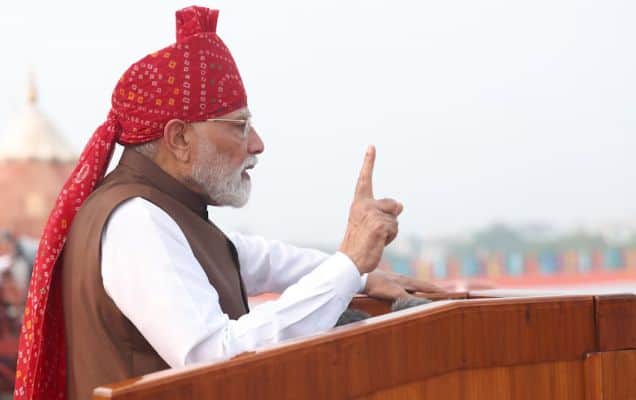
The Prime Minister, Shri Narendra Modi addressed the ‘Empowering Youth, Transforming J&K’ event at Sher-i-Kashmir International Conference Centre (SKICC) in Srinagar, Jammu & Kashmir today. The Prime Minister inaugurated and laid the foundation stone for multiple development projects in J&K worth more than Rs 1,500 crores encompassing the sectors of road, water supply, and infrastructure in higher education. He also launched Competitiveness Improvement in Agriculture and Allied Sectors Project (JKCIP) worth Rs 1,800 crores. Shri Modi also initiated handing out employment letters to 200 fresh government recruits. On the occasion, the Prime Minister took a walkthrough of the exhibition and interacted with young achievers of the Union Territory.
Addressing the gathering, the Prime Minister expressed excitement about his visit to Jammu & Kashmir and mentioned two specific reasons for it. He said, “Firstly, today’s event is related to the inauguration and foundation stone laying of developmental projects in Jammu & Kashmir and secondly, this is the first meeting with the people of Jammu & Kashmir after the Lok Sabha elections.” Recalling his recent visit to Italy for the G7 Summit, the Prime Minister highlighted the impact of continuity of the government for three terms as it has changed the outlook of the world towards India. He also said that all time high aspirations of Indians are the nation's biggest strength. He said that this high aspiration leads to high expectations from the government and in this backdrop, the third continuous term of the government is special as the only parameter of an aspirational society is performance. “People have faith in the intentions and policies of the government”, he added.

The Prime Minister said that the big message of people’s mandate in this Lok Sabha Elections is that of stability. He recalled the long phase of unstable governments in the last decade of the last century when the country witnessed 5 elections in 10 years resulting in development coming to a standstill. “Leaving that phase behind, India has now entered a new phase of stable government leading to strengthening of democracy.” He also noted the role of the people of Jammu & Kashmir in this strengthening of democracy. “We are witnessing Atal ji’s vision of Insaniyat, Jamhooriyat aur Kashmiriyat, turning into a reality today”, PM Modi said. Mentioning record voter turnout in the recent elections, the Prime Minister praised the trust of the people of Jammu & Kashmir in democracy. “I have come to express my thanks for your efforts for keeping the flag of democracy high”, he added.
“The transformation in Jammu & Kashmir is a result of the work done by the government in the last 10 years”, Prime Minister Modi said. Pointing out that the women and people from lower income backgrounds in the region were deprived of their rights, the Prime Minister said that the present government worked towards bringing opportunities and restoring their rights by adopting the mantra of ‘Sabka Saath Sabka Vikas’. The Prime Minister highlighted that the refugees migrating from Pakistan, people from the Valmiki community and families of Safai Karamcharis got their voting rights for the first time. He also mentioned fulfilling the long-pending wish of the Valmiki community to be included in the SC category, reservation of seats in the Legislative Assembly for the SC community, and inclusion of the Paddari tribe, Pahariya caste, Gadda Brahman and Koli community in the SC category. He also underlined that OBC reservation has been made applicable in the Panchayat, Nagar Palika and Nagar Nigam elections. Throwing light on the power of the Constitution of India and its significance in letter and spirit, the Prime Minister underlined that it enshrines the rights of the 140 crore citizens of India and provides opportunities to become a partner in nation-building. PM Modi also lamented the non-acceptance of the Constitution of India and the neglect shown towards Jammu & Kashmir since independence. “I am delighted that today, we are living the Constitution of India. Through the Constitution, we are finding new ways to change the face of Kashmir for good”, the Prime Minister said with pride. “The Constitution of India has finally been adopted by Jammu & Kashmir in the true sense”, PM Modi exclaimed, “The walls of Article 370 have been brought down.”

Referring to the developments that have taken place in Kashmir in the last 10 years, the Prime Minister said that the world is witness to the recent changes in the Kashmir valley. It continues to praise the people of the valley for their hospitality during the G20 Summit. He said that the organization of a global event like the G20 Summit in the valley has made the people of Kashmir proud. Seeing children continue to play at Lal Chowk till late in the evening fills every Indian’s heart with joy. Similarly, the bustling markets of the valley light up everyone’s face. Recalling the sports car show held near Dal Lake in March this year, Shri Modi said the whole world watched that program, which stands as a testimony to the progress in the valley. He mentioned how tourism in Kashmir has become the talk of the town, adding that tomorrow’s International Yoga Day programme will attract even more tourists here. Quoting Lieutenant Governor Sinha, the Prime Minister said that the figure of over 2 crores tourists visiting the valley is record-breaking and contributes significantly to the local economy.
“I am devoted myself with full dedication and honesty to ensure that a way out of the past generation’s miseries may be found. We are making all possible effort to remove all distances whether of the heart or of Delhi (Dil ya Dilli)”, PM Modi stressed. He emphasized the need for collective efforts to ensure that the fruits of democracy reach every family and person. He said that every paisa of central assistance is spent on the welfare of the people of Jammu & Kashmir. “What can be better than the people of Jammu & Kashmir selecting their representative and tackling their problems through them. That is why preparations for the assembly elections have started. The day is not far when you will select the new government of Jammu & Kashmir with your own vote. The day will come soon when Jammu & Kashmir will shape its future as a state once again”, the Prime Minister said.

Referring to the projects for which foundation stones were laid or inauguration was done, the Prime Minister mentioned major developmental projects worth more than Rs 1,500 crores and Agriculture and Allied Sectors (JKCIP) Project worth Rs 1,800 crores. He praised the UT administration for fast recruitments in government jobs and informed that in the last 5 years, about 40,000 recruitments were done. He also noted the positive impact of massive investments in Jammu & Kashmir.
Hailing the progress in Kashmir, the Prime Minister said that today the valley is witnessing major development works on almost every front, including rail connectivity, education, health infrastructure, electricity and water. He highlighted that thousands of kilometers of roads have been built under the Pradhan Mantri Gramin Sadak Yojna, adding that besides new highways and expressways, the valley is also going to be connected with railways. The alluring view of the Chenab railway bridge fills everyone with pride. Notably, the Gurez Valley in north Kashmir gained access to grid connectivity for the first time. Shir Modi reiterated that today, the valley is brimming with opportunities in every field, from agriculture to horticulture to sports and start-ups.

Hailing the development that has taken place in Kashmir in the last 10 years, the Prime Minister said that the valley is gradually emerging as a major hub of start-ups, skill development and sports. He pointed out that almost 70 per cent of the valley’s agricultural sectors comprises start-ups, further adding that more than 50 degree colleges have been set up in the valley in the past few years. “Seats in polytechnics have increased, and opportunities to learn new skills. IIT, IIM, and AIIMS are being built along with many new medical colleges have been built,” he continued. Skills are also being developed at the local level in the tourism and hospitality sector, he said. The Prime Minister also suggested introducing online courses for tourist guides, and establishing youth tourism clubs in schools-colleges-universities... all these works are happening in Kashmir today.
The Prime Minister highlighted the positive impact of the development work on the narishakti of Jammu and Kashmir. He mentioned tourism and IT training to the women of local Self Help Groups.

Speaking about the initiation of the Krishi Sakhi program two days ago, the Prime Minister informed that more than 1200 women from Jammu & Kashmir are working as Krishi Sakhis. He also touched upon the Namo Drone Didi program and said that the daughters of Jammu & Kashmir are being trained under the scheme. “Government is making these efforts to improve the income of women and provide livelihood opportunities”, he added.
“India is moving towards becoming a major world power in tourism and sports”, the Prime Minister said as he noted Jammu & Kashmir’s potential in these two sectors. He highlighted the development of excellent sports infrastructure in every district of Jammu & Kashmir and mentioned around 100 Khelo India centers being built. He informed that around 4,500 youth of Jammu & Kashmir are being trained for national and international competitions. Touching upon winter sports, PM Modi said that Jammu & Kashmir is becoming the winter sports capital of India. He also spoke about the recently concluded fourth edition of the Khelo India Winter Games in February this year which witnessed the participation of more than 800 players from all over the country. “Such events will create new possibilities for international sports events here in the future”, he added.

The Prime Minister warned the people of Jammu & Kashmir about the enemies of peace and humanity who stand against the development. Shri Modi asserted, “This is their last ditch effort to stop the development of Jammu & Kashmir, to ensure that peace is not established here”, He stressed that the government has taken serious note of the recent terror incidents where the Union Home Minister has reviewed all the arrangements in collaboration with the Jammu & Kashmir administration. The Prime Minister reiterated, “I assure you that no stone will be left unturned to teach a lesson to the enemies of Jammu & Kashmir. The new generation of Jammu & Kashmir will live in permanent peace. We will strengthen the path of progress chosen by Jammu & Kashmir”. The Prime Minister concluded his address by congratulating the people of Jammu & Kashmir for today's development projects.

Lieutenant Governor of Jammu & Kashmir, Shri Manoj Sinha and Union Minister of State for Ayush (Independent Charge) Shri Prataprao Jadhav were present on the occasion.
Background
The event ‘Empowering Youth, Transforming J&K’ is pivotal for the region, which showcases progress and inspires young achievers.
The Prime Minister laid the foundation stone and inaugurated 84 major developmental projects valued at more than Rs 1,500 crore. The inaugurations will include projects related to road infrastructure, water supply schemes, and infrastructure in higher education etc. Additionally, the Prime Minister laid the foundation stone for projects like improvement of the Chenani-Patnitop-Nashri Section, development of Industrial Estates and construction of 06 Government Degree Colleges.

The Prime Minister launched the Competitiveness Improvement in Agriculture & Allied Sectors (JKCIP) Project worth Rs 1,800 crores. The project will be implemented in 90 Blocks across 20 districts of J&K, and will have the project outreach of 300,000 households covering 15 lakh beneficiaries. The foundation stone laying/inauguration and launch of these projects will empower the youth and upgrade the infrastructure in Jammu & Kashmir.
The Prime Minister also distributed appointment letters to more than 2000 persons appointed in government service.
Click here to read full text speech
आज हमारी society की aspiration all-time high है।
— PMO India (@PMOIndia) June 20, 2024
जब aspiration high होती है तो लोगों की सरकार से भी expectation...अपेक्षाएं भी बहुत ज्यादा बढ़ जाती है: PM @narendramodi in Srinagar pic.twitter.com/pemEF4gAVM
जनता की उम्मीदों पर चलते हुए हमारी सरकार perform करके दिखाती है, result लाकर दिखाती है: PM @narendramodi pic.twitter.com/yuMBsMYygb
— PMO India (@PMOIndia) June 20, 2024
लोकसभा इलेक्शन में मिले जनादेश का बहुत बड़ा मैसेज स्थिरता का है, stability का है: PM @narendramodi pic.twitter.com/PvZiKyY6V6
— PMO India (@PMOIndia) June 20, 2024
अटल जी ने जो इंसानियत, जम्हूरियत और कश्मीरियत का विजन दिया था... उसे आज हम हकीकत में बदलते देख रहे हैं: PM @narendramodi pic.twitter.com/BTpGqfM81t
— PMO India (@PMOIndia) June 20, 2024
जम्मू-कश्मीर में आज सही मायने में भारत का संविधान लागू हुआ है। pic.twitter.com/YPsjoe1l4B
— PMO India (@PMOIndia) June 20, 2024
आज जम्मू कश्मीर स्टार्ट-अप्स, स्किल डेवलपमेंट और स्पोर्ट्स का एक बड़ा हब बन रहा है: PM @narendramodi pic.twitter.com/Yk8x6BtZEY
— PMO India (@PMOIndia) June 20, 2024