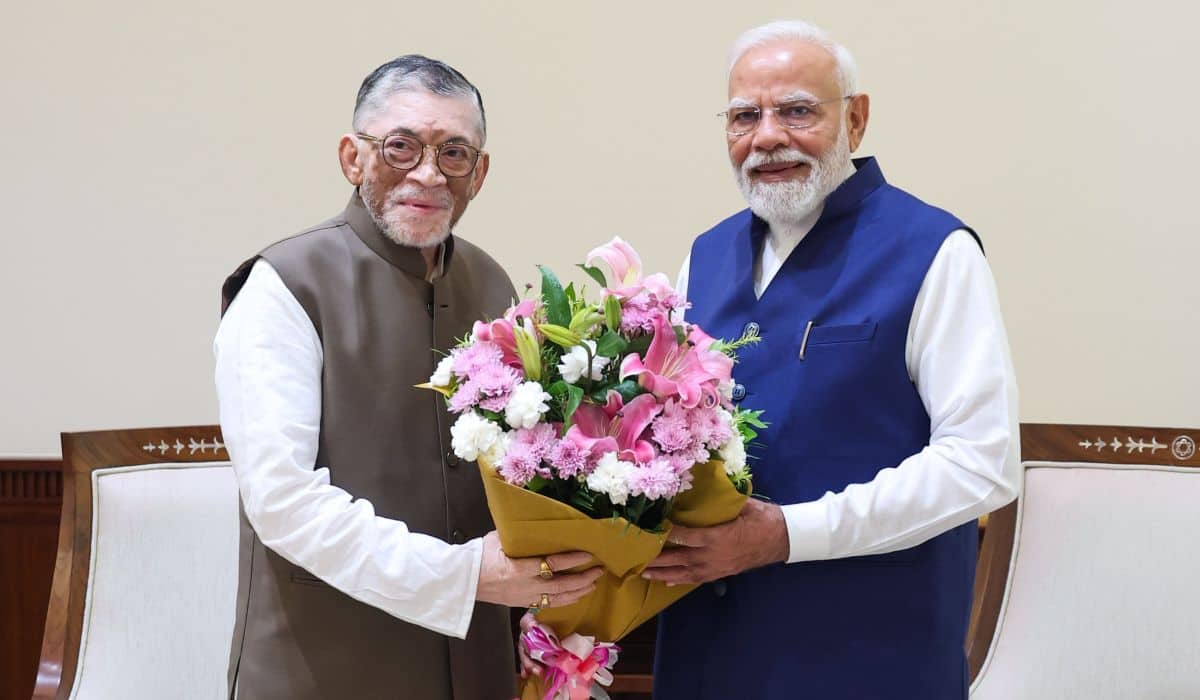
The swearing-in ceremony of Prime Minister Shri Narendra Modi and the Council of Ministers took place in Rashtrapati Bhavan on 09 June 2024. Leaders from India’s neighbourhood and the Indian Ocean region participated in the ceremony as honoured guests.

The leaders who attended the ceremony included President of Sri Lanka, H.E. Mr. Ranil Wickremesinghe; President of Maldives, H.E. Dr. Mohamed Muizzu; Vice-President of Seychelles, H.E. Mr. Ahmed Afif; Prime Minister of Bangladesh, H.E. Sheikh Hasina; Prime Minister of Mauritius, H.E. Mr. Pravind Kumar Jugnauth accompanied by his spouse; Prime Minister of Nepal, H.E. Mr. Pushpa Kamal Dahal ‘Prachanda’; and Prime Minister of Bhutan, H.E. Mr. Tshering Tobgay. Leaders of Maldives, Bangladesh, Nepal and Bhutan were accompanied by Ministers.

Following the swearing-in ceremony, Prime Minister Shri Narendra Modi met with the visiting leaders in Rashtrapati Bhavan. The leaders congratulated him for taking oath as the Prime Minister of India for the historic third consecutive term. Thanking them for gracing the occasion, Prime Minister reaffirmed India’s commitment to its ‘Neighbourhood First’ policy and ‘SAGAR Vision’. Prime Minister emphasized that in his third term, India will continue to work for the peace, progress and prosperity of the region in close partnership with the countries, even as it pursues its goal of VIKSIT BHARAT by 2047. In this context, he called for deeper people-to-people ties and connectivity in the region. He further added that India would continue to amplify the voice of the Global South in the international arena.

The leaders also attended a Banquet hosted by President Smt. Droupadi Murmu at Rashtrapati Bhavan. President while welcoming them and conveying her wishes to Prime Minister Modi in the service of the nation, stated that India’s democratic exercise was not only a moment of pride for its people, but an inspiration to millions around the world.

The participation of leaders from India’s neighbourhood and the Indian Ocean region on the momentous occasion of swearing-in ceremony of Prime Minister and Council of Minister, underlines India’s deep-rooted bonds of friendship and cooperation with the region.

Explore More
শ্রী রাম জন্মভূমি মন্দিরের ধ্বজারোহণ উৎসবে প্রধানমন্ত্রীর বক্তব্যের বাংলা অনুবাদ

জনপ্রিয় ভাষণ

শ্রী রাম জন্মভূমি মন্দিরের ধ্বজারোহণ উৎসবে প্রধানমন্ত্রীর বক্তব্যের বাংলা অনুবাদ
India’s digital economy enters mature phase as video dominates: Nielsen

Media Coverage

India’s digital economy enters mature phase as video dominates: Nielsen
NM on the go

Nm on the go

Always be the first to hear from the PM. Get the App Now!
...
Cabinet approves increase in the Judge strength of the Supreme Court of India by Four to 37 from 33
May 05, 2026

The Union Cabinet chaired by the Prime Minister Shri Narendra Modi today has approved the proposal for introducing The Supreme Court (Number of Judges) Amendment Bill, 2026 in Parliament to amend The Supreme Court (Number of Judges) Act, 1956 for increasing the number of Judges of the Supreme Court of India by 4 from the present 33 to 37 (excluding the Chief Justice of India).

Point-wise details:

Supreme Court (Number of Judges) Amendment Bill, 2026 provides for increasing the number of Judges of the Supreme Court by 04 i.e. from 33 to 37 (excluding the Chief Justice of India).

Major Impact:

The increase in the number of Judges will allow Supreme Court to function more efficiently and effectively ensuring speedy justice.

Expenditure:

The expenditure on salary of Judges and supporting staff and other facilities will be met from the Consolidated Fund of India.

Background:

Article 124 (1) in Constitution of India inter-alia provided “There shall be a Supreme Court of India consisting of a Chief Justice of India and, until Parliament by law prescribes a larger number, of not more than seven other Judges…”.

An act to increase the Judge strength of the Supreme Court of India was enacted in 1956 vide The Supreme Court (Number of Judges) Act 1956. Section 2 of the Act provided for the maximum number of Judges (excluding the Chief Justice of India) to be 10.

The Judge strength of the Supreme Court of India was increased to 13 by The Supreme Court (Number of Judges) Amendment Act, 1960, and to 17 by The Supreme Court (Number of Judges) Amendment Act, 1977. The working strength of the Supreme Court of India was, however, restricted to 15 Judges by the Cabinet, excluding the Chief Justice of India, till the end of 1979, when the restriction was withdrawn at the request of the Chief Justice of India.

The Supreme Court (Number of Judges) Amendment Act, 1986 further augmented the Judge strength of the Supreme Court of India, excluding the Chief Justice of India, from 17 to 25. Subsequently, The Supreme Court (Number of Judges) Amendment Act, 2008 further augmented the Judge strength of the Supreme Court of India from 25 to 30.

The Judge strength of the Supreme Court of India was last increased from 30 to 33 (excluding the Chief Justice of India) by further amending the original act vide The Supreme Court (Number of Judges) Amendment Act, 2019.