The source of our faith, inspiration and energy is our Constitution: PM Modi

Published By : Admin | November 26, 2021 | 17:35 IST
“We all may have different roles, different responsibilities, different ways of working, but the source of our faith, inspiration and energy is the same - our Constitution”
“Sabka Saath-Sabka Vikas, Sabka Vishwas-Sabka Prayas, is the most powerful manifestation of the spirit of the Constitution. Government dedicated to the Constitution, does not discriminate in development”
“India is the only country on course to achieve the goals of the Paris Agreement ahead of time. And yet, in the name of environment, various pressures are created on India. All this is the result of a colonial mentality”
“On the strong foundation of separation of power, we have to pave the path of collective responsibility, create a roadmap, determine goals and take the country to its destination”


Namaskar!

Chief Justice N.V. Ramana ji, Justice U.U. Lalit ji, Law Minister Shri Kiren Rijiju ji, Justice D.Y. Chandrachud ji, Attorney General Shri K.K. Venugopal ji, President of the Supreme Court Bar Association Shri Vikas Singh ji, and ladies and gentlemen associated with the judicial system of the country!

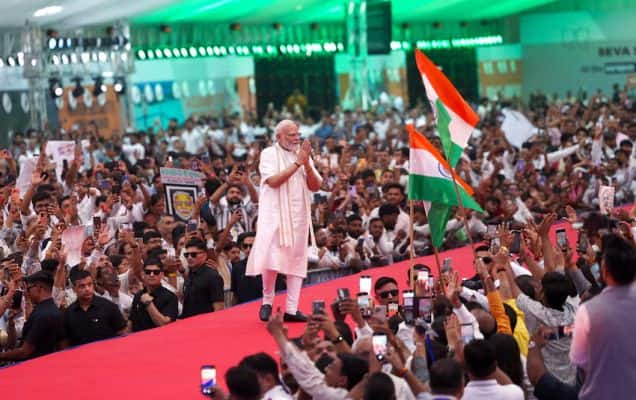
I spent the morning with my colleagues in the legislature and the executive. And now I am among the scholars associated with the judiciary. We may all have different roles, responsibilities and ways of doing things, but the source of our faith, inspiration and energy is the same - our Constitution! I am happy that today our collective spirit is being expressed in the form of this event on Constitution Day, strengthening our constitutional resolutions. All the people associated with this program deserve to be congratulated.

Excellencies,

In the light of the dreams of the people who lived and died for freedom and cherished the great tradition of India for thousands of years, our Constitution makers gave us the Constitution. Hundreds of years of servitude had plunged India into many problems. India, once known as the Golden Bird, was battling poverty, hunger and diseases. Against this background, the Constitution has always helped us in taking the country forward. But today in comparison to other countries which became independent almost at the same time as India, they are much ahead of us today. A lot remains to be done and we have to reach the goals together. We all know how much emphasis is laid on ‘inclusion’ in our Constitution. But it has also been a fact that even after so many decades of independence a large number of people of the country continue to face ‘exclusion’. Millions of people, who did not even have toilets in their homes, who were living their lives in the dark due to lack of electricity, whose biggest struggle in their life was to get some water; I think understanding their troubles and pain and expending oneself to make their life easier, is the real respect to the Constitution. And I am satisfied that a massive campaign is on to convert ‘exclusion’ into ‘inclusion’ in the country and in accordance with the basic spirit of the Constitution. We also need to understand the biggest benefit of this (campaign). A lot of worries of the poor have been lessened after more than two crore poor got their pucca houses, more than eight crore poor families got free gas connections under the Ujjwala scheme, more than 50 crore poor whose free treatment up to Rs 5 lakh in the biggest hospitals has been ensured, crores of poor got basic facilities like insurance and pension for the first time. These schemes have been extremely useful to them. During this Corona period, free food grains are been ensured to more than 80 crore people for the last several months. The government is giving free food grains to the poor by spending more than Rs 2.60 lakh crores on the Pradhan Mantri Garib Kalyan Anna Yojana. Just yesterday, we extended this scheme till March next year. Our Directive Principles – “Citizens, men and women equally, have the right to an adequate means of livelihood” are a reflection of this spirit. You all will agree that when the common man, the poor of the country, joins the mainstream of development and gets equality and equal opportunity, his world changes completely. When a street vendor connects with the system of bank credit, he also gets a feeling of participation in nation building. When public places, public transport and other facilities are built keeping in mind the Divyangs, when they get common sign language for the first time after 70 years of independence, they feel confident. When transgenders get legal protection and get Padma awards, their faith in the society and in the Constitution becomes stronger. When a strict law is made against the evil of the Triple Talaq, then the faith of those hopeless sisters and daughters in the Constitution is strengthened.


Excellencies,

Sabka Saath-Sabka Vikas, Sabka Vishwas-Sabka Prayas, this is the most powerful manifestation of the spirit of the Constitution. The government committed to the Constitution does not discriminate in development and we have proved this. Today the poorest of the poor are getting the same access to quality infrastructure which was once limited to the resourceful people. Today, the focus of the country for the development of Ladakh, Andaman and Nicobar, North East is as much as the metro cities like Delhi and Mumbai. But in the midst of all this, I would like to draw your attention to one more thing. You must have also experienced that the government is called liberal and is praised if it does something for a particular section, for a marginalized section. But I am surprised that sometimes a government is applauded if it does something better for a state. But not much attention is paid when the government does it for everyone, for every citizen and for every state and how the government schemes benefit every section and every state equally. In the last seven years, we have tried to ensure development without any discrimination and bias for every person, every section, and every corner of the country. On 15th August this year, I talked about the saturation of welfare schemes for the poor and we are also engaged in mission mode in this regard. It is our effort to work with the mantra of सर्वजन हिताय, सर्वजन सुखाय (Wellbeing of all, Happiness for all). The recent report of the National Family Health Survey also shows how the picture of the country has changed due to these measures. Many facts of this report prove the point that when work is done with good intention, progress is made in the right direction, and efforts are made to achieve the goal by mobilizing everyone, then there are bound to be better results. If we talk about gender equality, then the number of daughters is increasing in comparison to men. More opportunities are being available to pregnant women for deliveries in hospitals. As a result, the maternal mortality rate and infant mortality rate are decreasing. There are many other indicators on which we as a country are doing very well. Every percentage point increase in all these indicators is not just a figure. This is a proof of the rights being given to millions of Indians. It is very important that people get the full benefits of public welfare schemes and infrastructure projects are completed on time. Unnecessary delay due to any reason deprives the citizen of his entitlement. I am from Gujarat so I want to give an example of the Sardar Sarovar Dam. Sardar Patel had dreamed of such a dam on Mother Narmada. Pandit Nehru had laid the foundation stone for it. But the project was stuck for decades due to misinformation and the movement in the name of the environment. The judiciary was hesitant to take a decision on it. The World Bank had also refused to fund this project. Today Kutch district is one of the fastest growing districts of India because of the development that took place there with the water of the same Narmada. Kutch is almost like a desert and it got the identity of the rapidly developing region. Once known for migration, Kutch is today making its mark due to agro-exports. What could be a bigger green award than this?


Excellencies,

It was a compulsion for India and for many countries of the world to live in the shackles of colonialism for many generations. Since India's independence, a post-colonial period started all over the world and many countries became independent. Today there is no country in the world that apparently exists as a colony of another country. But this does not mean that the colonial mindset has ceased to exist. We are seeing that this mindset is giving birth to many skewed ideas. The most glaring example of this is seen in the impediments put in the way of the progress of developing countries. The resources and the path which led to the western countries reaching the present status, today there is an attempt to restrict the same resources and the same path for the developing nations. In the last few decades, a web of different types of terminology has been created for this. But the objective has remained the same – to halt the progress of developing countries. Nowadays we see that efforts are being made to hijack the issue of the environment for the same purpose. We saw its live example at the COP-26 summit a few weeks ago. In terms of absolute cumulative emissions, developed countries together have emitted 15 times more than India since 1850. Even in terms of per capita, developed countries have emitted 15 times more than India. The US and EU together have an absolute cumulative emission 11 times higher than that of India. On a per capita basis, the US and the EU have emitted 20 times more than India. Yet today, the lessons of environmental protection are preached to India whose civilization and culture has a tendency to live with nature, where God is seen in stones, trees and in every particle of nature and where the earth is worshiped as a mother. These values ​​are not just bookish for us. Today, the number of lions, tigers, dolphins etc. is increasing and the parameters of different types of biodiversity in India are continuously improving. The forest cover is increasing in India. Degraded land is improving in India. We have voluntarily increased the fuel standards of vehicles. We are one of the world's leading countries in all types of renewable energy. And India is the only country making progress towards achieving the goals of the Paris Agreement ahead of time. The world has acknowledged that if there is any country in the G20 group which is doing the best work, it is India, and yet, various pressures are put on India in the name of environment. All this is the result of colonial mentality. But unfortunately, obstacles are created in the development of our country due to such a mentality, sometimes in the name of freedom of expression or something else. Without knowing the circumstances of our country, the aspirations and dreams of our youth, many times there is an attempt to weigh India on the benchmark of other countries and efforts are made to impede the country’s progress. The people doing this damage do not face the consequences. The consequences of their action cause distress to a mother whose child cannot study because of the stalling of a power plant, to a father who cannot take his ailing son to hospital because of stalled road projects and to that middle class family which cannot enjoy modern facilities as these go beyond what they can afford in the name of environment. This colonial mindset crushes the hopes and aspirations of crores of people in the countries like India striving for development. This colonial mindset is a big obstacle in further strengthening the power of determination that was created during the freedom movement. We have to remove it and for this, our greatest strength, our greatest inspiration, is our Constitution.


Excellencies,

Both the government and the judiciary are born out of the womb of the Constitution. Hence, both are twins. These two have come into existence only because of the Constitution. Hence, from a broader perspective, even though they are different, they complement each other.

It is said in our scriptures:

ऐक्यम् बलम् समाजस्य, तत् अभावे स दुर्बलः।

तस्मात् ऐक्यम् प्रशंसन्ति, दॄढम् राष्ट्र हितैषिण:॥

That is, the strength of a society and a country lies in its unity and united efforts. Therefore, those who are well-wishers of a strong nation, they praise unity and emphasize it. Keeping the interests of the nation paramount, this unity should be in the efforts of every institution of the country. Today, when the country is setting extraordinary goals for itself in the virtuous period, finding solutions to decades- old problems and taking resolutions for a new future, then this accomplishment will be fulfilled with collective efforts. That is why the country, which will be celebrating the centenary of independence in another 25 years, has called for 'Sabka Prayas' (collective effort) and the judiciary also has a large role in it.

Excellencies,

Separation of power between judiciary, executive and legislature is often talked about and forcefully reiterated and is very important in itself. Therefore, it is very necessary to show this collective resolve in accordance with the spirit of the Constitution between this virtuous period of independence till the completion of the 100 years of India’s independence. Today, the common man of the country deserves more than what he has. When we celebrate the centenary of the independence of the country, what will be the India of that time, for this we have to work now. Therefore, it is very important to walk with the collective responsibility to fulfill the aspirations of the country. On the strong foundation of separation of power, we have to determine the path of collective responsibility, make a roadmap, set goals and take the country to the destination.

Excellencies,

The use of technology in justice delivery during the Corona period has created new confidence. Judiciary has equal stakes in the mega mission of Digital India. The computerization of more than 18,000 courts, linking of 98 percent of court complexes with wide area network, national judicial data grid for transmission of judicial data in real time and e-court platforms to reach millions of people shows that technology has become a very big force of our justice system and very soon we will see an advanced judiciary functioning. Time is changing, the world keeps on changing, but these changes have become the means of evolution for humanity. This is because humanity accepted these changes, and at the same time, upheld human values. The concept of justice is the most refined reflection of these human values. And, the Constitution is the most sophisticated system of this concept of justice. It is the responsibility of all of us to keep this system dynamic and progressive. All of us will discharge these roles with full devotion and the dream of a new India will be fulfilled before the 100 years of independence. This mantra संगच्छध्वं, संवदध्वं, सं वो मनांसि जानताम् (May we move in harmony, speak in one voice; may our minds be in agreement) always inspires us and we are proud of it. May we have common goals, common minds and together we achieve those goals! With this spirit, I end my speech by conveying many best wishes to all of you and the countrymen in this sanctified atmosphere of Constitution Day. Once again many congratulations to all of you.

Thank you very much!


Explore More
শ্ৰী ৰাম জনমভূমি মন্দিৰৰ ধ্বজাৰোহণ উৎসৱত প্ৰধানমন্ত্ৰীৰ সম্বোধনৰ অসমীয়া অনুবাদ

Popular Speeches

শ্ৰী ৰাম জনমভূমি মন্দিৰৰ ধ্বজাৰোহণ উৎসৱত প্ৰধানমন্ত্ৰীৰ সম্বোধনৰ অসমীয়া অনুবাদ
‘Highly Focused’: Canada PM Mark Carney Calls PM Modi A ‘Unique Leader’ After India Visit

Media Coverage

‘Highly Focused’: Canada PM Mark Carney Calls PM Modi A ‘Unique Leader’ After India Visit
NM on the go

Nm on the go

Always be the first to hear from the PM. Get the App Now!
...
India – Finland Joint Statement on the State Visit of President of the Republic of Finland
March 05, 2026

At the invitation of the Hon'ble Prime Minister of India, Shri Narendra Modi, President of the Republic of Finland, H.E. Dr. Alexander Stubb, is on a State Visit to India from 4-7 March 2026. President Stubb, who is on his first visit to India in his present capacity, is visiting New Delhi and Mumbai and is accompanied by Ms. Sari Multala, Minister of Climate and the Environment of Finland, Mr. Matias Marttinen, Minister of Employment of Finland, and a high-level delegation comprising of officials and business leaders. Prime Minister Modi inaugurated the 11th edition of the Raisina Dialogue on 5 March 2026 in New Delhi with President Stubb as the Chief Guest delivering the Inaugural Keynote Address. President Stubb’s visit follows the visit of H.E. Mr. Petteri Orpo, Prime Minister of the Republic of Finland for the AI Impact Summit in February 2026.

On 5 March 2026, President Stubb was warmly welcomed by Hon’ble President of India Smt. Droupadi Murmu at Rashtrapati Bhavan. Prime Minister Modi and President Stubb held wide-ranging discussions during a bilateral meeting, and jointly addressed the media. Prime Minister Modi also hosted a luncheon in honour of the visiting dignitary.

The President of Finland congratulated India for successfully hosting the AI Impact Summit 2026. Both Leaders shared the view that working towards safe, trustworthy, and inclusive development of AI is of paramount importance.

The Leaders affirmed the deep and enduring friendship between India and Finland, built on a foundation of mutual respect and the values of democracy and rule of law, as well as commitment to global peace, security, and international law.

The Prime Minister of India and the President of Finland reiterated their commitment to the rules-based international order and multilateral cooperation, with the UN at its core.

The Leaders underlined the importance of redoubling efforts to reach the Sustainable Development Goals, and the importance of global cooperation against the challenges of climate change and loss of biodiversity.

Welcoming the landmark Free Trade Agreement between India and the European Union concluded in the India-EU Summit on 27 January 2026, the Leaders acknowledged the immense and mutually beneficial opportunities for both parties of increased trade and investments, including for the India-Finland bilateral relationship.

Building on the momentum provided by the India-Finland Virtual Summit on 16 March 2021 and the meetings of the Prime Ministers of both countries in the margins of two editions of India-Nordic Summit in 2018 and 2022 in Stockholm and Copenhagen respectively, as well as during the AI Impact Summit in February 2026, the Leaders emphasized their shared commitment to continue expanding and deepening the cooperation between the two nations. In this spirit, the leaders agreed to elevate the India-Finland relations to a Strategic Partnership in Digitalization and Sustainability, based on converging interests and mutual benefits.

Trade and Investment

The Prime Minister of India and the President of Finland called upon the business community to make use of the vast opportunities unleashed by the landmark India-EU FTA. In this context, The Leaders agreed that the aim should be to double the value of current trade between India and Finland by 2030.

The Leaders took note of the lively interactions between the respective business communities, reflected by the large business delegation visiting India together with the Finnish President, as well as the companies that joined the Finnish Prime Minister in February in connection with the AI Impact Summit in New Delhi. Both leaders expressed confidence that the India-Finland Business Summit and CEOs interaction scheduled to take place in Mumbai on 7 March would help pave the way for enhancing trade, technology collaboration and investments ties.

The Leaders welcomed the growing startup collaboration, manifested by the active participation of innovative Indian startups in Slush in Helsinki and Finnish startups in Startup Mahakumbh in New Delhi, as well as initiatives such as the Indo-Finland Startup Corridor.

Digitalization

Recognizing the transformative power of digitalization as a key driver of inclusive social and economic development, the Leaders identified digital transformation, including new and emerging technologies such as 5G, 6G, high-performance and quantum computing and Artificial Intelligence, as priority areas where collaboration based on mutual trust and benefit can be strengthened. The Leaders noted India’s experience in Digital Public Infrastructure, including digital payments such as the Unified Payments Interface (UPI), and discussed possibilities for cooperation in this area.

Against this backdrop, the Leaders asked the relevant ministries to establish a cross-sectoral Joint Working Group on Digitalization to define priorities and foster work on concrete and substantial actions driving the digital transition.

The Finnish President emphasized the positive impact of the considerable number of Indian professionals in the Finnish R&D and tech innovation ecosystems, contributing to social and economic development by means of digital transition and sustainability for the benefit of all.

The Leaders noted with satisfaction the Joint Calls by the Indian Department of Science and Technology and Business Finland to provide RDI funding for joint initiatives of Indian and Finnish companies and research organizations with focus on semiconductors, 6G, and energy systems. They also took note of the cooperation framework between Bharat 6G Alliance and the University of Oulu, Finland, welcoming all efforts to further strengthen bilateral collaboration on 6G.

Furthermore, the Leaders welcomed the work between the Indian Ministry of Electronics and Information Technology and Business Finland to further explore avenues of RDI collaboration with special focus on AI, noting also the discussions between the Indian Centre for Development of Advanced Computing and the Finnish IT Centre for Science with respect to High-Performance Computing.

In the field of advanced technology, the Leaders also highlighted Space tech as an emerging area of collaboration with considerable future potential and active private sector engagement between Indian and Finnish players.

Sustainability

On sustainability, both Leaders underlined the great potential in advancing clean energy solutions, notably in areas such as low carbon transition, energy efficiency, biofuels, smart grids, and green hydrogen. In addition, they highlighted the importance of cooperation in circular economy, sustainable water management and meteorology.

To this end, the Leaders welcomed the establishment of a Joint Working Group on Sustainability, bringing together relevant actors from both countries to enhance collaboration on sustainability-related issues.

Moreover, the Leaders underscored the importance of implementing the Memorandum of Understanding on Cooperation in the field of Renewable Energy, encompassing many key areas of collaboration that contribute to sustainability, including bioenergy and waste-to-energy solutions, power storage and flexible RE systems, green hydrogen, as well as wind, solar and small hydro power.

They acknowledged the renewal of the Memorandum of Understanding on Environmental Cooperation, and collaboration under the Leadership Group for Industry Transition (LeadIT) and encouraged the parties to advance the deeper collaboration in circular economy, climate action, and sustainability.

Both sides acknowledged that the rapid deployment of Smart Energy solutions, including Advanced Metering Infrastructure (AMI) and other digital grid technologies, has enhanced efficiency while increasing cybersecurity risks to critical power infrastructure. They agreed to explore future areas of cooperation in promoting resilient, reliable and sustainable smart grid systems.

The Finnish President extended his appreciation to India for hosting the next World Circular Economy Forum in the later part of 2026, a Finnish initiative providing a platform to enhance circular economy solutions and bring together leading expertise in the search for new collaborative initiatives.

The Prime Minister of India acknowledged Finland’s active role in bringing together Indian, Finnish and other Nordic stakeholders in the framework of the Indo-Nordic Water Forum, promoting new collaborations and best practices in water resources management and wastewater management for circular economy solutions.

With respect to meteorological collaboration, the Leaders underscored the ongoing cooperation in aerosol monitoring and air quality forecasting between the Finnish Meteorological Institute (FMI) and the Indian Meteorological Department (IMD). They welcomed the work to establish a Virtual Research Center between FMI and the Indian Institute of Technology Madras (IITM), also taking note of the already ongoing FMI-IITM research collaboration with multilateral projects exceeding a total value of Euros 11 million.

The Leaders also took note of the exchange of experiences between the Indian Ministry of Rural Development and the National Land Survey of Finland and the Finnish Environment Institute, cities, and companies about Land Stack, an integrated GIS based digital platform of land and property information.

The Leaders welcomed the signing of Memorandum of Understanding on fostering cooperation in the field of Official Statistics which provides a framework for exchange of best practices, methodologies, and technical expertise in the area of official statistics.

Mobility, education, and people-to-people contacts

The Prime Minister of India and the President of Finland recognized the importance of people-to-people contacts in all fields, including skilled workers, specialists and young professionals, researchers and students, businesspersons, and academics, thereby nurturing economic prosperity, contributing to a rich social fabric, and enhancing mutual understanding.

In this context, the Leaders hailed the signing of a Memorandum of Understanding on Migration and Mobility Partnership, laying the frameworks for smooth, orderly, and mutually beneficial mobility for the years to come. Both sides agreed to take the steps required for the implementation of the MoU in a comprehensive and coordinated manner, that serves both India’s and Finland’s prosperity and economic growth. The Leaders also acknowledged the contacts between the respective Foreign Ministries, looking into possibilities of establishing bilateral dialogue on consular matters.

The Leaders took note of the Joint Statement endorsed by the High-Level Dialogue on Cooperation in Education (31 January 2024) and encouraged the relevant parties to accelerate their joint efforts to advance the common agenda, focusing on the agreed areas of secondary education, higher education, skill development, and student mobility.

In this context, they noted the growing interest in India towards the Finnish education system, the increasing cooperation in teacher training, as well as early childhood education institutions and schools that are being set up according to the Finnish model, as concrete expressions of the stakeholders’ shared will and commitment to continue developing the collaboration on education.

Furthermore, the Leaders highlighted the discussions on a bilateral audiovisual co-production agreement that will provide a solid frame to enhance cooperation in the film and gaming industries.

India-EU-relations

Both Leaders welcomed the new Joint India-EU Comprehensive Strategic Agenda, endorsed in the India-EU Summit on 27 January 2026, based on shared values and principles, mutual trust, converging interests, and shared political will. They agreed that India and the EU can be stable, predictable, and trusted partners, building a multifaceted and deepening long-term relationship with many positive outcomes for both sides.

The Leaders underlined that the conclusion of Free Trade Agreement takes the India-EU relations to a new level. In addition to clear economic benefits by enhancing market access and removing trade barriers, both Leaders noted that the FTA could support economic security and resilience through diversifying critical value chains and opening new markets.

As a platform to address key trade, technology, and economic security issues, the Leaders reaffirmed their support to further enhance the work of the India-EU Trade and Technology Council as the cornerstone of the India-EU technology partnership.

The Prime Minister of India and the President of Finland underscored that the signing of India-EU Security and Defense Partnership added another meaningful dimension to the India-EU Strategic Partnership that will deepen co-operation in areas of shared interests, including maritime security, defense industry, cyber and hybrid threats, space, as well as counter-terrorism.

The leaders lauded the signing of the MoU on Comprehensive Framework of Cooperation on Mobility and the launch of pilot European Union Legal Gateway Office in India.

Multilateral cooperation

The Leaders recognized the need to reform the UN system. In this context, they emphasized the importance of a comprehensive reform of the UN Security Council to make it more efficient, representative, inclusive, and reflective of contemporary geopolitical realities. The President of Finland reiterated Finland’s support for the permanent membership of India in a reformed UNSC.

The leaders underscored the vital role of cooperation within the United Nations and other international bodies to safeguard multilateralism and uphold a rules-based international order, including supporting mutual candidacies and nominations.

Both sides agreed to continue their constructive cooperation in multilateral fora, including on peace and security, human rights, sustainable development as well as climate change and biodiversity.

The Leaders reiterated their shared commitment to promoting a free, open, peaceful and prosperous Indo‑Pacific, in accordance with international law, including the UNCLOS. In this context, India welcomed Finland to join the Indo-Pacific Oceans Initiative.

Both leaders reaffirmed their commitment to further strengthening cooperation and dialogue on Arctic matters, including through joint research initiatives, academic exchanges, and capacity-building programmes. They took note of the first India–Finland Arctic Dialogue titled "The Himalayan and Arctic Ecosystems: India–Finland Partnership for a Sustainable Future” held in January 2026 in Rovaniemi, Finland, which brought together parliamentarians, government officials, academics and experts to deliberate on strategies and pathways for deepening collaboration on Arctic matters. Both leaders also underscored the importance of advancing cooperation in the structures of the Arctic Council, and within the broader framework of the India-Nordic Summit.

Both leaders unequivocally and strongly condemned terrorism and violent extremism in all its forms and manifestations, including cross-border terrorism. They called for decisive and concerted international efforts to combat terrorism in a comprehensive and sustained manner and in accordance with international law. They agreed to enhance cooperation to counter violent radicalization and extremism, combat financing of terrorism, promote internationally agreed anti‑money laundering standards, prevent exploitation of new and emerging technologies for terrorist purposes, and tackle terrorist recruitment. The leaders reaffirmed strong commitment to continue taking active measures to disrupt the terror financing channels including at the UN and FATF. They condemned in the strongest terms the terrorist attack in Pahalgam, Jammu and Kashmir on 22 April 2025 and the terror incident near Red Fort, New Delhi on 10 November 2025.

Both Leaders agreed to continue to support efforts towards the achievement of a comprehensive, just, and lasting peace in Ukraine through dialogue and diplomacy, based on the principles of the UN Charter and international law, including independence, sovereignty, and territorial integrity.

Conclusion

To take forward the cooperation under the India-Finland Strategic Partnership in Digitalization and Sustainability, the Leaders asked the respective Working Groups on Digitalization and Sustainability to develop a future-oriented and concrete Action Plan, including definition of priority areas and related actions, and report back to the Ministry for Foreign Affairs of the Republic of Finland and the Ministry of External Affairs of the Republic of India on the progress achieved.

The President of Finland thanked the Prime Minister of India for the excellent arrangements during his state visit, and both Leaders expressed their appreciation of the open and constructive dialogue, and the forward-reaching and evolving cooperation. They agreed to continue their interaction with a solid foundation in a shared spirit of mutual respect and collaboration. President Stubb invited Prime Minister Modi to pay a visit to Finland, and Prime Minister Modi accepted the invitation.