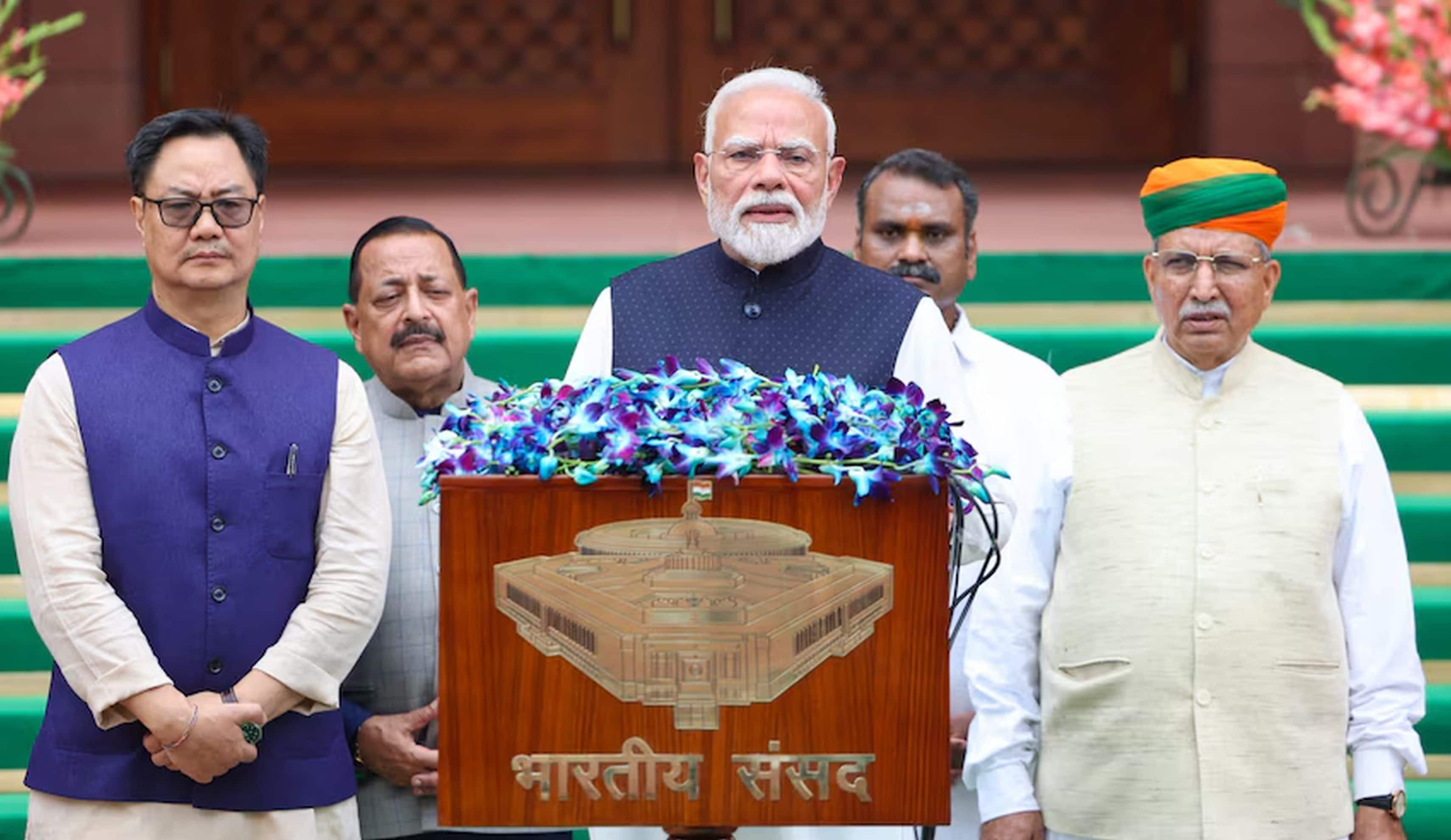
Greetings to all my dear Farmer brothers and sisters!
Today, I feel so fortunate to avail this opportunity to speak with my farmer brothers and sisters from different corners of the country. When I speak to farmers, I speak to the village and its residents, and also to the farm labourers. I am also speaking to the mothers and sisters who work on the farm fields. And in this context probably this feeling is a little different from all the interactions I had through Mann ki Baat.
When I decided to speak about farmers in Mann Ki Baat, I never expected that the farmers from far off villages across the country would be willing to ask numerous questions and would provide such information. I was taken aback to receive your numerous letters and questions in such huge numbers. I can say that you all are very aware and active and you all probably yearn that somebody listens to you. First of all I would like to express my heartfelt greetings to you all. I have read your letters and understood the agony and struggle in your lives. Despite bearing so much misery, I cannot imagine what all you have gone through in your lives.
You all have taken me aback but I take this Mann ki Baat to be an opportunity for education and experience. My dear farmer brothers and sisters, I would like to assure you, that all your questions and queries from different aspects that you brought to my notice would be addressed by me and I will bring consciousness and sensitivity on those subjects in my government and not let my village, my poor people, my farmer brothers will not be forced to live in this pathetic condition. I am shocked, farmers have written letters related to farming but they have also brought some other issues, like the problems they face with the village mafias and gangs. I can understand the problems related to natural calamities, but they are also facing the issues with small time businessmen.
Some farmers have to drink contaminated water in their villages, some have raised concerns on the facilities to provide shelter to their cattle, and some have also mentioned that there is no facility to dispose off the dead animals, which leads to various diseases among the villagers. This suggests that today through Mann Ki Baat, the governing bodies are getting a unique chance to understand numerous problems of the farmers. We can attain our rights to govern the country only when we can understand and provide solution to all these small but important issues. I feel so embarrassed when I read your letters and think what we have done so far. I have no answer to this question. What have we done? Yes, you words have touched my heart. I will try my best to bring a change and would awaken the sleeping government to run in the most appropriate manner. This will be my primary focus and that is a promise from my side.
I am aware that you had to face great difficulties last year due to scarcity of rain. This year, due to the unseasonal rain and hail-storm, all the states above Maharashtra had to bear a lot of difficulties. Farmers, across all the corners of the country had to face great difficulties. A poor farmer who leads his life through slogging in the fields has no other source of living or income. I am with you in this difficult time of your life. Our government is also taking stock of the situation minutely, on various issues of the farmer and is in touch with different departments of the state. The ministers are also out in the field visiting various states and collecting reviews and analysing its situation. I have also asked the state governments to work closely along with the central government and strive to help as much as possible to our farmer brothers and sisters in this situation. I can assure you that the government will take proper steps and solve your problems promptly and help you in this difficult time. We will do whatever is possible to help you and do our best to fulfil those.
Villagers and farmers have raised various issues. Irrigation problem is one of the most important issues. Farmers are also angry due to the unavailability of roads in villages. They are also unhappy about the increasing price of fertilizers. There is no electricity. They are also unhappy about the fact that they are unable to educate their children, which in their wish is also a complaint. Mothers and sisters are angry with the drug abuse prevailing in the villages. Some women have also addressed the issues of tobacco intake by their husbands. I can understand your pain. Some farmers believe that they can only hear the strategies adopted by the government, but it never reaches the villagers. Farmers have mentioned that they slog day and night to provide food to the entire nation, but they never receive the full amount of money in return. When they go out to sell the crops and other farm products, there is no one to buy from us. So, they are left with no other option, than to sell the products at lower prices. They are doomed in both the case, if they produce more or less. This means farmers have brought to my notice their inner thoughts through their letters. I can assure all my farmer brothers and sisters that the state and central government will take proper steps actively from now on. I will inspire the government to speed up the actions and provide solutions to all your problems. I can understand that you are losing patience. This is quite natural as you have waited for sixty long years. I will try to find a full-proof solution to this.
My farmer brothers, I have found one primary problem among your various questions that is the ‘Acquisition of Land Bill’, prevailing in almost all the states. I am shocked to hear these rumours spread across the country. It is good that you have raised such small issues and questions. I will try to bring the truth before you. You must be aware that the Acquisition of Land bill was passed 120 years ago. Post-independence, this law was practised till 60-65 years. Today, the activists, who call themselves as the supporters of farmers, also practised this law in the country, governed the country and the farmers got their share. Everybody believed that there should be a change in this law and I too believed in the change. We were in the opposition and we too believed in the change of law.
In the year 2013, a new law was passed in haste. We too supported this law giving our full support to the government. If a law benefits the farmers, who would not like to support it, so we too supported the law. But after the initiation of the law, some of the concerns got raised in our minds. We felt that this way we would be betraying the hopes of farmers. We do not have any rights to betray the farmers. On one side, when our government was formed, we saw that all the states raised their voice to amend the law, to improve the law; the law must be modified to plug the loop holes. On the other side, we found that no state is ready to implement the law, only Maharashtra and Haryana governments under Congress rule had implemented the law who proclaim to be well-wishers of farmers, they brought an ordinance and decided to provide just half of the decided amount as compensation. What kind of justice is this to the farmers? After reviewing all these points, we felt that there should be some re-thinking. When things are done in haste then some drawbacks remain. The motive might be good but if there are drawbacks, then they should be rectified.
Now, I will speak of most primary drawback, which you all will find quite astonishing. All the people, who are self-proclaimed well-wishers of farmers are not ready to give any answers to these questions. Are you all aware that there are 13 different laws in our country through which most of our country’s land, like Railway, National Highway and minefields is acquired. Are you aware that in the law of previous government, these 13 areas have been excluded from the law? With this exclusion, I mean that the farmers would receive the same compensation as they used to get under the previous law. You tell me, is this not a drawback? This was a mistake or not? This was a mistake or not? We have modified this law and the farmers would receive four times the compensation, even if these 13 areas be used for railways or highways. We have tried to improve the law. Who would say that this amendment is against the farmers? This is why; we had brought an ordinance. If we wouldn’t have brought the enactment, the lands of farmers would have been used according to the previous law and they would not have received their compensation. When this law was passed, many in the government too raised their voice against this law. Even those who were involved in the making of the law, got upset and said that this law is neither beneficial to the farmers, nor the village or to the country. This law can be useful, it was said only to fill the treasury of the officers and for their enjoyment, to promote red-tapism. If this was the truth, apt modifications should have been done or not? Thus, we have tried to eliminate the drawbacks of the law and work on the direction of betterment of the farmers. Firstly, we have included the 13 laws which were excluded under the Acquisition of Land Bill, so that the farmers are provided with the remuneration and all rights and they do not have to incur loss due to the exclusion. I have heard the rumours being spread, that Modi government is passing a law, which will provide less remuneration to the farmers and they will not receive the full compensation.
My dear farmer brothers and sisters, I cannot even think of committing this sin. In the year 2013, under the dispensation of previous government, the compensation which was decided has not been modified a bit. We have decided to provide four times the compensation than the one provided earlier. Not only this, we have also included the 13 areas which were excluded in the earlier law. We have also continued with the clause that in case of acquisition of land for development of the city, the land owners will receive 20% of the developed land, so that they are benefited financially at all times. The youth of the family gets a job. We have also decided to provide employment to the children of the farmers. We have also added a new programme. The new addition is that the district authorities will have to announce that who will be employed from the family, in what field they will be employed and what will be their work location. Government will have to provide written announcement for the same. We have fixed the government responsibility by adding this feature.
My dear farmer brother and sisters, we all agree that the government land must be used first. Post this, the barren land must be used. Lastly, when there is no option left, the farm lands can be touched. So, we have started a survey for finding all the barren lands, for making it a priority for usage.
We have received complaints from our farmers that more than the required land is for use is gobbled up. With the enactment of this new law, I can assure you that before using the land, a survey will be conducted, and then it will be decided so that more than the required land is not acquired. Sometimes, in the foresight that something is going to happen, there is lot of damage. In the name of Social Impact Assessment (SIA), if these judicial proceedings are carried on for several years, how can a farmer take a right decision in this situation? He cannot decide whether to grow the crops in the field, as he is in a fix as he will keep thinking that the judgement can come any day. This will lead to two to four years of loss and things will be stuck due to red-tapism. Due to the long and difficult proceedings, a poor farmer is forced to beg before the officers to get their work done – Sir, please write this, please do not write this.... this is going to happen, that is going to happen. I do not want my farmers to fall prey to these officers. I do not think this is a right thing to do. Procedures were long and difficult. I have tried to make this procedure simple and easy.
My dear farmer brothers and sisters, the law was passed in the year 2014, but the states have not adopted the law yet. Farmers are still at the same place. States have opposed this law. Please tell me if I should listen to the states or not? I should trust the states or not? How can a country run without trusting its own states? So, I believe we should trust our states and we should specially trust our central government. One, I am willing to trust my states and secondly the improvement we are trying to bring in the law by trying to eliminate the drawbacks and trying to better the conditions of the farmers, even after this, if the states are not ready to support this movement, they are free to do so. That is why; I would like to request you all not to fall prey to these rumours. These rumours are absolutely ‘against farmer’ rumours. It is part of the conspiracy of keeping the farmers poor as always. This is a part of the conspiracy of not taking the country forward. We have to save ourselves from this conspiracy and save our country and save our farmers as well.
Now, if one were to ask the farmer residing in the village that what are your plans for your three sons? He will respond that one of them will carry on with the farming but the other two will have to seek jobs elsewhere. So, now even the sons of farmers are seeking out jobs. They too have to move out and seek employment somewhere. So arrangements need to be made for that too. So we have decided that whatever is important for the welfare of the village, welfare of the farmer and whatever is important for the employment of members of the farming community, all such things should be connected. We are the ones who believe in “Jai Jawan Jai Kisan”. Jai Jawan is related to the security of the country. As far as the security of the nation is concerned, the farmers of the nation do not ever step back from their responsibilities. If some land is required for national security we will have to ask the farmers for it. And I have complete faith that the farmers will give us the land. So we have added the clause for taking land for such purposes. I want to ask each and every member of the village, is road required or not? If water is required in the fields, don’t we need to create canals? There are still many poor families in the village who do not have a house to live in. Is not land required for construction of houses? Tell me is this for the industrialists? Is this land being demanded for the ultra rich? Try and understand the truth.
Yes, there is something I want to announce without a doubt. In the new ordinance too, any private industrialist, owner of a manufacturing unit, will have to follow the same set of rules that were laid out in the Land Acquisition Act of 2013. The rules for the corporates are the same as in 2013. Then why this lies are being spread. My farmer brother and sisters, misunderstanding is being created that you will not get your legal rights, that you cannot approach the courts. This is entirely false. No government at the centre can take away your legal rights. The constitution given to us by Baba Saheb Ambedkar ensures that you can approach any court in any part of the country. All we have done is to bring some sort of system to your doorsteps.
We have created an Authority. Now this Authority will work at district level and the issues of the farmers will be resolved at the district level itself by the Authority. And if you are not satisfied with the solutions offered there you can approach the courts as well. This is the arrangement we have made.
There is a misconception that the law related to returning the acquired land in five years has been scrapped. This is not true, dear farmer brothers and sisters, what we have said whenever a project is undertake, a timeline has to be specified in terms of the number of years in which it will be completed. If the project is not completed in the specified time period, then whatever farmer’s wish has to be adhered to. So we have set a timeframe for government projects. What is the today’s case scenario, those lands which were acquired about 40 years ago, the government has not done anything on them. This cannot continue any longer. We have decided to set a time limit to governmental projects. Yes there are projects which take time, maybe around 20 years. For example if 500 km long railway track is to be laid then it will take time. So we want it all written down, the time frame in which a project will be completed. So, what we are doing is fixing the liability of the government. We have fixed the government’s responsibility.
Let me also tell you something, dear farmer brothers. Those sitting in the air conditioned rooms who formulate these rules have no idea of the condition of the villagers. Whenever a dam is made or a reservoir is constructed, the rule is to acquire land till the point where there is a possibility of water getting to the maximum level in a span of 100 years. So the water gets filled once in 100 years. For 99 years no water gets filled. Yet the land lies with the government. What is currently happening in the states is that land has been acquired, compensation paid and yet farmers are working on those lands. If the land gets flooded once in 100 years, that year the land can be taken. The law of 2013 denied the farmers the right to cultivate the land. All we want is that if the land does not get flooded then it should be available for farmers for cultivation. And hence that land should not be acquired from the farmer. This kind of flexibility is necessary. So the farmer benefits even after giving up the land and also get compensation in lieu of their land. This will doubly benefit the farmers. This kind of organization is both necessary and practical. And we are the ones who have thought about it.
Another misconception being spread is that “consent” is not necessary. I urge you, my brothers and sisters to protect yourself from such politically motivated propaganda. The law which was promulgated in 2013 has no provision for consent in schemes for which the government is acquiring land. So people are being misled on this consent issue. The issue of consent did not exist previously, it does not exist now. And so my brothers and sisters, to say that it was beneficial for you before but it is not so now, this is an unfortunate attempt to mislead you. I assure and insist that this consent clause is very much functional in case of private industries, corporate and individual enterprise.
Another thing I would like to share that some people talk about the PPP model. Dear brother and sisters, if a road worth Rs.100 crores is made, will the corporate run away with it? The ownership of the road will be with the government. The ownership of the land is with the government. The construction agency is different. The construction agency is different because the government does not have the requisite amount of money. The government wants that a road be made in the village, as well as hospital and the poor children get education, so monetary investment is required. The private investors construct roads but not for themselves. He does not take it with himself; he makes it for the government. In a way he invests his money. This means in a government project someone else puts in the money which is called the PPP model. But the ownership rests with the government and government means of all of you, of the 125 crore Indians and hence we have said there that there is no need for a consent. Hence it was necessary for me to dispel these myths around the PPP model.
Sometimes this issue of consent will increase red-tapism and nepotism. Tell me, there is a village; a road has been constructed till that village, now a road has to be constructed till the next village which is 5 kms ahead. The road for the first village has been made, but the land for the road to other village lies with the previous village. So tell me will the villagers wilfully give land for road till the other village? Tell me will they give their consent? So what sin have the people of other village committed? Should they not get the roads? Similarly, if I am making a canal, this village has got the water and we have to provide water supply to another village and the said land falls with the people of the previous village who already have water and they deny giving their consent for acquiring their land and say that we already have the water, we are not going to give consent for land acquisition for supply of water to another village. So now you tell me, the people of the other village should get water or not?
My brothers and sisters, this is a practical issue. So we are evolving a process which does not take long. This is for the farmers’ right, not for industries and industrialists. It is for the betterment of the villages, the villagers and the benefit of their children.
Another issue is coming up. I have said this before. In every farmer family, the farmer wants one son to do farming and the others to take up other sources of employment. Such are the times today that different efforts need to be mad to run the household. If we make a road and government establishes an Industrial Corridor next to it, which is not private. I again reiterate that a Corridor by the government, not for the rich, or the industrialists, so if the government makes a Corridor on the left or right of a 50 or 100 km road, then all the residents of the near those villages – maybe 50, 100, 200 villages falling along it will have an opportunity for employment, their kin will get employment.
Tell me dear brother and sisters, do we want the children of our villages to suffocate in the slums of Delhi and Mumbai. Should they not get an employment opportunity closer to their home if a small industry comes up some 20-25 kms away from their village? So this corridor will be made by the government and will not be private. The government will make these Corridors and create these employment opportunities for the villagers. This proposal is about government ownership, it is for the betterment of the villages, betterment of the farmers of villages, it is for the betterment of the future generations of the villagers, it is for the betterment of the poor of the villages, it is to make electricity available to the villages. For these there were some drawbacks in the last Land Acquisition Bill, which we have tried to resolve all the shortcomings of this bill authentically. Still I have maintained in the parliament that if anyone feels that there are some short comings, we are ready to make amendments.
When we put the bill in the Parliament, certain leaders of the farming community gave us some suggestions and we added them. We still say that the land acquisition should be pro farmers. We are committed for this. There are lot of lies being spread. I request you, dear brothers to not get swayed and don’t make your decision based on these lies. Important issue is how to make farmers strong, how to make our villages strong. The farmer should get the right price for his efforts; farmers should get a proper market, a proper storage for his production. It is our effort to make right decisions for the betterment of the village and the farmers.
Dear brothers and sisters, it is our effort to see that the nation progresses and so do our farmers by increasing their yield. And so we have introduced “Soil Health Card”. If a person falls sick a laboratory test is undertaken for them, similarly a lab test can be undertaken for our motherland. So we are working not only to protect your land but also to make it healthy.
And so, not land acquisition, but making the land healthy is our task. And so we have introduced the concept of “Soil Health Card”. Every farmer is going to benefit from it. Your undue expenses on fertilizers will be saved. Your yield will increase. That you get proper price for your production, there should be proper granaries, proper rules and regulations and that you are saved from exploitation - we are working on all these issues. I remember, when I was the chief minister of Gujarat, I worked a lot in this direction. The condition of farmers in our Gujarat was very bad, we worked on the water issues and we saw a big change. The farmers made a huge contribution to the development of Gujarat which was beyond all expectations. The entire villages would be deserted, but the change happened. We want this type of change in the entire country, which makes our farmers very happy.
And so my farmer brother and sisters, today I got an opportunity to talk to you. But the issue of the ordinance is making headlines every day and I chose to speak about it more. But my dear brothers and sisters, I will speak to you again and on other issues. But I want to assure you that whatever you have written to me, I will shake the entire government and will make them see the reality about what is actually happening on the ground. I am happy that you have told me so many things and I believe that you have told me because you trust me. I want to assure you that I will not shatter your faith.
I desire your love and blessings at all times. You are the elders of the nation, you can never think wrong for others rather you will suffer loses for other’s benefit. This has been your tradition. And these farmers do not suffer, should have to be the prime focus of my government. Today, after hearing this “Mann ki Baat” many thoughts may have arisen in your mind. Please do write into me at the Akashvani address. I will talk again. Based on your letters, I will try to rectify all the mistakes of my government. I will try to speed up the efforts and if somewhere injustice is being done, I will try and provide justice.
We are in middle of the auspicious festival of Navratri. My Heartfelt Greetings to you All!