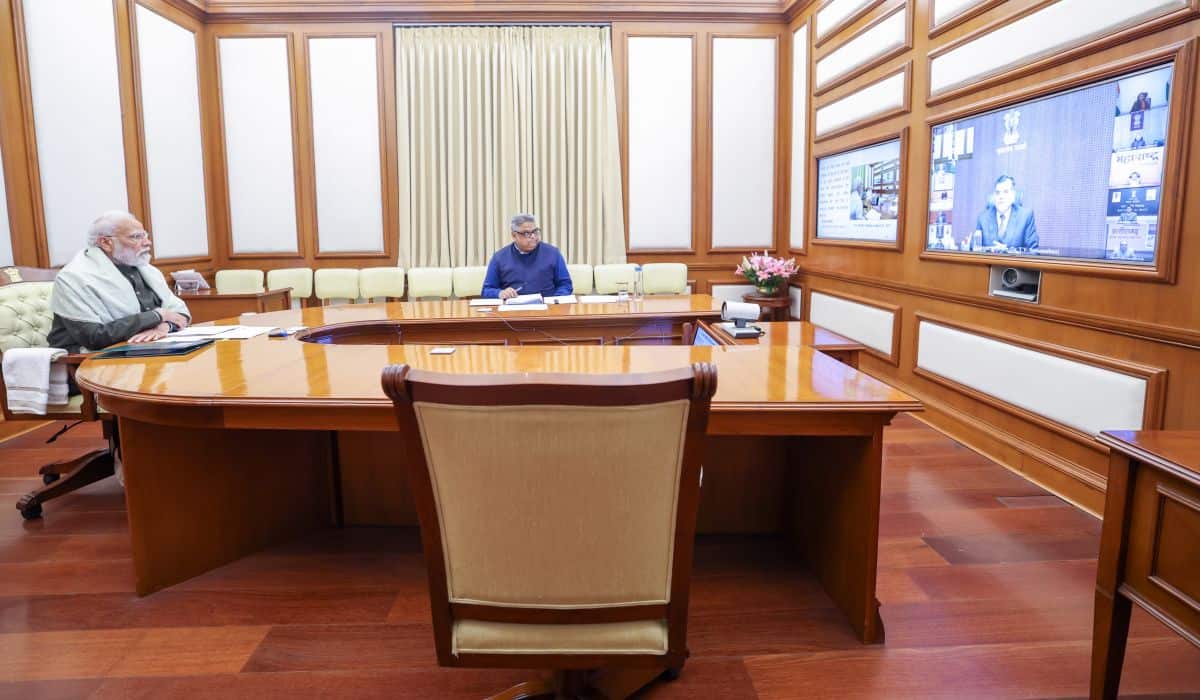
Prime Minister Shri Narendra Modi chaired the 50th meeting of PRAGATI - the ICT-enabled multi-modal platform for Pro-Active Governance and Timely Implementation - earlier today, marking a significant milestone in a decade-long journey of cooperative, outcome-driven governance under the leadership of Prime Minister Shri Narendra Modi. The milestone underscores how technology-enabled leadership, real-time monitoring and sustained Centre-State collaboration have translated national priorities into measurable outcomes on the ground.
Review undertaken in 50th PRAGATI
During the meeting, Prime Minister reviewed five critical infrastructure projects across sectors, including Road, Railways, Power, Water Resources, and Coal. These projects span 5 States, with a cumulative cost of more than ₹40,000 crore.
During a review of PM SHRI scheme, Prime Minister emphasized that the PM SHRI scheme must become a national benchmark for holistic and future ready school education and said that implementation should be outcome oriented rather than infrastructure centric. He asked all the Chief Secretaries to closely monitor the PM SHRI scheme. He further emphasized that efforts must be made for making PM SHRI schools benchmark for other schools of state government. He also suggested that Senior officers of the government should undertake field visits to evaluate the performance of PM SHRI schools.
On this special occasion, Prime Minister Shri Narendra Modi described the milestone as a symbol of the deep transformation India has witnessed in the culture of governance over the last decade. Prime Minister underlined that when decisions are timely, coordination is effective, and accountability is fixed, the speed of government functioning naturally increases and its impact becomes visible directly in citizens’ lives.
Genesis of PRAGATI
Recalling the origin of the approach, the Prime Minister said that as Chief Minister of Gujarat he had launched the technology-enabled SWAGAT platform (State Wide Attention on Grievances by Application of Technology) to understand and resolve public grievances with discipline, transparency, and time-bound action.
Building on that experience, after assuming office at the Centre, he expanded the same spirit nationally through PRAGATI bringing large projects, major programmes and grievance redressal onto one integrated platform for review, resolution, and follow-up.
Scale and Impact
Prime Minister noted that over the years the PRAGATI led ecosystem has helped accelerate projects worth more than 85 lakh crore rupees and supported the on-ground implementation of major welfare programmes at scale.
Since 2014, 377 projects have been reviewed under PRAGATI, and across these projects, 2,958 out of 3,162 identified issues - i.e. around 94 percent - have been resolved, significantly reducing delays, cost overruns and coordination failures.
Prime Minister said that as India moves at a faster pace, the relevance of PRAGATI has grown further. He noted that PRAGATI is essential to sustain reform momentum and ensure delivery.
Unlocking Long-Pending Projects
Prime Minister said that since 2014, the government has worked to institutionalise delivery and accountability creating a system where work is pursued with consistent follow-up and completed within timelines and budgets. He said projects that were started earlier but left incomplete or forgotten have been revived and completed in national interest.
Several projects that had remained stalled for decades were completed or decisively unlocked after being taken up under the PRAGATI platform. These include the Bogibeel rail-cum-road bridge in Assam, first conceived in 1997; the Jammu-Udhampur-Srinagar-Baramulla rail link, where work began in 1995; the Navi Mumbai International Airport, conceptualised in 1997; the modernisation and expansion of the Bhilai Steel Plant, approved in 2007; and the Gadarwara and LARA Super Thermal Power Projects, sanctioned in 2008 and 2009 respectively. These outcomes demonstrate the impact of sustained high-level monitoring and inter-governmental coordination.
From silos to Team India
Prime Minister pointed out that projects do not fail due to lack of intent alone—many fail due to lack of coordination and silo-based functioning. He said PRAGATI has helped address this by bringing all stakeholders onto one platform, aligned to one shared outcome.
He described PRAGATI as an effective model of cooperative federalism, where the Centre and States work as one team, and ministries and departments look beyond silos to solve problems. Prime Minister said that since its inception, around 500 Secretaries of Government of India and Chief Secretaries of States have participated in PRAGATI meetings. He thanked them for their participation, commitment, and ground-level understanding, which has helped PRAGATI evolve from a review forum into a genuine problem-solving platform.
Prime Minister said that the government has ensured adequate resources for national priorities, with sustained investments across sectors. He called upon every Ministry and State to strengthen the entire chain from planning to execution, minimise delays from tendering to ground delivery.
Reform, Perform, Transform
On the occasion, the Prime Minister shared clear expectations for the next phase, outlining his vision of Reform, Perform and Transform saying “Reform to simplify, Perform to deliver, Transform to impact.”
He said Reform must mean moving from process to solutions, simplifying procedures and making systems more friendly for Ease of Living and Ease of Doing Business.
He said Perform must mean to focus equally on time, cost, and quality. He added that outcome-driven governance has strengthened through PRAGATI and must now go deeper.
He further said that Transform must be measured by what citizens actually feel about timely services, faster grievance resolution, and improved ease of living.
PRAGATI and the journey to Viksit Bharat @ 2047
Prime Minister said Viksit Bharat @ 2047 is both a national resolve and a time-bound target, and PRAGATI is a powerful accelerator to achieve it. He encouraged States to institutionalise similar PRAGATI-like mechanisms especially for the social sector at the level of Chief Secretary.
To take PRAGATI to the next level, Prime Minister emphasised the use of technology in each and every phase of the project life cycle.
Prime Minister concluded by stating that PRAGATI@50 is not merely a milestone it is a commitment. PRAGATI must be strengthened further in the years ahead to ensure faster execution, higher quality, and measurable outcomes for citizens.
Presentation by Cabinet Secretary
On the occasion of the 50th PRAGATI milestone, the Cabinet Secretary made a brief presentation highlighting PRAGATI’s key achievements and outlining how it has reshaped India’s monitoring and coordination ecosystem, strengthening inter-ministerial and Centre-State follow-through, and reinforcing a culture of time-bound closure, which resulted in faster implementation of projects, improved last-mile delivery of Schemes and Programmes and quality resolution of public grievances.