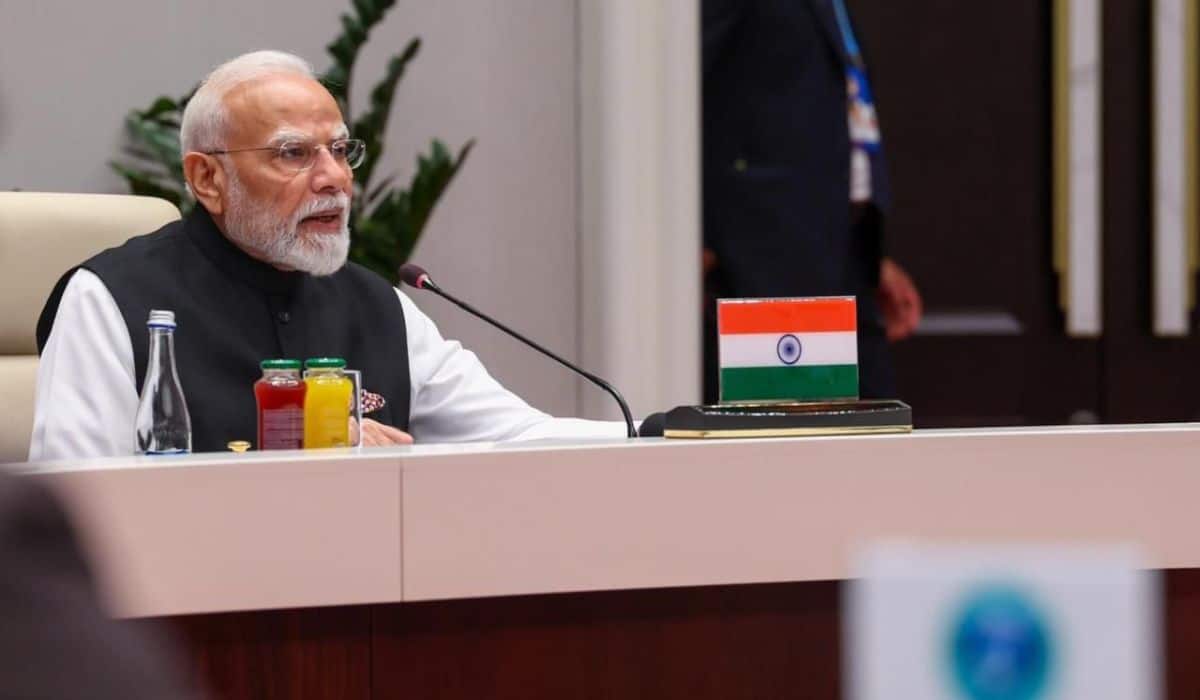
The Prime Minister of the Republic of India, Mr. Narendra Modi paid an official visit to Turkmenistan from 10-11 July, 2015 at the invitation of the President of Turkmenistan Mr.Gurbanguly Berdimuhamedov.
During the visit, Prime Minister of the Republic of India Narendra Modi held extensive discussions with President of Turkmenistan Gurbanguly Berdimuhamedov on bilateral relations as well as regional and international issues of mutual interest. The two Leaders expressed satisfaction at the continued development of bilateral relations based on deep-rooted civilizational, historical and cultural linkages and a shared interest in international as well as regional peace and stability.

Political and Diplomatic engagement
The Leaders noted with satisfaction the increase in high-level exchanges between the two countries in recent years and reiterated the significance of regular bilateral interactions in reinforcing the momentum for cooperation between the two countries. The Leaders encouraged the continued enhancement of exchanges at all levels, including at the level of leaders, ministers, parliamentarians and senior officials bilaterally and on the sidelines of multilateral events.
The Leaders welcomed the successful conclusion of the 5th meeting of the Turkmen-India Intergovernmental Joint Commission on trade, economic, scientific and technological cooperation, held in Ashgabat on April 8, 2015. They noted that the Commission had identified new and potential areas of cooperation and called for effective implementation of the decisions made at the meeting. They stressed the need to strengthen other institutional linkages and in this regard, directed their senior officials to hold regular dialogue on bilateral, regional and global issues through existing mechanisms such as Foreign Office Consultations, Consular Consultations, Joint Working Group on Energy as well as establishment of additional mechanisms on mutually agreed issues.
Defence and Security Cooperation
The Leaders noted that the nature and rapid spread of international terrorism in the recent years poses one of the most serious global threats today. The Leaders resolved to deepen ongoing cooperation in countering various security threats. They also agreed to step up efforts against cross-border threats such as terrorism, organized crime and illegal drug- trafficking.
The Leaders welcomed the signing of the Defence Cooperation Agreement during the visit, which would provide a framework for intensifying bilateral defence and security cooperation through exchanges of high and mid-level visits, training and dialogue between the Ministries of Defence of the two countries and other relevant organizations. It would also enable capacity building and technical cooperation, thus imparting a new momentum to the bilateral partnership in the defence sector.
Economic Engagement
The Leaders acknowledged that despite a steady increase in bilateral trade over the last few years, the trade volumes between the two countries could potentially be increased manifold to the mutual benefit of both countries. Towards this end, the two Leaders agreed to actively work towards rapid enhancement in the levels of bilateral trade, investment and economic cooperation.
The Leaders resolved to increase cooperation in various sectors and identified energy, petrochemicals, transport, communications, information and technology, textile industry, chemical and pharmaceutical industry, construction and agro-processing as potential areas for cooperation between the two countries.
The Leaders further agreed to create favourable conditions and promote participation of private companies of both countries, including through joint ventures in various infrastructural and investment projects in the two countries.
The Leaders reaffirmed their readiness to hold, both in Turkmenistan and India, national exhibitions, business forums and other events involving the business communities of the two countries for facilitating business interactions and linkages between the two countries.
Energy and Petrochemicals

The Leaders noted that cooperation in energy sector, especially the Turkmenistan-Afghanistan-Pakistan-India (TAPI) pipeline project, forms a key pillar of economic engagement between the two countries. They recognised that implementation of the TAPI project would have a transformational impact on trade between the two countries and decided to take measures for early implementation of this important regional project. They welcomed establishment of ‘TAPI Ltd’ as a Special Purpose Vehicle (SPV) in November 2014 in Ashgabat and acknowledged that it was a milestone in implementation of this strategic project.
The Leaders reaffirmed their strong commitment towards timely implementation of this strategic project for the common benefit of peoples of the four countries and noted that the selection of the Consortium Leader for the project, to be finalized by 1 September 2015, would mark a crucial step in the early implementation of the project.
The Leaders welcomed the enhanced bilateral cooperation in the field of chemicals and petrochemicals as well as the opening of "ONGC Videsh Ltd (OVL)” representative office in Turkmenistan. The Leaders further welcomed the signing of a Memorandum of Understanding between the State Concern "Turkmenhimiya” and Indian PSU Rashtriya Chemicals and Fertilizers Limited to provide a framework for long-term sourcing of urea from Turkmenistan.
The Leaders also welcomed the Indian proposal to set up a urea production facility in Turkmenistan in collaboration with Turkmen entities and noted that such a proposal would expand the ambit of economic cooperation between the two countries. Prime Minister Narendra Modi informed that India’s state companies in the oil and gas sectors possess diverse expertise in the field of training, designing, construction, exploration and production, and invited Turkmen Companies to engage in long-term cooperation with these Indian firms. President of Turkmenistan Gurbanguly Berdimuhamedov welcomed the offer and acknowledged that India’s technical expertise could be of value in assisting Turkmenistan’s efforts to further develop its hydrocarbon and petrochemical sector.
Transport and Connectivity
The Leaders reaffirmed their intention to work together in exploring alternative transport corridors for additional connectivity options between the two countries. The Leaders welcomed the first expert level meeting on connectivity between India and Turkmenistan in Delhi in June 2015 and agreed to continue the discussions and interactions under the framework of a JWG for exploring various connectivity options between India and Turkmenistan. The President of Turkmenistan welcomed India’s intention to join the Ashgabat Agreement.
The Leaders acknowledged the significance of Turkmenistan as a gateway to other Central Asian countries and the Caspian region and agreed to support each other’s initiatives in enhancing transport corridors and infrastructure to facilitate movement of goods. President of Turkmenistan appreciated Government of India's efforts in promoting International North South Transport Corridor (INSTC) for transportation of goods between India and Central Asia, including Turkmenistan and beyond and conveyed that Turkmenistan would consider becoming party to the above-mentioned Corridor. Prime Minister of the Republic of India Narendra Modi noted that the recently inaugurated Kazakhstan-Turkmenistan- Iran railway line could be a linked corridor of the INSTC to streamline movement of goods and commodities between India and Turkmenistan and beyond.
The Leaders noted that the air connectivity between the two countries could to a certain extent overcome this natural barrier of the lack of direct surface connectivity between the two countries. In this context, they called for increasing frequency of flight operations between the two countries, including by offering fifth freedom rights for increased viability. The Leaders felt that the potential of direct flight connectivity between the two countries could be better utilized to encourage export of goods from India to Turkmenistan, and agreed to take necessary measures to encourage transportation of cargo through their airlines.
Capacity Building and Science and Technology

The Leaders appreciated the role of Indian Technical and Economic Cooperation (ITEC) programme in capacity building and human resource development of Turkmen nationals and in creating a talented pool of professionals in Turkmenistan across various sectors to meet the developmental needs of the growing Turkmen economy. Prime Minister Narendra Modi conveyed India's readiness to offer new training courses in sectors desired by Government of Turkmenistan. President of Turkmenistan welcomed this proposal.
The Leaders welcomed the successful up-gradation of the India Turkmenistan Industrial Training Centre in Ashgabat with Indian assistance to provide continued advanced training to Turkmen nationals.
The Leaders also welcomed the signing of the Programme of Cooperation in Science and Technology, which would provide added impetus for a framework for cooperation in this important area.
Cultural Cooperation
The Leaders underlined that cultural exchanges have made an important and positive contribution to the development of comprehensive cooperation between the two countries and to deepening the bonds of friendship and mutual understanding between their peoples. The Leaders noted the recent successful Turkmen cultural festival in India in 2014 and Indian Council for Cultural Relations (ICCR) 'Namaste Turkmenistan' festival in various parts of Turkmenistan this year and called for similar events to be held in future as well.
The Leaders called for finalizing of the Programme of Cooperation on Culture between the two countries. The Leaders also acknowledged the contribution made by the scholarships offered by Indian Centre for Cultural Relations (ICCR) to Turkmen students in forging stronger bonds at a popular level.
The Leaders acknowledged the commencement of a new chapter in their cultural ties through the inauguration of a Centre of Yoga and Traditional Medicine in Ashgabat. The Leaders underscored the universal value of Yoga and its positive and holistic perspective on health. The Leaders acknowledged that the traditional medicine centre would help combine traditional medical knowledge and practices of India and Turkmenistan, which would benefit the people. Prime Minister Narendra Modi thanked President Gurbanguly Berdimuhamedov for his support in declaring June 21 as International Day of Yoga (IDY) at the United Nations and for the extensive celebrations of the first IDY in Ashgabat.
The Leaders welcomed unveiling of a bust of Mahatma Gandhi in Ashgabat, further symbolizing the commitment of both sides to work together towards a peaceful world order.
The Leaders agreed to work for the successful conduct of the 5th Asian Indoor and Martial Arts Games in Ashgabat in 2017, including within the Agreement in the field of Sports concluded during the visit.
International Cooperation
The Leaders reiterated their commitment to strengthen regional as well as multilateral cooperation, including through enhanced interaction in the United Nations and other regional and international organizations of which they are members. They underscored the importance of enhancing the role of the United Nations and its institutions as a universal instrument in addressing global issues and safeguarding sustainable development.
Prime Minister Narendra Modi congratulated President of Turkmenistan Gurbanguly Berdimuhamedov and the Government of Turkmenistan on the 20th anniversary of adoption of Permanent Neutrality at the United Nations and noted that this policy had contributed to peace, development and stability in Turkmenistan and the region at large.

The Leaders acknowledged the urgent need for reform of the United Nations Security Council in the context of strengthening and expanding the role of the United Nations in addressing the pressing contemporary challenges.
The Sides will further strengthen cooperation in a multilateral format within the UN framework, maintain close interaction and coordination in order to create a favourable international environment for the development of the two countries.
Looking Ahead
The Leaders reaffirmed their commitment to work closely on issues discussed and agreed during their official talks to ensure, through existing bilateral mechanisms and other means, concrete outcomes to forge a closer bilateral partnership in the days ahead.
The Leaders agreed that the visit of Prime Minister Narendra Modi has helped consolidate and deepen the longstanding cordial relations between India and Turkmenistan, and in defining a framework for an enhanced mutually beneficial partnership between the countries.
Prime Minister of the Republic of India Narendra Modi expressed his gratitude to the President of Turkmenistan Gurbanguly Berdimuhamedov and the Turkmen people for the warm welcome accorded to him. He invited the President of Turkmenistan to pay an official visit to the Republic of Indiaat a convenient time. The invitation was accepted with pleasure.