The Minister of Home Affairs and Cooperation, Shri Amit Shah, my colleagues in the Union Cabinet, Arjun Munda and Shri Piyush Goyal ji, officials of national cooperative committees, other dignitaries, ladies and gentlemen!
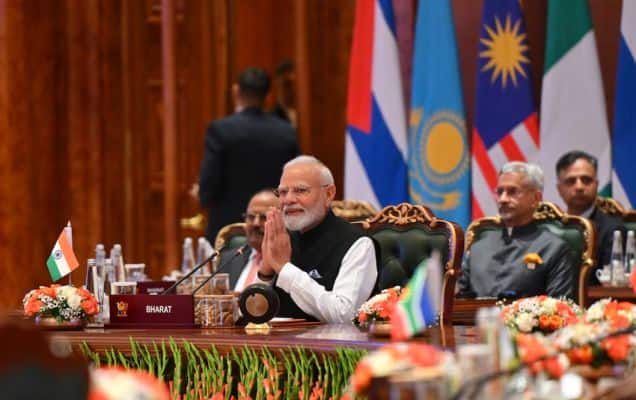
Today, 'Bharat Mandapam' is becoming witness to another significant achievement in the ‘Amrit Yatra’ of ‘Viksit Bharat’. Today, we are moving forward in the direction of realizing the resolution of ‘Sahkaar Se Samriddhi’ (prosperity through cooperation) that the country has taken. Cooperation plays a significant role in strengthening the foundation of agriculture and farming. Keeping this in mind, we have established a separate Ministry of Cooperation. And today this program is happening with the same spirit. Today, we have launched the world's largest storage scheme for our farmers... the warehousing scheme. Under this scheme, thousands of warehouses and godowns will be built in every corner of the country. Today, a significant task of computerization of 18,000 PACS (Primary Agricultural Credit Societies) has also been completed. All these projects will give a new fillip to agricultural infrastructure in the country, connecting agriculture with modern technology. I congratulate you all for these important and far-reaching initiatives, and extend my best wishes to all of you.

Friends,
Cooperatives are an ancient concept in Bharat. It is also said in our scriptures – अल्पानाम् अपि वस्तूनाम्, संहति: कार्य साधिका॥ meaning, when small things and limited resources are combined, they lead to significant achievements. This inherent cooperative system has continued to work in the rural economy of ancient Bharat. Cooperatives were the foundation of our self-reliant society. Cooperative is not just a system; it is a sentiment, it is a spirit. The spirit of cooperatives often yields remarkable results beyond the boundaries of institutions and resources. Cooperatives can transform a simple arrangement associated with livelihood into a significant industrial capability. It is a credible way to revitalize the economy, especially the rural and agricultural economy of the country. Through a separate ministry, we are also making efforts to bring together this capability of the country and to harness the scattered strength of the agricultural sector. A very important example of Farmer Producer Organizations (FPOs) is before us. Through FPOs, even small farmers in villages are becoming entrepreneurs today, exporting their products to foreign countries. We had set a target of creating 10,000 FPOs in the country. As a result of having a separate Ministry of Cooperation, 8,000 FPOs have already been formed and are operational in the country. The success stories of many FPOs are being discussed not only within the country but also outside. Similarly, another satisfying change is that the benefits of cooperatives are now reaching livestock farmers and fishermen as well. Today, more than 25,000 cooperative units are operational in fish farming. The government has set a target of creating two lakh cooperative societies in the next five years, and a significant number of these are expected to be in the fisheries sector.
Friends,
As the Chief Minister of Gujarat, I have experienced the power of cooperatives firsthand. The success story of Amul in Gujarat is known worldwide today. We all are aware of Lijjat Papad's presence in markets across the globe. These movements have been primarily led by the women of our country. Today, women are also involved in cooperatives in dairy and agriculture sectors, with millions of them actively participating. Recognizing the capabilities of women, the government has also given priority to them in cooperative-related policies. You may know that recently, amendments were made to the Multi-State Cooperative Societies Act. Under this, it is now mandatory to have women directors on the board of Multi-State Cooperative Societies. If the Nari Shakti Vandan Adhiniyam is passed in Parliament, it receives a lot of attention in the country. However, we have created such a powerful and important law regarding Multi-State Cooperative Societies, but very few people discuss it.

Friends,
Cooperatives address the personal problems of farmers by harnessing collective strength, and storage is a prime example of this. Previously, farmers suffered significant losses due to the lack of infrastructure related to storage. Previous governments never paid much attention to this need. However, today, this problem is being addressed through cooperative societies. This is a significant development in itself. Under the world's largest storage plan, a capacity of 700 lakh metric tons of storage will be prepared in the next 5 years. This campaign will cost more than 1.25 lakh crore rupees. Upon completion of this plan, our farmers will be able to store their produce according to their needs. They will also find it easier to obtain loans from banks. And when they feel the time is right to sell their produce, they will be able to bring their produce to the market at the right time and sell it.
Friends,
Modernizing agricultural systems is equally essential for the development of ‘Viksit Bharat’. Along with creating new arrangements in the agricultural sector, we are also preparing cooperative institutions like PACS for new roles. These societies are now also working as Pradhan Mantri Jan Aushadhi Kendras. They are also operating thousands of Pradhan Mantri Kisan Samriddhi Kendras. We have also transformed cooperative societies into retail outlets for petrol and diesel. Many cooperative societies are now also distributing LPG cylinders. PACS are also playing the role of ‘Pani Samitis’ (water committees) in several villages. In other words, the utility of PACS and credit societies is increasing, and their means of income are also growing. Moreover, cooperative societies are now providing hundreds of government facilities as Common Service Centres in villages. These societies will connect rural areas with opportunities in technology and Digital India on a larger scale through computers, providing new employment opportunities for youth in rural areas.

Friends,
The role of cooperative organizations is crucial for the realization of the vision of ‘Viksit Bharat’. I understand the significance of your role and the role of cooperative institutions very well. Therefore, I have higher expectations from all of you. After all, expectations are from those who act; those who do not act, who will expect from them? The more actively and significantly you contribute to the building of ‘Aatmanirbhar Bharat’ (self-reliant Bharat), the quicker we will achieve our goals. Without ‘Aatmanirbhar Bharat’, it is not possible to build a ‘Viksit Bharat’. Considering your capabilities and your organizational capacity, many suggestions are coming to my mind. I cannot present them all at once to you, but I would like to suggest something. For example, I suggest that our cooperatives create a list, specifying which items we import from abroad. Now we will not import those items. What can the cooperative sector do in this regard? We need to create a support system in the country for that. Cooperative institutions can easily take up this responsibility. Now, for example, although we are referred to as an agriculture-centric nation, the truth is that we have been singing the same song for the past 75 years. Yet, it is also an unfortunate fact that we import billions of dollars worth of edible oil every year. How can we become self-reliant in edible oil? The sesame grown in this very soil, the oil extracted from it can better the lives of our citizens. And if my cooperative sector colleagues do not work together for this, then who will do it? Am I saying the right thing or not? You will do it, shouldn't you? Look, even the oil we consume comes from abroad, and for energy, the oil needed to run vehicles, to operate tractors, petrol, diesel, these fuels are also imported, and we need to reduce this import bill too. For this, we are currently making significant progress with ethanol. Over the past 10 years, there has been a manifold increase in ethanol production, procurement, and blending. Today, this work is mostly managed by sugar mills, and government companies buy ethanol from them. Can't cooperative societies be involved in this? The more they get involved, the more its scale will increase. Regarding reducing the import of pulses, you see, even though we are an agriculture-centric nation, we import pulses from outside. In terms of reducing the import of pulses too, the people in the cooperative sector can do significant work, can play a leading role. There are also many small items associated with manufacturing that we import, but we can produce them domestically with the help of cooperatives.
Friends,
Today, we are placing greater emphasis on organic farming as well. Cooperatives can play a significant role in this as well. Cooperatives can play a significant role in making the food provider also the energy provider and fertilizer provider. If cooperatives get involved in it, results will come quickly. Now, as far as installing rooftop solar panels or small solar panels on the farm's shed is concerned, if 50-60 farmers come together and form a cooperative organization, install solar panels on the shed's roof, and generate electricity, sell electricity to both the farmers and the government. A cooperative organization can easily handle it. Nowadays, we are seeing that big multinational companies are taking interest in the Gobardhan Yojana. This is going to become a significant source of energy. Why should cooperatives lag behind in this field? Cooperative organizations can think about expanding their role whether it is the work of converting waste to wealth, making biogas from cow dung, producing organic fertilizers, etc. This will also reduce the country's import bill related to fertilizers. You should also step forward in the global branding of products from our farmers and small entrepreneurs. Now, look at Gujarat. Previously, there were many dairies operating under different names in Gujarat. There are still many dairies, but Amul has become a brand. Today, its voice is heard globally. We can also create a common brand for our various products. Our goal should be to make our millets, that is, "Shree Anna" a brand. Why shouldn’t millets of Bharat brand appear on every dining table around the world? Cooperatives should come forward with a comprehensive action plan in this regard.

Friends,
Cooperatives can make a significant contribution to increasing the income of villages. We have seen a clear change in the dairy sector. I have been in the cooperative sector programs for the last three days. First, I was in Ahmedabad where Amul completed 50 years. Then yesterday, I was in Banaras where I inaugurated the Banaras Dairy. The experience in Banaras shows that with the advent of dairy cooperatives, the income of women dairy farmers is increasing rapidly. Cooperatives are entering another area. I urged the people of Gujarat's cooperative sector to enter the world of honey. We have had a white revolution; now let's have a sweet revolution. And our people should come forward in the honey sector. You also know how much benefit the farmers are getting from the honey sector. In the last 10 years, honey production has increased from 75 thousand metric tons to now almost 1.5 lakh metric tons. There has also been an increase in honey exports from 28 thousand metric tons to 80 thousand metric tons. In this, along with NAFED and TRIFED, cooperative organizations of states have also played a significant role. We need to expand this scope even further.
Friends,
In Gujarat, we have seen that when the money earned from selling milk started going directly into the bank accounts of the sisters, it brought about a meaningful social change. Now our cooperative societies, our PACS, have been computerized. Therefore, it should now be ensured that whatever work is done, whatever payments are made, they should be digital. Especially cooperative banks should work quickly to adopt digital technology. Another topic is the soil health card. We have made such a big program for soil testing for soil health check-ups. I urge cooperative organizations, PACS, to set up small soil testing labs in their areas. They should encourage farmers to make it a habit to continuously monitor the health of their land, the health of the soil. They should build a network of soil testing.

Friends,
Increasing the participation of youth and women in cooperatives is another area where we need to intensify our efforts. Farmers who are involved in the cooperative sector can contribute in this regard. Along with this, we can tell them that the dividends and other benefits they receive will now include free soil testing provided by their cooperative organization. They should be taught to focus on their crops based on the experience gained from soil testing.
Friends,
This will bring freshness to cooperatives, a new energy will emerge. There is also a great need for skill development, training, and increasing awareness in cooperatives. A lot has changed, and everything should be done on paper. Gone are the days when a lot of verbal promises used to be made. Therefore, training is very important, and efforts should be made in this regard. PACS and cooperative societies will also need to learn from each other. Many cooperative institutions do innovative work. They take many initiatives. Many areas of the country are unaware of this. Can we create a common portal to share best practices? And everyone can upload their new experiences, new methods on it. How to further promote these best practices? There should be arrangements for online training and some modules should be created for it. You know that the Aspirational District Program, the campaign of ambitious districts, has a unique feature. There is a system of healthy competition, where rankings fluctuate up and down ten times a day. Every officer thinks that their district should move ahead. Can we create different verticals in the cooperative sector? One vertical for each type of cooperative, another vertical for another type of cooperative, and create a management system in such a way that there is also healthy competition round the clock within it. There should be competition in cooperative organizations and rewards should be given to the best performers. Something innovative should come out of such cooperative institutions -- a big movement that the government and cooperative institutions together can give a new shape to it.

Friends,
One thing that continues to be a question mark with cooperative institutions is transparency in their elections. Bringing transparency in cooperative elections is very important. This will increase people's trust and more and more people will join cooperatives.
Friends,
To make cooperative societies the foundation of prosperity, our government is also reducing the challenges they face. You may recall that while companies had lower cess, cooperative societies had to pay higher cess. We have reduced the cess rate from 12% to 7% for cooperative societies with incomes ranging from one crore to 10 crore rupees. This has increased the funds available for these societies to operate, paving the way for them to progress like companies. There used to be discrimination in alternative taxes between cooperative societies and companies as well. We have reduced the minimum alternative tax for societies from 18% to 15%, bringing it at par with the corporate world. Another issue was that cooperative societies had to pay TDS on withdrawals exceeding one crore rupees. We have increased this withdrawal limit to three crore rupees annually. This benefit will now be utilized for the welfare of the members. I am confident that our collective efforts in the direction of cooperatives will unlock all possibilities for development through the country's collective strength.
With this wish, I thank you all. And as Amitbhai mentioned, lakhs of people have gathered at different centres today. I also thank them for joining this important initiative today with as much enthusiasm and eagerness, and I also wish them good luck. Let's come together with the true spirit of cooperation, shoulder to shoulder, step by step, to achieve the goal of a ‘Viksit Bharat’. Let's walk together in one direction, and we will continue to achieve results. Thank you very much.