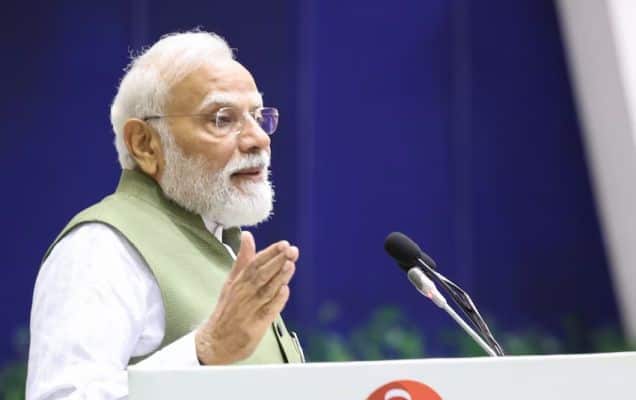
Jai Jinendra!
Jai Jinendra!
Acharya Bhagwant Shri Padmasagar Surishwar Ji Maharaj Saheb, Governor of Gujarat Acharya Devvrat Ji, Chief Minister Shri Bhupendra Bhai, Deputy Chief Minister of the State Bhai Harsh Sanghavi Ji, Param Pujya Acharya Bhagwant, Pujya Sadhu Bhagwant, Sadhviji Bhagwant, all Acharyas and Muni Bhagwants present in this holy assembly, honorable philanthropists, scholars, ladies and gentlemen!
Today, on the auspicious festival of Bhagwan Mahavir Jayanti, I have got the privilege of coming to this holy Jain pilgrimage site. First of all, I bow at the feet of Bhagwan Mahavir. From Koba Tirth, I give best wishes of Bhagwan Mahavir Jayanti to all countrymen.
Friends,
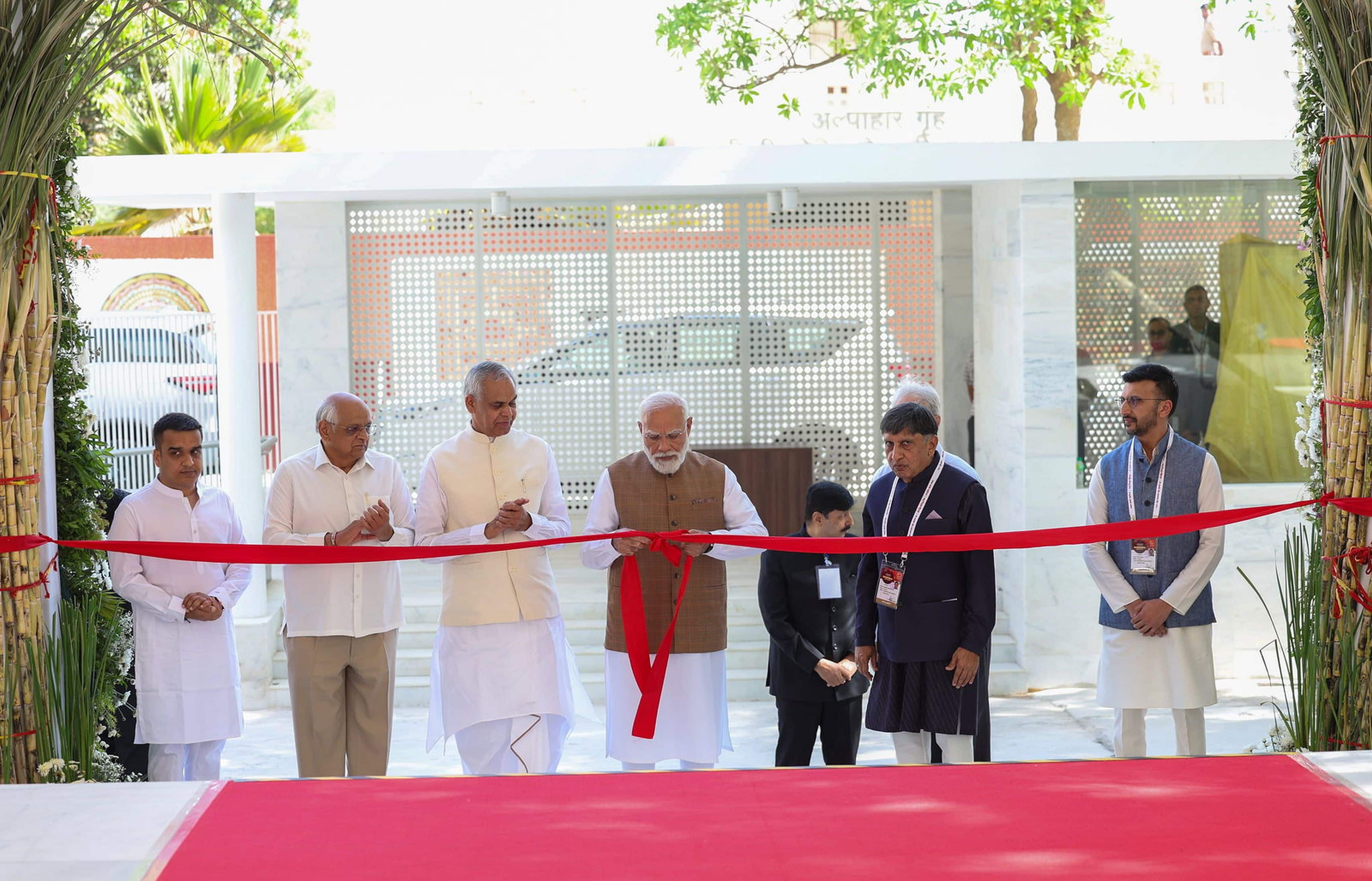
Today, I also salute the memory of Param Pujya Acharya Shri Kailas Sagar Surishwarji Maharaj Saheb. His dream has established this great center of knowledge and faith on this land of Koba. This site of Koba Tirth is saturated with spiritual peace. A place whose energy is so divine, in which the penance of so many Jain Munis and saints is associated, there creation and service manifest and operate on their own. I have been seeing for years how a continuous tradition of study, spiritual practice, and restraint has been going on in Koba Tirth. Here values are protected, cultural values get strength, and knowledge is nourished. This 'Triveni' (confluence of three) is the foundation of Indian civilization. To keep this Triveni flowing is the responsibility of all of us.
Friends,
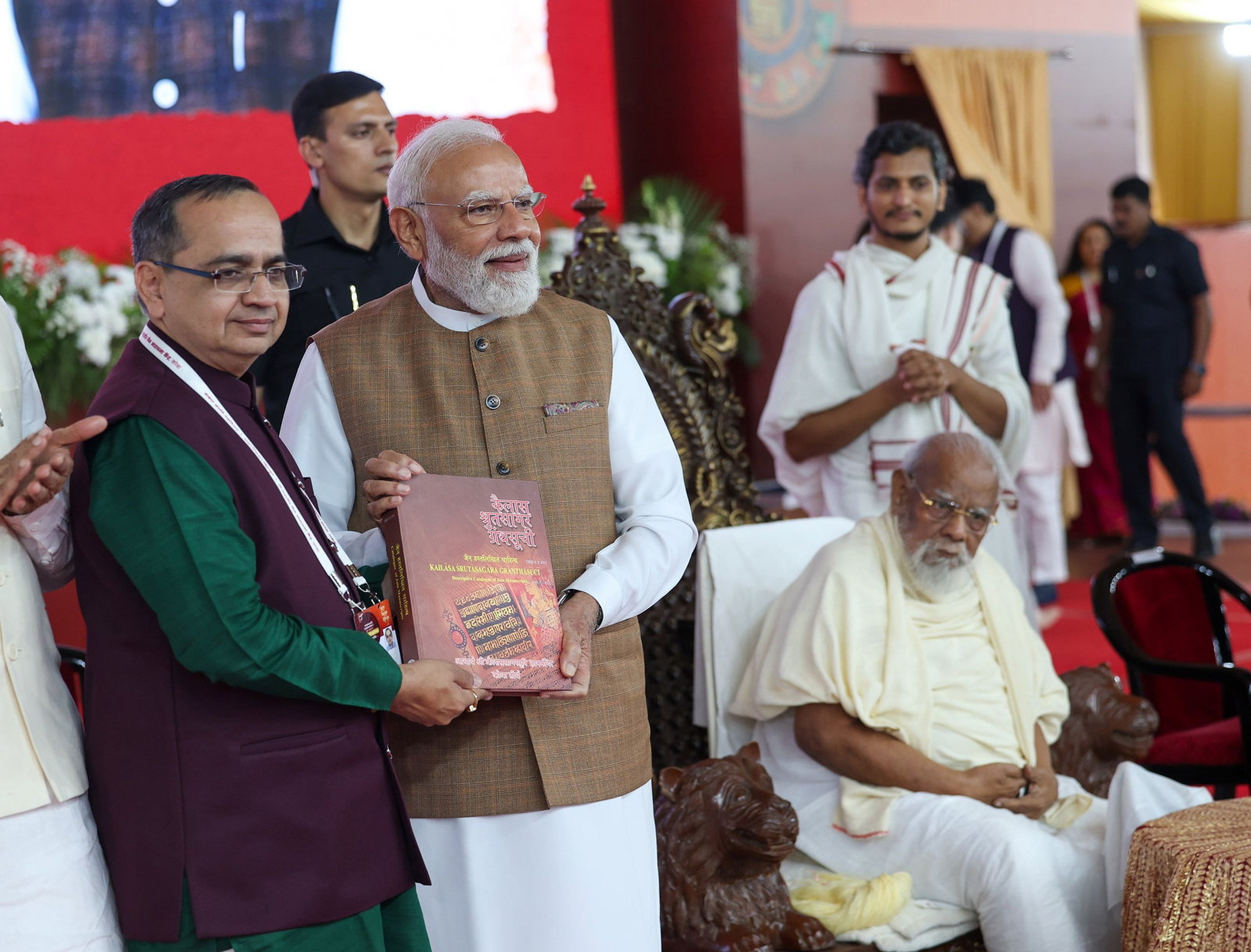
I am happy that to make the thousands of years of Indian heritage, the timeless knowledge of Jainism, our treasures and the inspirations derived from them immortal for the coming centuries, and to pass them on to the next generation in a new and modern form, our saints conceived this Jain Heritage Museum. Today, that conception is being realized in a grand form. This Samrat Samprati Museum has become a sacred center of Jain philosophy, Indian culture, and our ancient heritage. I congratulate all our Jain Munis and saints for this unique effort. I bow at their feet. I also appreciate all those thousands of dedicated people who gave immense contribution to this work.
Brothers and sisters,
When we innovate to pass on eternal knowledge to the new generation, bring freshness, then by this our heritage also gets enriched and the coming tomorrow also gets inspiration. Samrat Samprati Museum is the heritage of crores of people of India; it is the heritage of India's glorious past. For this, I give many, many congratulations to all the countrymen.
Friends,
Samrat Samprati is not merely the name of a historical king. Samrat Samprati is such a bridge that connects India's philosophy and practice. Because, when we look into history, we see that in many civilizations of the world, great thinkers and philosophers were born. Ideals of humanity were also carved in different definitions. But, when the question of authority and power came, many rulers sidelined ideals and values. Because of this, a chasm kept being created between thought and practice, thought and system. But, in India, there were rulers like Samrat Samprati, who worked considering authority as service and spiritual practice. Where on one hand some rulers ruled by making violence a weapon, on the other hand, Samrat Samprati expanded non-violence while sitting on the throne. He promoted truth, non-stealing, and non-possessiveness. To live life with such detachment, with such selfless feeling, considering governance as a medium of service - this lesson we get only from India's past. We are preserving this very past in this museum.
Friends,
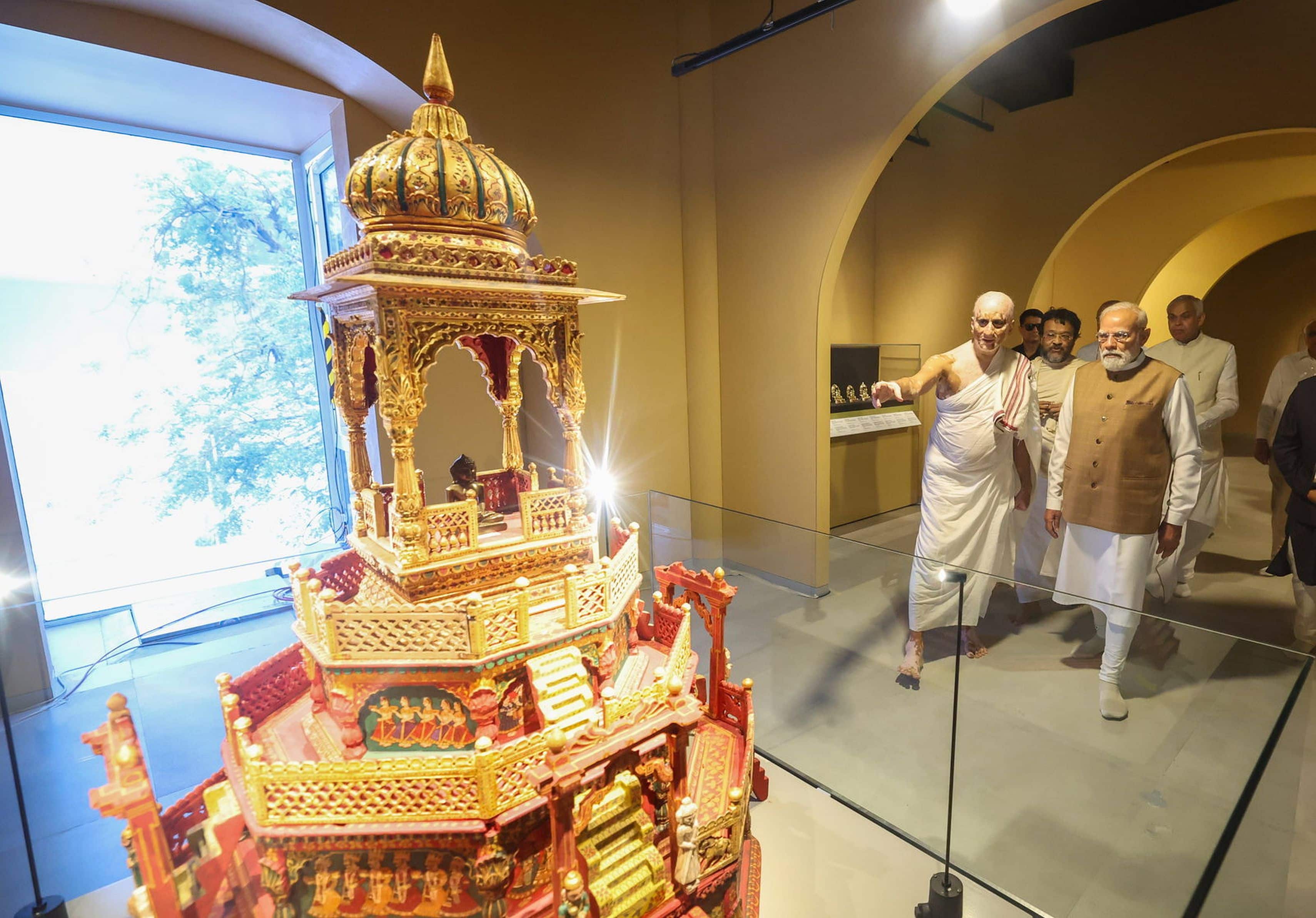
I was seeing, this museum has also been designed in such a way that the identity of grand India is visible at every step. Its seven galleries, every gallery proclaims India's diversity and cultural prosperity. In the first gallery, we see the Navpad. Navpad means, Arihant, Siddha, Acharya, Upadhyay, and Sadhu. Right Vision, Right Knowledge, Right Conduct, and Right Penance; that is, we learn from those who have known life by doing penance themselves, and the knowledge we acquire should be right! Our character should be right! Because when knowledge is right, it becomes the foundation of equanimity and service.
Friends,
In the third gallery, the lives of our Tirthankaras, their teachings and episodes have also been brought to life in artistic ways.
Brothers and sisters,
In this museum, the greatest specialty, the greatest strength of India is visible. As I mentioned earlier, this strength of ours is - India's diversity and unity in diversity. The world has always seen conflict in the name of belief, religion, and faith, but in this museum, there is glorious representation of all other religions of India as well. Vedic and Buddhist traditions, Vedas, Puranas, Ayurveda, Yoga, philosophy - all colors of different traditions being present together like a rainbow, this can happen only in India.
Friends,
In the kind of circumstances that exist in the world today, the way the world is scorching in the fire of instability and unrest, the heritage of this museum, its message, is very important not only for India but for the entire humanity. It should be our effort that the number of curious people, students, and researchers coming here from countries across the world increases further. The people who come here should take the teachings of India and Jainism to every corner of the world.
Friends,
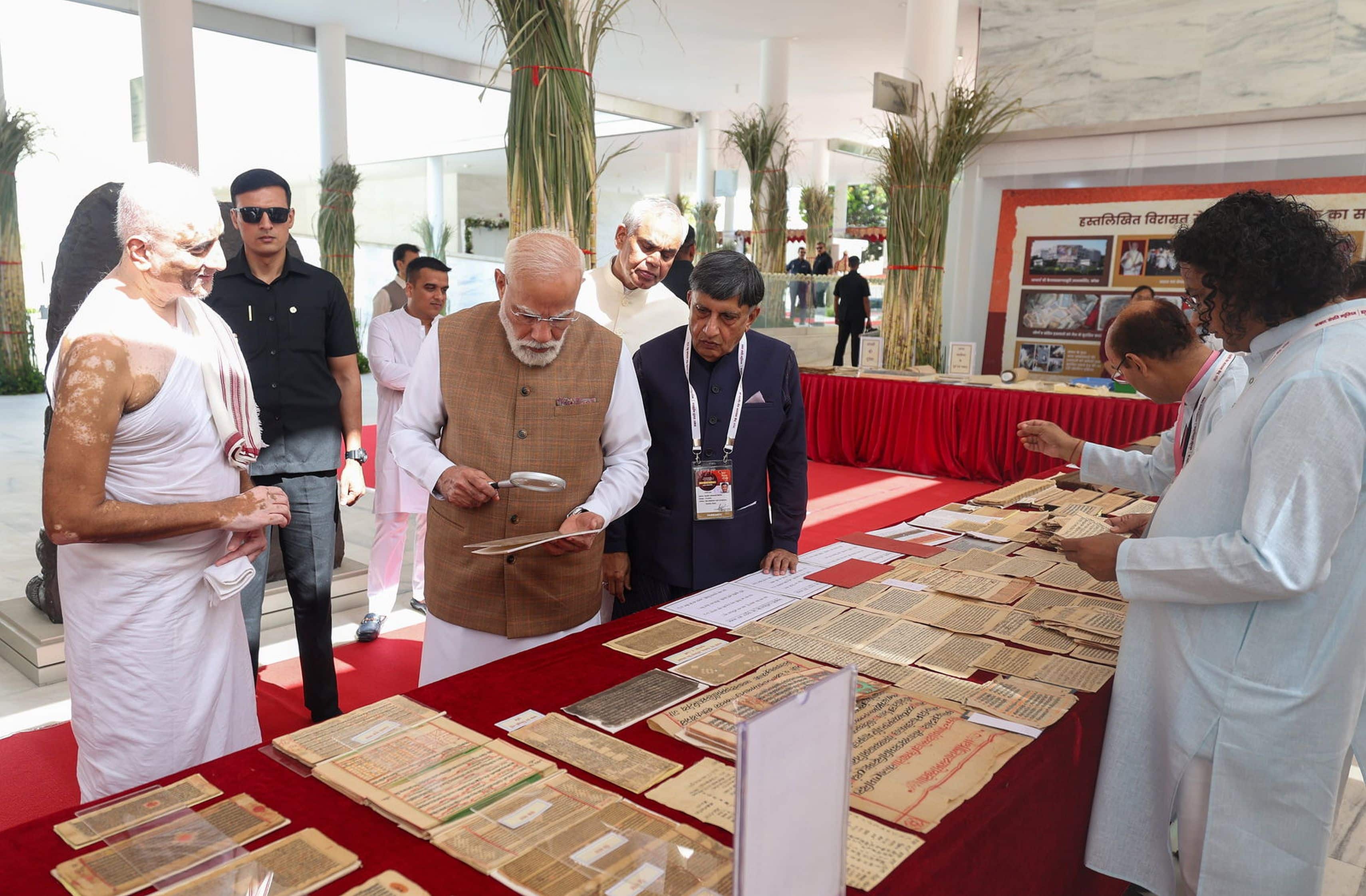
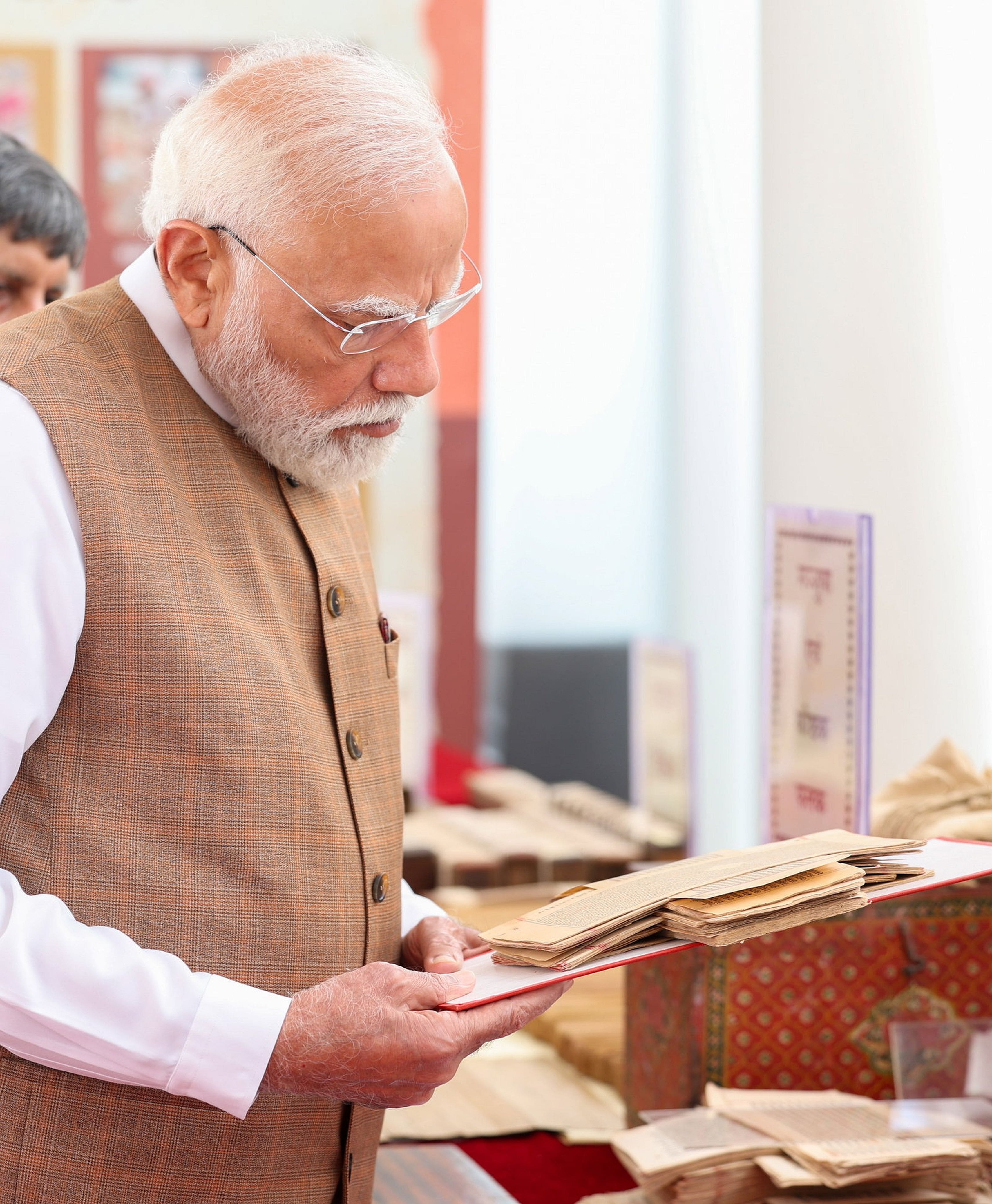
In India, knowledge has always been a free flow. In every era, Tirthankaras and sages-thinkers were born. The collection of knowledge kept increasing, with time much new was added. Imagine, at one time our universities like Taxila and Nalanda used to be full of lakhs of books and manuscripts. But, foreign invaders, in religious narrow-mindedness, considering knowledge also as their enemy, burnt them; such great heritages of humanity were destroyed. In that difficult period, people preserved the remaining manuscripts generation after generation and protected them. After independence, to find them, to preserve them, should have been the responsibility of the country, but unfortunately, due to the slave mentality, no attention was paid to this. Great personalities and saints like Acharya Bhagwant Shri Padmasagar Surishwar Ji Maharaj Saheb understood its importance; they dedicated their entire life for this. For 60 years of life, village to village, city to city, from every corner of the country, they searched for manuscripts. More than three lakh such manuscripts, that hundreds of years old knowledge inscribed on palm leaves and birch bark, is today secured and compiled in Koba. This is a very big service to India's past, India's present, and our future.
Friends,
The mistake the previous governments made by neglecting manuscripts, today we are rectifying it. For this, we have started the ‘Gyan Bharatam Mission’. In this work, we are using technology. Under this mission, the digitization of ancient manuscripts is being done, and they are being preserved in a scientific manner. All efforts like scanning, chemical treatment, and digital collection are happening in this direction. This Sunday in ‘Mann Ki Baat’, I mentioned in detail how a survey has also been started in this direction. In this, people from across the country are uploading manuscripts preserved with them. This campaign will play a big role in collecting manuscripts scattered in every corner of the country.
Friends,
The ‘Gyan Bharatam Mission’ at the government level and the extraordinary contribution of Kobatirth, these shared efforts of society and government are also a symbol of India's new cultural resurgence.
Friends,
Today, efforts to preserve the country's cultural heritage and bring it before the world are happening at every level. While the work of preserving manuscripts and knowledge heritage is ongoing, along with it, the restoration of ancient temples, development of pilgrimage sites, development of historical sites, and the promotion and expansion of Ayurveda and Yoga are being worked upon at every level. Here in Gujarat itself, a massive Maritime Museum is being built in Lothal, and it is going to become the world’s largest Maritime Museum; it is 70-80 kilometers away from here. On the other side, a very large museum has been built in Vadnagar; it has already found its place among the good museums of the world. There are also preparations to build the ‘Yuge Yugeen Bharat’ Museum in Delhi. Today, for the first time, meaningful work has been done to bring forward the history of the freedom struggle in a holistic form. You must remember, previously these tasks were done through a political lens; how to set the narrative of one political family, how to speak things according to the votebank - everything revolved around this. We have ended this mentality. We are moving with the mantra of ‘Sabka Saath, Sabka Vikas’. This very mantra is the soul of the vision of a Developed India.
Friends,
All of you saints are making such a great effort to cherish the heritage of India. When we rise above personal aspirations and work for the goals of society and the nation, the development of the country gains more momentum. With this very feeling, I had also participated in the program held in Delhi on Navkar Mahamantra Day. In that event, all four sects had gathered together. On that historic occasion, I had made nine requests, spoken about nine resolutions, which our Chief Minister Bhupendra Bhai also just mentioned. Every time, I definitely repeat those nine resolutions before you. Today's occasion is also to repeat them again. First resolution - the resolution to save water. Second resolution - One Tree in the Name of Mother. Third resolution - Mission of Cleanliness. Fourth resolution - Vocal for Local. Fifth resolution - Desh Darshan (Touring the Country). Sixth resolution - Adopting Natural Farming. Seventh resolution - Adopting a Healthy Lifestyle. Eighth resolution - bringing Yoga and Sports into life. Ninth resolution is - the resolution to help the poor, and the tenth resolution you all have added yourselves, and that is - preservation of India's heritage. Today’s program is a reflection of this.
Friends,
In the coming times, we have big goals before us; we have to fulfill big resolutions. Our unity, these cultural supports of ours, will become our strength in this. I am confident that the Samrat Samprati Museum will play an important role in this direction in the coming time. It will become such a center of knowledge, spiritual practice, and culture from where the new generation will get inspiration and society will get a new energy. With this confidence, I once again give many, many congratulations to all of you for this important work.
And at the same time, I also urge everyone that while Maharaj Saheb has done all this, if we do not even give time to see it, how will it work? Let it not be that more and more people just come here and leave after seeing; try to know, try to understand; this is an invaluable treasure. And I want people of all generations in Gujarat to come here with their families, see it to their heart's content, and take pride in the knowledge and great heritage. And for me, today’s Mahavir Jayanti is auspicious in many ways because as soon as I arrived here in Gandhinagar, upon stepping on the land of Gujarat, the first program is connecting with the roots, and from here I will now go to Sanand; the second program is there - connecting with the world. Here I took a sip of the great cultural traditions and grand past, and in Sanand, the inauguration of the construction of world’s state-of-the-art technology chips is happening, the inauguration of semiconductors is happening. Here it is about connecting with the roots and from there connecting the world, and all this is happening on the land of Gujarat, happening on the land of India. Many, many best wishes to all of you. Thank you very much.
Jai Jinendra!
Jai Jinendra!
Jai Jinendra!