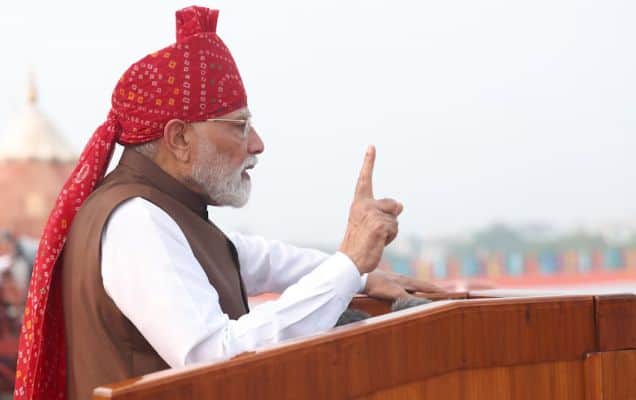
Principal Secretary Shri P. K. Mishra, Chairman of Karmayogi Bharat Shri S. Ramadorai, Chairperson of the Capacity Building Commission S. Radha Chauhan, Other distinguished guests, ladies and gentlemen!
My heartfelt congratulations to all of you on the occasion of Karmayogi Sadhana Week. In this era of the 21st century, with rapidly changing systems, a swiftly transforming world, and India advancing at the same pace, it is essential to continuously update public service in line with the times. Karmayogi Sadhana Week is an important step in this effort. You are all familiar with the principle of governance we are pursuing today, whose core mantra is Citizen Devo Bhava. With this spirit, the focus is now on making public service more capable and more sensitive to citizens. Governance is being given a new identity by making it citizen-centric.
Friends,
A major principle of success is not to shorten someone else’s line, but to lengthen your own. Since independence, many institutions in our country have worked with different focuses, but there was a need for one institution dedicated to capacity building-one that could enhance the abilities of every employee, every karmayogi working in government. This vision gave birth to the Capacity Building Commission (CBC). On its foundation day today, this new beginning, along with the successful role of iGOT Mission Karmayogi, is giving our efforts manifold energy. I am confident that through these initiatives, we will succeed in building a team of modern, capable, dedicated, and sensitive karmayogis.
Friends,
A few weeks ago, during the inauguration of Seva Teerth, I had also spoken to you in detail about the resolve of a developed India. To achieve this goal, we need fast economic growth, modern infrastructure and technology, and a large skilled workforce. In achieving these targets, the role of our public institutions and public servants is crucial. We are all witnessing and experiencing how aspirational today’s India is. Every citizen has their own dreams and goals, and it is our responsibility to provide maximum support in fulfilling them. Our governance must ensure that citizens’ ease of living and quality of life improve day by day. That is our benchmark. For this, you must learn something new every day and embody the spirit of karmayogi.
Friends,
When we speak of reforms and changes in administrative services, it also means a change in the behavior of public servants. We all know that in the old system, emphasis was placed more on being an officer. But today, the country emphasizes duty-importance lies not in position, but in work. The Constitution grants us rights through our duties. If, before every decision, you ask yourself what your duty demands, the impact of your decisions will automatically multiply. I repeat once again: we must view our present efforts on the canvas of the future. 2047, a developed India-that is our canvas, that is our goal. We must ask ourselves: what impact will our work today have on the nation’s development journey? How many citizens’ lives can change through one decision? How can individual transformation become institutional transformation? These questions must be part of every effort. From my experience, I can say that this requires immense energy, and such energy can only come from a spirit of service.
Friends,
When we talk about learning, technology becomes extremely important in today’s context. You have all seen how, in the past 11 years, technology has been integrated into governance and administration. From governance and delivery to the economy, we have witnessed the power of the tech revolution. With the advent of AI, this change will accelerate even further. Therefore, understanding technology and using it correctly has become an essential part of public service. The best administrators and public servants will now be those who understand technology and data. This will form the basis of decision-making. Hence, efforts are being made to facilitate capacity building and continuous learning in the field of AI. Your participation and involvement in this are very important. I hope that Karmayogi Sadhana Week will focus equally on this subject.
Friends,
In our federal structure, the success of the nation means the collective success of the states. For decades, states were categorized as advanced, backward, or sick. Today, we are ending all such definitions. We must bridge every gap between states, and this will only happen when every state works with equal intensity. We must break silos and move forward with better coordination and shared understanding. For this, we need a whole-of-government approach. If both government and bureaucracy adopt this approach, every mission will succeed. Karmayogi Sadhana Week is an effort to ensure exactly this.
Friends,
We must always remember that for the common citizen, the local office is the face of the government. Your working style, your behavior-these determine citizens’ trust in democracy and constitutional systems. Therefore, whatever we do, at whichever level, we must preserve that trust. Once again, I congratulate the entire team of the Capacity Building Commission. I am confident that Karmayogi Sadhana Week will become an important chapter in our journey towards a developed India.
Thank you very much.
Namaskar.