After Independence, Sardar Patel united over 550 princely states; For him, the vision of 'Ek Bharat, Shreshtha Bharat' was paramount: PM
Every thought or action that weakens the unity of our nation must be shunned by every citizen, this is the need of the hour for our country: PM
This is Iron Man Sardar Patel's India, it will never compromise on its security or its self-respect: PM
Since 2014, our government has dealt a decisive and powerful blow to Naxalism and Maoist terrorism: PM
On Rashtriya Ekta Diwas, our resolve is to remove every infiltrator living in India: PM
Today, the nation is removing every trace of a colonial mindset: PM
By honouring those who sacrificed their lives for the nation, we are strengthening the spirit of 'Nation First': PM
To achieve the goal of a Viksit Bharat, we must thwart every conspiracy that seeks to undermine the unity of the nation: PM
The four pillars of India's unity are Cultural unity, Linguistic unity, Inclusive development & Connection of hearts through connectivity: PM
The devotion to Maa Bharti is the highest form of worship for every Indian: PM

I will say Sardar Patel, and you all will say Amar Rahein, Amar Rahein.

Sardar Patel -Amar Rahein, Amar Rahein.

Sardar Patel – Amar Rahein, Amar Rahein.

Sardar Patel – Amar Rahein, Amar Rahein.

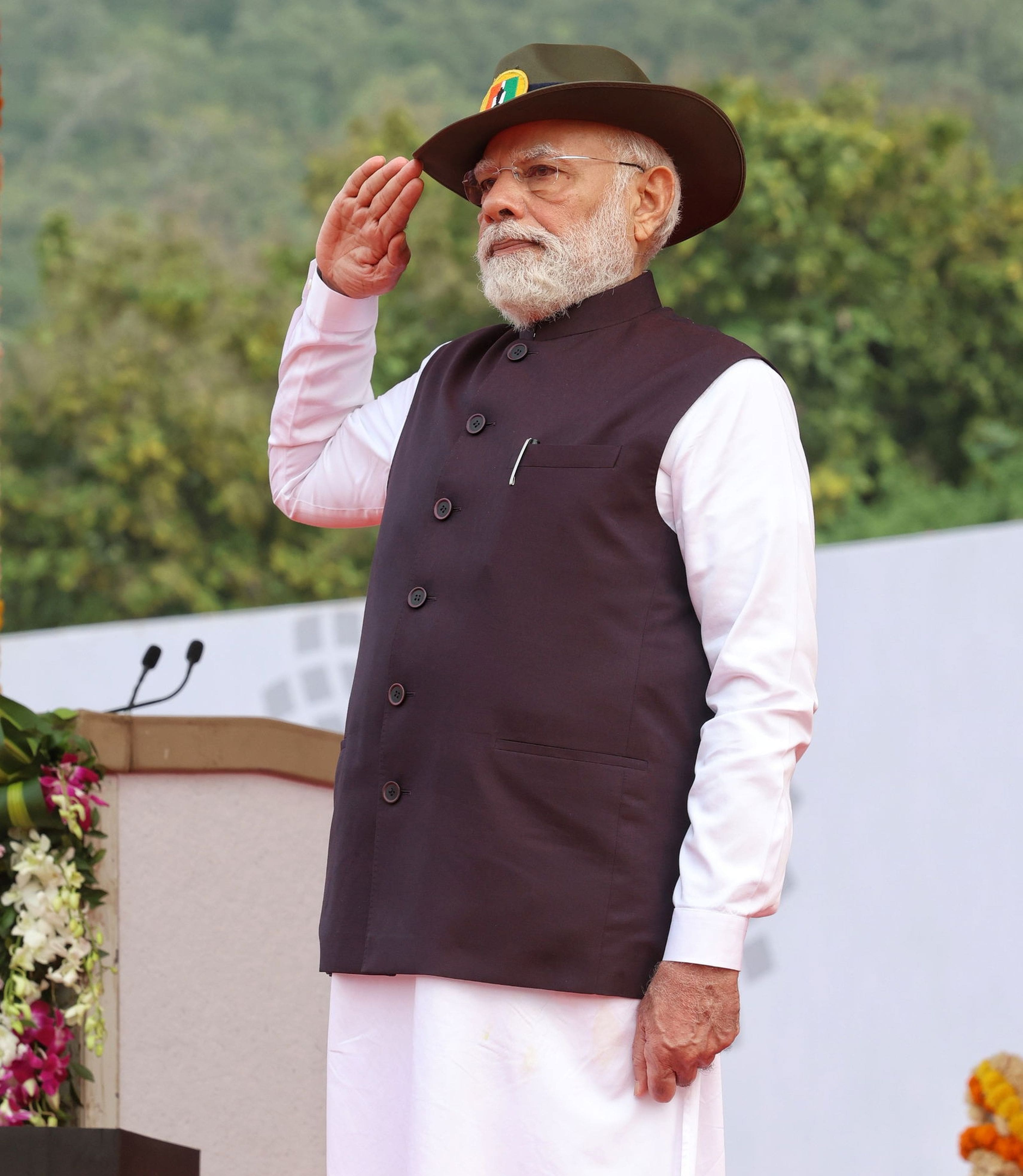
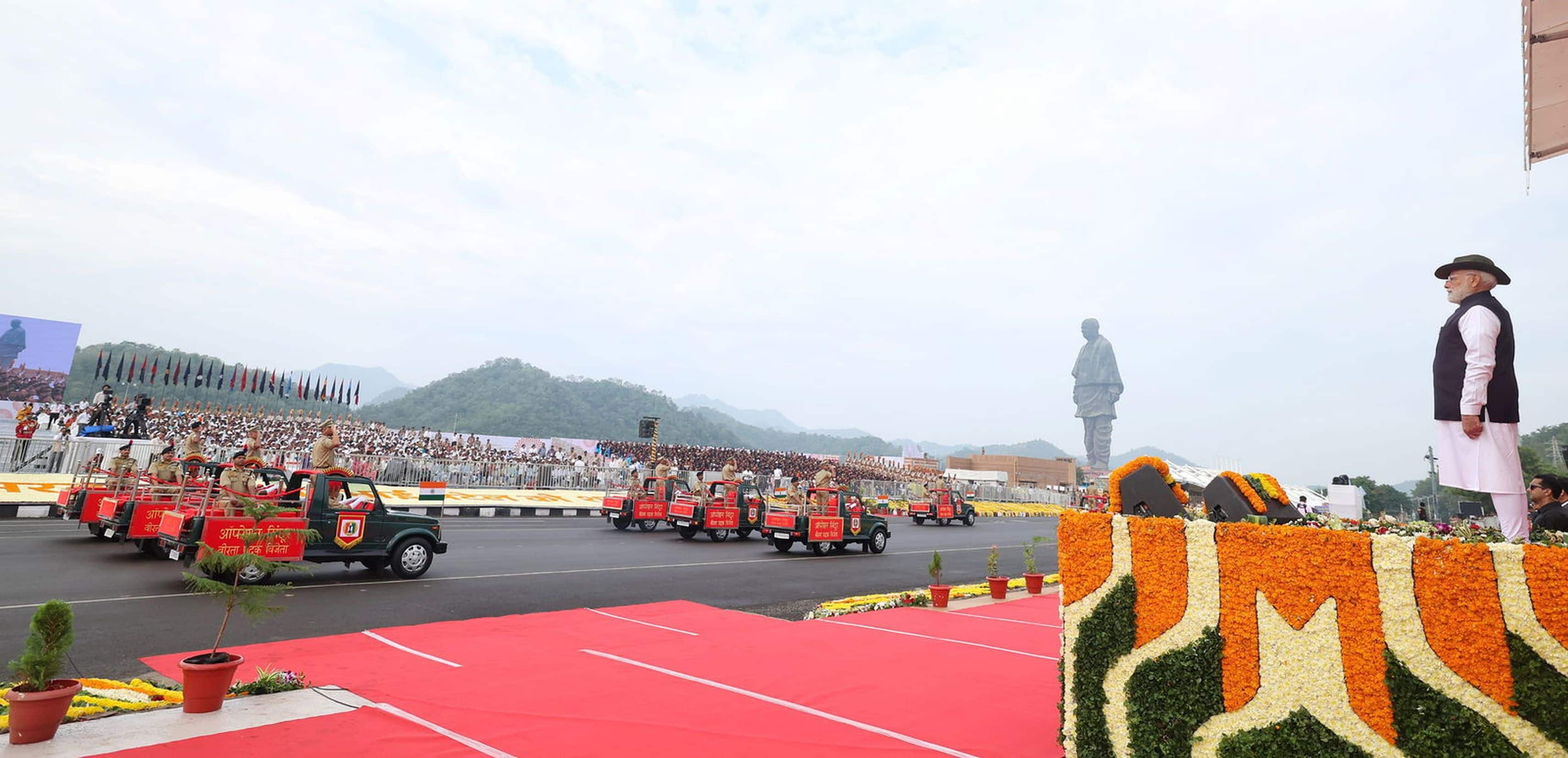
The historic occasion of Sardar Patel's 150th birth anniversary, this divine morning in Ektanagar, this panoramic view, our presence at the feet of Sardar Saheb, today we are all witnessing a great moment. The Run for Unity being held across the country, the enthusiasm of crores of Indians, we are directly experiencing the resolve of the new India. The programmes that took place here recently, including the wonderful presentation that took place yesterday evening, had the tradition of the past, the hard work and bravery of the present, and also a glimpse of the achievements of the future. To commemorate the 150th birth anniversary of Sardar Saheb, a commemorative coin and a special postage stamp have also been issued. I extend my heartiest greetings and best wishes to all 140 crore countrymen on the birth anniversary of Sardar Saheb and Rashtriya Ekta Diwas (National Unity Day).
Friends,

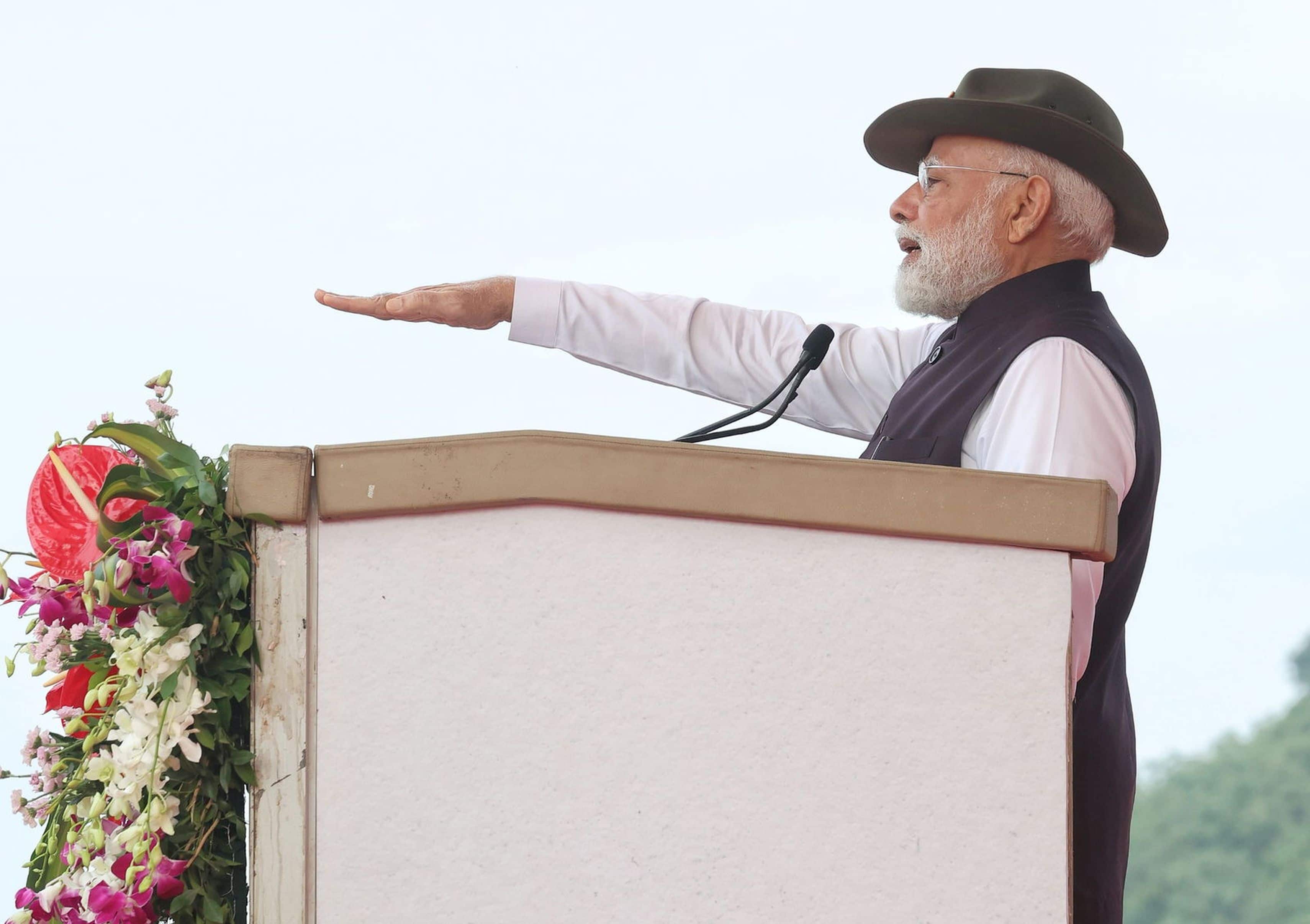
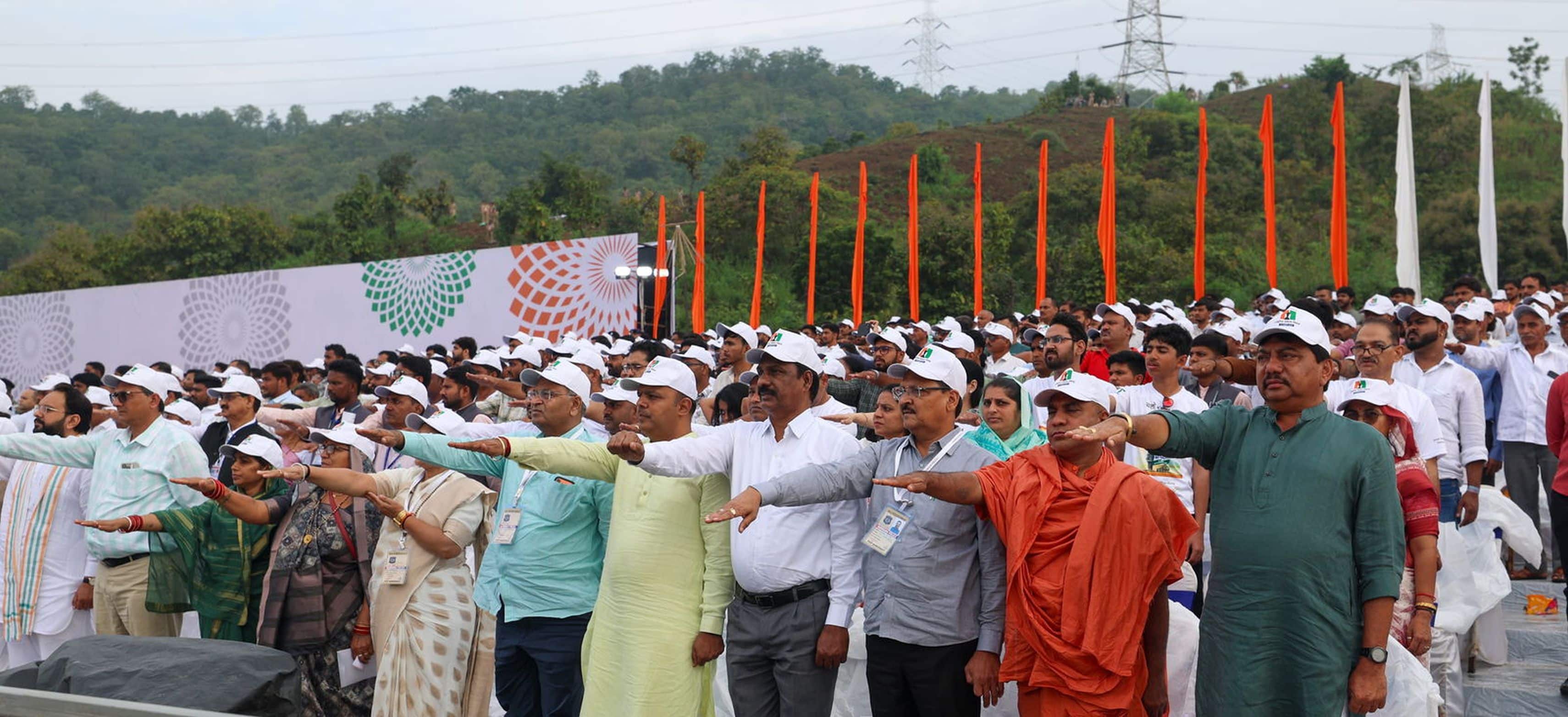
Sardar Patel believed that time should not be wasted in writing history, we should work hard to create history. This sentiment is reflected in his biography. The policies made by Sardar Saheb, the decisions he took, created a new history, made a new history. After independence, he made the impossible task of uniting more than five hundred and fifty princely states possible. The idea of one India – a great India (Ek Bharat- Shreshth Bharat) was paramount for him. That is why today, Sardar Patel's birth anniversary, has naturally become a grand festival of national unity. Just as we 140 crore countrymen celebrate Independence Day on 15th August and Republic Day on 26th January, similarly the importance of Unity Day is a moment of inspiration and pride for us. Today crores of people have taken the oath of unity, we have resolved that we will promote such works which will strengthen the unity of the country. Here in Ekta Nagar itself, Ekta Mall and Ekta Garden are seen strengthening the thread of unity.

Friends,

Every citizen must stay away from anything that weakens the nation's unity. This is a national duty; this is a true tribute to Sardar Saheb. This is what the country needs today, this is the message and also the resolution of Unity Day for every Indian.

Friends,

Sardar Saheb placed the sovereignty of the country above everything else, but unfortunately, in the years following Sardar Saheb's demise, the then governments were not as serious about the sovereignty of the country. On the one hand, the mistakes made in Kashmir, on the other hand, the problems arising in the North-East and the Naxalite-Maoist terrorism that flourished at various places across the country, these were direct challenges to the sovereignty of the country. However, instead of following Sardar Sahib's policies, the governments of that era chose a spineless approach. The country suffered the consequences of this in the form of violence and bloodshed.
Friends,

Many in today's younger generation may not know that Sardar Sahib wanted the entire Kashmir region to be merged, just as he had merged other princely states. But Nehru ji did not let his wish be fulfilled. Kashmir was divided with a separate constitution and a separate flag!

Friends,

The country burned in the fire of the mistake that Congress had made on Kashmir for decades. Due to the poor policies of Congress, a part of Kashmir went under the illegal occupation of Pakistan. Pakistan gave impetus to terrorism, State sponsored terrorism.

Friends,

Kashmir and the country have paid such a heavy price. Yet, Congress has always been submissive to terrorism.

Friends,

Congress forgot Sardar Saheb's vision, but we did not forget. After 2014, the country once again witnessed his inspiring steely resolve. Today, Kashmir has broken free from the shackles of Article 370 and has fully integrated into the mainstream. Today even Pakistan and the masters of terrorism have come to know what is the real strength of India! The entire world had seen in Operation Sindoor that today, if anyone dares to raise an eyebrow at India, India enters their homes and strikes back. Every time India's response is bigger than before, more decisive than before. This is also a message to the enemies of India, this is the India of Iron Man Sardar Patel, it never compromises on its security and honour.
Friends,

India's biggest success in the last 11 years regarding national security is breaking the backbone of Naxalism-Maoist terrorism. Before 2014, the situation in our country was such that Naxalites and Maoists ruled within the country, in the heart of the country. The country's Constitution was not enforced in Naxalite areas. The police administration was unable to function there. Naxalites used to openly issue new decrees. They prevented the construction of roads. Schools, colleges and hospitals were blown up with bombs. And the government and administration seemed helpless in the face of them.

Friends,

After 2014, our government launched a massive attack on Naxalism-Maoist terrorism. We also marginalized urban Naxalite supporters and urban Naxalites. We won the ideological battle and confronted them in their strongholds; the results are before the country today. Before 2014, about 125 districts of the country were under the grip of Maoist terror. Today, this number has declined to only 11. And even in that, Naxalism is still prevalent in some serious manner only in three districts. And today, in the presence of Sardar Patel, from this land of Ekta Nagar, I assure the entire country that until the country is completely free from Naxalism, Maoism and that terror, we are not going to stop, we are not going to sit in peace.

Friends,

Today, infiltration poses a significant threat to the nation's unity and internal security. Foreign intruders kept coming into the country for decades, they kept occupying the resources of the countrymen, kept disturbing the demographic balance, kept putting the unity of the country at stake, but the previous governments kept turning a blind eye to such a big problem. The nation's security was deliberately jeopardized for vote bank politics. Now for the first time the country has decided to fight a decisive battle against this big threat. I have announced the Demography Mission from the Red Fort.
But friends,

Now today when we are raising this issue seriously, some people are putting their own interests above the national interest. These people are fighting a political battle to give rights to the infiltrators. They believe that once the country has been divided, it doesn't matter to them if it continues to be divided. Whereas the truth is that if the security and identity of the country is in danger, then every person will be in danger. Therefore, today on National Unity Day, we have to take a pledge again that we will drive out every infiltrator living in India.

Friends,

When we talk about national unity in a democracy, one of its aspects is that we respect diversity of ideas. Differences of opinion are acceptable in democracy, but there should not be any differences of heart. But look at the irony, after independence, the very people to whom the country entrusted the responsibility, tried to kill the spirit of 'we the people'. They despised every person and organization that was different from their own thinking and ideology and tried to discredit it. Political untouchability was made a culture in the country. We all know what has happened to Sardar Patel and his legacy under Congress governments? What did these people do with Baba Saheb Ambedkar during his lifetime and even after his death? What did they do to Netaji Subhash Chandra Bose? Congress did the same to people like Dr. Lohia and Jayaprakash Narayan. This year marks the 100th anniversary of the Rashtriya Swayamsevak Sangh (RSS). What kind of attacks and conspiracies were made on the Sangh! Every effort was made to make untouchable every person and every idea that was outside of one party and one family.

Brothers and sisters,

We are proud that we have ended this political untouchability that was dividing the country. We built the Statue of Unity for Sardar Patel. We built Panchtirtha of Baba Saheb. Baba Saheb's house in Delhi, the place of his Maha Parinirvana, was in a dilapidated condition due to neglect during the Congress era. We have transformed that sacred site into a historical memorial. During the Congress regime, there was a museum in the name of only one former Prime Minister. We have risen above political untouchability and created the PM Museum, dedicated to the contributions of all the Prime Ministers of the country. We awarded the Bharat Ratna to a popular leader like Karpoori Thakur. We also conferred the Bharat Ratna to Pranab Da, who dedicated his entire life to the Congress party. And, we also honoured a leader like Mulayam Singh Yadav ji with opposing ideology with the Padma Award. The idea behind these decisions was to strengthen the spirit of unity for the nation, rising above political differences. We have also seen this glimpse of unity in our all-party delegation that went abroad after Operation Sindoor.
Friends,

The idea of ​​attacking the unity of the country for political gains is part of the mentality of slavery. Congress not only inherited the party and power from the British, but it also imbibed the mentality of slavery. You see, just after a few days, our national song Vande Mataram is going to complete 150 years. When the British divided Bengal in 1905, Vande Mataram became the voice of every citizen in protest. Vande Mataram became the voice of the unity and solidarity of the country. The British even tried to ban the very idea of ​​saying Vande Mataram. The British were not successful in this attempt! The slogan of Vande Mataram kept echoing from every corner of India. However, the work which the British could not do, was done by the Congress. Congress removed a portion of Vande Mataram on religious grounds. That is, Congress divided the society and also furthered the agenda of the British. And today I am saying one thing with great responsibility - the day Congress decided to break, cut and divide Vande Mataram, on that very day it laid the foundation of the partition of India. If Congress had not committed that sin, the picture of India would have been different today!

Friends,

Due to such thinking of the people sitting in the government at that time, the country carried the symbols of slavery for so many decades. You remember, the mark of slavery was removed from the flag of our Navy when you gave us the opportunity to serve the country and our government came into power. Rajpath became the Kartavya Path when we made this change. The Cellular Jail in the Andamans, the site of the sacrifices of revolutionaries in the freedom struggle, was granted national monument status only during the Morarji Desai government. Till some time ago, the Andaman Islands were named after the British. We named these after Netaji Subhash. Many islands were named after Param Vir Chakra winners. We also installed a statue of Netaji Subhas Chandra Bose at India Gate.

Friends,

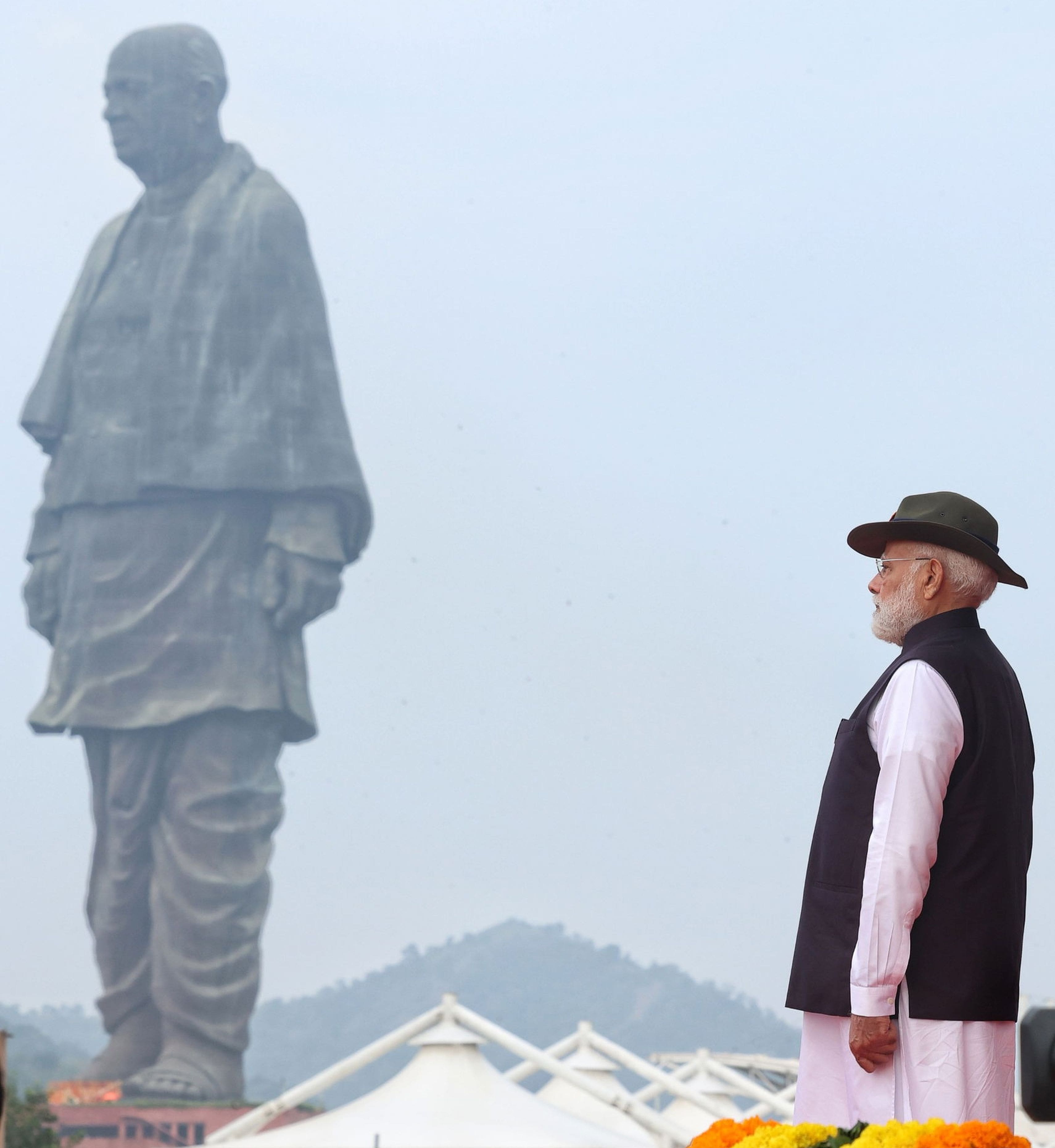
Even the soldiers who were martyred in the defence of the country did not get the proper respect due to the slave mentality. We immortalised those memories by establishing the National War Memorial. Even in the internal security of the country, 36 thousand soldiers, these soldiers of our police force, the country is not even aware that these khaki-clad people of the police force have sacrificed their lives. 36 thousand martyrs, this figure is not small. Our police, BSF, ITBP, CISF, CRPF, all our paramilitary forces, their bravery was also deprived of respect. It is our government which honoured those martyrs by building a police memorial. Today, standing at the feet of Sardar Patel, I salute all those people across the country who have served by being in the police force, all those people who are serving the country today by being in the police force, I stand at the feet of Sardar Patel, today I salute them, I feel proud of them, I respect them. Today the country is removing every trace of the slave mentality. By honouring those who sacrifice for the country, we are strengthening the spirit of 'Nation First'.

My dear countrymen,

Unity is the foundation of the existence of a nation and society. As long as there is unity in the society, the integrity of the nation is safe. Therefore, to achieve the goal of a developed India, we have to foil every conspiracy that breaks the unity of the country, we have to foil it with the power of unity. That is why, today the country is continuously working on every front of national unity. This ritual of India's unity has four pillars. The first pillar of unity is cultural unity! It is India's culture that has kept India immortal as a nation, irrespective of political circumstances, for thousands of years. Our twelve Jyotirlingas, seven Puris, four Dhams, more than 50 Shaktipeeths, tradition of pilgrimages, these are the life energy which makes India a conscious nation. Today, we are carrying forward this tradition through events like Saurashtra Tamil Sangamam and Kashi Tamil Sangamam. Through International Yoga Day, we are also giving a new identity to India's great science of Yoga. Today, our yoga is becoming a medium to connect people.

Friends,

The second pillar of our unity is linguistic unity! India's hundreds of languages and dialects are a symbol of India's open and creative thinking. Because, here no society, power or sect has ever made language its weapon. There has been no attempt to impose a single language. That is why India has become such a rich nation in the world in terms of linguistic diversity. Our languages have strengthened our identity like different notes of music. That is why friends, we consider every language as a national language. We proudly say that India has the world's oldest language, Tamil, and we are proud of it. We have a heritage of knowledge like Sanskrit. Similarly, every Indian language has its own uniqueness, its own literary and cultural wealth. We are promoting every Indian language. We want the children of India to study in their mother tongue and progress. The people of India should also know and learn from other languages ​​of the country. Let languages become the unifier of our unity. And this is not a one-day task. It is an ongoing task, one for which we all must shoulder the responsibility together.

Friends,

The third pillar of our unity is discrimination-free development! Because poverty and discrimination are the biggest weaknesses in the social fabric. The country's enemies have always exploited these weaknesses. That is why Sardar Saheb wanted to work on a long-term plan for the country against poverty. Sardar Patel once said that if India had gained independence 10 years earlier than in 1947, India would have been free from the crisis of food shortage by 1947. He said that just as he solved the challenge of merging the princely states, he would not stop until he had solved the challenge of food shortage. This was the willpower of Sardar Saheb. To tackle even the biggest challenges, we must demonstrate this willpower. And I am proud that our government is working to fulfill even these unfulfilled resolutions of Sardar Saheb. In the last decade, we have lifted 25 crore countrymen out of poverty. Today crores of poor people are getting houses. Clean water is reaching every home. Free medical care is available. That is, a dignified life for every citizen, this is the mission and vision of the country today. These discrimination and corruption free policies are strengthening national unity today.
Friends,

The fourth pillar of national unity is – connection of hearts through connectivity. Today, a record number of highways and expressways are being built in the country. Trains like Vande Bharat and Namo Bharat are transforming Indian Railways. Even small cities are now getting connected with airport facilities. This modern infrastructure is completely changing the world's view of India. It has also reduced the distances between north and south, east and west within the country. Today, people are easily traveling to other states for tourism and business. This is a new era of people to people connect and cultural exchange. It is strengthening national unity, and the digital revolution that has taken place has also provided an opportunity to strengthen this unity. Today, digital connectivity is also paving a new path for connecting hearts.
Friends,

Sardar Patel once said, "I find the greatest happiness when I work for the country." Today I also make the same appeal to every citizen of the country. There can be no greater joy than working for the country. The worship of Mother India is the greatest worship of every citizen of the country. When 140 crore Indians stand together, the rocks themselves give way. When 140 crore countrymen speak in one voice, those words become the proclamation of India's success. We must make this fundamental mantra of unity our resolution. We must not divide; we must not weaken. This is our true tribute to Sardar Saheb. I am confident that together we will strengthen the resolve of 'One India, Best India'. Together we will fulfill the dream of a developed India and a self-reliant India. With this sentiment, I once again pay my tribute at the feet of Sardar Saheb. Say with me - Bharat Mata ki Jai. Friends, this voice must reach every corner of the country.

Bharat Mata ki Jai!

Bharat Mata ki Jai!

Bharat Mata ki Jai!

Vande Mataram.

Vande Mataram.

Vande Mataram.

Vande Mataram.

Vande Mataram.

Vande Mataram.

Vande Mataram.

Thank you all very much!

Explore More
Today, the entire country and entire world is filled with the spirit of Bhagwan Shri Ram: PM Modi at Dhwajarohan Utsav in Ayodhya

Popular Speeches

Today, the entire country and entire world is filled with the spirit of Bhagwan Shri Ram: PM Modi at Dhwajarohan Utsav in Ayodhya
‘Highly Focused’: Canada PM Mark Carney Calls PM Modi A ‘Unique Leader’ After India Visit

Media Coverage

‘Highly Focused’: Canada PM Mark Carney Calls PM Modi A ‘Unique Leader’ After India Visit
NM on the go

Nm on the go

Always be the first to hear from the PM. Get the App Now!
...
India – Finland Joint Statement on the State Visit of President of the Republic of Finland
March 05, 2026

At the invitation of the Hon'ble Prime Minister of India, Shri Narendra Modi, President of the Republic of Finland, H.E. Dr. Alexander Stubb, is on a State Visit to India from 4-7 March 2026. President Stubb, who is on his first visit to India in his present capacity, is visiting New Delhi and Mumbai and is accompanied by Ms. Sari Multala, Minister of Climate and the Environment of Finland, Mr. Matias Marttinen, Minister of Employment of Finland, and a high-level delegation comprising of officials and business leaders. Prime Minister Modi inaugurated the 11th edition of the Raisina Dialogue on 5 March 2026 in New Delhi with President Stubb as the Chief Guest delivering the Inaugural Keynote Address. President Stubb’s visit follows the visit of H.E. Mr. Petteri Orpo, Prime Minister of the Republic of Finland for the AI Impact Summit in February 2026.

On 5 March 2026, President Stubb was warmly welcomed by Hon’ble President of India Smt. Droupadi Murmu at Rashtrapati Bhavan. Prime Minister Modi and President Stubb held wide-ranging discussions during a bilateral meeting, and jointly addressed the media. Prime Minister Modi also hosted a luncheon in honour of the visiting dignitary.

The President of Finland congratulated India for successfully hosting the AI Impact Summit 2026. Both Leaders shared the view that working towards safe, trustworthy, and inclusive development of AI is of paramount importance.

The Leaders affirmed the deep and enduring friendship between India and Finland, built on a foundation of mutual respect and the values of democracy and rule of law, as well as commitment to global peace, security, and international law.

The Prime Minister of India and the President of Finland reiterated their commitment to the rules-based international order and multilateral cooperation, with the UN at its core.

The Leaders underlined the importance of redoubling efforts to reach the Sustainable Development Goals, and the importance of global cooperation against the challenges of climate change and loss of biodiversity.

Welcoming the landmark Free Trade Agreement between India and the European Union concluded in the India-EU Summit on 27 January 2026, the Leaders acknowledged the immense and mutually beneficial opportunities for both parties of increased trade and investments, including for the India-Finland bilateral relationship.

Building on the momentum provided by the India-Finland Virtual Summit on 16 March 2021 and the meetings of the Prime Ministers of both countries in the margins of two editions of India-Nordic Summit in 2018 and 2022 in Stockholm and Copenhagen respectively, as well as during the AI Impact Summit in February 2026, the Leaders emphasized their shared commitment to continue expanding and deepening the cooperation between the two nations. In this spirit, the leaders agreed to elevate the India-Finland relations to a Strategic Partnership in Digitalization and Sustainability, based on converging interests and mutual benefits.

Trade and Investment

The Prime Minister of India and the President of Finland called upon the business community to make use of the vast opportunities unleashed by the landmark India-EU FTA. In this context, The Leaders agreed that the aim should be to double the value of current trade between India and Finland by 2030.

The Leaders took note of the lively interactions between the respective business communities, reflected by the large business delegation visiting India together with the Finnish President, as well as the companies that joined the Finnish Prime Minister in February in connection with the AI Impact Summit in New Delhi. Both leaders expressed confidence that the India-Finland Business Summit and CEOs interaction scheduled to take place in Mumbai on 7 March would help pave the way for enhancing trade, technology collaboration and investments ties.

The Leaders welcomed the growing startup collaboration, manifested by the active participation of innovative Indian startups in Slush in Helsinki and Finnish startups in Startup Mahakumbh in New Delhi, as well as initiatives such as the Indo-Finland Startup Corridor.

Digitalization

Recognizing the transformative power of digitalization as a key driver of inclusive social and economic development, the Leaders identified digital transformation, including new and emerging technologies such as 5G, 6G, high-performance and quantum computing and Artificial Intelligence, as priority areas where collaboration based on mutual trust and benefit can be strengthened. The Leaders noted India’s experience in Digital Public Infrastructure, including digital payments such as the Unified Payments Interface (UPI), and discussed possibilities for cooperation in this area.

Against this backdrop, the Leaders asked the relevant ministries to establish a cross-sectoral Joint Working Group on Digitalization to define priorities and foster work on concrete and substantial actions driving the digital transition.

The Finnish President emphasized the positive impact of the considerable number of Indian professionals in the Finnish R&D and tech innovation ecosystems, contributing to social and economic development by means of digital transition and sustainability for the benefit of all.

The Leaders noted with satisfaction the Joint Calls by the Indian Department of Science and Technology and Business Finland to provide RDI funding for joint initiatives of Indian and Finnish companies and research organizations with focus on semiconductors, 6G, and energy systems. They also took note of the cooperation framework between Bharat 6G Alliance and the University of Oulu, Finland, welcoming all efforts to further strengthen bilateral collaboration on 6G.

Furthermore, the Leaders welcomed the work between the Indian Ministry of Electronics and Information Technology and Business Finland to further explore avenues of RDI collaboration with special focus on AI, noting also the discussions between the Indian Centre for Development of Advanced Computing and the Finnish IT Centre for Science with respect to High-Performance Computing.

In the field of advanced technology, the Leaders also highlighted Space tech as an emerging area of collaboration with considerable future potential and active private sector engagement between Indian and Finnish players.

Sustainability

On sustainability, both Leaders underlined the great potential in advancing clean energy solutions, notably in areas such as low carbon transition, energy efficiency, biofuels, smart grids, and green hydrogen. In addition, they highlighted the importance of cooperation in circular economy, sustainable water management and meteorology.

To this end, the Leaders welcomed the establishment of a Joint Working Group on Sustainability, bringing together relevant actors from both countries to enhance collaboration on sustainability-related issues.

Moreover, the Leaders underscored the importance of implementing the Memorandum of Understanding on Cooperation in the field of Renewable Energy, encompassing many key areas of collaboration that contribute to sustainability, including bioenergy and waste-to-energy solutions, power storage and flexible RE systems, green hydrogen, as well as wind, solar and small hydro power.

They acknowledged the renewal of the Memorandum of Understanding on Environmental Cooperation, and collaboration under the Leadership Group for Industry Transition (LeadIT) and encouraged the parties to advance the deeper collaboration in circular economy, climate action, and sustainability.

Both sides acknowledged that the rapid deployment of Smart Energy solutions, including Advanced Metering Infrastructure (AMI) and other digital grid technologies, has enhanced efficiency while increasing cybersecurity risks to critical power infrastructure. They agreed to explore future areas of cooperation in promoting resilient, reliable and sustainable smart grid systems.

The Finnish President extended his appreciation to India for hosting the next World Circular Economy Forum in the later part of 2026, a Finnish initiative providing a platform to enhance circular economy solutions and bring together leading expertise in the search for new collaborative initiatives.

The Prime Minister of India acknowledged Finland’s active role in bringing together Indian, Finnish and other Nordic stakeholders in the framework of the Indo-Nordic Water Forum, promoting new collaborations and best practices in water resources management and wastewater management for circular economy solutions.

With respect to meteorological collaboration, the Leaders underscored the ongoing cooperation in aerosol monitoring and air quality forecasting between the Finnish Meteorological Institute (FMI) and the Indian Meteorological Department (IMD). They welcomed the work to establish a Virtual Research Center between FMI and the Indian Institute of Technology Madras (IITM), also taking note of the already ongoing FMI-IITM research collaboration with multilateral projects exceeding a total value of Euros 11 million.

The Leaders also took note of the exchange of experiences between the Indian Ministry of Rural Development and the National Land Survey of Finland and the Finnish Environment Institute, cities, and companies about Land Stack, an integrated GIS based digital platform of land and property information.

The Leaders welcomed the signing of Memorandum of Understanding on fostering cooperation in the field of Official Statistics which provides a framework for exchange of best practices, methodologies, and technical expertise in the area of official statistics.

Mobility, education, and people-to-people contacts

The Prime Minister of India and the President of Finland recognized the importance of people-to-people contacts in all fields, including skilled workers, specialists and young professionals, researchers and students, businesspersons, and academics, thereby nurturing economic prosperity, contributing to a rich social fabric, and enhancing mutual understanding.

In this context, the Leaders hailed the signing of a Memorandum of Understanding on Migration and Mobility Partnership, laying the frameworks for smooth, orderly, and mutually beneficial mobility for the years to come. Both sides agreed to take the steps required for the implementation of the MoU in a comprehensive and coordinated manner, that serves both India’s and Finland’s prosperity and economic growth. The Leaders also acknowledged the contacts between the respective Foreign Ministries, looking into possibilities of establishing bilateral dialogue on consular matters.

The Leaders took note of the Joint Statement endorsed by the High-Level Dialogue on Cooperation in Education (31 January 2024) and encouraged the relevant parties to accelerate their joint efforts to advance the common agenda, focusing on the agreed areas of secondary education, higher education, skill development, and student mobility.

In this context, they noted the growing interest in India towards the Finnish education system, the increasing cooperation in teacher training, as well as early childhood education institutions and schools that are being set up according to the Finnish model, as concrete expressions of the stakeholders’ shared will and commitment to continue developing the collaboration on education.

Furthermore, the Leaders highlighted the discussions on a bilateral audiovisual co-production agreement that will provide a solid frame to enhance cooperation in the film and gaming industries.

India-EU-relations

Both Leaders welcomed the new Joint India-EU Comprehensive Strategic Agenda, endorsed in the India-EU Summit on 27 January 2026, based on shared values and principles, mutual trust, converging interests, and shared political will. They agreed that India and the EU can be stable, predictable, and trusted partners, building a multifaceted and deepening long-term relationship with many positive outcomes for both sides.

The Leaders underlined that the conclusion of Free Trade Agreement takes the India-EU relations to a new level. In addition to clear economic benefits by enhancing market access and removing trade barriers, both Leaders noted that the FTA could support economic security and resilience through diversifying critical value chains and opening new markets.

As a platform to address key trade, technology, and economic security issues, the Leaders reaffirmed their support to further enhance the work of the India-EU Trade and Technology Council as the cornerstone of the India-EU technology partnership.

The Prime Minister of India and the President of Finland underscored that the signing of India-EU Security and Defense Partnership added another meaningful dimension to the India-EU Strategic Partnership that will deepen co-operation in areas of shared interests, including maritime security, defense industry, cyber and hybrid threats, space, as well as counter-terrorism.

The leaders lauded the signing of the MoU on Comprehensive Framework of Cooperation on Mobility and the launch of pilot European Union Legal Gateway Office in India.

Multilateral cooperation

The Leaders recognized the need to reform the UN system. In this context, they emphasized the importance of a comprehensive reform of the UN Security Council to make it more efficient, representative, inclusive, and reflective of contemporary geopolitical realities. The President of Finland reiterated Finland’s support for the permanent membership of India in a reformed UNSC.

The leaders underscored the vital role of cooperation within the United Nations and other international bodies to safeguard multilateralism and uphold a rules-based international order, including supporting mutual candidacies and nominations.

Both sides agreed to continue their constructive cooperation in multilateral fora, including on peace and security, human rights, sustainable development as well as climate change and biodiversity.

The Leaders reiterated their shared commitment to promoting a free, open, peaceful and prosperous Indo‑Pacific, in accordance with international law, including the UNCLOS. In this context, India welcomed Finland to join the Indo-Pacific Oceans Initiative.

Both leaders reaffirmed their commitment to further strengthening cooperation and dialogue on Arctic matters, including through joint research initiatives, academic exchanges, and capacity-building programmes. They took note of the first India–Finland Arctic Dialogue titled "The Himalayan and Arctic Ecosystems: India–Finland Partnership for a Sustainable Future” held in January 2026 in Rovaniemi, Finland, which brought together parliamentarians, government officials, academics and experts to deliberate on strategies and pathways for deepening collaboration on Arctic matters. Both leaders also underscored the importance of advancing cooperation in the structures of the Arctic Council, and within the broader framework of the India-Nordic Summit.

Both leaders unequivocally and strongly condemned terrorism and violent extremism in all its forms and manifestations, including cross-border terrorism. They called for decisive and concerted international efforts to combat terrorism in a comprehensive and sustained manner and in accordance with international law. They agreed to enhance cooperation to counter violent radicalization and extremism, combat financing of terrorism, promote internationally agreed anti‑money laundering standards, prevent exploitation of new and emerging technologies for terrorist purposes, and tackle terrorist recruitment. The leaders reaffirmed strong commitment to continue taking active measures to disrupt the terror financing channels including at the UN and FATF. They condemned in the strongest terms the terrorist attack in Pahalgam, Jammu and Kashmir on 22 April 2025 and the terror incident near Red Fort, New Delhi on 10 November 2025.

Both Leaders agreed to continue to support efforts towards the achievement of a comprehensive, just, and lasting peace in Ukraine through dialogue and diplomacy, based on the principles of the UN Charter and international law, including independence, sovereignty, and territorial integrity.

Conclusion

To take forward the cooperation under the India-Finland Strategic Partnership in Digitalization and Sustainability, the Leaders asked the respective Working Groups on Digitalization and Sustainability to develop a future-oriented and concrete Action Plan, including definition of priority areas and related actions, and report back to the Ministry for Foreign Affairs of the Republic of Finland and the Ministry of External Affairs of the Republic of India on the progress achieved.

The President of Finland thanked the Prime Minister of India for the excellent arrangements during his state visit, and both Leaders expressed their appreciation of the open and constructive dialogue, and the forward-reaching and evolving cooperation. They agreed to continue their interaction with a solid foundation in a shared spirit of mutual respect and collaboration. President Stubb invited Prime Minister Modi to pay a visit to Finland, and Prime Minister Modi accepted the invitation.