The Right Honourable Prime Minister Mark Carney,
Distinguished delegates of both countries,
Friends from the media,
Namaskar!
It gives me great pleasure to welcome Prime Minister Carney to India. This is his first visit to India as Prime Minister. We regard it as an important milestone in our bilateral relationship.
At the G7 Summit held in Canada last year, he extended a warm welcome to me and to my delegation. It is my privilege today to reciprocate that warmth and hospitality. There are very few individuals in the world whose curriculum vitae reflects leadership of the central banking institutions of two countries.
From our very first meeting, our relationship has been infused with renewed energy, mutual trust, and a spirit of positivity. I attribute the growing momentum across all areas of cooperation to my friend, Prime Minister Carney.
Friends,
India and Canada have an unwavering faith in democratic values. We celebrate diversity. The welfare of humanity is our shared vision. It is this very vision that inspires us to move forward across every sphere of cooperation. Today, we discussed transforming this vision into a Next Level Partnership.
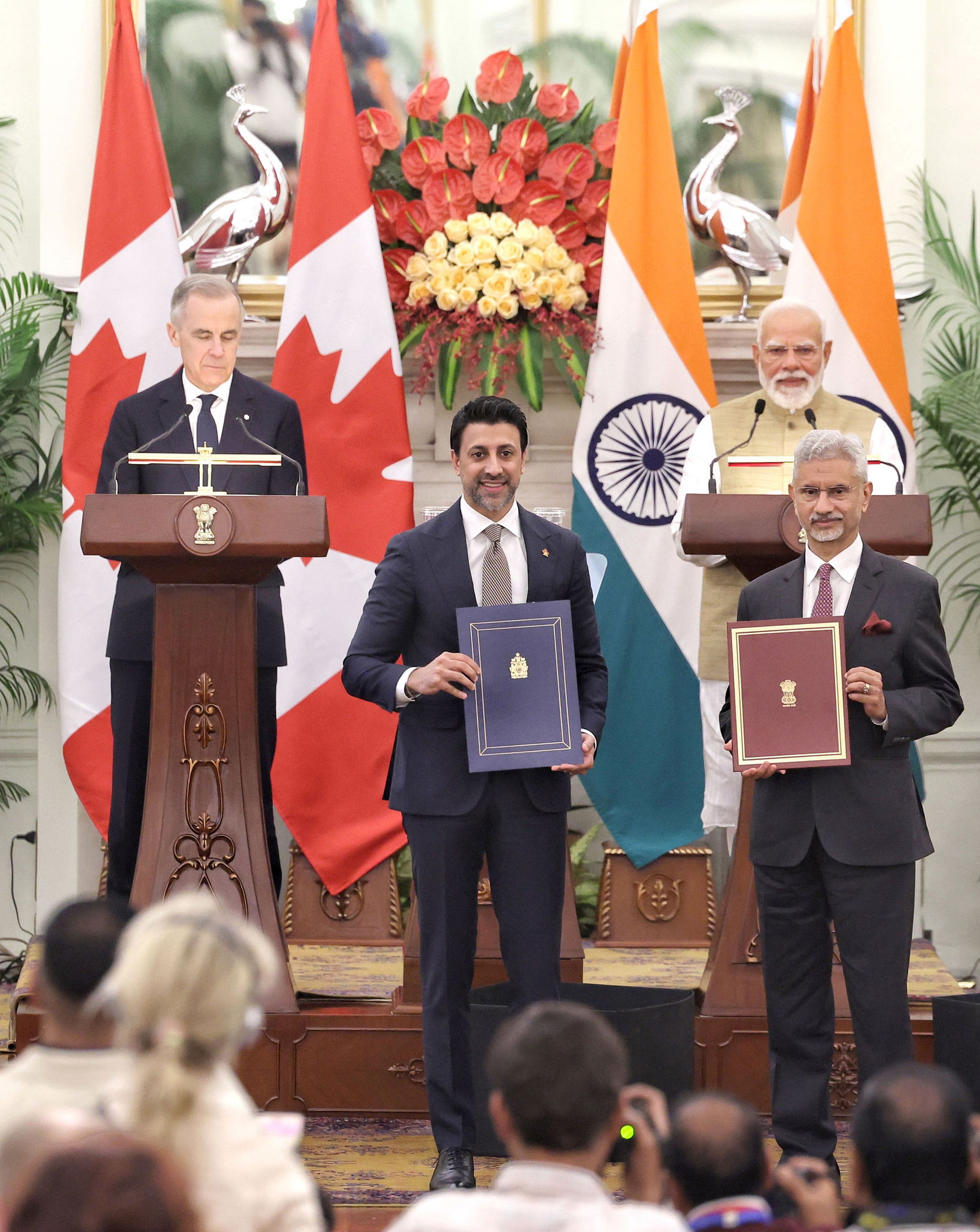
Our objective is to expand bilateral trade to 50 billion dollars by 2030. Unlocking the full potential of our economic cooperation remains a priority for us. Accordingly, we have decided to expedite the finalisation of the Comprehensive Economic Partnership Agreement. This will create new opportunities for investment and employment in both countries.
Canadian pension funds have invested 100 billion dollars in India. This stands as a testament to their deep confidence in India’s growth story.
Today, we will also be meeting business leaders from both countries. Their insights and recommendations will help shape the roadmap of our economic partnership.
Friends,
In the domains of technology and innovation, we are natural partners. Through the Canada–India Innovation Partnership, we will turn ideas into global solutions.
I express my appreciation to Prime Minister Carney for Canada’s valuable contribution to the success of the AI Impact Summit held in India last month. Beyond Artificial Intelligence, we will also deepen our cooperation in the fields of quantum technologies, supercomputing, and semiconductors.
The Memorandum of Understanding concluded today on Critical Minerals will strengthen resilient supply chains. In the space sector, we will connect startups and industries from both our countries.
Friends,
For Prime Minister Carney, the environment is not a separate agenda, but an integral part of economic stability. In the energy sector, we are forging a Next Generation Partnership that will place special emphasis not only on hydrocarbons, but also on renewable energy, green hydrogen, and energy storage.
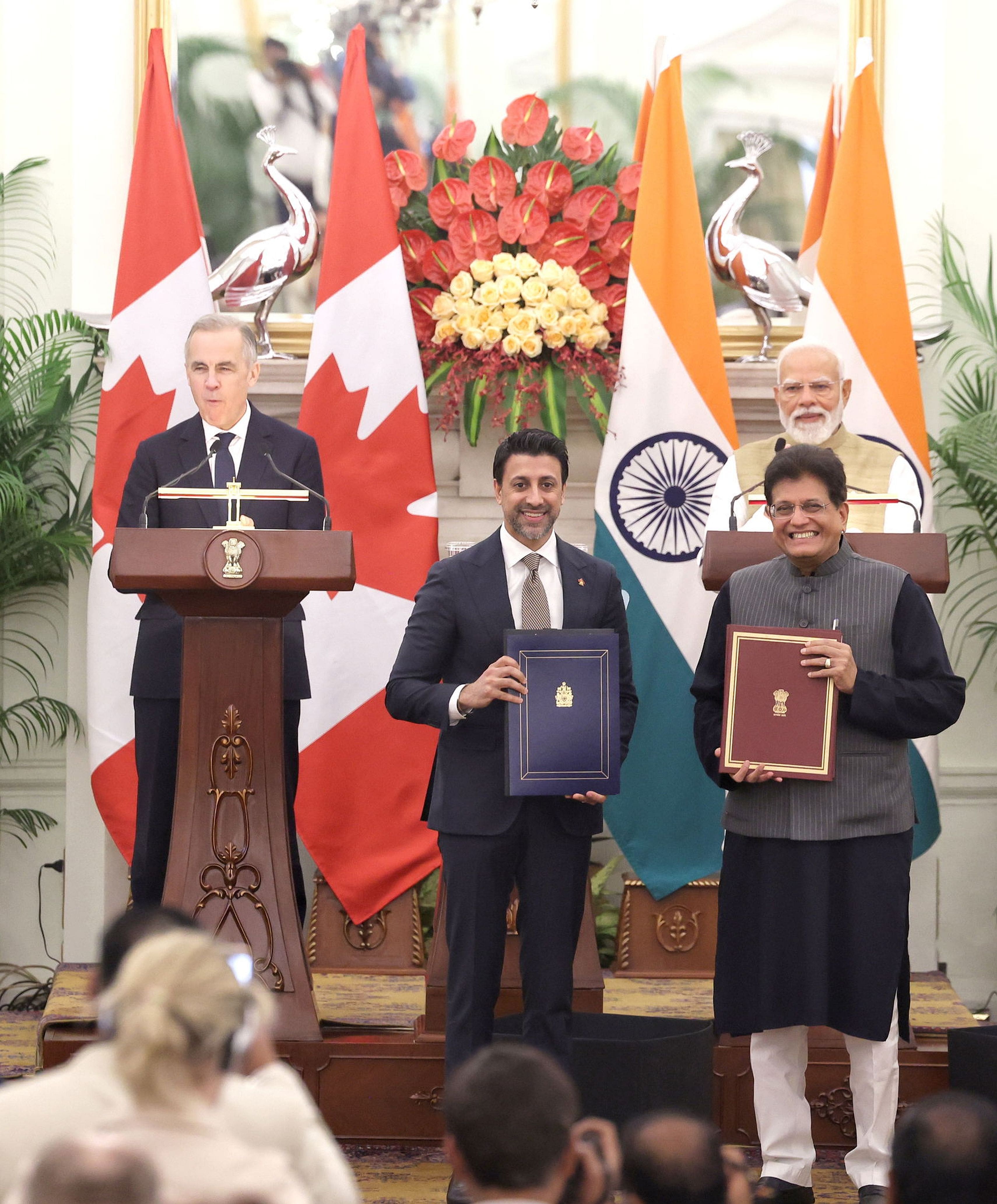
We are pleased that Canada has decided to join the International Solar Alliance and the Global Biofuel Alliance. To further advance our shared efforts, we will be convening the India-Canada Renewable Energy and Storage Summit later this year.
In the field of civil nuclear energy, we have concluded a landmark agreement for the long-term supply of uranium. We will also work together on Small Modular Reactors and advanced reactors.
Value addition in agriculture, agri-technology, and food security are our shared priorities. In this direction, an India-Canada Pulse Protein Centre of Excellence will be established in India.
Friends,
The growing cooperation in the fields of defence and security reflects the depth of our mutual trust and the maturity of our relationship. We will work towards strengthening collaboration between our defence industries, enhancing maritime domain awareness, and expanding military exchanges. In this spirit, we have decided today to establish the India-Canada Defence Dialogue.
Friends,
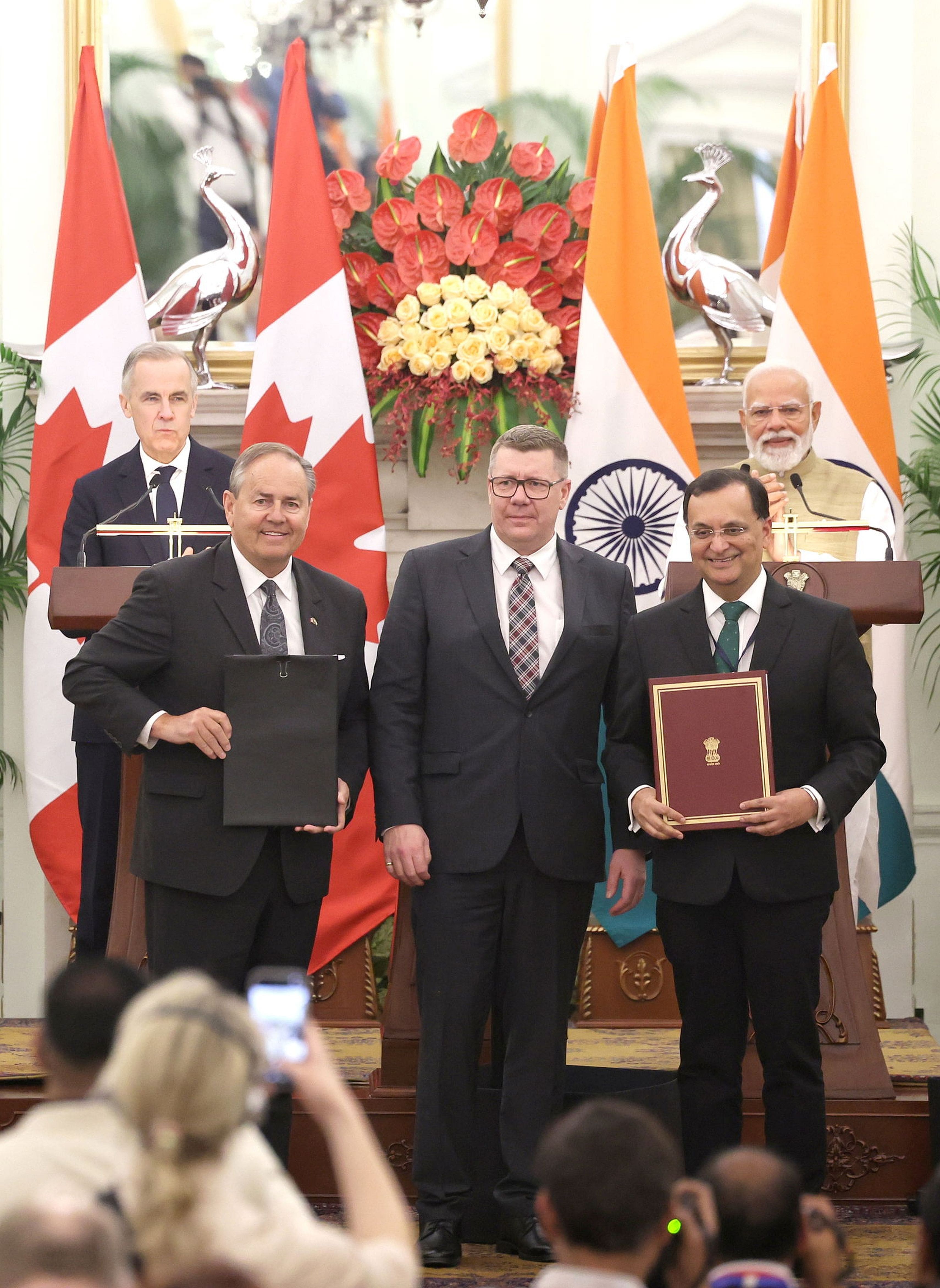
People-to-people ties are the true strength of our relationship. Today, we have taken several important decisions to further strengthen them. New partnerships among universities are being announced today in areas such as Artificial Intelligence, healthcare, agriculture, and innovation. We have also agreed to facilitate the establishment of campuses in India by Canadian universities.
Indigenous and tribal communities form an important part of our shared cultural heritage. To promote greater cultural exchanges, a Memorandum of Understanding has been concluded between our two sides today.
Friends,
For India, Canada is an important partner in the Indo-Pacific. We welcome its interest in becoming a Dialogue Partner in the Indian Ocean Rim Association. This will impart new depth to our maritime cooperation.
We are in agreement that terrorism, extremism, and radicalisation constitute shared and grave challenges, not only for our two countries, but for humanity as a whole. Our close cooperation in combating these threats is of utmost importance for global peace and stability.
India’s position regarding the tensions prevailing across the world has been clear and consistent. We have always called for the preservation of peace and stability. When two democracies stand together, the voice for peace becomes even more powerful and resonant.
The current situation in West Asia is a matter of deep concern for us. India supports the resolution of all disputes through dialogue and diplomacy. We will continue to work closely with all countries to ensure the safety and security of Indian nationals present in the region.
Excellency,
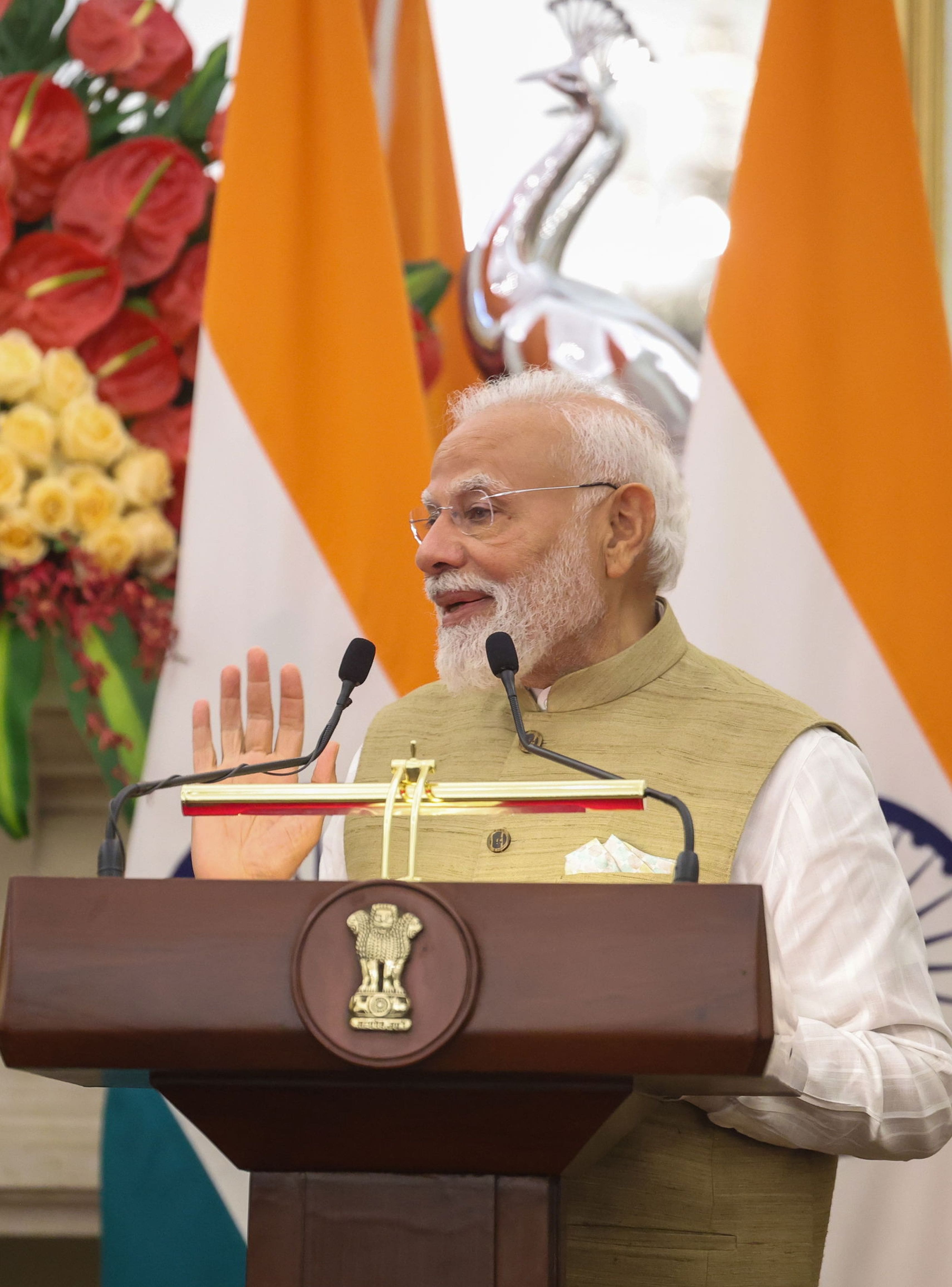
Your visit has imparted renewed strength to every dimension of our cooperation. I once again extend my heartfelt appreciation for your deep commitment to India and for your visionary leadership.
Thank you very much.
With Canada and India innovation partnership, we will turn ideas into global solutions: PM @narendramodi
— PMO India (@PMOIndia) March 2, 2026
कृषि में value addition, agri-technology और खाद्य सुरक्षा हमारी साझा प्राथमिकताएं हैं।
— PMO India (@PMOIndia) March 2, 2026
इस दिशा में भारत में India-Canada Pulse Protein Centre of Excellence स्थापित किया जाएगा: PM @narendramodi
Civil Nuclear Energy में हमने long term uranium supply की landmark deal की है।
— PMO India (@PMOIndia) March 2, 2026
हम Small Modular Reactors और advanced reactors पर भी मिलकर काम करेंगे: PM @narendramodi
हमें ख़ुशी है कि कैनेडा ने International Solar Alliance और Global Biofuel Alliance से जुड़ने का निर्णय लिया है।
— PMO India (@PMOIndia) March 2, 2026
हमारे साझा प्रयासों को आगे बढ़ाने के लिए हम इस वर्ष India-Canada Renewable Energy and Storage Summit आयोजित करेंगे: PM @narendramodi
हम defence industries, maritime domain awareness और military exchanges बढ़ाने पर काम करेंगे।
— PMO India (@PMOIndia) March 2, 2026
इसी उद्देश्य से आज हमने India-Canada Defence Dialogue की स्थापना करने का निर्णय लिया है: PM @narendramodi
हम सहमत हैं कि Terrorism, Extremism और Radicalisation दोनों देशों के लिए ही नहीं, पूरी मानवता के लिए साझा और गंभीर चुनौतियाँ हैं।
— PMO India (@PMOIndia) March 2, 2026
इनके विरुद्ध हमारा करीबी सहयोग वैश्विक शान्ति और स्थिरता के लिए अत्यंत महत्वपूर्ण है: PM @narendramodi
पश्चिम एशिया की वर्तमान स्थिति हमारे लिए गहरी चिंता का विषय है।
— PMO India (@PMOIndia) March 2, 2026
भारत dialogue और diplomacy के माध्यम से सभी विवादों के समाधान का समर्थन करता है।
इस क्षेत्र में मौजूद सभी भारतीय नागरिकों की सुरक्षा के लिए हम सभी देशों के साथ मिलकर काम करते रहेंगे: PM @narendramodi