India is not just progressing, India is moving to the Next: PM Modi

Published By : Admin | March 12, 2026 | 22:47 IST
We have One goal, one destination, ‘Viksit Bharat’: PM
Despite many global crises, the world's leaders and experts look to India with great hope: PM
If you want to be part of the future, you have to be in India : PM
India is not just progressing; India is moving to the Next level : PM
India will make every effort to ensure that its farmers and citizens are protected from the burden of global challenges : PM

Today, March 12, is a very historic day. On March 12, 1930, Mahatma Gandhi started the Dandi Yatra from Sabarmati Ashram. This was a turning point in India's independence movement because this journey connected every corner of the country with a single goal: India's independence. Today, around 100 years after this historic journey, we Indians have set out on another journey. This journey is the journey of Developed India (Viksit Bharat). Our goal is one, our destination is one - Developed India. And in the attainment of this goal, the churning that happens in such summits and the nectar derived from them play a big role. I am grateful to all of you for inviting me to the Next Summit. Many colleagues from the country and the world have come here; some are old acquaintances as well. I greet you all.​

​Friends,

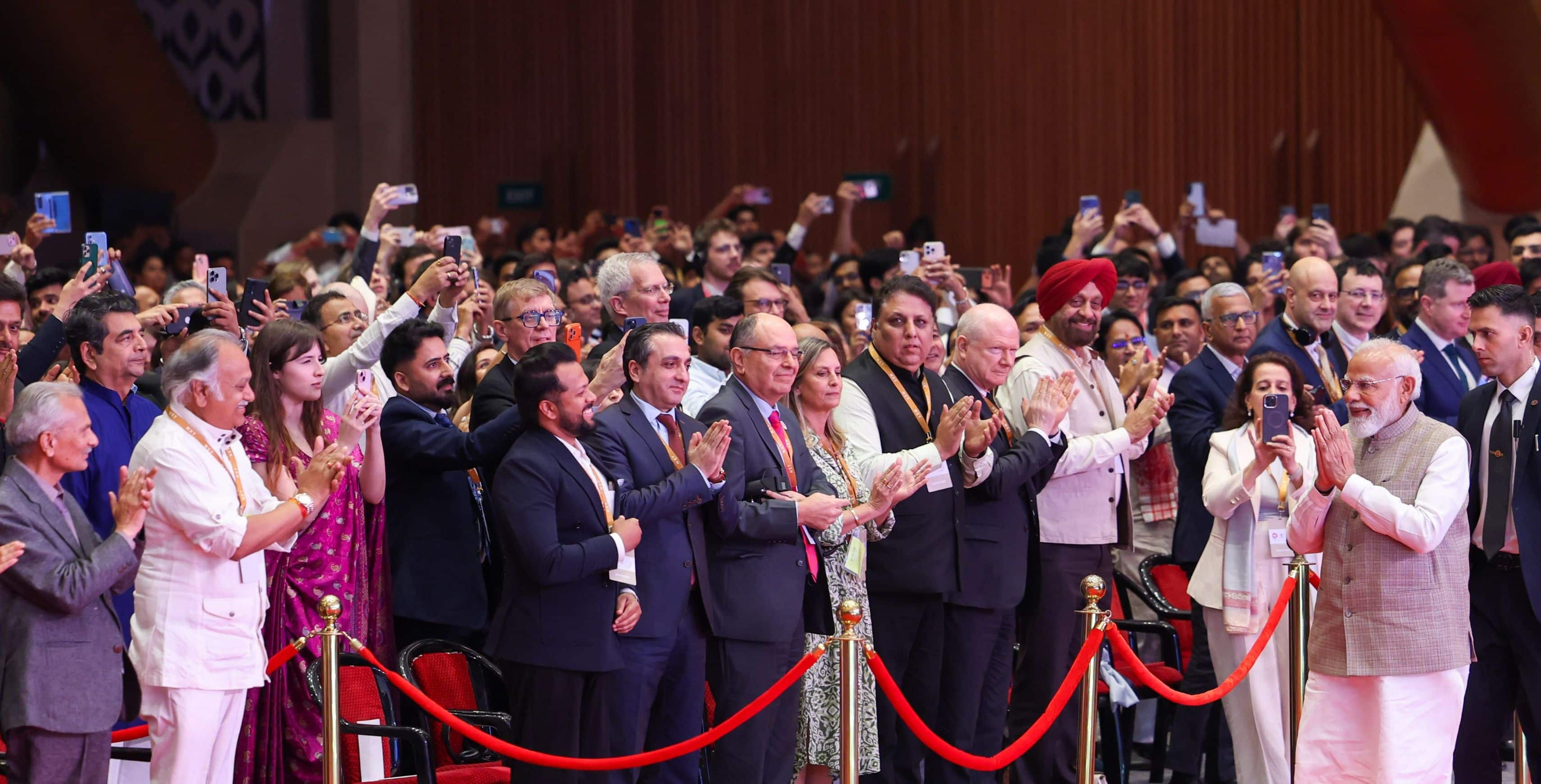
​This period of the 21st century is like "na bhuto na bhavishyati" (neither happened before, nor will happen in the future). On one side is the horror of war, supply chains are being destroyed again, and questions are being raised on the relevance of global institutions like the United Nations. In such a period, our India is moving forward, even in these adverse circumstances. Today, at an important stage in history, the country whose name is discussed most is India. Amidst so many crises at present, every serious leader and every knowledgeable person in the world has great expectations regarding India. Just recently, the President of Finland, Alexander Stubb, came to India. He said that the Global South will now decide the direction of the world, and the most powerful country to determine that direction will be India. Before this, Canada's PM Carney also said that over the next three decades, the centre toward which the world's Economic Gravity is shifting is India. French President Macron also believes that India has become an inevitable partner in solving the world's biggest issues. Today, if we extract the essence of the statements from global leaders in the tech and economic worlds, only one sentiment emerges. If you want to be a part of the future, you have to be associated with India; you have to be in India.
​​Friends,

​Just now India has won the T20 World Cup. Everyone is happy, and in India, the matter of cricket is such that if talk of crores is going on in some office, some great presentation is going on, guests from abroad are giving a presentation, even then, he moves his eyes away from the slide for a moment to see what the score is. And someone or the other definitely asks—brother, what happened to the score? The same situation holds for the Indian economy today. Today, everyone wants a running commentary of the economy. What was the status of India's economy last month? What is the condition today? Countrymen remain curious to know all this. I do not remember whether such curiosity was in the country before. And if it was, when was it? This shows the level of Indians' aspirations and self-confidence today. This is also the biggest reason for the world's trust in India.

​And friends,

​Certainly, when so many expectations are attached, when the eyes of the world are on our country, then the responsibility of all of us increases even more.

​Friends,

​Today's India is not just moving forward. India is taking itself to the Next Level. Today, Next Generation physical infrastructure is being built in the country; we are moving toward Next Generation digital infrastructure. UPI has taken Digital Payments to the Next Phase. Today, India has become the country with the fastest real-time digital payments in the world.

​​Friends,

​India today is also doing Next Generation reforms; it is riding on the Reform Express. At one time in India, many tasks and many decisions were considered Next to Impossible; today, India is taking those decisions too. It was once said that removing Article 370 was impossible. But today, the wall of Article 370 has fallen in Jammu and Kashmir. Once it seemed that everyone's connection to the banking system is impossible. But today, more than 50 crore Jan Dhan accounts have made this possible. Once, it seemed that ending Triple Talaq is impossible. But today, Muslim sisters have received freedom from this injustice. Once, 33 per cent reservation for women in the Lok Sabha and Legislative Assemblies also seemed impossible. But today a law has been made for this. Once, India's limits were highlighted in space and advanced technology. But today Moon Mission, Semiconductor Mission, Quantum Mission—all these are leading India toward the Next Frontier of Technology.

​Friends,

​Today's India is not only dreaming dreams. India is making them true. That is why today the world is saying that India is not just progressing. India is moving to the Next

​Friends,

​A very important basis for a country's development is how we handle challenges. We all know that global circumstances change suddenly. In past years, we first saw the disaster of Corona, then saw the Russia-Ukraine crisis, and now another big war is going on very close to us. This war has pushed the entire world into a very big energy crisis.

Friends,

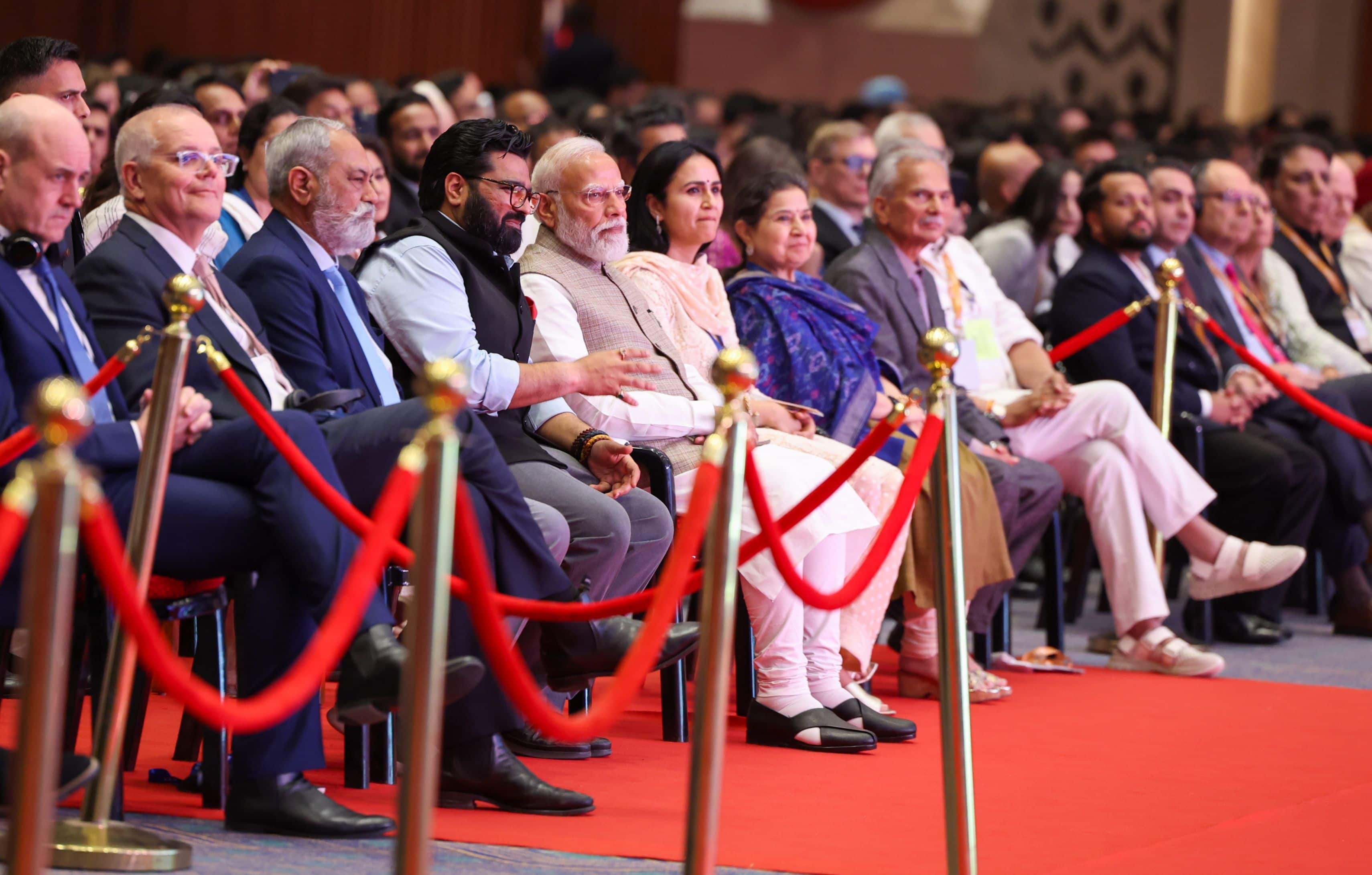
​In such dire circumstances, it is very important how we as a nation compete with this. A time of crisis is, in a way, a test of the entire nation. We have to deal with the circumstances with peace and patience. By increasing public trust and making people aware, we have to move forward. And everyone has a role in this. Every political party, media, social institutions, industry, youth, village, city—everyone's role is important. And we have seen in the Corona period that when everyone moves together, the country's potential to compete with the crisis increases many times. Today, there is another challenge before the country, and therefore, we will have to make efforts together, keeping the national interest paramount and fulfilling our duties.
​Friends,

​Nowadays, there is much discussion regarding LPG. Some people are trying to create panic to push their own agenda. I do not want to make political comments about them at this time. But I will certainly say that by doing so, they are getting exposed before the public themselves and are also doing great damage to the country. 

​Friends,

​Today, no country is untouched by the impact of this global crisis stemming from the war. To a greater or lesser extent, everyone is a victim. The Government of India, too, is leaving no stone unturned to deal with this crisis. And we are making efforts at different levels. In recent days, I have had conversations with the top leaders of many countries about this. Efforts are also ongoing to overcome the obstacles that have arisen in the supply chain. 

​Friends,

​To support India's rapid development, it has been necessary to continuously promote different energy sources. And to strengthen this, we have worked on two levels simultaneously. First, that energy access increases in the country, we prepared the infrastructure.

​And second so that we do not have to depend only on foreign countries for Energy, we emphasized self-reliance in the Energy sector. Now I give you some figures of the Gas sector itself. As of 2014, there were only 14 crore LPG connections in the country. That is, only about half of the families in the country had LPG connections. Today, there are more than double that number, i.e., about 33 crore domestic LPG connections. In the past 11 years, we have doubled our bottling capacity. Distribution centres have also increased from 13,000 to more than 25,000. In 2014, there were only 4 LNG Terminals in the country; today, their number has also doubled. The gas pipeline, which used to be about 3,500 kilometres long, has been expanded to 10,000 kilometres. Because about 60 per cent of LPG comes from abroad, import terminal capacity has also been significantly expanded at the country's large ports. 

​Friends,

​Before 2014, only 25-26 lakh houses in the country had access to cheap gas through pipes, i.e., PNG. Today, this number has also reached more than 1.25 crore. In 2014, vehicles running on CNG in the country were also not more than 10 lakhs. Today, this number is more than 70 lakhs. And this is becoming possible only because City Gas Distribution networks have been established in more than 600 districts of the country in the last decade. 

​Friends,

​This global crisis has once again shown why it is so necessary for any country to be self-reliant. That is why in past years, we have worked in a holistic way to make India self-reliant in energy sectors. 

​Friends,

​To reduce dependence on petroleum, we emphasised ethanol and biofuels. Before 2014, the country had only one-to-one-and-a-half per cent ethanol blending capacity. Today, we are reaching near-20 per cent ethanol blending in petrol. If this work had not been done, we would have had to buy about 18 crore barrels of additional oil from abroad in the past 11 years. Looking at the situation today, due to ethanol, we have to import about 4.5 crore barrels less oil per year. That is, the country has saved about 1.5 lakh crore rupees from this alone.
​Friends,

​A very big consumer of petroleum in India is also our Railways. The electrification of railway lines in our country began 60 years ago. Despite this, until 2014, only 20 percent of railway routes could be electrified. On the remaining railway routes, thousands of diesel engines used to run. Today, nearly 100 percent electrification of the broad-gauge network in India has been completed. Due to this, in the year 2024-25 alone, Indian Railways has saved about 180 crore liters of diesel. If electrification had not happened, extra crude oil would have had to be imported every year to produce this much diesel. Similarly, we increased the metro network and focused on electric mobility.

​Similarly, we have done another very big job regarding renewable energy. Today, half of our total installed power generation capacity comes from renewable sources. Our total renewable capacity today has crossed the historic figure of 250 gigawatts. Just think: in 2014, India's solar power capacity was only 2 gigawatts; today it has increased about 40 times to 130 gigawatts. To increase the use of electricity over gas for domestic use, the PM Surya Ghar Muft Bijli Yojana was implemented. So far, about 30 lakh families have installed rooftop solar under this scheme. 

​Friends,

​Apart from this, we also worked on the GOBARdhan scheme. Under this, work was done on making Compressed Biogas. So far, more than 100 plants have started in the country and work is going on more than 600. 

​Friends,

​In the field of petrol-diesel, we have also made extensive efforts in the direction of capacity building. Before 2014, India had almost no strategic petroleum reserve—that is, the capacity to store crude oil for times of crisis. Today, we have a strategic petroleum reserve of more than 50 lakh tonnes. And work is going on for even more capacity. In the past decade, we have also increased our refining capacity by more than 40 million tonnes annually. Only then has India become one of the world's largest refining hubs today. That is, you can guess on what a large scale and in what great directions we are working to make India self-reliant. We will certainly be able to compete with this crisis arising from the war. I have full faith in the 140 crore countrymen. Just as we brought the country out of the Corona crisis by being organised together, in the same way, we will overcome this global crisis too. And I will repeat again, as far as the government is concerned, we will not let any deficiency remain in any kind of effort or attempt. In every decision, the public interest will remain paramount. 

​Friends,

​From the Ukraine war until today, we have seen how its impact continues to fall from the global market to the citizens of the world. But it has always been the every possible effort of the Government of India that the burden of the circumstances created by the war does not fall on the citizens of India. For example, when the Russia-Ukraine crisis escalated, fertiliser prices skyrocketed. Despite this, the bag of urea which was available for 3000 rupees in the international market, we gave to our farmers for only 300 rupees. 3000 rupees was going on in the world, in our place it was being given for 300; this time too, our every possible effort will be that the war has the minimum impact on the lives of the country's farmers and the country's citizens. 

​Friends,

​At this important time today from this stage today, there is also a request to the state governments. It is necessary that black-marketing not occur and that rumours not spread; therefore, serious monitoring of the situation is required. Strict action is also necessary against those who are doing black marketing.
​Friends,

​The past decade has been one of sensitive governance along with self-reliance. A large part of our country, the people living there, remained far from the thinking of the Congress governments sitting in Delhi. But our government connected the people left behind in the race of development to the priorities of governance. Today, for the construction of such infrastructure as housing, roads, schools-hospitals in these areas, special campaigns like Aspirational District scheme, Aspirational Block scheme, and PM JANMAN scheme are being run. 

​Friends,

​A very big sin of the Congress governments was also that they left a large part of the country to burn in the fire of Maoist terror. A very large part of almost every big state of the country was in the grip of Maoist terror. But friends, n the past years, the country took a resolution to change this situation. We moved forward with high morale. And the country is seeing its result today. In the year 2013, more than 180 districts—more than 180 districts—were affected by Maoist terror. Today, the number of districts affected by Maoist terror has reached single digits.​Friends,

​In the past year alone, more than 2100 Naxals have surrendered, more than 900 arrests have been made, and those who were not ready to give up weapons, security forces have killed more than 300 such hardcore Naxals. The result is that in the areas that were once forced to live under the shadow of fear, a new energy of development is flowing today. 

​Friends,

​The speed at which India is moving forward today makes it is impossible to stop the speed of its progress. The aspiration of 140 crore Indians is at the next level today. I know that when one dream is fulfilled, new dreams, new aspirations take birth. I do not consider this a burden, but rather consider it the capital of the people's trust. Yes... I have some such well-wishers in the country who think that under the burden of expectations, Modi will someday be crushed, will someday be suppressed; but their intention is so foul that their expectations are never fulfilled, and as long as the blessings of the countrymen are there, they will not be fulfilled either. Now only the hopes and aspirations of 140 crore Indians will be fulfilled. India will become self-reliant in every sector; India will become developed in every condition.

​With this sentiment, I conclude my speech.

​A huge thanks to all of you again.

​Thank you!

Explore More
Today, the entire country and entire world is filled with the spirit of Bhagwan Shri Ram: PM Modi at Dhwajarohan Utsav in Ayodhya

பிரபலமான பேச்சுகள்

Today, the entire country and entire world is filled with the spirit of Bhagwan Shri Ram: PM Modi at Dhwajarohan Utsav in Ayodhya
Lakshadweep Tourist Numbers Soar After PM Modi’s Appeal, Maldives Sees Sharp Dip In Indian Visitors

Media Coverage

Lakshadweep Tourist Numbers Soar After PM Modi’s Appeal, Maldives Sees Sharp Dip In Indian Visitors
NM on the go

Nm on the go

Always be the first to hear from the PM. Get the App Now!
...
India-Italy Joint Declaration
May 20, 2026

At the invitation of the President of the Council of Ministers of the Italian Republic, Giorgia Meloni, the Prime Minister of India, Shri Narendra Modi, paid an official visit to Italy on 19-20 May 2026. The visit, following Prime Minister Modi’s visit to Italy in June 2024 for the G7 Summit and Prime Minister Meloni’s visit to India for the G20 Summit in 2023, provided renewed momentum to the bilateral ties. The two leaders decided to elevate India-Italy relations to the level of a Special Strategic Partnership.

Political Dialogue

The two Prime Ministers welcomed the strong momentum of high-level exchanges and agreed to hold annual meetings of leaders including on the sidelines of multilateral events, as well as regular Ministerial and institutional-level meetings.

They appreciated the concrete progress achieved across the diverse pillars of the Joint Strategic Action Plan 2025-2029 adopted by the two leaders in their meeting during the G20 Summit held in Rio de Janeiro in November 2024. They agreed to establish Foreign Ministers-led mechanism to review the India-Italy Joint Strategic Action Plan 2025-29 and provide strategic guidance to India-Italy Special Strategic Partnership.

Economic Cooperation and Investments

Both leaders expressed satisfaction at the growing dynamism of bilateral economic and industrial cooperation, with three high level business fora held since the last year. Building on the opportunities arising from India’s rapid and consistent economic growth and the successful conclusion of the negotiations for the EU–India Free Trade Agreement, they reaffirmed the shared objective of expanding bilateral trade in both direction with aim to reach to € 20 billion by 2029.

They welcomed the increase of bilateral investments in key sectors and encouraged the respective industries to forge industrial and technology partnerships in order to build resilient supply chains. They welcomed the prospect of greater investments, particularly in textiles, clean technologies, semiconductors, automotive, energy, tourism, pharmaceuticals and medical technologies, digital technologies, critical raw materials, steel, ports and infrastructure. They encouraged industries to utilize the policy incentives and schemes in place in both countries which seek to enhance business linkages and production facilities.

Both Prime Ministers agreed to encourage dialogue and cooperation among stock exchanges, investment funds, venture capital, banks, insurance companies and financial institutions.

They agreed to facilitate industrial partnerships, including between SMEs, to foster deeper integration of supply chains. They encouraged new sectoral missions in the coming months in priority areas of mutual interest.

The two Prime Ministers welcomed the signing of the Memorandum of Understanding for cooperation in Critical Minerals. They agreed to further strengthen and expand bilateral cooperation in field of critical minerals by establishing a structured framework for collaboration, with particular emphasis on sustainability and resilient supply chains. They underscored the importance of promoting joint efforts in recovery of critical minerals from unconventional sources, including electronic waste and mine tailings, as an integral component of circular economy initiatives. They also expressed satisfaction on signing of the Memorandum of Understanding for cooperation in the field of agriculture and agricultural research between respective ministries and institutions.

Connectivity

The two Prime Ministers reaffirmed their commitment to cooperate on the India-Middle East-Europe Economic Corridor (IMEC), recognising its transformational potential in reshaping and promoting global trade, connectivity and prosperity. Appreciating the preliminary discussions around the project, they encouraged the first IMEC Ministerial meeting to take concrete steps for advancing this initiative in 2026.

They welcomed the signing of an MoU on maritime transport and ports and directed their respective ministries/departments to establish a joint working group to implement the MoU at the earliest.

Science, Technology, Innovation, Start-ups and Artificial Intelligence

The two Prime Ministers reaffirmed that innovation, science and technology are core drivers of the India-Italy partnership.

They announced the creation of INNOVIT India, an innovation hub located in India aimed at strengthening cooperation between the respective innovation ecosystems, support startup acceleration programs, market access and business matching, joint research, university collaboration, and talent mobility in sectors including fintech, healthcare, semiconductors, logistics and supply chains, agritech, energy, quantum computing, and artificial intelligence. Both leaders welcomed the inaugural Science and Innovation Dialogue between Indian and Italian universities and research centres held in Delhi in April 2025 and look forward to holding its next edition in Italy later this year.

Both leaders underlined the importance of an open, free, secure, stable, accessible and peaceful ICT environment, which is an enabler for innovation and economic growth. PM Modi thanked PM Meloni for Italy’s constructive participation in the AI Impact Summit that took place on 19th February 2026 in New Delhi. Both leaders reaffirmed their commitment to a human-centric, secure, trustworthy and robust Artificial Intelligence. They agreed to collaborate in this domain including in third countries.

The two Prime Ministers placed particular emphasis on opportunities for cooperation in the field of supercomputing.

Building on the 2025–2027 Executive Program for Scientific Cooperation, they supported the implementation of joint projects and the facilitation of mobility of researchers in area of quantum technologies, renewable energy, green hydrogen and sustainable blue economy. They also welcomed the ongoing implementation of the Memorandum of Understanding for cooperation in the field of scientific research and the launching of a joint call for proposals to fund research projects.

The two Prime Ministers acknowledged the longstanding scientific collaboration between the Indian Academia and the International Centre for Theoretical Physics (ICTP) in Trieste and welcomed the signing of a Letter of Intent between the Indian Department of Science and Technology and the Elettra Sincrotrone center in Trieste, Italy in support of activities related to the access of synchrotron radiation facility at Elettra for Indian researchers.

Space

While appreciating the ongoing collaboration between Italian Space Agency and the Indian Space Research Organisation, the two leaders agreed to strengthen the partnership on Earth observation, heliophysics and space exploration, with focused thematic engagement and to explore cooperation on access to space and protection of space infrastructures. They expressed satisfaction with the recent reciprocal visits of their respective space industry delegations and looked forward to further promote commercial collaboration through exchanges of experts and joint initiatives also in third countries.

Defence

Both Prime Ministers expressed satisfaction with the deepening of defence cooperation including through Ministerial exchanges, service-to-service ties, port visits, and welcomed the adoption of a Joint Declaration of Intent and a Defence Industrial Roadmap which will promote partnerships for technological cooperation, co-production and co-development projects, including helicopters, naval platforms, marine armament and electronic warfare. They also recognized the importance of protecting critical infrastructures and their related supply chains through the strengthening of industrial resilience.

The two sides agreed to examine the feasibility of establishing an annual high level military structured dialogue, complementing the work of the Joint Defence Committee and the Military Cooperation Group, and to promote joint exercises and inter-force courses.

Both leaders agreed to launch a Dialogue on Maritime Security, with the aim of increasing maritime security cooperation, coordination, and the exchange of information and best practices in the maritime domain.

Security

The two leaders strongly condemned terrorism and violent extremism in all its forms and manifestations, including cross border terrorism. The two leaders strongly condemned the April 2025 Pahalgam terror attack and reiterated their commitment to cooperate in the fight against terrorists and terrorist groups and their affiliates including those listed in the UN Security Council 1267 Sanctions regime. They called upon all countries to continue to work towards eliminating terrorist safe havens and infrastructure, disrupting terrorist networks and combating the financing of terrorism, consistent with the Financial Action Task Force’s guidelines. Both leaders reiterated their commitment to work together at the UN, FATF and other multilateral platforms.

Both leaders welcomed the first meeting of the Permanent Task Force between India and Italy on countering the financing of terrorism and the upcoming meeting of the Joint Working Group on Counter Terrorism.

Both leaders welcomed the conclusion of an MoU between the Italian Guardia di Finanza and the Directorate of Enforcement of India and looked forward to early conclusion of the Agreement on Exchange and Mutual Protection of Classified Information and the Agreement on strengthening of Police Cooperation. They also welcomed the ongoing discussions on other agreements including Extradition Treaty and Mutual Legal Assistance Treaty.

Migration and Mobility

The two leaders agreed to enhance mobility of students, researchers and skilled workers, particularly in STEM sectors, and to expand cooperation on skills development, in line with the needs of the labour market, including through a specific Joint Declaration of Intent on the facilitation of mobility of nurses from India to Italy. In this context, they welcomed the ongoing discussions between relevant agencies on Social Security Agreement (SSA).

They welcomed the launch of "ICI - Italy Calls India: a University-Enterprise talent bridge” aimed at enhancing the talent of Indian students enrolled in Italian universities by offering concrete pathways for guidance, matching, and qualified integration into Italian enterprises.

They also discussed the possibility of strengthening the cooperation to fight against irregular migration, labour exploitation and human trafficking to ensure safe and legal migration.

Culture and Educational Exchanges

The two leaders highlighted culture as a key pillar of bilateral dialogue and welcomed the signing of an MoU regarding Italy’s participation in the development of the National Maritime Heritage Complex in Lothal. They acknowledged the Indian National Pavilion at the Venice Art Biennale in 2026. They expressed their intention to celebrate 2027 as the "Year of Culture and Tourism between Italy and India”, which will feature a broad calendar of initiatives, and pave the way to a major exhibition on ancient cultural relations between Italy and India to be co-organized by the two Ministries of Culture.

The two leaders encouraged the organization of an Italy–India Cultural Forum, bringing together institutions, experts, and representatives of the creative industries. The two leaders appreciated the launching of the twinning program between Indian and Italian sites inscribed on the UNESCO World Heritage List, aimed at strengthening cooperation in the protection, enhancement and management of cultural heritage.

The two leaders agreed to further develop the film and audio-visual cooperation between the two Nations, building on the strength and innovative capacities of their industries and on the legal framework provided by the bilateral co-production agreement.

The two Prime Ministers reaffirmed their intention to strengthening cooperation in higher education and welcomed the adoption of the Indo-Italian Roadmap on Higher Education and Research. Prime Minister Modi invited Italian universities and institutions of excellence to open campuses in India under India’s New Education Policy.

India-EU Relations

The Leaders welcomed the new Joint India–EU Comprehensive Strategic Agenda agreed at the India–EU Summit on 27 January 2026 and the conclusion of negotiations of the India–EU Free Trade Agreement which would elevate ties to a new level by enhancing market access, reducing trade barriers, and strengthening economic security and resilience through diversified value chains and new market opportunities.

They also reaffirmed their support for strengthening the India–EU Trade and Technology Council as a key platform for cooperation in trade, critical technologies, and economic security. The leaders welcomed the India–EU Security and Defence Partnership and appreciated progress in mobility cooperation, including the MoU on a Comprehensive Framework for Mobility.

Multilateral Cooperation

Both Leaders stressed the urgent need to reform the United Nations to make it more representative and suited to present-day realities.

Both Leaders emphasized the importance of working together in the United Nations and other global platforms including G20 to protect multilateralism and uphold a rules-based international order.

Recognizing the strategic priority both countries attach to Africa, the two Prime Ministers agreed to work together in trilateral initiatives with African partners in areas such as Digital Public Infrastructure (DPI), agriculture, education, healthcare, artificial intelligence, connectivity and infrastructure and renewable energy in line with India’s development partnership in Africa and Italy’s Mattei Plan.

The Leaders reaffirmed their shared commitment to a free, open, peaceful and prosperous Indo-Pacific, in line with international law, including UNCLOS. They look forward to their continued partnership in Science and Technology and Academic cooperation pillar of Indo-Pacific Ocean Initiatives.

Both leaders expressed deep concern over the situation in the West Asia/the Middle East and its effects in the region as well as the rest of the world. The leaders welcomed the ceasefire announced on 8 April 2026 and underlined the importance of de-escalation, dialogue and diplomacy for a lasting peace in the West Asia/the Middle East. They also called for freedom of navigation and the resumption of global flows through Strait of Hormuz.

Both leaders expressed concern over the ongoing war in Ukraine, which continues to cause immense human suffering and negative global consequences. They agreed to continue to support efforts towards the achievement of a comprehensive, just and lasting peace in Ukraine through dialogue and diplomacy, in accordance with the international law and the principles of the UN Charter.

Conclusion

Noting the impressive growth and deepening of India-Italy Special Strategic Partnership, the two leaders reaffirmed their commitment to further expand cooperation across all sectors and continue close high-level consultations on key global and regional developments.

Prime Minister Modi thanked Prime Minister Meloni for the warm hospitality extended by the Government and the people of the Italian Republic and invited Prime Minister Meloni to visit India at a mutually convenient time.