INS Vikrant is not just a warship, it is a testimony to 21st-century India's hard work, talent, impact and commitment: PM
INS Vikrant is a towering symbol of Aatmanirbhar Bharat and Made in India: PM
The extraordinary coordination among the three services together compelled Pakistan to surrender during Operation Sindoor: PM
Over the past decade, our defence forces have steadily moved towards becoming self-reliant: PM
Our goal is to make India one of the world's top defence exporters: PM
The Indian Navy stands as the guardian of the Indian Ocean: PM
Thanks to the valour and determination of our security forces, the nation has achieved a significant milestone, We are eliminating Maoist terrorism: PM

Bharat Mata ki Jai!

Bharat Mata ki Jai!

Bharat Mata ki Jai!

Today is a remarkable day, this moment is unforgettable, and this sight is extraordinary. On one side of me lies the vast, boundless ocean, and on the other side is the immense strength of the brave soldiers of Maa Bharati. On one side of me lies the infinite horizon and endless sky, and on the other side stands the mighty and magnificent INS Vikrant, embodying infinite power within itself. The sparkle of sunlight on the water of the sea is, in a way, like the Deepavali lamps lit by our brave soldiers. These are our divine garlands of light. It is my great fortune that this time I am celebrating the sacred festival of Diwali amidst the valiant warriors of our Navy.

Friends,

It’s hard to express the experience in words the night I spent yesterday on INS Vikrant. I saw the excitement and enthusiasm that filled all of you. When I saw you singing songs of your own creation yesterday, and the way you described Operation Sindoor in those songs … perhaps no poet could express the feelings that a soldier standing on the battlefield can. On one hand, I witnessed military might before my eyes.

Friends,

These great ships, these aircraft that fly faster than the wind and these submarines all have their own place. But it is your spirit, your passion, that breathes life into them. These ships may be made of iron, but when you board them, they become living, fearless forces of valour. I’ve been among you since yesterday, and every single moment has taught me something new, shown me something new. When I left Delhi, my heart longed to live this very moment.

But friends,

Your hard work, your dedication, your discipline, your devotion, all of it is on such a high level, such a great height, that I have not been able to fully live it myself. But I have certainly been able to understand it. I’ve come to know it. I can imagine how difficult it must be to live that life. But when I was close to you, experiencing your breath, feeling your heartbeat, seeing that sparkle in your eyes last night, then I went to sleep a bit early, which I usually don’t. Perhaps the reason I fell asleep early was the deep sense of contentment I felt after watching you all throughout the day. It wasn’t just sleep; it was peaceful sleep born from that inner satisfaction.

Friends,

The deep night over the ocean and the sunrise this morning has made my Diwali very special in many ways. So once again, I extend my heartfelt Diwali wishes to all of you! Wishing you all, and from this heroic land of INS Vikrant Diwali greetings to every citizen of the country, and especially to your families as well!

Friends,

On the festival of Diwali, everyone wishes to celebrate it with their families. I, too, have grown used to celebrating Diwali with my family. And since you are my family, I have come here, among you, to celebrate Diwali. I am celebrating this Diwali with my family and that’s what makes this Diwali so special for me.
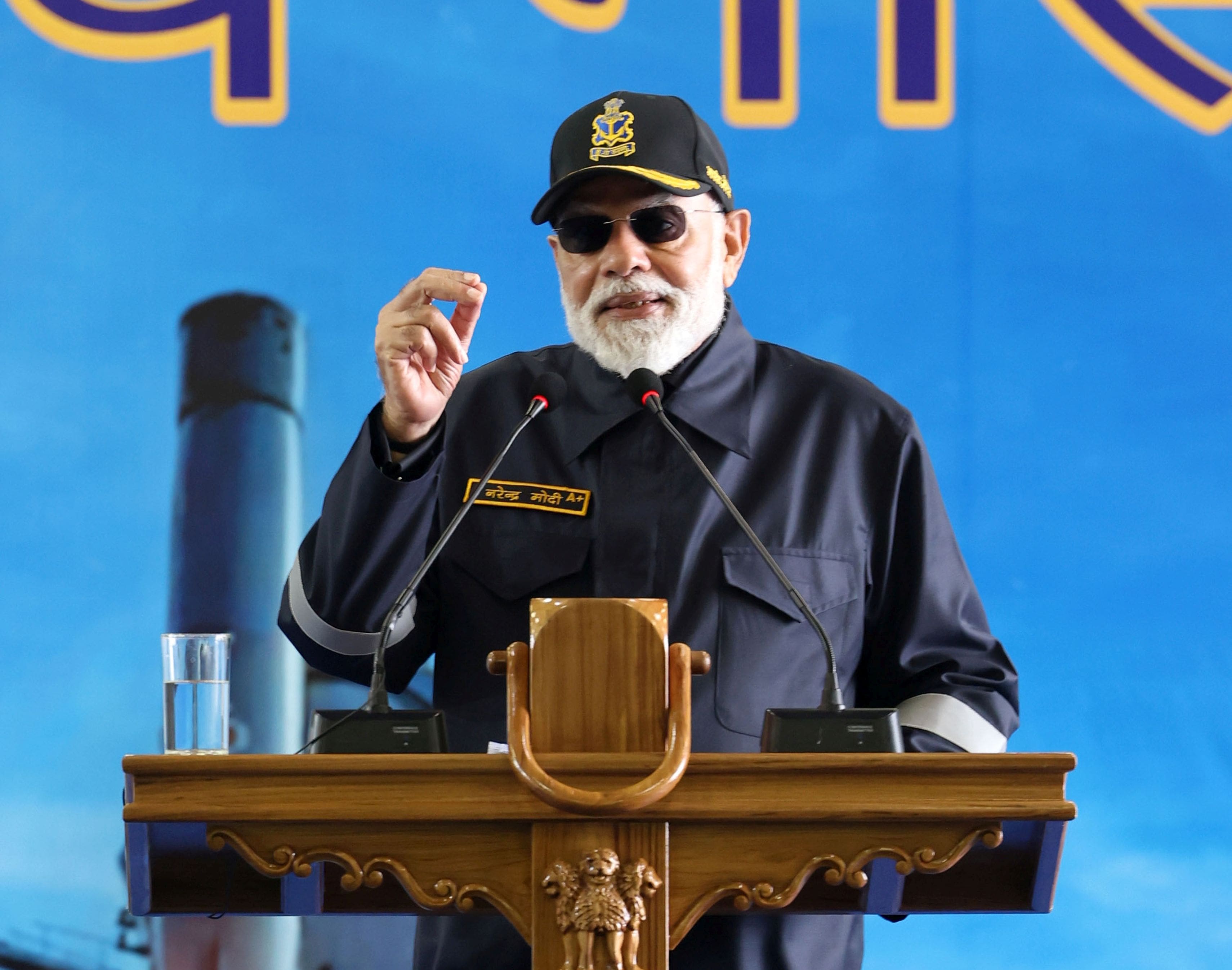
Friends,

I remember when INS Vikrant was dedicated to the nation, I had said: Vikrant is vast, grand, awe-inspiring. Vikrant is unique, it is exceptional. Vikrant is not just a warship, it is a symbol of Bharat’s hard work, talent, impact, and commitment in the 21st century. You all will remember the day Bharat received the indigenous INS Vikrant, our Navy also let go of a major symbol of colonialism. Inspired by Chhatrapati Shivaji Maharaj, our Navy adopted a new naval ensign. Chhatrapati Shivaji Maharaj ki Jai! Chhatrapati Shivaji Maharaj ki Jai! Chhatrapati Shivaji Maharaj ki Jai!

Friends,

Our INS Vikrant today is a powerful symbol of ‘Aatmanirbhar Bharat’ (self-reliant India) and ‘Made in India’. Cutting through the ocean, the indigenous INS Vikrant reflects Bharat’s military strength. Just a few months ago, we saw how even the very name of Vikrant sent shockwaves through Pakistan, stealing their sleep at night. Such is INS Vikrant, a name that alone can crush the enemy’s courage. That is INS Vikrant! That is INS Vikrant! That is INS Vikrant!

Friends,

On this occasion, I especially want to salute our armed forces. The fear created by the Indian Navy, the extraordinary skill shown by the Indian Air Force, and the bravery of the Indian Army along with the remarkable coordination of all three forces forced Pakistan to surrender so quickly during Operation Sindoor. And so, friends, once again, from this sacred place of service, this land of valour aboard INS Vikrant, I salute the brave soldiers of all three armed forces.

Friends,

When the enemy is in sight, when war is imminent, the position of one who has the strength to fight on their own is always stronger. For the forces to be strong, it is essential that they are self-reliant. These brave soldiers are born from this very soil, raised in it. The mother whose lap they were born from has also been nurtured in this same soil. And that is why they carry an inner inspiration: to give their all, even their lives, for the honour of this motherland. Even if I bring in the strongest, tallest soldiers from around the world and offer them all the money, will they be ready to die like you do? Will they give it all like you do? The strength that comes from being Indian, from having your life deeply rooted in Bharat’s soil, in the same way, as every tool, every weapon, every component becomes Indian, our strength will multiply manifold. We are proud that our armed forces have made rapid strides toward self-reliance in the past decade. Our armed forces made a list of thousands of items and decided that these will no longer be imported. As a result, most of the essential equipment for the forces is now being produced within the country. In the last 11 years, our defence production has more than tripled. Just last year, it crossed a record of 1.5 lakh crore rupees. Let me share another example with the nation: Since 2014, the Indian Navy has received more than 40 indigenous warships and submarines from Indian shipyards. To all fellow Indians listening, remember this number. I’m confident that once you hear this, the light of your Diwali lamps will shine even brighter. What is our capability today? On average, one new indigenous warship or submarine is being added to the Navy every 40 days. Every 40 days!

Friends,

Our missiles like BrahMos and Akash proved their capabilities in Operation Sindoor as well. BrahMos — just the name alone creates fear. The moment people hear BrahMos is coming, many start to worry! Now, several countries around the world want to buy these missiles. Whenever I meet world leaders, many express the same desire that they want them too! Bharat is now building the capacity to export weapons and defence equipment for all three services. Our goal is to place Bharat among the world's top defence exporters. In the last decade, our defence exports have grown over 30 times! Behind this success is the huge role played by our defence startups and indigenous defence manufacturing units. Even our startups are showing great strength and innovation today!

Friends,

When it comes to power and capability, Bharat has always followed the tradition of: ज्ञानाय दानाय च रक्षणाय! i.e., Knowledge, prosperity, and strength and all for the service and protection of humanity. Today, in this interconnected world, when global economies and development depend heavily on maritime trade routes, the Indian Navy plays a critical role in global stability. Today, 66% of the world’s oil supply, and 50% of global container shipments pass through the Indian Ocean. And in securing these routes, the Indian Navy stands guard like the sentinel of the Indian Ocean. And you are the ones doing this job. Moreover, Indian Navy is acting as a global security partner through mission-based deployments, anti-piracy patrols, and humanitarian assistance operations, in this entire region.

Friends,

Our Navy plays a major role in ensuring the security and integrity of our islands. Some time ago, we decided that the Tricolour must be hoisted on every island of the country on Republic Day. The Navy has been fulfilling this resolution every 26th January with great pride and honour. I congratulate our Navy for that! Today, the Indian Navy is hoisting the Tricolour on every island of Bharat.

Friends,

As Bharat moves ahead rapidly, we are also striving to ensure that all countries of the Global South progress alongside us. For this, we are working swiftly on the “SAGAR – Maritime Vision”. We are becoming development partners for many nations, and whenever required, we are ready to extend humanitarian assistance anywhere in the world. From Africa to Southeast Asia, the world now looks to Bharat as a true global friend in times of disaster and crisis. In 2014, when our neighbouring country Maldives faced a drinking water crisis, we launched Operation Neer, and our Navy reached there with fresh water supplies. In 2017, when Sri Lanka was hit by devastating floods, Bharat was the first to extend a helping hand. In 2018, when a tsunami struck Indonesia, Bharat stood shoulder to shoulder with the people of Indonesia in rescue and relief efforts. Similarly, whether it was the earthquake in Myanmar, or the crises in Mozambique in 2019 and Madagascar in 2020, Bharat reached everywhere with a spirit of service and compassion.

Friends,

Our armed forces have also conducted rescue operations to bring back Indians trapped abroad from time to time. From Yemen to Sudan, wherever there was a need, your courage and valour greatly strengthened the faith of Indians living across the world. We have not only saved thousands of our own citizens but also rescued citizens of other nations trapped in those countries and safely brought them home.

Friends,

Our military forces have served the nation on land, at sea, and in the air, with complete dedication, sensitivity, and devotion. At sea, our Navy safeguards the nation’s maritime borders and trade interests. In the skies, our Air Force remains ever committed to Bharat’s security. On land, from the scorching deserts to the icy glaciers, our Army, BSF, and ITBP personnel stand like an unbreakable wall. Similarly, on various other fronts, the SSB, Assam Rifles, CRPF, CISF, and our intelligence agencies work seamlessly as one unit in the service of Maa Bharati. I also take this opportunity to appreciate the Indian Coast Guard, which works in perfect coordination with the Navy to secure our coastline day and night. Their contribution to this grand mission of national defence is truly immense.

Friends,

It is because of the valour and courage of our security forces that the country has achieved another major success in recent years and this achievement is the elimination of Maoist terrorism. Today, the country stands on the brink of complete freedom from Naxalite-Maoist violence, and that liberation is knocking on the door! Friends, before 2014, around 125 districts in the country were affected by Maoist violence. Over the past 10 years, this number has kept declining from 125 districts down to just 11, and even among these, only 3 districts show traces of their influence. Out of 125, only 3 remain! For the first time, more than a hundred districts are now completely free from Maoist terror, breathing the fresh air of freedom and celebrating a truly joyous Diwali. After generations of fear and violence, millions of people are now stepping into the mainstream of development. In regions where Maoists once prevented roads, schools, and hospitals from being built, where they blew up existing schools and shot doctors, and where they didn’t allow even mobile towers to be installed, today highways are being built, industries are emerging, and schools and hospitals are shaping the future of the children. This success belongs entirely to the sacrifice, dedication, and courage of our security forces. I am happy that this year, people will celebrate Diwali with pride and happiness for the first time ever in many of these districts.

Friends,

Today, I stand among our brave soldiers. Our Navy personnel are those who walk fearlessly with death in their hands and courage and risk come naturally to you. But think of our police personnel, who usually carry nothing more than a stick. They don’t have the same kind of resources or training, their work involves maintaining peace and harmony with civilians. Yet, these very police forces, be it BSF, CRPF, or others, have fought the Naxalites with exceptional bravery. The battles they have fought deserve the highest praise. On this sacred festival of Diwali, I extend my heartfelt congratulations to all my police personnel. I know of many such brave men and women who have lost their legs but not their spirit, who have lost their arms but not their courage; some can no longer walk without a wheelchair, yet their hearts remain unshaken. I know families who were targeted by Maoist extremists, their limbs were cut off, their villages made unlivable. These countless heroes have endured immense pain and made great sacrifices so that peace could prevail, so that citizens could live better lives, and children could study and dream of a brighter future. They gave themselves for the nation’s peace and progress.

Friends,

Perhaps for the first time since independence, our police forces faced such a massive challenge. But I am confident that they have nearly eradicated this 50-year-old scourge in the last 10 years, they have succeeded in about 90% of the cases. You understand warfare well, but when war is fought within one’s own land, it requires immense patience and restraint, ensuring that no innocent life is lost. It’s been a remarkable effort and one day, volumes will be written about how this form of internal guerrilla warfare was handled. The world will study how Bharat’s brave forces destroyed Maoist terrorism through their valour and strategy. We, as Indians, are proud of this that such heroism has taken root in our very soil.

Friends,

Today, these very districts are seeing record levels of sales and purchases during the GST Bachat Utsav (Savings Festival). In areas where once Maoists didn’t even allow the mention of the Constitution, where its existence was denied, today the spirit of “Swadeshi” (self-reliance) echoes in every corner. Misguided youth who once carried 303 rifles are now embracing the Constitution.

Friends,

Bharat today is advancing at a remarkable pace. We are fulfilling the dreams of 140 crore countrymen. From the land to the skies, what was once unimaginable is now becoming reality before our eyes. This momentum, progress, and transformation reflect the faith of the nation, and from that faith springs the mantra of development. In this great journey of nation-building, our armed forces have a monumental role. You are not those who merely flow with the current. गंगा कहे गंगादास, जमुना कहे जमुनादास, this is not in the Army’s veins, No, you are not ones who drift. You have the power to direct the current, to change its course! You have the courage to guide time itself, the valour to cross the impossible, and the spirit to overcome every obstacle. The mountain peaks where our soldiers stand firm have become symbols of Bharat’s triumph. The seas on which our Navy stands guard, even the mighty waves of the ocean seem to chant Bharat’s victory. “Bharat Mata ki Jai!” — not just your voices, but every wave echoes it. You have inspired even the ocean’s tides to proclaim “Victory to Maa Bharati!” From the roar of the sea, the winds from the mountains, the dust from the deserts, if one listens carefully with heart and mind united, a single voice emerges from every grain of soil and every drop of water: Bharat Mata ki Jai! Bharat Mata ki Jai!” With this spirit of enthusiasm and confidence, I once again extend my heartfelt Diwali greetings to all of you, your families, and the 140 crore citizens of the country. May you always nurture victory, faith, and resolve within you. May your dreams take flight and reach new heights.

Now, together with me, say it aloud: Bharat Mata ki Jai! Bharat Mata ki Jai! Bharat Mata ki Jai! Vande Mataram! Vande Mataram! Vande Mataram! Vande Mataram! Vande Mataram! Vande Mataram! Vande Mataram! Vande Mataram! Vande Mataram! Thank you very much!

Explore More
Today, the entire country and entire world is filled with the spirit of Bhagwan Shri Ram: PM Modi at Dhwajarohan Utsav in Ayodhya

பிரபலமான பேச்சுகள்

Today, the entire country and entire world is filled with the spirit of Bhagwan Shri Ram: PM Modi at Dhwajarohan Utsav in Ayodhya
Pharma exports rose 2% to over $31 billion in FY26 despite sharp decline in March

Media Coverage

Pharma exports rose 2% to over $31 billion in FY26 despite sharp decline in March
NM on the go

Nm on the go

Always be the first to hear from the PM. Get the App Now!
...
Joint Strategic Vision for India-ROK Special Strategic Partnership
April 20, 2026

At the invitation of Prime Minister Shri Narendra Modi, President of the Republic of Korea (ROK) H.E. Lee Jae Myung paid a State Visit to India from 19 – 21 April, 2026, marking the earliest visit to India by a Korean President after assuming office. President Lee Jae Myung was accompanied by a high level delegation including Ministers, Senior Officials and leading CEOs of Korean Companies.

2. The two leaders held a friendly, fruitful and forward-looking bilateral meeting on 20th April 2026 in New Delhi. They underscored their respective Governments’ commitment to work together in concrete ways in multiple domains to bring lasting prosperity, peace and progress to their peoples and to foster meaningful cooperation among them in a turbulent and fast-changing world. They announced the following Joint Strategic Vision for implementingand adding further content to the India-ROK Special Strategic Partnership in the next five years (2026-2030).

3. India and the ROK, two vibrant and resilient democracies of Asia and leading world economies, are connected by deep historical ties and mutual goodwill between their peoples. The two nations share democratic and civilizational values and have similar interests in regional and global issues. India views the ROK as an indispensable partner in its "Act East” Policy. Similarly, the ROK views India as a central pillar of the ROK’s pragmatic diplomacy and inheriting and evolving the achievements of the New Southern Policy. India and the ROK also acknowledge the significant role of their partnership in fostering peace, stability, and security in the Indo-Pacific region.

Reinforcing political foundations through high-level exchanges

4. Recalling the positive spirit of their two previous meetings on the sidelines of the G7 Summit in Kananaskis in June 2025 and the G20 Summit in Johannesburg in November 2025, the two leaders agreed to have leader-level meetings annually, in either country or on the margins of international events, to realize the full potential of the India-ROK Special Strategic Partnership and to provide continuous guidance to the engagement, going forward.

5. Expressing satisfaction at the frequency of high level exchanges, which have imparted renewed momentum to the bilateral engagement, the two leaders agreed to further intensify bilateral political exchanges and ministerial dialogues. Towards this end, the leaders decided that the meetings of the India-ROK Joint Commission led by the Foreign Ministers, Finance Ministers’ Meeting, and Joint Committee of the S&T Ministers will be held this year. Further, it was agreed that the Defence Minister of India will visit the ROK in May, 2026 for the joint inauguration of the War Memorial being built to commemorate India’s participation in the Korean War. They also agreed that an India-ROK Industrial Cooperation Committee, a new dialogue mechanism of the Ministers responsible for Industries in the two countries, will be launched and will hold its first meeting this year.

6. Taking note of the visit of the ROK Deputy Speaker to India in January 2026, the two leaders supported regular exchanges of Speakers and Members of the Parliament of India and the National Assembly of the ROK. They expressed satisfaction over the establishment of India-ROK Parliamentary Friendship Groups in both countries.

7. To bring the next generation of thought leaders of India and the ROK closer, the two leaders welcomed the launch of respective programmes and initiatives by the two Foreign Ministries, starting this year, that will enable young legislators, diplomats, eminent personalities, media and officials to exchange visits, deepen mutual understanding and collaborate on common challenges and opportunities.

8. The two leaders encouraged greater exchanges between states and provinces of their nations to promote balanced regional growth, dynamism and resurgence. The two leaders also noted the sister-city and friendship-city relationships, including Busan-Mumbai, Incheon-Kolkata, and Ulsan-Chennai.

Build Deeper Understanding through Greater Strategic Trust

9. The two leaders acknowledged the similarity of their nations’ visions of a free, open, peaceful and prosperous Indo-Pacific region based on the rule of law. In this context, Prime Minister Modi welcomed the ROK joining the Indo-Pacific Oceans initiative (IPOI).

10. They underlined the importance of regular consultations on emerging strategic and security-related developments among senior officials. Following the India-ROK Foreign Policy and Security Dialogue between the two Foreign Ministries in February 2026, the two sides will aim to hold the Joint Committee Meeting on Defence Industry Cooperation and the inaugural Defence and Foreign Affairs 2+2 Dialogue at Vice Minister levels at a mutually convenient time.

11. The two leaders welcomed the launch of an India-ROK Economic Security Dialogue that aims at enhancing resilience in supply chains, promoting market diversification and advancing cooperation in cutting-edge technologies on the basis of mutual strategic trust.

12. The two leaders unequivocally and strongly condemned terrorism and violent extremism in all its forms and manifestations, including cross-border terrorism. They agreed to enhance cooperation to root out terrorists’ safe havens, eliminate terrorist financing channels and their nexus with transnational crime, and halt cross-border movement of terrorists. Both sides strongly condemned the terrorist attack in Pahalgam, Jammu and Kashmir on 22 April 2025 and called for perpetrators, organisers, and financiers to be brought to justice without any further delay. Prime Minister Modi also explained to President Lee that The Resistance Front had claimed responsibility for the attack. President Lee noted this with serious concern.

Creating Mutual Wins through Industrial Dynamism

13.The two leaders welcomed the conclusion of the MOU on India-ROK Industrial Cooperation Committee to bolster bilateral economic ties, expand trade and investment, and unlock new opportunities for collaboration across industry, with focus on bilateral cooperation in sectors such as automobile, shipbuilding, chemicals, semiconductors, telecom equipment, display, secondary batteries; and for cooperating to strengthen supply chains for strategic resources, critical minerals and rare earths; trade of green hydrogen and its derivatives, nuclear power plant projects; and overseas resource development projects.

14. India’s Maritime Amrit Kaal vision has unleashed new opportunities for long-term and strategic bilateral collaboration with the ROK, a leading shipbuilding and maritime nation. The two sides adopted a Comprehensive Framework for Partnership on Shipbuilding, Shipping and Maritime Logistics and looked forward to its early implementation. The two leaders welcomed and expressed support for a range of B2B collaborations concluded and planned between Indian and Korean businesses for shipyard development, critical infrastructure required for shipyard establishment, port operations, and shipping & maritime logistics in India. They welcomed the opening of office of Korea Marine Equipment Association (KOMEA) in Mumbai, the first such office that will contribute to the development of ancillary ecosystem to support the maritime industry.

15. The leaders also took note of the successful hosting of the India-ROK Business Forum on 20 April 2026. In order to nurture continuous business engagements, the two sides agreed to hold regular interactions among leading industry associations on the sidelines of the Industrial Cooperation Committee and its Working Groups’ meetings.The two leaders welcomed the announcements made by Indian and Korean businesses for investment and B2B collaboration.

16. The leaders agreed to foster a more conducive business environment to encourage further investment by Korean and Indian companies in each other’s markets.

17. The two leaders welcomed the conclusion of an MOU on Cooperation in the field of Small and Medium sized Enterprises (SME). They directed concerned Departments/Ministries to explore ways to extend India-ROK cooperation to the SMEs of the two countries, including activities under the ambit of MOU to connect small and medium businesses to help SMEs to smoothly explore and benefit from the respective markets.

18. Collaboration between India, a major economy enjoying robust growth in steel industry and the ROK, a technology leader in green steel-making, is of critical importance. They agreed to the establishment of an India-ROK Annual Steel Dialogue,which would focus on boosting trade opportunities, solidifying economic ties and promoting cleaner energy in the steel sector. They also welcomed the signing of an MOU between POSCO and JSW for establishing a 6 MMT Integrated Steel Plant in Odisha.

Catalysing Partnerships focussing on Trade, Finance and Development

19. Emphasizing the importance of realizing the full potential of India-ROK bilateral trade and to promote mutually beneficial exchanges in new avenues of trade including digital trade, supply chain collaboration and green economy, the two leaders welcomed the decision to resume and expedite the CEPA upgrade negotiations for early conclusion.

20. India’s fintech revolution, illustrated by the Unified Payments Interface and regulatory innovations, has created many opportunities for trans-border collaboration. The two leaders welcomed the signing of an MOU between National Payment Corporation of India Limited (NPCIL) and Korea Financial Telecommunications and Clearings Institute (KFTC) for phased integration of the digital payment systems of the two countries to enhance inter-operability and strengthen economic and people-to-people ties. They also welcomed the MOU between International Financial Services Centres Authority (IFSCA) of India and the Financial Services Commission (FSC) / Financial Supervisory Service (FSS) of the ROK for cooperation and consultation for development and supervision of cross-border financial products.

21. The two leaders expressed satisfaction with the successful holding of the ‘ROK-India Financial Cooperation Forum’ with the participation of financial authorities and institutions from both countries to strengthen cooperation in the financial sector, including banking, capital markets and fin-tech.

22. The ROK’s financial entities are important players in India’s economic development, focusing their investments on infrastructure, manufacturing, and the growing financial market. In this context, the two leaders noted the successful operation in India by the Korea Investment Corporation, and welcomed the interest of Korea Development Bank to open an office in India. Prime Minister Modi also invited the National Pension Service of the ROK to explore opening of its office in India.

23. Recognizing the potential for development partnership between India and ROK, the two leaders agreed to continue to work together to advance development cooperation for capacity-building of skilled industrial human resources in India, including ongoing projects implemented by KOICA. The two sides agreed to work together to ensure effective development cooperation between the two countries.

Future-proofing growth through partnerships in emerging industries

24.India and the ROK, two nations with strong and complementary digital capabilities, can contribute to industries and technologies defining the world’s future. The two leaders welcomed the launch of a Framework for India-Korea Digital Bridge focusing on AI, data governance and digital businesses, while also recognizing the role of enabling technologies, including semiconductors, in supporting digital innovation and cooperation. Prime Minister Modi briefed President Lee about the growth of semiconductor industry in India and welcomed Korean businesses to take advantage of government incentives and the growing market. The two leaders appreciated respective visions for AI development, inspired by the principles of "AI for All” and "MANAV” that promote innovation alongside accessibility and inclusivity. They expressed a desire to deepen India-Korea partnership across AI verticals, including for research and talent nurturing.

25.The two leaders underscored the strategic importance of India-ROK cooperation in defence industries, by reinvigorating the 2020 MOU on ‘Roadmap to Defence Industry Cooperation’. They expressed satisfaction over the successful joint venture of K9-Vajra howitzers with the second batch of production in progress. They welcomed ongoing efforts to replicate the model in other futuristic defence technologies/platforms like Self-Propelled Air Defence Gun-Missile Systems and other areas of mutual interest.

26.Recognizing the innovations in defence industry taking place in both countries, the two leaders decided to launch a ‘Korea-India Defence Accelerator’ (KIND-X) innovation platform to connect businesses, incubators, investors, defence start-ups and universities from both sides.

27. Space being a promising frontier of national development in both countries, the two leaders welcomed the initiatives to form a Joint Working Group between Indian Space Research Organisation (ISRO) and Korea Aero Space Administration (KASA), to explore opportunities for cooperation at the National Space Agency level, and the holding of an India-ROK "Space Day” in collaboration with IN-SPACe in Bengaluru on 20 April 2026, to promote collaboration among the space startups, industries and research institutes. The two leaders encouraged their sides to explore opportunities for mutual support for each other's satellite navigation systems.

Uniting for Mother Earth

28. The two leaders recognized that in the face of present turmoil in global energy and resources market, India and the ROK, as major importers of hydrocarbons and key minerals, need to work towards efficient energy use, mineral extraction, processing and recycling, and co-development of alternative energies and materials in an environmentally sustainable manner.The leaders also underlined the importance of building secure, resilient, and innovation-driven supply chains across critical minerals and advanced technologies. To this end, the two leaders agreed to cooperate across the critical minerals value chain including strengthening linkages between the geological survey organizations of the two countries for mapping and exploration of critical minerals through the use of artificial intelligence. They supported collaboration in recovery of critical minerals from unconventional sources such as e-waste and mine tailings, as part of circularity initiatives.

29. Furthermore, while President Lee welcomed India’s joining the Pax Silica initiative, Prime Minister Modi expressed appreciation for the Republic of Korea’s leadership as Chair of the Forum on Resource Geostrategic Engagement (FORGE). They also agreed to explore strengthening cooperation on securing critical materials, such as naphtha, in times of supply disruption or market instability, in accordance with market conditions and commercial considerations. The two sides will explore opportunities to expand the bilateral trade of critical materials.

30. India and the ROK are partners in combating global challenges of climate change through a positive and proactive agenda that also promotes their economic well-being. In this context, the two leaders welcomed the conclusion of an MOC under Article 6.2 of the Paris Agreement, which establishes a cooperative approach for investment-driven mitigation projects, advances the achievement of their respective Nationally Determined Contributions, and further strengthens their strategic partnership in the area of climate action.

31. As environmentally responsible nations, India and the ROK decided to pursue institutional cooperation through an MOU on Cooperation in the Field of Climate and the Environment. The two leaders welcomed the ROK joining as a member of the International Solar Alliance (ISA) and India joining as a member of the Global Green Growth Institute (GGGI). Prime Minister Modi also invited the ROK to join the Global Biofuels Alliance and the International Big Cat Alliance and Coalition for Disaster Resilient Infrastructure (CDRI).

32. In recognition of the extensive interests in India-ROK to address global challenges affecting the future of humanity, the two leaders welcomed the adoption of a Joint Statement on Cooperation in the field of Sustainability along with the launch of a dialogue between the two Foreign Ministries on Global Themes, including Climate Change, Arctic, and Maritime Cooperation.

Amplifying the soft power quotient

33. Building on the rich and shared cultural heritage of India and the ROK, thetwo leaders supported further strengthening cultural linkages between institutions in the two countries. They welcomed the extension of the Cultural Exchange Programme (CEP) for the period 2026-2030 and encouraged their concerned agencies to develop suitable plans to implement this in a befitting manner. They also decided to commemorate the year 2028-29 as the Year of India-ROK Friendship through a series of cultural activities.

34. The two leaders welcomed the signing of an MOU on Cultural and Creative Industries (CCIs). Furthermore, the two sides also agreed to promote collaboration in the film sector, including co-productions, training exchanges, and technology sharing in areas such as animation and visual effects (VFX).

35. The two leaders agreed to support activities to promote awareness about each other’s rich cultural heritage and soft power projection, including celebration of India Day in the ROK and Korea Day in India.

36. Recalling the shared Buddhist heritage of the two countries and in line with their objective of deepening the historical and civilizational connect between India and the ROK, the two leaders welcomed India’s donation of 200 artefacts to the ROK and welcomed Gimhae’s efforts to promote cultural exchanges between the two countries.

37. The two leaders welcomed the signing of an MOU on Cooperation in the field of Sports to encourage and facilitate engagements such as exchange of experts and personnel, exchange of programmes and knowledge related to coaching, talent development and sports science, and cooperation between sports authorities and other sports bodies between India and the ROK.

People to People relations

38. The two leaders reaffirmed their commitment to strengthening educational cooperation as a cornerstone of the bilateral partnership. They welcomed collaboration between universities and secondary schools through expanded information sharing, as well as faculty and student exchange programmes and joint academic initiatives—particularly in the fields of Artificial Intelligence and STEM.

39. Recognizing the importance of linguistic and cultural understanding, the two leaders supported the teaching and learning of the Korean language in India and Indian languages, especially Hindi, in the ROK, through academic curriculum, digital tools, teacher training and relevant institutional frameworks. They welcomed the launch of the first Korea Education Centre in India in January 2026.

40. The two sides also agreed to enhance university-level academic cooperation through joint research, credit transfer and exchange of students between the twenty-three Indian Institute of Technology (IITs) and the ten Korean National Universities participating in the KNU10 Consortium in the ROK.

41. The two leaders welcomed the provision of the Global Korea Scholarship (GKS) for Indian recipients, and reciprocal offer of scholarships to Korean recipients through the Indian Council for Cultural Relations (ICCR) Atal Bihari Vajpayee General Scholarship and ICCR Lata Mangeshkar Scholarship Scheme for Art and Culture, and the AYUSH Scholarship Scheme for holistic wellness. To deepen bilateral educational ties, the two leaders aimed to expand these programs by increasing scholarship slots for each other’s nationals under their respective schemes.

42. India and the ROK share strong complementarities in the field of human resources. The two leaders reaffirmed their commitment to leverage each other’s scientific and technological prowess, and to strengthen linkages between their scientific institutions and human capital. In this regard, they welcomed the decision to promote joint R&D through the next Joint Committee on Science and Technology.

43. The two sides concurred on seeking ways to make visa and immigration related processes more efficient, with a view to encouraging more active people-to-people exchanges. The leaders also supported the strengthening of air connectivity between India and the ROK to promote more active exchanges of people and goods.

44. Celebrating the contributions of the Korean and India communities residing in each other’s country, the two leaders reaffirmed their commitment to support their well-being and active participation in their respective societies for the betterment of both countries.

Partnership for Global Good

45. Recognizing both countries’ contribution and commitment towards global non-proliferation efforts, the two sides committed to continue working together for India’s membership of the Nuclear Suppliers Group, with the aim of further strengthening the international non-proliferation regime.

46. Both sides reaffirmed their strong commitment to a rules-based, open, fair, equitable, transparent, inclusive, and non-discriminatory multilateral trading system, with the World Trade Organization at its core. They underscored the importance of engaging constructively to strengthen the multilateral trading system and the functioning of the WTO. India and the ROK agreed to enhance the collaboration in the multilateral fora, including the G20, in view of the ROK’s Presidency of the Group in 2028.

47. The two Leaders reiterated their commitment to respect freedom of navigation and overflight, and unimpeded lawful commerce, based on the principles of international law, as reflected notably in the United Nations Convention on the Law of the Sea (UNCLOS). The two leaders urged all parties to resolve disputes through peaceful means in accordance with the universally recognised principles of international law, including UNCLOS.

48. Both leaders expressed deep concern over the current situationinthe West Asia. They called on all parties to uphold the fundamental principles of international peace and security, including respect for sovereignty and territorial integrity, prioritise protection of civilians and freedom of navigation.They emphasized that dialogue and diplomacy should be pursued to de-escalate tensions and address underlying issues.

49. The two leaders reaffirmed their commitment to the complete denuclearization and permanent peace on the Korean Peninsula. India supports the ROK’s efforts to resume inter-Korean dialogue through proactive de-escalation and confidence-building measures, aiming to achieve peaceful coexistence and shared growth on the Korean Peninsula by expanding inter-Korean exchanges, normalization of relations, and achieving denuclearization in a phased manner. They also pledged to prevent proliferation of weapons of mass destruction and delivery systems, particularly to terrorists and non-state actors.

50. The two leaders expressed support for a just and lasting peace in Ukraine in accordance with international law, including the UN Charter. They stressed the importance of cessation of hostilities in Ukraine through dialogue and diplomacy.

51. Both sides resolved to work together for comprehensive UN reforms including Security Council expansion to make it more democratic, accountable, participative and representative of today’s world. Additionally, both leaders agreed to work towards UN Security Council reforms to reflect contemporary global realities.

52. The leaders expressed satisfaction at the comprehensive review of the India–Republic of Korea Special Strategic Partnership during their bilateral talks. Noting the completion of 10 years of the Partnership in 2025, marking a decade of deepened cooperation, they reaffirmed their commitment to further strengthen the Partnership in the years ahead.