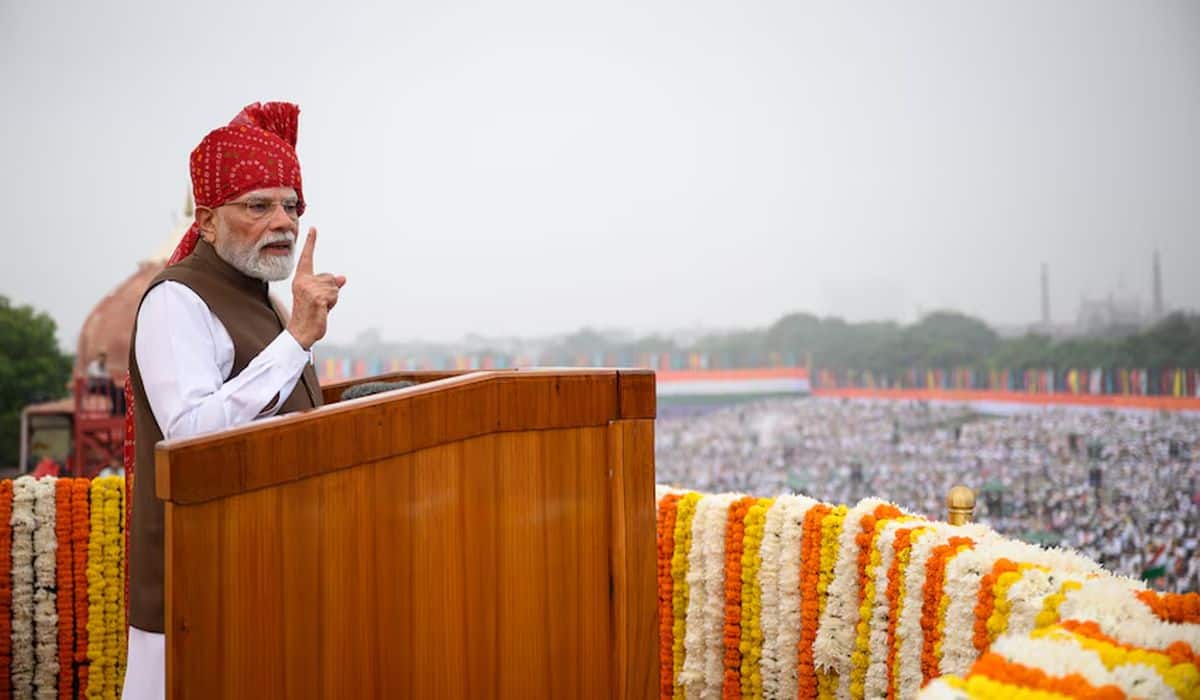
Friends of India the people of Japan and my Indian friends who have gathered here in such large numbers! My greetings to you all!
I was wondering why I was being taken to Kobe. I have been here a number of times; there are so many faces. I asked -'why are you taking me there? Who will come?' But I am indeed surprised to see your increased enthusiasm! I am really grateful to you for your love.
I am fortunate to have got the opportunity of coming to Japan once again after seven months. Even the last time I had got the opportunity to interact with the Indians settled here as well as the Japanese friends. It is indeed a coincidence that when I had come here last year, the election results of my dear friend Shinzo Abe was out and all of you had reposed your faith in him again. And today when I am with you, the world's largest democracy, India, has expressed greater love and faith than ever before on their Prime Servant.
I know that many of you have contributed to this mandate. Some of you had come to India and had directly worked for it, had put great efforts in the scorching heat of 40-45 degree Celsius. Some people had also provided all possible information through social media, Twitter, Facebook, Narendra Modi app etc. Some other had written letters to their old friends and had emailed to their villages. In a way, you had strengthened the festival of democracy and had made it livelier. I express my gratitude to you all for the same.

Friends,
The 130 crore Indians have made an even stronger government and it is an important event in itself. For the first time in three decades, a government with absolute majority was formed for the second time in succession. Such an accomplishment in a vast country like India is not a small thing. Although in 1984 one party had formed government in succession; but you know the conditions of that period. You are also aware of the reasons for the same. You are also aware of the reasons why the people had gone to vote. I need not repeat. But it is true that after 1971, the country had given the government a pro-incumbency mandate for the first time.

Friends,
Are you happy with the sweeping mandate of India or not? Whose victory is it? When I get to hear it from you, it gives me immense pleasure. This is the victory of truth. It is the victory of Indian democracy. You can understand the intent of India even from Japan. There is no difference between your and their aspirations. Hence, we get to hear your reply. It gives immense satisfaction that we are moving in the right direction.
When we watch a cricket match in the stadium, we come to know later the reason for how a player got 'out'. But those watching the match live on T.V sitting at home and are far away from the field, get to know immediately the reason for 'out' which could be because of problem with wavelength. Similarly, you are watching India from a distance. You have a greater capability of getting hold of the truth. Therefore your reply - 'victory for truth, victory for democracy and victory for the Indians', holds immense importance to me. It inspires me and gives me a new strength. I am grateful to you all for the same.

One of the reasons behind this victory is faith in the hopes and aspirations of the people keeping devoted to the democratic values. 61 crore voters had come out in scorching heat of 40 - 45 degree Celsius and had gone to the polling booth far away from their houses to cast their votes. The number of voters is higher than the population of any country except China. India's democracy is enormous with 10 lakh polling stations, more than 40 lakh EVM machines and more than 600 political parties actively participated in the elections with more than 8000 candidates. It was such a big festival of democracy! There was no greater democratic election in the history of humanity and every Indian should be proud of this.
Breaking this record or creating a better record in the future too will be in the hands of India. In a way, India has the copyright. As Indians we all as well as India's well-wishers are proud of it. This will inspire the entire world. It has proved yet again that the loyalty of the common masses of India towards democracy is unwavering. Our democratic institutions and democratic system are pioneering in the world.
Friends,
This strength of India will give new hope to the 21st century world. This election and its impact are not limited to India only; this is a motivating event for the democratic minds of the world. This mandate has been given to meet the expectations and aspirations of New India. And this mandate will also give new lease of life to our relationship with the world. Automatically the world will have faith in India. Whenever they will talk to India, they will think -- Yes, this government has the mandate of the people; the people have elected the government with absolute majority. Thus, whatever will be decided, they will carry that forward.
A government with absolute majority is essential in international relations. However, a greater public mandate in that absolute majority not only strengthens the government further but also enhances the confidence and faith.
The people have added the nectar of 'Sabka Vishwas' to 'Sabka Sath Sabka Vikas'. We are moving ahead with this mantra. It will also strengthen the world's faith in India and will reassure the world. I can feel the same.

Japan has a significant place in India's relationship with the world. These relationships are age-old. The essence of this relationship is a sense of belonging, goodwill, respect for each other's culture and civilization. These relationships also have a link to Mahatma Gandhi. Coincidentally, this year marks the 150th birth anniversary of Mahatma Gandhi. We have been learning and hearing one lesson taught by Gandhi ji since our childhood - 'Bura Mat Dekho, Bura Mat Suno, Bura Mat Kaho' i.e. see no evil, hear no evil, and speak no evil". Every child of India knows this concept very well. However, very few people are aware of the fact that the three monkeys chosen by Bapu for sending out this message were created by Japan in the 17th century. Mizaru, Kikazaru, and Iwazaru are Japan's heritage, whom Pujya Bapu chose as a symbol for a great social message and propagated it.
Friends,
This association of our conduct, behaviour and rituals is also preceded by the arrival of Buddhism in Japan. The next Gion festival is scheduled to be held in Kyoto next month. And the chariot used in this Gion festival is decorated with Indian silk yarn. And this tradition is not new; it has been there since time immemorial.
Similarly, four of the Seven Gods of Fortune – shichifukujin , are directly related to India. Mother Saraswati is recognized in Japan as Benzaiten, Kichijoten as Mother Lakshmi, Bishamon as Lord Kuber, and Daikokuten as Mahakal.
Friends,
The Shibori art of fabric printing is an age-old bridge between India and Japan relations. Within the Bandhani art of Gujarat's Kutch and Jamnagar, the artisans have been using the resist technique for ages. That is, the people working in Japan will feel that they are in Japan if they watch the artisans of Kutch and Jamnagar and the people of Kutch and Jamnagar will feel they are in Gujarat if they see the workers of Japan. There is a lot of similarity. Moreover, there is also a little similarity in our languages. 'Dhyan' or meditation in India is known as Zen in Japan. 'Seva' or service in India is known as 'Seva' in Japanese too. सेवा परमो धर्म:, that is, self-less service is considered as the prime duty in India. And the Japanese society has exhibited the same in practice.
Friends,
Many Indians including Swami Vivekananda, Gurudev Rabindranath Tagore, Mahatma Gandhi, Netaji Subhas Chandra Bose, Justice Radha Vinod Pal, have strengthened our relationship with Japan. There has also been love and respect for India and Indians in Japan.
Consequently, the relationship between India and Japan started strengthening after the end of the Second World War. About two decades back, Prime Minister Atal Bihari Vajpayee ji and Prime Minister Yoshiro Mori ji together had given a form of global partnership to our relationship.
In 2014, after I became the Prime Minister, I got the opportunity to strengthen this friendship with my friend Prime Minister Shinzo Abe. We took our diplomatic relations away from the formalities of capitals and diplomats and brought them directly to the people. Besides Tokyo, I have also travelled to Kyoto, Osaka, Kobe and Yamanashi along with Prime Minister Abe. And I have visited Kobe multiple times. I get confused with the number of visits to Kobe - four, five or three times. I used to come here even when I was not the PM. Last year, Prime Minister had welcomed me to his home in Yamanashi. His special gesture was heart touching for every Indian. Otherwise, such a personal touch in diplomatic relations is rare.
I was fortunate to take my friend Prime Minister Abe to Ahmedabad and Varanasi besides Delhi. Prime Minister Abe also joined the Ganga Aarti in my parliamentary constituency and one of the world's oldest cultural and spiritual cities - Kashi. He not only was a part of it but always ensured that he mentioned about his spiritual experience during all his speeches. He still mentions it. These pictures are also etched in the minds of every Indian
Friends,
Japan has played an important role in India's development journey over the last six decades. This role is going to be stronger in 21st Century New India. In 1958, Japan had approved its first Yen loan to India. Since then, Japanese companies have been working in India and they have created a separate identity of being the best quality.
There was a time when we were collaborating for manufacturing cars. Today we are collaborating for manufacturing bullet trains. There are Japanese projects and investments from East to West and North to South in the country. Similarly, India's manpower and talent are contributing to strengthen Japan's economy.
Friends,
Our cooperation in building a New India will be more widespread. We are moving forward with the goal of making India a 5 trillion dollars economy in the coming five years. Social sector is our priority. Besides this, we are emphasizing upon huge investment in infrastructure.
The digital infrastructure, in particular, puts India in the forefront as an attractive destination to invest by the whole world. Digital literacy in India is growing very fast today. Digital transactions are at record level. A huge infrastructure is being prepared for innovation and incubation; a new environment is being created. With this, we have the goal of turning India into an eco system of 50 thousand startups in the coming five years.
Friends,
There was a time when the saying - 'sky is the limit' was true. But India is exploring the space after crossing that limit. It is our goal to get affordable and effective space technology to make the lives of 130 crore people of India easier and safer. I am happy that we are moving ahead with success in this regard.
Recently, India was able to manage the various challenges associated with the Fani cyclone with minimum damage. The world has appreciated the effort made with the use of government machinery, human resources and space technology together. India did it! On one hand, the nation was busy with the elections, while on the other hand this task was completed in an amazing way! The world appreciated the work. It is an encouraging factor for us. This is the reason why in a few months we are going to launch Chandrayaan-2, carrying our Moon Mission forward. We are ready to send our first man mission, Gaganyaan by 2022. And we are working with the dream of sending an Indian who will unfurl the tricolour there.
We are looking for possibilities to ensure that there is our station in space. All the work that is being done today is for the people of India brimming with aspirations. This new middle class is full of aspirations and hopes. It is waiting for quick results. We are developing newer ways of development for them.
Friends,
At a time when the whole world is viewing India as the gateway of several possibilities, then our synergy with Japan is also going to set a new height. I believe that Japan's Kaizen Philosophy also applies to the progress of Indo-Japan relations. When I was the Chief Minister of Gujarat, I used to get my CM staff trained in Kaizen continuously because the Kaizen process is a process which never stops. Our relationships will continue to grow even stronger.
Friends,
As the Prime Minister, it is my fourth visit to Japan. In each of these visits, I felt an affinity towards India in Japan. I have had a direct experience in Japan of various aspects like taking pride in one's civilization and values, making talent and technology a part of one's traditions and nation building. I am not the only person to have experienced this.
A century ago, even Swami Vivekananda ji was pretty much influenced by the civilization, dedication of the people and work ethics when he had visited Japan. Then Swami Vivekananda ji had even said that every Indian should travel to Japan, but at that time the population was less. Now this will not be possible as there are 130 crore people of the country ... Anyway! I too understand that; but you all, the representatives of the 130 crore people are present here. You all continue to take the work culture, work ethics, talent, tradition and technology of Japan to India and tell the people here about the same things in India. This bridge gives us new strength; always helps to change into a new system and makes relations lively. These are not rituals but a vibrant system. And a vibrant system is formed by association of the people.
Finally, before I end my speech, I wish you all, the people of Japan, the Indians and Japanese brothers and sisters the very best for the new Reiwa era. I wish for a beautiful harmony in everyone's lives during this era. I express my heartfelt gratitude to you for your heartiest welcome and hospitality towards me whenever I am in Japan, especially in Kobe.
Perhaps you are aware of the fact that International Yoga Day was on June 21 and the Indian Government honours and rewards the organizations and individuals working for promoting and spreading Yoga in India and abroad. You might be aware of the fact that this time the Government of India has decided to honour the organization working for yoga in Japan. That's a matter of great pride. That is, we are connected in every way.
With this pride, once again I express my heartfelt gratitude to you for giving me the opportunity to be with you all and to seek your blessings.
Thank you!
New India की आशाओं और आकांक्षाओं को पूरा करने के लिए मिला ये आदेश पूरे विश्व के साथ हमारे संबंधों को भी नई ऊर्जा देगा।
— PMO India (@PMOIndia) June 27, 2019
सबका साथ, सबका विकास, सबका विश्वास के जिस मंत्र पर हम चल रहे हैं, वो भारत पर दुनिया के विश्वास को भी मजबूत करेगा: PM
जब दुनिया के साथ भारत के रिश्तों की बात आती है तो जापान का उसमें एक अहम स्थान है।
— PMO India (@PMOIndia) June 27, 2019
ये रिश्ते आज के नहीं हैं, बल्कि सदियों के हैं। इनके मूल में आत्मीयता है, सद्भावना है, एक दूसरे की संस्कृति और सभ्यता के लिए सम्मान है: PM
हमारी बोलचाल के भी कुछ सूत्र हैं जो हमें जोड़ते हैं।
— PMO India (@PMOIndia) June 27, 2019
जिसे भारत में 'ध्यान' कहा जाता है, उसे जापान में 'Zen' कहा जाता है। और जिसे भारत में 'सेवा' कहा जाता है, उसे जापान में भी 'सेवा' कहा जाता है: PM
लगभग 2 दशक पहले, प्रधानमंत्री अटल बिहारी वाजपेयी जी और प्रधानमंत्री योशिरो मोरी जी ने मिलकर हमारे रिश्तों को Global Partnership का रूप दिया था।
— PMO India (@PMOIndia) June 27, 2019
2014 में प्रधानमंत्री बनने के बाद, मुझे मेरे मित्र प्रधानमंत्री शिंज़ो आबे के साथ मिलकर इस दोस्ती को मजबूत करने का मौका मिला: PM
दिल्ली के अलावा अहमदाबाद और वाराणसी प्रधानमंत्री आबे को ले जाने का सौभाग्य मुझे मिला।
— PMO India (@PMOIndia) June 27, 2019
प्रधानमंत्री आबे मेरे संसदीय क्षेत्र और दुनिया की सबसे पुरानी सांस्कृतिक और आध्यात्मिक नगरी में से एक काशी में गंगा आरती में शामिल हुए।
उनकी ये तस्वीरें भी हर भारतीय के मन में बस गई हैं: PM
एक समय था जब हम कार बनाने में सहयोग कर रहे थे और आज हम बुलेट ट्रेन बनाने में सहयोग कर रहे हैं।
— PMO India (@PMOIndia) June 27, 2019
आज भारत का ऐसा कोई भाग नहीं है जहां जापान के प्रोजेक्ट्स या इंवेस्टमेंट्स ने अपनी छाप न छोड़ी हो।
इसी प्रकार भारत का Talent और मैनपावर जापान को मजबूत करने में योगदान दे रहा है: PM
प्रधानमंत्री के रूप में यह मेरी जापान की चौथी यात्रा है। यात्राओं में जापान में भारत के प्रति एक आत्मीयता, एक अपनापन अनुभव किया।
— PMO India (@PMOIndia) June 27, 2019
अपनी सभ्यता और अपने मूल्यों पर गर्व करना, Talent और Technology को राष्ट्रनिर्माण का हिस्सा बनाना, ये मैंने जापान में प्रत्यक्ष अनुभव किया है: PM