Remembering Dr. Lohia

Published By : Admin | March 26, 2019 | 03:06 IST

Today is a day to honour revolutionaries.

We pay tributes to great sons of Mother India - Bhagat Singh, Sukhdev and Rajguru for their ultimate sacrifice.

We bow to a prolific thinker, exceptional intellectual, revolutionary and devout patriot, Dr. Ram Manohar Lohia on his Jayanti.

Dr. Lohia combined a sharp mind and a penchant for mass politics.

When top leaders were arrested during the Quit India movement, a young Dr. Lohia remained unfazed, went underground and even started an underground radio station to further the movement.

In the history of Goa’s liberation, the name of Dr. Lohia is etched in golden letters.

Wherever the marginalised needed a voice, Dr. Lohia was there.

Dr. Lohia’s thoughts inspire us. He wrote about modernising agriculture and empowering farmers, which the NDA Government is effectively doing through efforts such as PM Kisan Samman Nidhi, Krishi Sinchai Yojana, e-Nam, Soil Health Cards and more.

Nothing pained Dr. Lohia more than the caste hierarchy and inequality between women and men. Our Mantra of ‘Sabka Saath, Sabka Vikas’ as well as our track record in the last five years show that we have made a long-lasting contribution in fulfilling the vision of Dr. Lohia. He would surely have been very proud of the NDA Government’s work.

Whenever Dr. Lohia spoke, inside or outside Parliament, the Congress trembled with fear.

Dr. Lohia knew how disastrous Congress was. In 1962 he said, “During the Congress regime neither agriculture and industry nor the army has improved.”

These words can accurately describe even subsequent Congress regimes, where farmers were harassed, industry was discouraged (except if they belonged to friends and relatives of Congress leaders) and national security was ignored.

Anti-Congressism was Dr. Lohia’s heart and soul. His efforts ensured a shock to the then all-powerful Congress in 1967 elections. That time, Atal Ji remarked- “Due to Dr. Lohia’s efforts, one could travel on board the Howrah-Amritsar Mail without having to pass a single Congress state!”

Unfortunately, today Dr. Lohia would be horrified at the political developments taking place.

Those parties that claim inspiration from Dr. Lohia have completely abandoned his principles. They are leaving no opportunity to insult him.

The veteran socialist leader from Odisha, Shri Surendranath Dwivedy remarked, “He (Dr. Lohia) was imprisoned many times more during Congress regime than under the British rule.”

Yet, today those parties that falsely claim to be Dr. Lohia’s followers are desperate to form an opportunistic Maha Milawat or adulteration alliances with the same Congress. It is both ironical and reprehensible.

Dr. Lohia always believed that dynastic politics was inimical to democracy. He would have been flabbergasted to see his ‘followers’ think about their own families first instead of the nation.

Dr. Lohia stated that one who works with ‘Samta’, ‘Samanata’ and ‘Samatva Bhaav’ is a Yogi. Sadly, the parties that claim to be his followers forgot this principle. They believe in ‘Satta’, ‘Swarth’ and ‘Shoshan.’ These parties are experts at grabbing power, looting as much as possible and exploiting others. Poor people, Tribals, Dalits, OBCs and women are not safe in their rule because these parties give a free run to criminals and anti-social elements.

In his works, Dr. Lohia called for complete equality between men and women. But, neck deep in vote bank politics, it was parties that dishonestly claim to be Dr. Lohia’s followers that opposed the NDA Government’s move to abolish the inhuman practice of Triple Talaq.

Is the commitment to vote bank politics bigger than the commitment to Dr. Lohia’s thoughts?

Today, a moot question facing 130 crore Indians is:

How can those who betrayed Dr. Lohia be expected to serve the nation?

Today they are betraying the principles of Dr. Lohia, tomorrow they will also betray the people of India.


Explore More
Today, the entire country and entire world is filled with the spirit of Bhagwan Shri Ram: PM Modi at Dhwajarohan Utsav in Ayodhya

Popular Speeches

Today, the entire country and entire world is filled with the spirit of Bhagwan Shri Ram: PM Modi at Dhwajarohan Utsav in Ayodhya
21% YoY rise in engineering exports in June shows sector's resilience amid global challenges: EEPC India Chairman

Media Coverage

21% YoY rise in engineering exports in June shows sector's resilience amid global challenges: EEPC India Chairman
NM on the go

Nm on the go

Always be the first to hear from the PM. Get the App Now!
...
A life devoted to India’s unity and progress
July 06, 2026

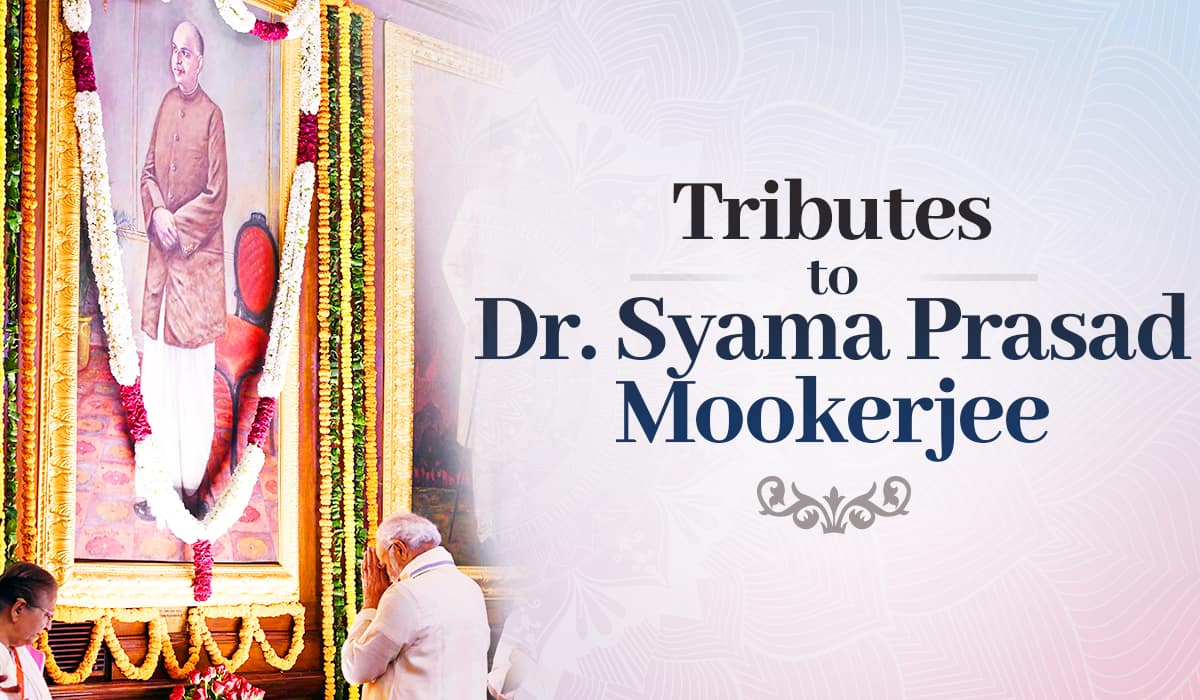
Today, 6th July, is a special day for countless people who cherish the ideals of nationalism and selfless service. We commemorate the 125th birth anniversary of Dr. Syama Prasad Mookerjee, whose life remains a timeless example of courage and unwavering commitment to Maa Bharti. Few leaders in modern India embodied the seamless confluence of intellect, public service and moral conviction as profoundly as Dr. Syama Prasad Mookerjee.

The young Syama Prasad was born into circumstances that could easily have assured him a protected and comfortable life. His father, Sir Ashutosh Mookerjee, was among the foremost educationists and intellectuals of his age. Yet, while destiny placed before him a path of privilege, his conscience led him towards one of sacrifice and national service. He was convinced that he could not remain a mute spectator to the turbulence of his times, be it fighting colonialism, communalism, humanitarian challenges and more. Along this journey, he endured profound personal tragedies, including the loss of an infant child and, later, his wife. Yet, these tragedies only deepened his resolve and strengthened his unwavering commitment to serve.

If there was one ideal that defined Dr. Syama Prasad Mookerjee’s public life above all else, it was the indivisibility of India. He stood firm during the upheaval of Partition to ensure that West Bengal remained an integral part of India. A few years later, that very conviction drew him to Jammu and Kashmir. Imprisonment did not deter him and isolation did not diminish him. His life came to an abrupt end in detention, far from the countless people whose cause he had made his own. There are moments in history when an individual’s final sacrifice transcends politics and enters the realm of national memory. Dr. Mookerjee’s last journey remains one such moment. Acharya Vinoba Bhave said that Dr. Mookerjee sacrificed himself for a cause in which he had faith. Years later, the revocation of Articles 370 and 35(A) in 2019 was the most fitting tribute to his martyrdom.

Dr. Mookerjee put India First and Indian values first. And he did it by building institutions and nurturing systems that defied conventional mindsets of those times. He became the youngest Vice Chancellor of the University of Calcutta. In his unique style, he brought positive changes that were patriotic and futuristic. Addressing a conference of educators, Dr. Mookerjee put it wonderfully when he said, “It is incorrect to look upon educational institutions as factories to produce potential clerks and low-paid staff. We have to turn out students who are capable of providing leadership to our self-governing institutions, such as municipal corporations, provincial and central legislatures and also of directing the affairs in various fields of life such as financial, commercial and industrial ones.”

Under his leadership, Calcutta University undertook unique efforts such as improving library infrastructure, boosting research in sciences, encouraging the study of artefacts and establishing courses in agriculture, to name a few. He drew attention to areas such as sports, teacher training and student welfare. To instil a sense of pride among students and alumni, he began a practice of marking 24th January as the foundation day of the University. He requested none other than Gurudev Tagore to compose a song for the University.

Yet another example of this spirit can be seen in the later part of his life, when he decided to form the Bharatiya Jana Sangh. At a time when the Congress Party was omnipresent, he felt that there was all the more reason for an alternative voice to speak up for India’s progress while staying attached to our cultural roots. It was perhaps fitting that the party’s symbol was the Diya, the earthen lamp. A single lamp may appear modest, yet it possesses the power to dispel darkness far beyond itself. It is exactly what the Jana Sangh did both during the years it was active and beyond.

Dr. Syama Prasad Mookerjee’s tenure as India’s first Minister for Industry and Supply reveals a statesman whose conception of development was remarkably comprehensive and humane. He viewed industry as a means of restoring dignity, opportunity and confidence to a newly independent nation. He respected wealth creation and value addition. While laying the foundations of modern industrial India through pioneering initiatives such as the Damodar Valley Corporation, the Sindri Fertiliser Plant and a robust industrial policy, he simultaneously ensured that India’s traditional strengths were not neglected. Handlooms, cottage industries, artisans and textile workers found in him an equally committed champion.

Here, I would like to share a personal experience. The Sindri plant, which Dr. Mookerjee worked to establish with a clear vision of self-reliance, was ignored by those who ran the nation for several decades. I feel honoured that our Government had the opportunity to contribute to its revival. It was indeed among the most special moments to have been there for that programme.

India’s civilisational tradition has long celebrated dialogue and discussions. Dr. Mookerjee embodied this democratic spirit. He joined Pandit Nehru’s Cabinet, believing that the task of nation-building in the early years transcended political differences. He served with sincerity and a constructive spirit. But when he felt that questions of national importance demanded a different course, he relinquished office with dignity and devoted himself wholeheartedly to the political work he believed the nation required.

75 years ago, Pandit Nehru brought the First Amendment, which was a direct assault on free speech. Dr. Mookerjee was among its staunchest critics. He understood fully what the Congress was capable of doing. And he was proven right. Those who brought the First Amendment 75 years ago imposed the Emergency in 1975 and 50 years ago, brought in the 42nd Amendment Act, which again struck at the core of liberal democratic values.

Dr. Mookerjee also stood out for his humanitarian efforts. When the most tragic famine struck Bengal in 1943, Dr. Mookerjee immersed himself in serving those affected. He ensured that several canteens and relief centres were opened to feed people. On one hand, he was deeply shaken by the plight of his people while on the other, he was repulsed by the insensitivity of the colonial rulers. He even wrote a book, Panchasher Manwantar, in which he expressed his angst. When a super cyclone hit Medinipur in 1942, his efforts to restore normalcy were widely lauded.

Speaking at a college in Kolkata, Dr. Mookerjee urged the youth, “Whatever work you undertake, do it seriously, thoroughly and well; never leave it half-done or undone, never feel yourself satisfied unless and until you have given it your very best.” As India advances towards the goal of a Viksit Bharat, the finest tribute we can pay him is to strive every day to build the strong, united, self-confident and compassionate India that he so deeply believed in. And knowing today’s youth, I am certain they will rise to the occasion and do exactly that.