PM Modi interacts with students during Pariksha Pe Charcha 2026

Published By : Admin | February 6, 2026 | 10:00 IST
Listen to everyone’s advice, but change your pattern only when you want to: PM
PM advises teachers to inform students in advance to create curiosity and improve understanding
Goals should be within reach but not easily achievable - Aim and Act: PM
Plough the mind, then connect the mind, and then place the subjects of study, this will help you succeed: PM
Balancing studies, skills, rest and hobbies is the key to growth: PM
Books impart knowledge, but only practice makes you professionally skilled: PM
Don’t waste time dwelling on the past, think of living what lies ahead: PM
Education is not only for exams but for life, exams are meant to examine oneself: PM
Aspire, not to be, but to do: PM
The Present is God’s greatest ‘Present’ - Live here and now: PM
The more involved you are in a moment, the longer you remember it: PM
Collaborative learning helps everyone improve: PM
Revise and become wise: PM
Strengthen your foundation in school, competitive exams will follow in time: PM
PM advises parents to allow children to blossom according to their capacity, ability, and interest
Turn your hobbies into practical products and share them for free, Feedback fuels new ideas and success: PM
Discover Yourself, Experience all that life offers: PM
Exams are like Festivals, celebrate them: PM
Real confidence comes from inner truth, Be true to who you are: PM
Comfort zones don’t shape life - your way of living does: PM
Not having a dream is a crime - have a dream always: PM
Be your own anchor, celebrate your strengths: PM
Dream big, fear less - read biographies: PM
Maintaining Cleanliness is the foremost priority and our duty: PM
Technology is a great teacher, embrace it, AI increases our capabilities: PM
Harness AI wisely, boost your wisdom: PM

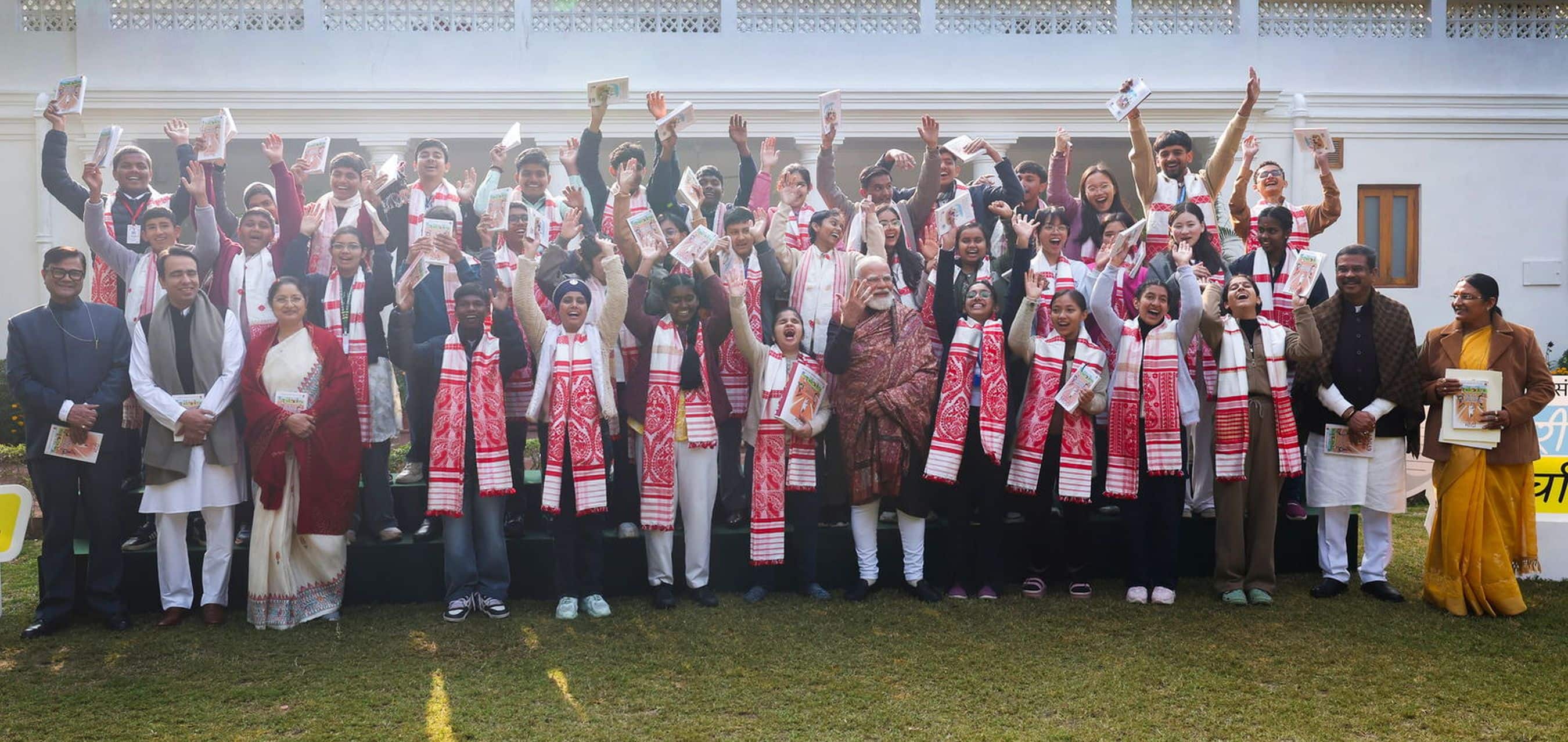
The Prime Minister, Shri Narendra Modi interacted with students today during the 9th edition of Pariksha Pe Charcha (PPC). The Prime Minister had an informal interaction with Exam Warriors, at his residence in Delhi.

Your Style, Your Pace

A Student from Gujarat asked that while parents worry for them and teachers support them, the issue arises when teachers suggest one study pattern, parents insist on another, and students follow a different trend, leaving them confused about which pattern is correct. The Prime Minister remarked that this continues throughout life, noting that even as Prime Minister people advise him differently. He highlighted that just as siblings at home have different eating patterns—some starting with vegetables, some with dal, some mixing everything together—everyone has their own way. He emphasized that enjoyment comes from following one’s own pattern. Shri Modi explained that some prefer studying at night, others early in the morning, and each has their own rhythm. He cautioned against dishonesty, mentioning how some students tell their mothers they will study in the morning but then avoid it. He stressed that students must trust their own pattern, listen carefully to suggestions, and add improvements only through personal experience, not merely because someone says so. He highlighted that when he began Pariksha Pe Charcha there was one pattern, but over time he improved it, even conducting sessions in different states, changing the format while retaining the core. Students noted that the Prime Minister’s nature was very friendly and that he mingled easily with them, explaining that everyone should listen to different patterns, take good qualities from each, focus on their own, and gradually strengthen it.
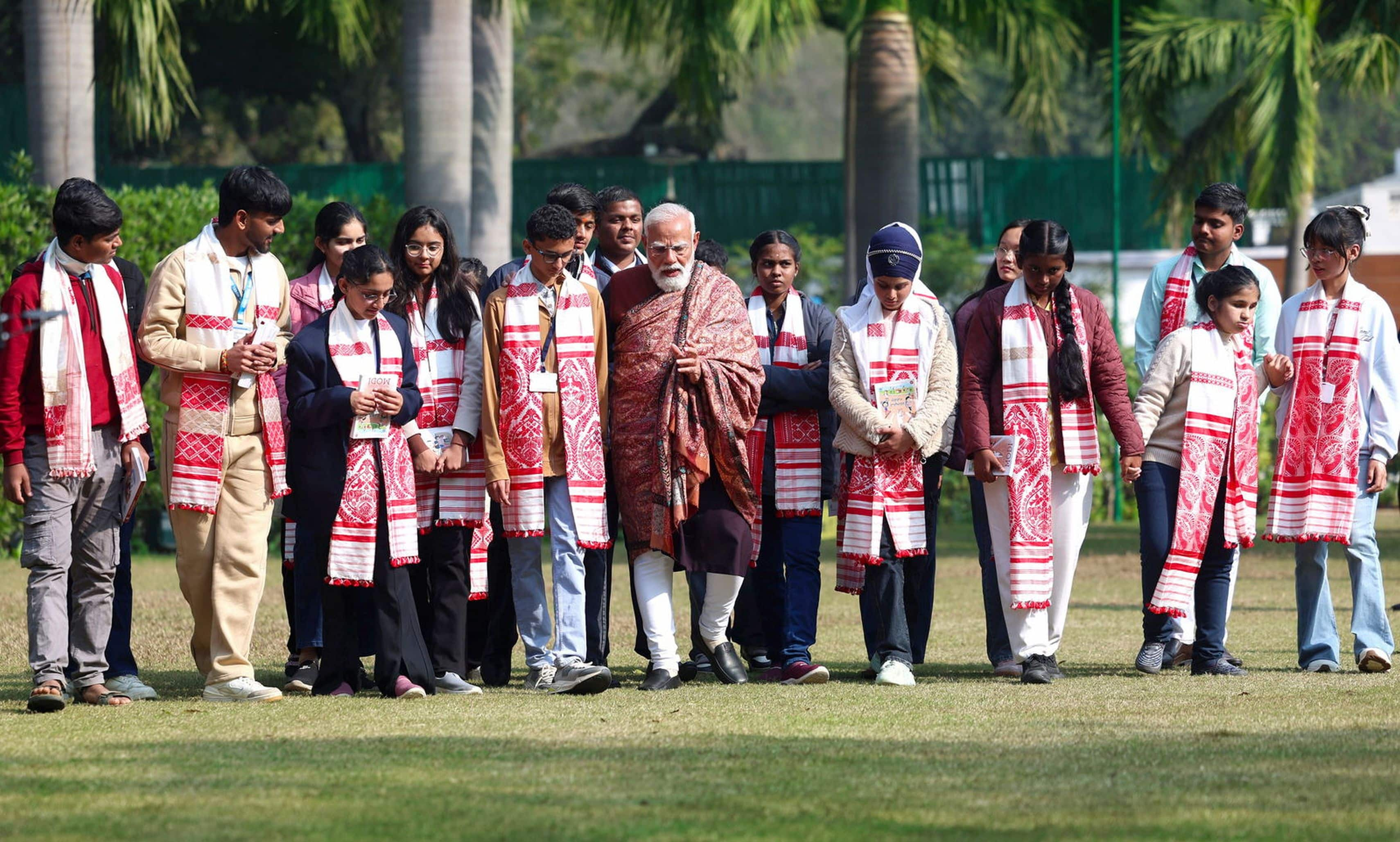
Interacting with the Prime Minister, another student who asked that often students cannot match the speed of school or teachers, and in trying to cover what is missed, they lose track of further chapters and fall behind. Shri Modi highlighted that teachers should keep their speed just one step ahead of the students, not too much, with the goal being within reach but not easily achievable. When the student recalled Exam Warrior mantra 26, “goal should be within reach but not easily achievable,” the Prime Minister praised the memory. He explained that if teachers go fifty steps ahead, students will give up, but like a farmer ploughs the field, teachers must plough the minds of students. He suggested that teachers should announce in advance the chapters to be taught in each week, so students can begin reading, asking, or searching online before the lesson. He emphasized that when the actual teaching happens, curiosity will arise, understanding will deepen, and focus will improve. He noted that if a chapter is very interesting, students will want to explore more, making revision stronger. The Prime Minister remarked that this is a simple method, and asked whether then the problem of teacher’s speed would remain. When the student replied yes, Shri Modi corrected, saying it would not, as students would no longer feel left behind because they had moved one step ahead of the teacher. He concluded, “Plough the mind, then connect the mind, and then place the subjects of study. You will always find students successful.” Students expressed that not everyone gets the opportunity to sit face-to-face with the Prime Minister, ask questions, and share conversations, and highlighted that he advised them to stay two steps ahead of teachers rather than two steps behind, ensuring they never fall behind.

A musical moment

A Student from Sikkim shared that she had composed a song in three languages—Hindi, Nepali, and Bengali—titled ‘Hamara Bharat Bhumi’, a patriotic song. The Prime Minister remarked with delight, asked if she enjoyed writing poetry, and upon her confirmation, encouraged her to recite. He lauded her and remarked on how she spoke of the unity of the nation—Ek Bharat, Shreshtha Bharat. Shri Modi then asked another student, Mansi, to sing. Mansi presented a song written by her mother, dedicated to students. The Prime Minister lauded her and asked to convey his congratulations to your mother. The student shared that she runs a YouTube channel, Facebook page, and Instagram account, with 1.5 lakh followers on Facebook. The Prime Minister expressed surprise and appreciation, and remarked that it was a matter of pride to meet such talented youth.
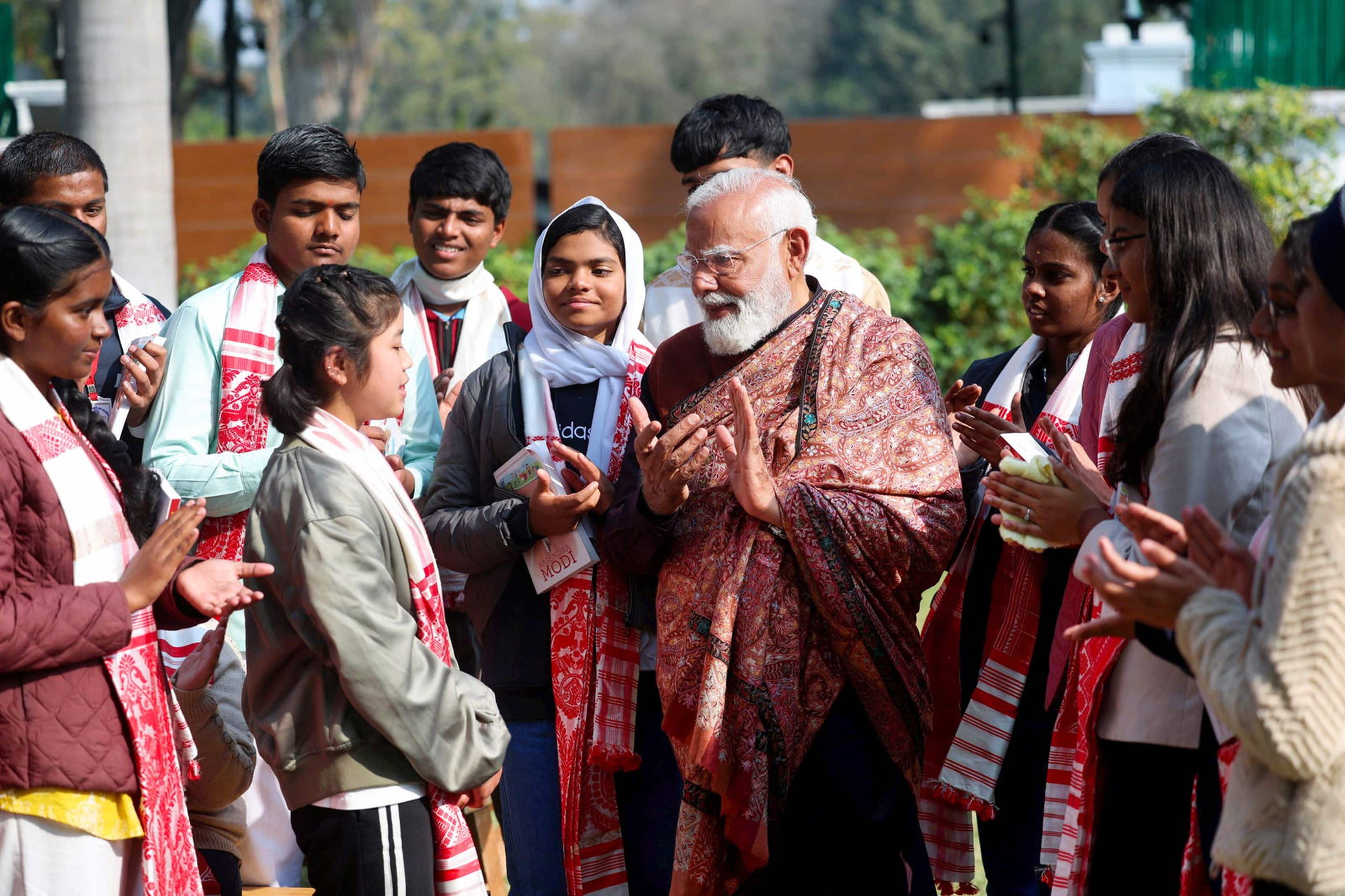
Shri Modi then welcomed all students, explaining that he had greeted them with Assam’s Gamosa, which he described as his most cherished possession. He highlighted that the Gamosa is a symbol of women’s empowerment in Assam and the North East, crafted at home by the region’s women, reflecting their strength and contribution. He said it was his heartfelt desire to gift the children the Gamosa as a mark of respect.

Preparation with Purpose

Student Sabavat Venkatesh then asked the Prime Minister whether skill or marks are more important, noting the confusion and fear among students. The Prime Minister remarked that balance is essential in life, whether between eating and sleeping, studying and playing, or skills and marks. He emphasized that leaning too far one way leads to imbalance, while proper balance ensures stability. He explained that skills are of two types—life skills and professional skills—and both are equally important. He stressed that no skill can develop without knowledge, observation, and study, and that skill begins with knowledge.
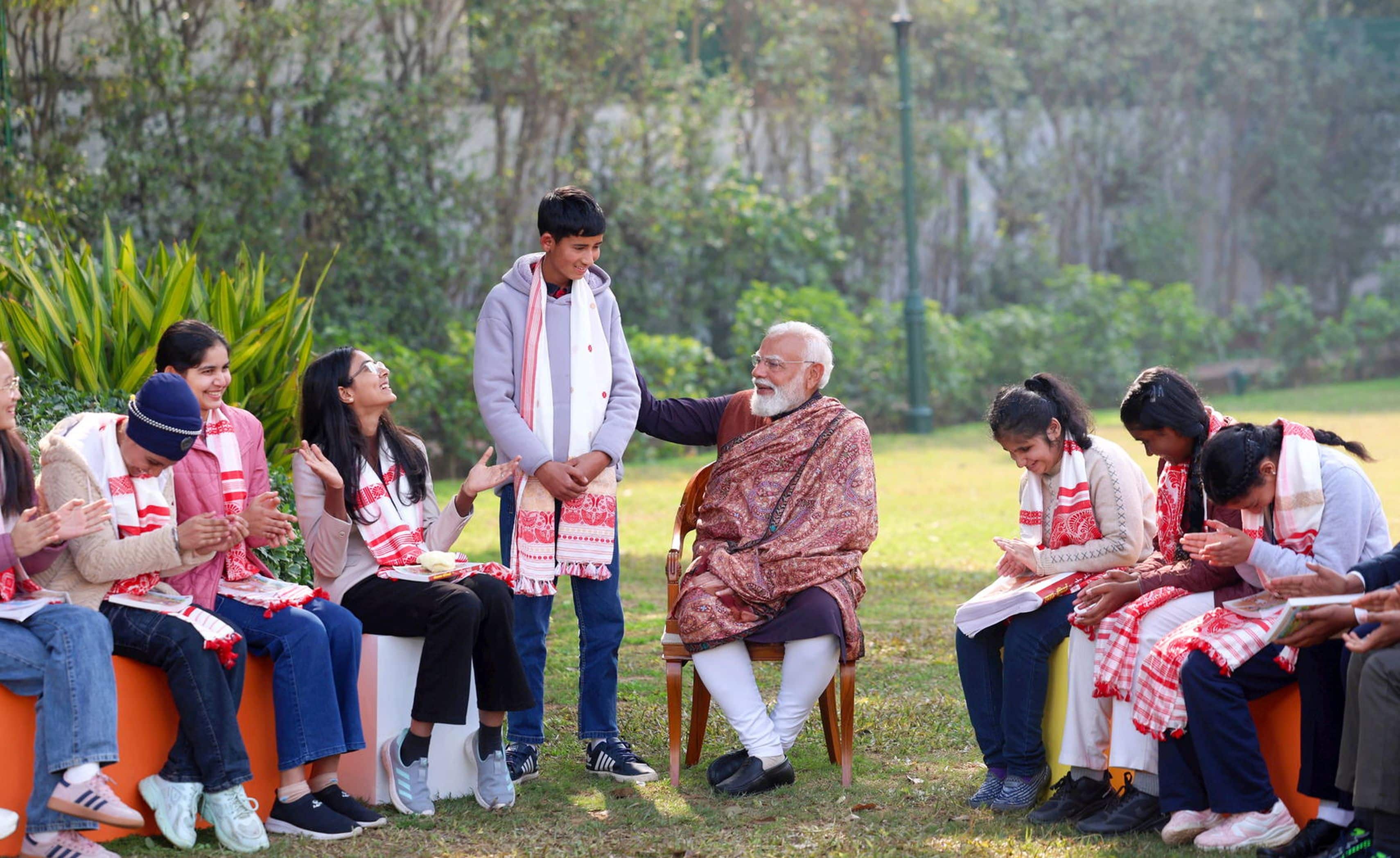
Shri Modi illustrated with examples: without life skills, one may struggle even in daily tasks like cooking or buying a ticket at a railway station. He emphasized that life skills must be fully achieved, including discipline, confidence, and adaptability. On professional skills, he explained that doctors must constantly update their skills, as books alone cannot make one a heart specialist—real skill comes from working with patients. Similarly, lawyers must practice under seniors to develop courtroom skills beyond knowing constitutional provisions. He underscored that professional skills require continuous learning and adaptation to new technologies, even at age 40, as advancements in medicine and other fields demand constant updating. He underlined that education and skill are twin siblings, inseparable, and that skill is indispensable in life.

Beyond marks and education as a medium

Further, a student from Sainik School, Imphal, Manipur, expressed admiration for Prime Minister Shri Narendra Modi, noting that his birthday coincides with the Prime Minister’s. Responding, Shri Modi remarked that he does not count the years that have passed but focuses on those that remain, urging students not to waste time dwelling on the past but to think of living what lies ahead.

When asked about exam preparation strategies based on past years’ questions, the Prime Minister highlighted that students often struggle when papers feel tough, not because they are outside the syllabus, but because focus is limited to repeated patterns. He noted that this issue existed even during his own student days and is sometimes perpetuated by teachers aiming only for marks. Shri Modi emphasized that good teachers ensure holistic development by covering the full syllabus and explaining its relevance to life. Using the example of a bowler in cricket, he explained that strengthening only shoulder muscles is insufficient; one must exercise, do yoga, strengthen the whole body and mind, adjust diet, and sleep properly. He stressed that education, similarly, is not only for exams but for life, and exams are meant to examine oneself. Marks are not the ultimate goal; complete development of life is. He advised that focusing solely on ten questions or patterns is limiting, and while they can be practiced, they should form only a small part of preparation, with the majority effort directed towards overall learning.
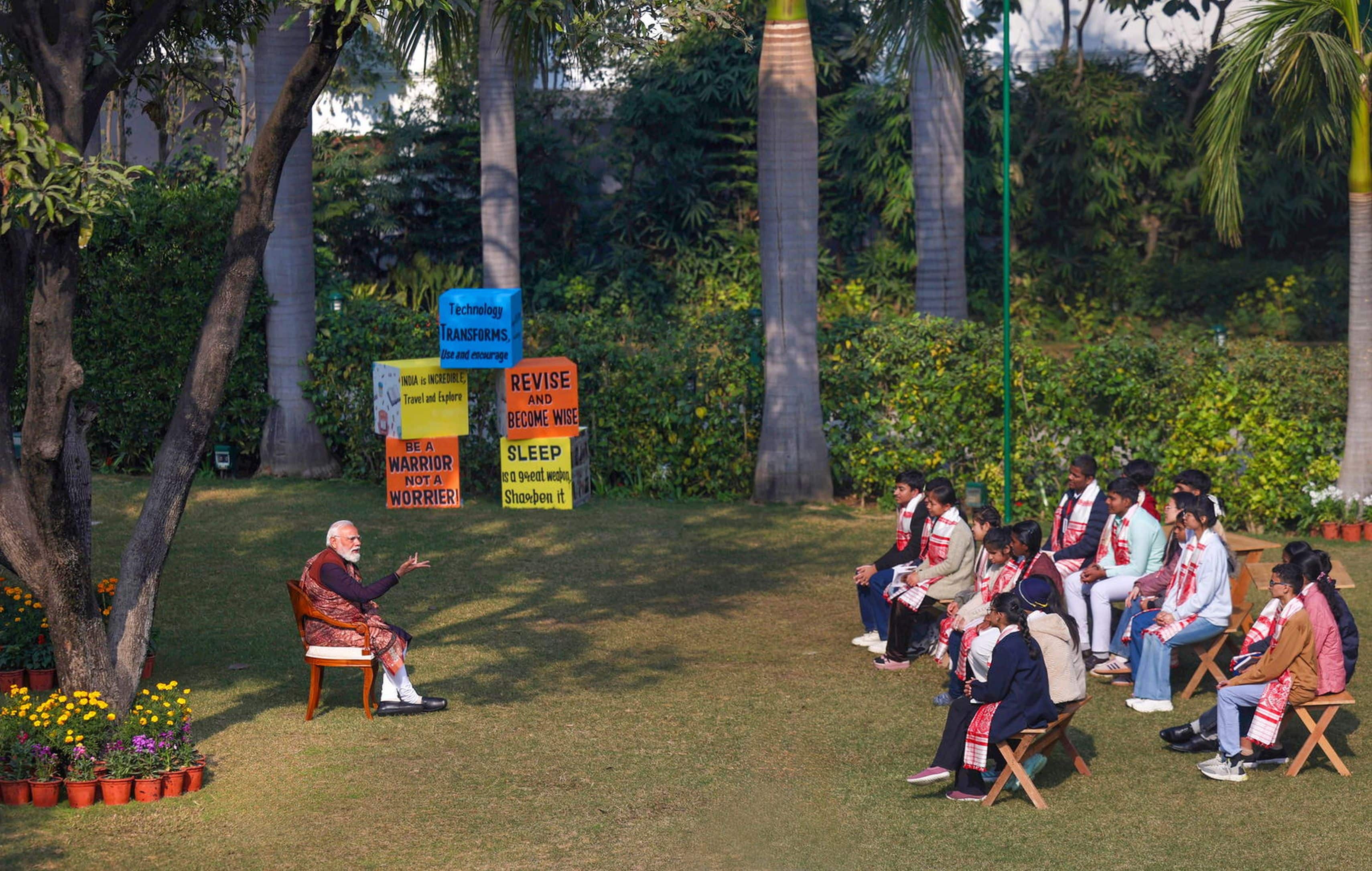
In response to a question on balancing study pressures, especially during pre-boards, the Prime Minister remarked that this is a common concern. He emphasized that education should not be seen as compulsion or burden but requires total involvement. Without full engagement, incomplete education cannot lead to success. He cautioned against the obsession with marks, asking whether anyone remembers the name of a student who scored highest marks last year in boards. When the student replied no, Shri Modi underscored that even if such achievements are praised briefly, they are soon forgotten, showing how little importance marks hold. He advised students not to tie their minds to marks but to focus on where their life is heading, continuously testing themselves not only in classrooms or exam halls but in life itself.

Less Pressure, More Learning

Continuing the interactive session, a student asked Prime Minister Modi how to remain calm and focused while studying, as many distracting thoughts arise and lessons are quickly forgotten. The Prime Minister responded by giving an example: “Just as you have come here today, even after 25 years if someone asks you about this program, will you forget or remember?” The student replied it would always be remembered as a special moment. Shri Modi explained that this is because the student is fully involved, thinking about the present, which ensures lasting memory.

He highlighted that memories remain when one is completely involved and when experiences are shared with friends. He advised students to make friends with those less confident and teach them, while also seeking guidance from brighter peers for a few minutes to validate their own understanding. He emphasized that this double benefit brings new ideas, opens the mind, and strengthens focus.
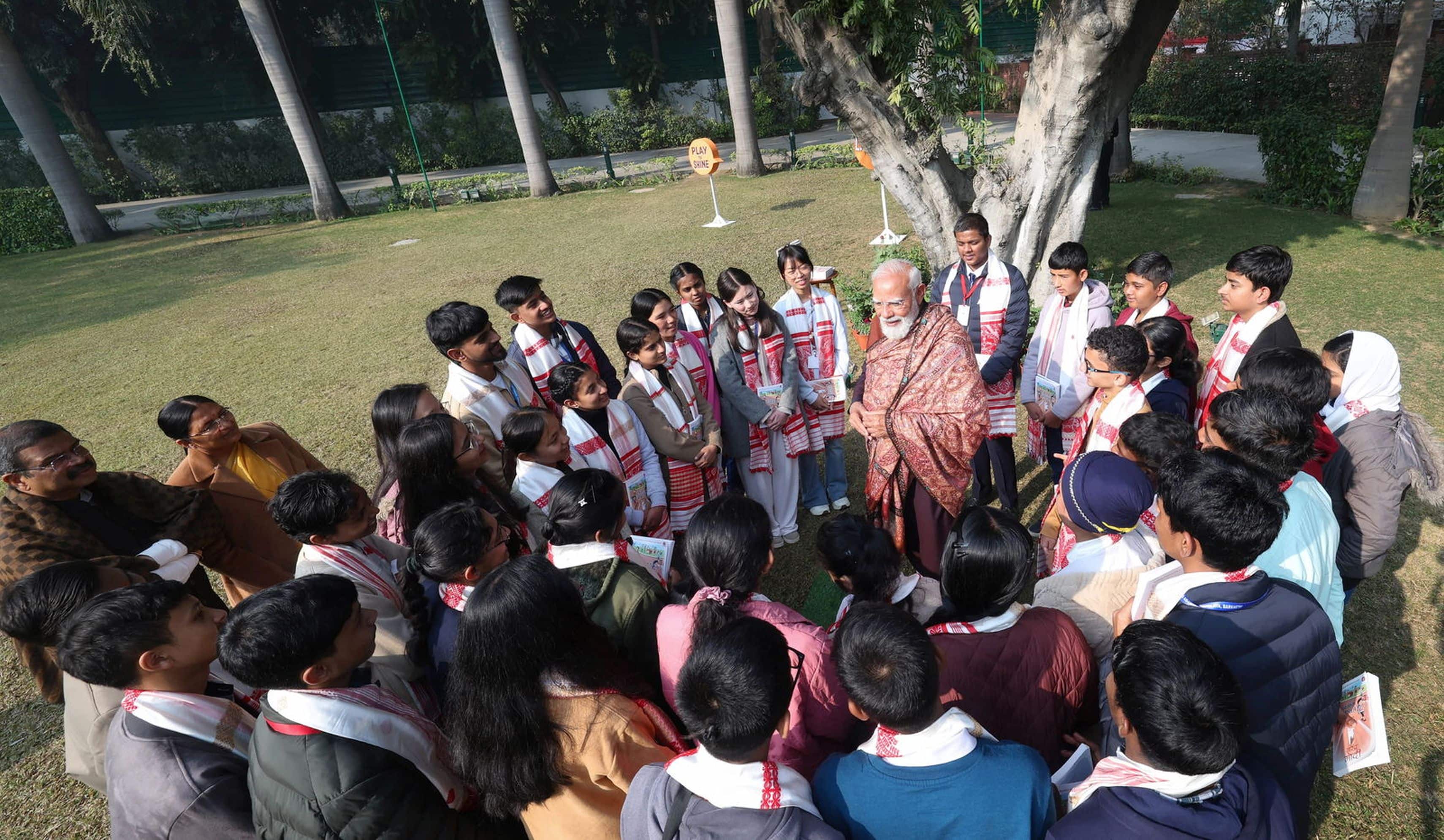
Another student from Punjab interacted and greeted Prime Minister Modi and asked about the challenge faced by Class 12 students who prepare simultaneously for board examinations and competitive exams, given their differing patterns and overlapping schedules. The Prime Minister acknowledged the concern, likening it to playing cricket and football at the same time, and emphasized that priority must be given to the Class 12 boards. He remarked that if students thoroughly absorb their syllabus, competitive exams will become a by-product without requiring separate effort. He further advised parents to allow children to blossom according to their capacity, ability, and interest.

Balancing marks, games and laughter

A student raised a question about pursuing a future in gaming despite societal pressure to focus only on studies. The Prime Minister explained that parents often discourage initially, but once success is achieved, they take pride and celebrate it. He encouraged the student to channel interest in gaming productively by creating games based on India’s rich stories such as Panchatantra or mythological events, and to share them on social media platforms to gain recognition. He highlighted that gaming is a skill requiring speed and alertness, which contributes to self-development, and advised focusing on building expertise in high-quality games. He cautioned against gambling in gaming, noting that laws have been enacted to prevent such practices, and stressed that gaming should be pursued as a constructive skill.
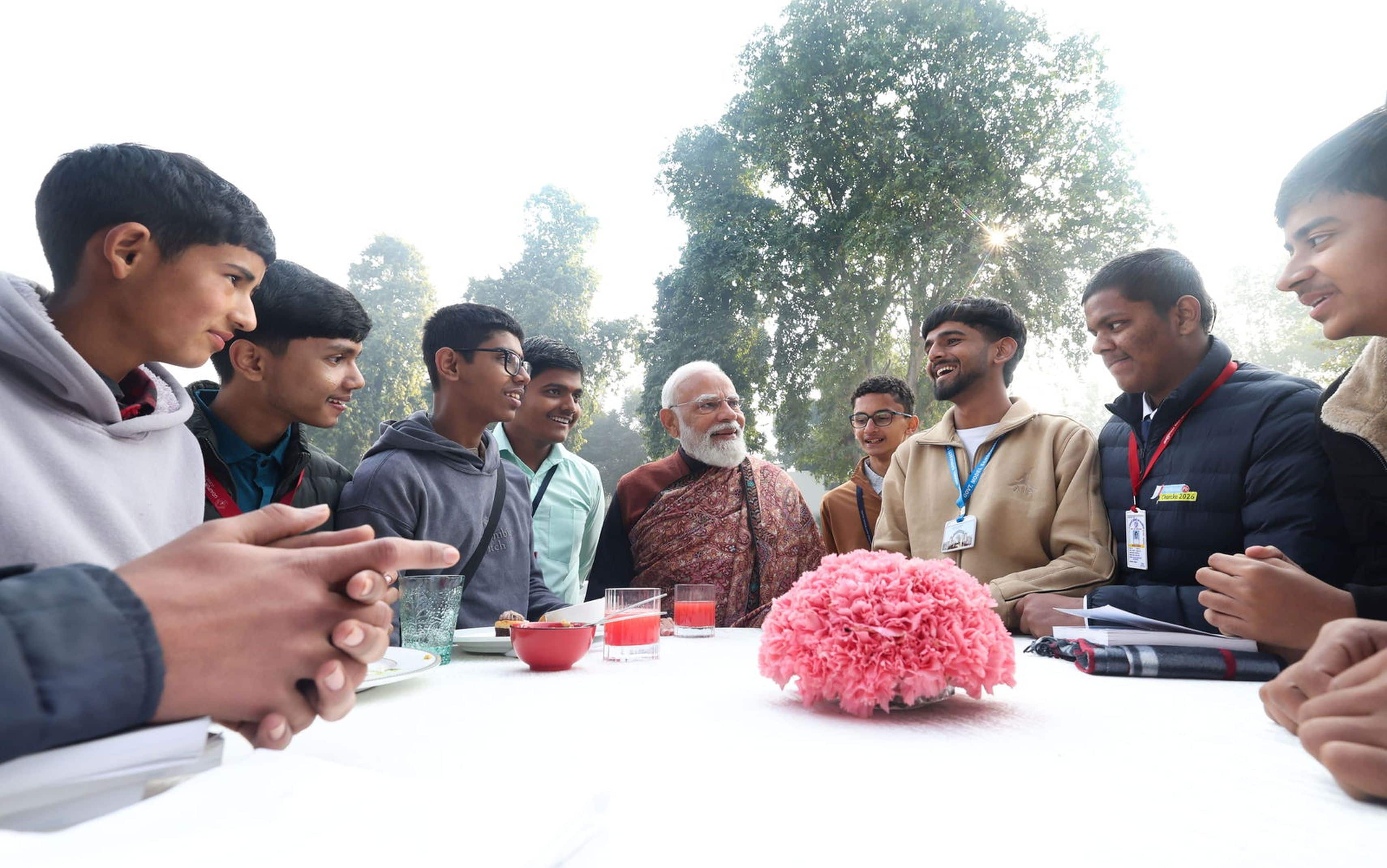
Students expressed excitement at visiting the Prime Minister’s residence, noting his friendly manner, genuine interest in their questions, and the thoughtful answers he provided.

Turning Fear into strength - managing stress, time & confidence

The students shared how reading Exam Warrior transformed their approach to examinations. One student remarked that earlier exams caused stress and fear, but after reading the book, exams had become a friend. Another highlighted that previously they felt anxious comparing themselves to others, but realized their own technique was unique and effective. A student noted that time management had always been a struggle, but after learning from Exam Warrior, they resolved to wake up early and manage tasks better.

Prime Minister Modi advised a simple method for time management: writing tasks in a diary before sleeping, tallying them the next day, and analyzing why some tasks were left incomplete. He emphasized that learning to use time productively removes pressure and fatigue, sharing that his own habit of proper time use keeps him stress-free despite numerous responsibilities.

Students expressed how their fear of subjects like mathematics had turned into interest, with one noting that maths was once a ghost but now had become a passion. The Prime Minister encouraged exploring Vedic Mathematics, describing it as enjoyable and magical, and suggested sharing such methods with friends to increase interest.
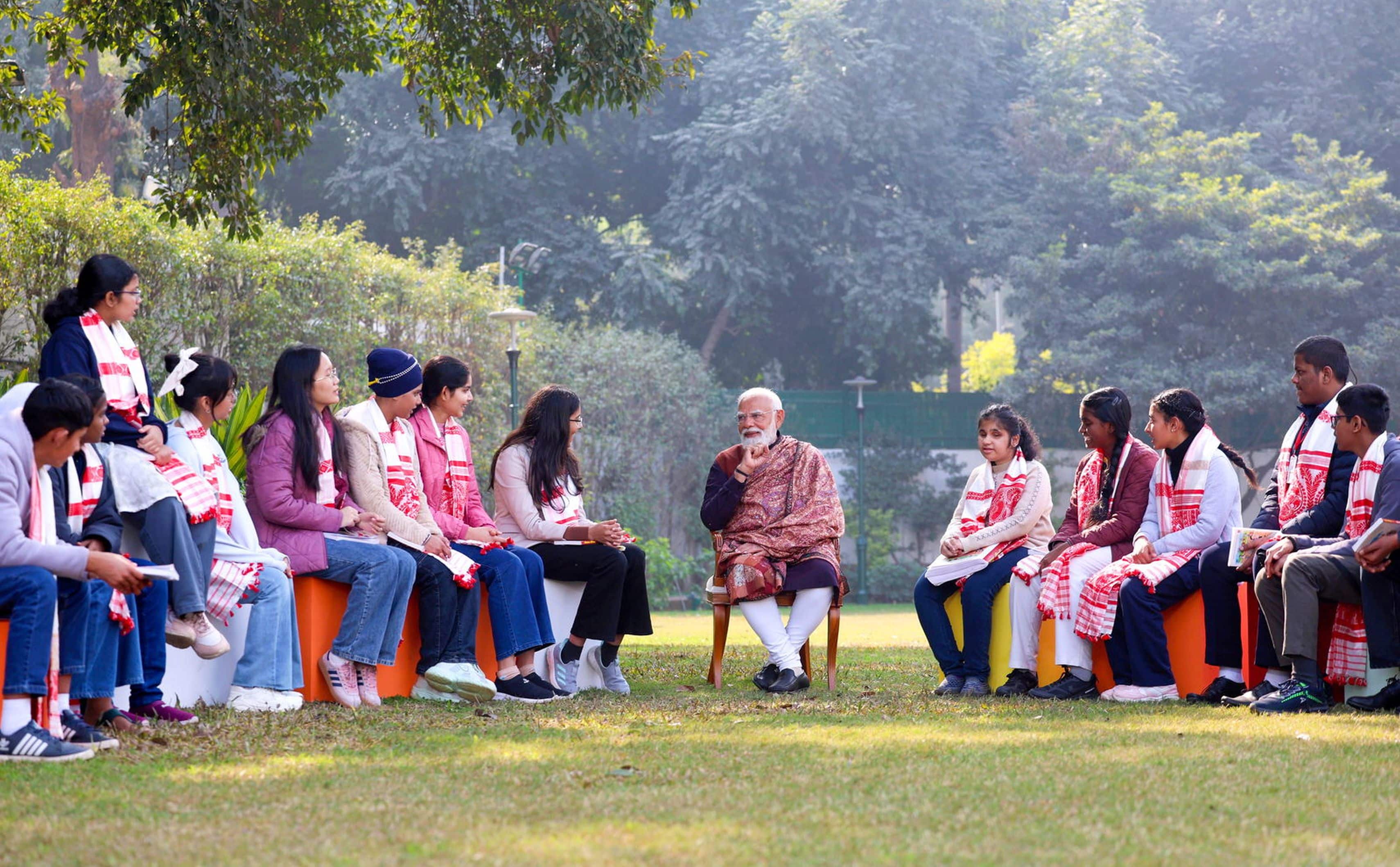
Another student shared that exam dates once caused fear, but the book’s mantra of treating exams as a celebration brought motivation. The Prime Minister advised that lessons from Pariksha Pe Charcha should also be shared with family members, as they can benefit equally.

Students reflected on how they overcame fear of low marks, realizing that marks are not everything and citing Dr. APJ Abdul Kalam’s example of persistence despite failures. The Prime Minister emphasized that reduced tension opens the mind to learning new skills such as singing, painting, or writing poems, and praised students who had begun creative pursuits.

Confidence gained from the book also helped students overcome fear of presentations. The Prime Minister explained that confidence comes from truth and experience, just as ordinary people can speak clearly when narrating events they witnessed. He stressed that students’ confidence arises from the truth of their own efforts and achievements.
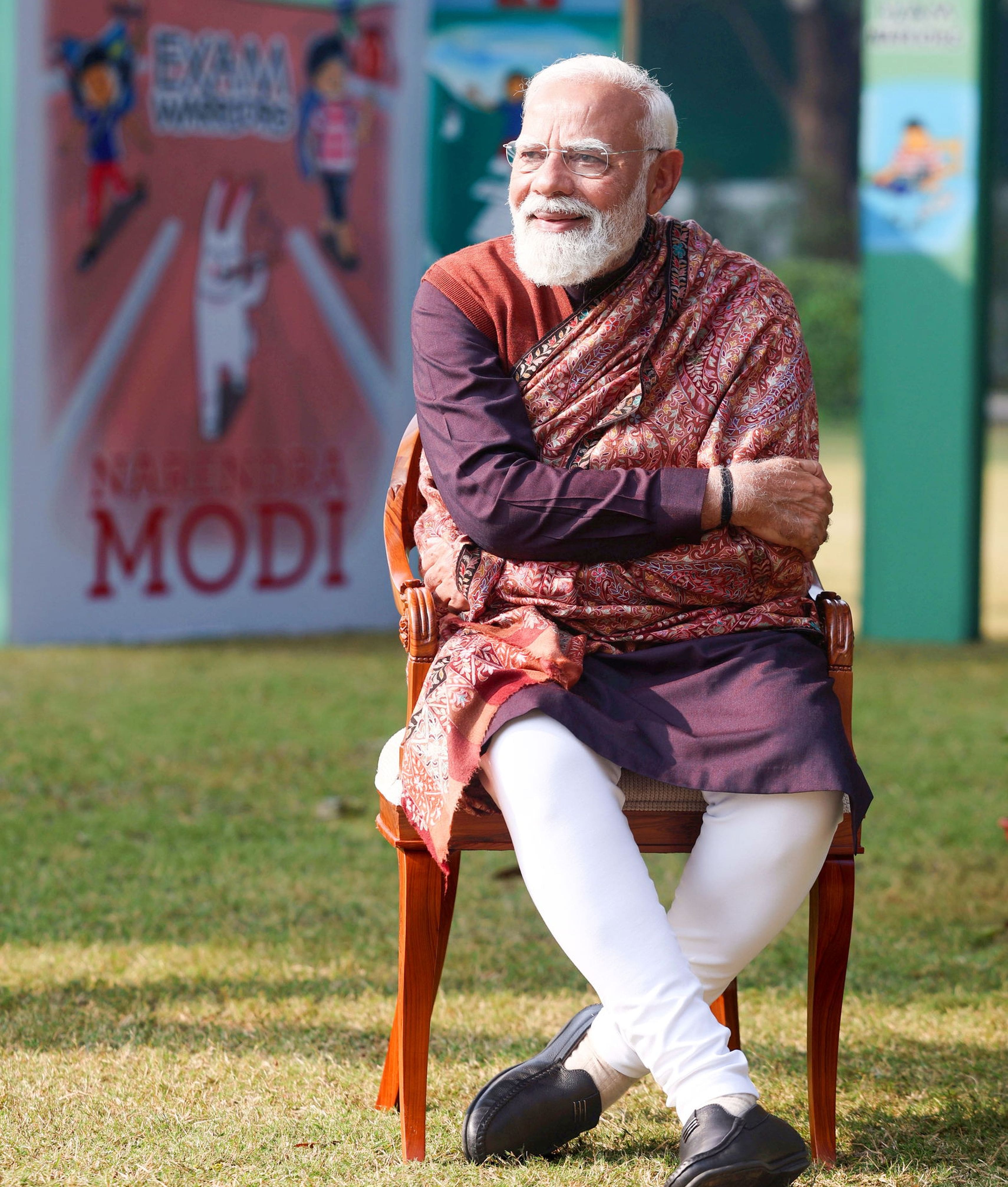
One student shared that lengthy literature papers once caused panic, but now they practice writing faster and improving handwriting. The Prime Minister advised techniques such as pausing for 30 seconds, taking deep breaths, and resetting the mind before tackling papers, noting that mistakes occur not because of lack of knowledge but due to haste. He concluded that with proper techniques and confidence, students can overcome exam fear and succeed.

Holding on through the noise

A student asked how to study amidst household noise and lack of parental support. The Prime Minister recalled a video of a child reading atop a bullock cart loaded with goods, emphasizing that comfort is not essential for success. He highlighted that many top scorers in board exams come from small villages without luxuries, and shared the inspiring story of blind girls who won in cricket despite hardships. He remarked that life is shaped not by comfort zones but by the way one lives.
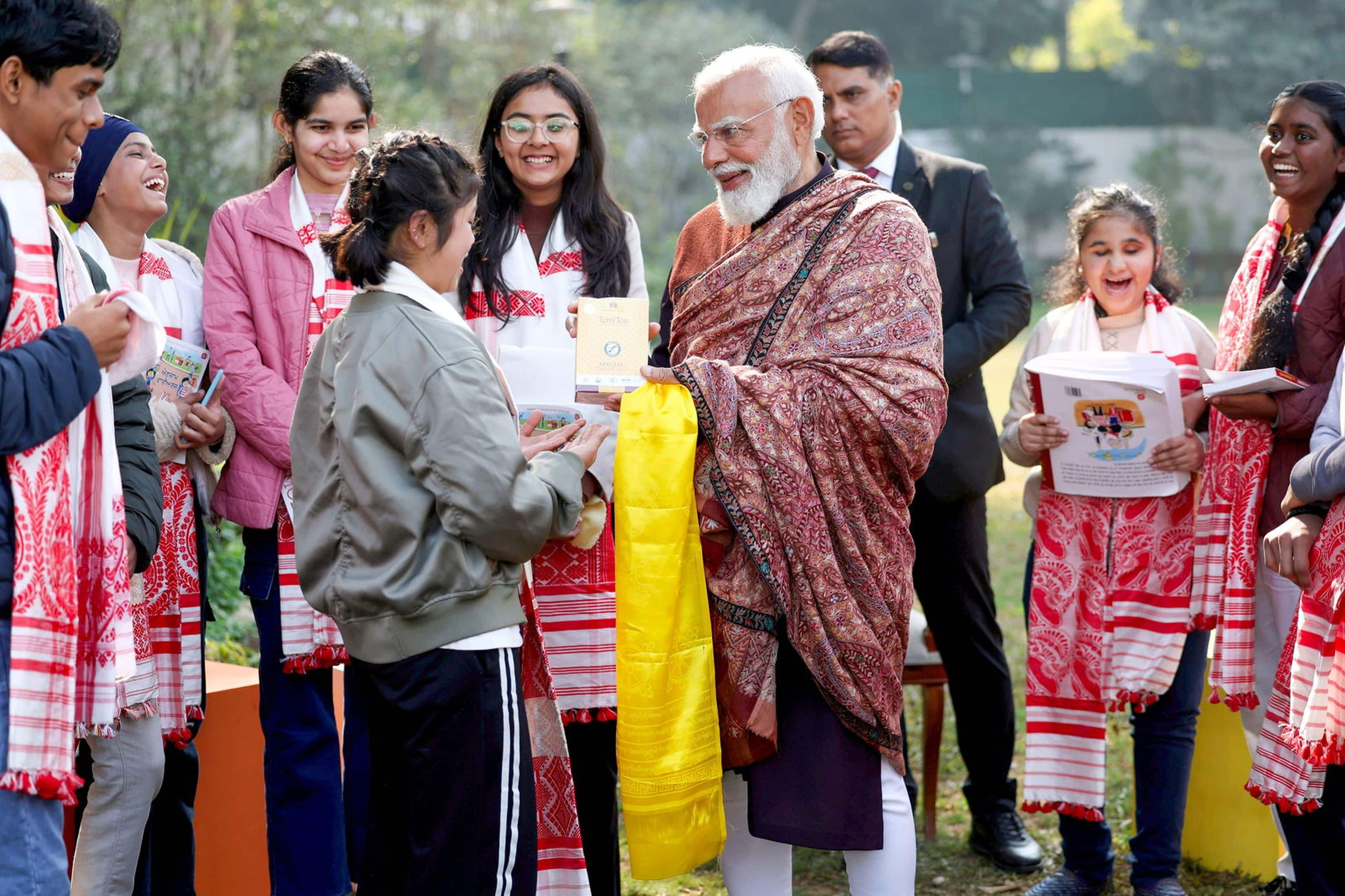
Another student from Tamil Nadu, raised the issue of guests disrupting exam preparation. The Prime Minister advised turning the situation around by asking guests about their own childhood experiences, thereby shifting the focus and easing pressure.

Big Dreams, Bigger Actions

A student from Ladakh asked whether children should dream big and how to begin fulfilling those dreams. The Prime Minister stated that not dreaming is a crime, but dreams must be backed by action. He explained that aspirations like becoming an astronaut require study, biographies, and focused interest, while cautioning against making dreams public to avoid ridicule. He encouraged students to write down their dreams and nurture them privately.
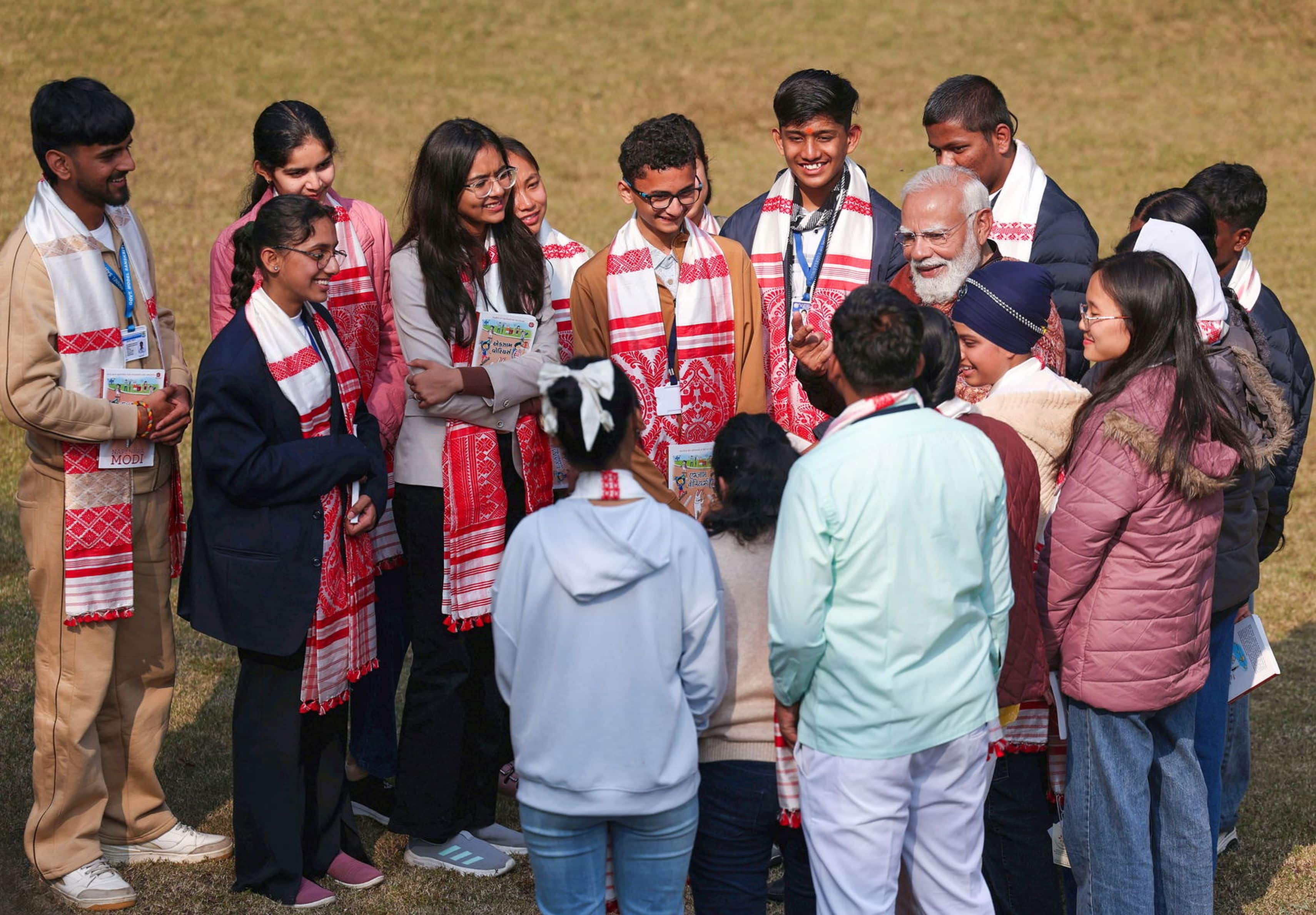
Responding to another query on daily habits to achieve big dreams, Shri Modi suggested reading biographies of great personalities. He explained that understanding their struggles and early steps helps students relate and gain confidence, showing them how to progress step by step.

A student then recited a heartfelt poem dedicated to the Prime Minister, describing him as the pride of India, a servant of humanity, and a leader carrying forward the dreams of the nation. The Prime Minister praised the poem warmly and lauded the student.

When PM became a teacher

Prime Minister Modi remarked that he envisions a developed India by 2047, coinciding with the centenary of independence, and emphasized that the youth, then aged 35 to 45, will be at the most crucial stage of their lives to reap the benefits of this vision. He highlighted that Mahatma Gandhi returned from Africa in 1915 and led the freedom struggle until 1947, and that sacrifices by leaders like Bhagat Singh inspired generations to fight for independence. He stressed that if such a monumental freedom could be achieved, then through collective effort a developed India can certainly be realized.

The Prime Minister urged students to write down their personal commitments towards developed India and asked them to identify five actions they could take, noting their responses on skill development, self-confidence, and use of indigenous products. He highlighted that adopting Swadeshi begins with preparing the mind and shedding the colonial mentality, pointing out how fascination with foreign goods persists even in schools. He directed students to list all items they use daily, identify foreign-made products, and gradually replace them with Indian alternatives, ensuring that within a year their households are filled with Indian goods. He asserted that if Indians themselves do not take pride in their own products, the world will not. He criticized the tendency to blame “Indian time” for delays, remarking that such attitudes demean the nation, and called for adherence to duty beginning with cleanliness. He stressed that developed nations appear clean not because of cleaners but because citizens do not litter, and urged that Indians must resolve never to compromise on cleanliness, even picking up litter themselves to instill shame in those who discard it. He underlined that maintaining health is also a duty, and if citizens fulfill such responsibilities, no force can stop India from becoming developed, with the youth enjoying the greatest benefits when they reach maturity. He asked whether work that yields fruit for them should be done, and students affirmed. He then highlighted the vast opportunities available to the current generation, particularly in technology, and remarked that while his era lacked such opportunities, today’s youth must use Artificial Intelligence wisely. He explained that using AI merely to summarize biographies adds little value, but asking AI to recommend biographies based on age and interests, then reading those books, leads to genuine development. He stressed that AI should be a tool to enhance strength and wisdom, not just entertainment. Students expressed appreciation for his guidance on AI usage, noting its relevance to their own technological pursuits.
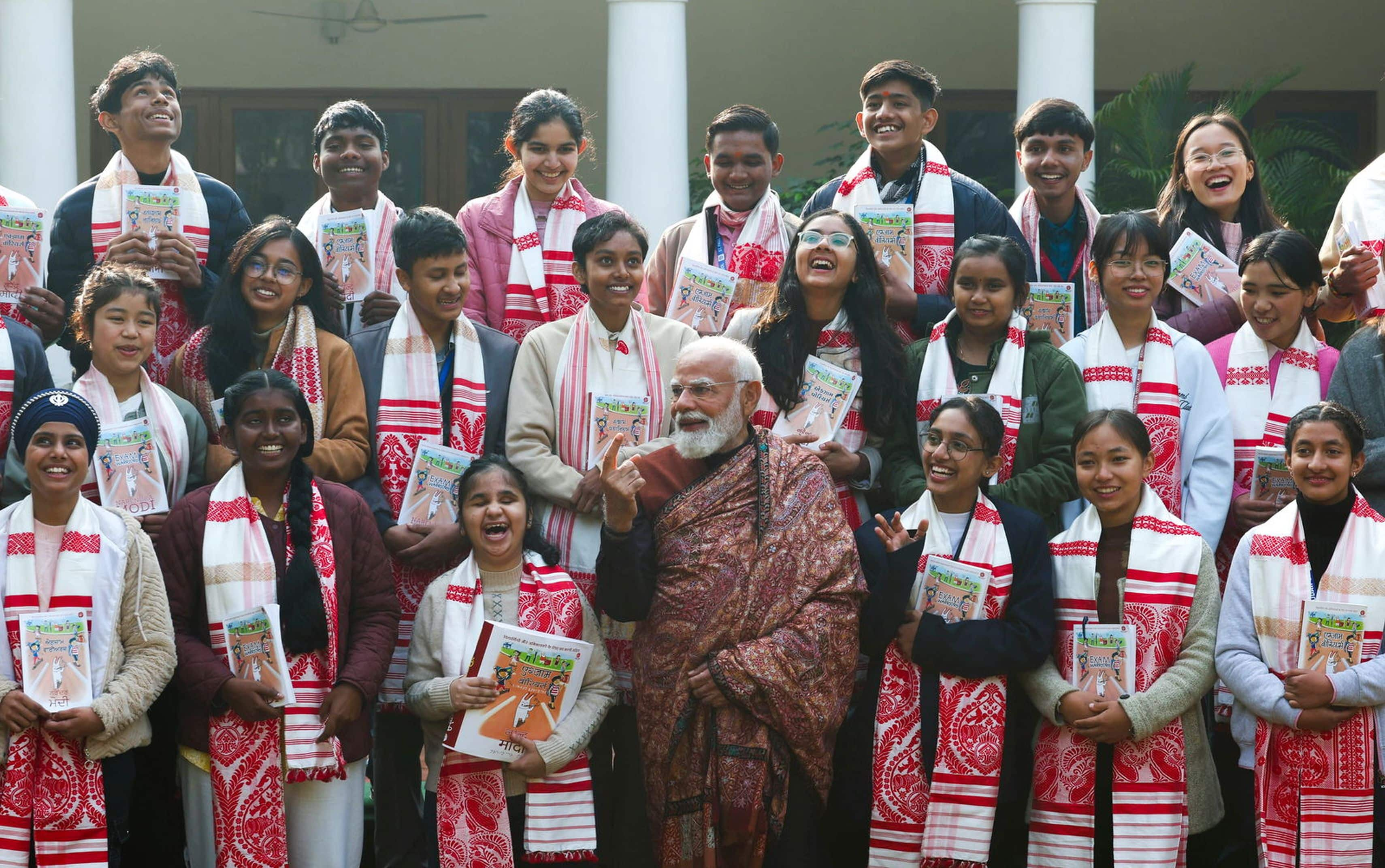
The Prime Minister listened to a student’s flute performance in Carnatic classical style and praised it. He appreciated a handmade bouquet presented by a student, noting its traditional Uttarakhand significance during Basant Panchami, acknowledged references to Tripura traditions, and commended organic tea and Assamese gamocha gifted by students, encouraging them to continue writing poetry. He extended warm thanks and best wishes to all.

Sharing glimpses from the upcoming episode of Pariksha Pe Charcha, the PM remarked that many students had suggested holding “Pariksha Pe Charcha” across different parts of the country, which was reflected in this special episode. He emphasized that within families, one should learn from the good qualities of siblings, and that aspiring to greatness is not wrong but should not be tied to comparisons. He highlighted the importance of education in both personal and social life, while also stressing that sports must be an essential part of life. He invited students to share their thoughts and experiences openly.

The next episode will be aired on 9th February 2026 at 10 AM.

Click here to read full text speech

Explore More
Today, the entire country and entire world is filled with the spirit of Bhagwan Shri Ram: PM Modi at Dhwajarohan Utsav in Ayodhya

Popular Speeches

Today, the entire country and entire world is filled with the spirit of Bhagwan Shri Ram: PM Modi at Dhwajarohan Utsav in Ayodhya
India's share in ship recycling rose to 35.4% in 2025: Shipping ministry

Media Coverage

India's share in ship recycling rose to 35.4% in 2025: Shipping ministry
NM on the go

Nm on the go

Always be the first to hear from the PM. Get the App Now!
...
India is not only a fast-growing economy, but also a credible one: PM Modi
June 22, 2026
India is not only a fast-growing economy, but also a credible one: PM
Along with being a rising power, India is also a reliable power: PM
For India, Nation First is the highest guiding principle: PM
Maoist terror is breathing its last in India: PM
The shift in mindset from "this can never be done" to "this will be done" is India's greatest achievement: PM
The government is empowering the poor and middle-class: PM
The collective efforts of 140 crore Indians will realise the dream of a Viksit Bharat: PM

Swar Sadhana, Manokamana, Aradhana - after such an auspicious beginning, it would have been wonderful if your program had continued. Greetings to all of you.

I extend my regards to all viewers of Republic TV Network, which now broadcasts in many languages. I also welcome all companions who have come to participate in this summit. In 24-hour news channels, breaking news holds great importance. And nowadays, if you look anywhere in the world, the entire world seems to be in breaking news mode. Amidst such hustle and bustle, you are hosting and participating in this summit, and therefore you deserve special congratulations. This time, your theme of discussion is equally significant: Great Power India: Nation First.

Friends,

Our scriptures say: Yato Dharmastato Jayah! - meaning, the root of victory and strength is Dharma. And Dharma means duty, Dharma means justice, Dharma means equality, Dharma means dialogue, Dharma means compassion. This very essence is embedded in the spirit of Nation First. India views its power through this lens, weighing it on this scale.

Friends,

India has another unique quality, which the world has now acknowledged. We are not a nation that reacts hastily to momentary events. We are a nation that has witnessed both development and destruction, endured them as well. We are a nation with the memory chip of ages embedded in our consciousness - a nation with the memory chip of millennia. That is why what India is doing today - and I say this with full responsibility - what India is doing today will write the future of the next thousand years. This is India’s greatest guarantee to the world. India is not only a fast-growing economy, it is also a credible economy. Alongside being a rising power - and you even stretched the dictionary to call it a superpower - I would certainly say that India is a reliable power. Just a few days ago, I returned from the G7 Summit, and every leader, every country understands very well that for today’s India, Nation First is the greatest mantra, the highest principle.

Friends,

Just a few days ago, our government completed 12 years. Arnab even compelled you to clap for that. If you weigh the achievements of the past twelve years, you will find that at the core of every decision, every step, every effort lies the spirit of Nation First. From the Swachh Bharat Abhiyan to Make in India, from emphasizing khadi to encouraging local products - all these initiatives succeeded because the people of the country placed the nation above all and fulfilled their duty. I salute the citizens of this country.

Friends,

Here with us is our companion, Shri Sridhar Vembu ji. When our entrepreneurs walk with the spirit of Nation First, when they set their goals by understanding the needs of the nation, institutions are built and the country prospers. I don’t know how much has been discussed here about Shri Vembu ji’s work, but recently I went to VivaTech in France. There were nearly 1.5 to 2 lakh young people there. As I and the President of France walked through different stalls to see the innovations of the youth, we came to the Zoho stall. I was astonished and filled with pride to see the crowd of European youth gathered there, eager to understand what this new creation was. Perhaps in India it is not discussed as much, but what I saw in France was remarkable. Congratulations to you.

Friends,

The impact of Nation First in government policy and decisions can be seen in our tribal regions. I am not here to deliver philosophy, but let me share a few light examples so you can understand how work happens. I speak of tribal areas - a population of more than 100 million, the tribal society. We all know that for decades, Maoist terror had entrenched itself there. Even in the 21st century, these terrorists did not allow a single facility to reach those areas. No government vehicle could pass through; they would be riddled with bullets. Many governments came and went, generations passed, and it seemed this misfortune of violence would remain forever. You can imagine - between 2004 and 2014, in those ten years, due to Maoist terror, more than 17,000 violent incidents occurred, and nearly 7,000 lives were lost.

Friends,

For you, today’s headline or half-hour TV debate might be that Maoist terrorism has ended. But things don’t happen like that. It requires immense effort, and that is why I want to explain. Nowadays, some people keep waving the Constitution, but when they were in government, in Naxal-affected areas, even uttering the word “Constitution” could get you shot. At that time, they sat silently, their hands trembling, unable to hold up the Constitution. The Congress was hardly affected by that painful situation.

Friends,

After 2014, we moved forward with the spirit of Nation First to change the situation. We did not just talk, we did not just announce, we acted. We resolved to uproot Naxalism-Maoism completely, and today the whole country can see the result. Maoist terrorism in India is now counting its final breaths.

And friends,

Often the final outcome is so vast and significant that the hard work behind it goes unnoticed. I want to especially tell Republic TV viewers about this.

Friends,

In those Naxal-affected areas where even going out in daylight would terrify ordinary people - fearing abduction, extortion, or looting - where even speaking of development was impossible, we advanced with a pledge of progress. In the past 12 years, our government has built more than 12,000 kilometers of roads in such regions. Many times, our construction equipment was burned, contractors were chased away. If 25 people worked on a road, 200 police personnel had to guard them so the work could continue. We did all this because we had resolved to do it.

Friends,

We built more than 9,500 mobile towers. Earlier, even one tower could not be installed, and if installed, it would be destroyed. Because they always wanted to fuel anger. We brought mobile connectivity to nearly 45,000 villages. In Naxal-affected districts, more than 1,800 bank branches were opened. Around 75,000 banking correspondents and more than 6,000 new post offices were established. We did not rely only on bombs, guns, and bullets, friends - we invested every ounce of strength given by God to win hearts.

Friends,

With firm resolve, we went into Naxal-affected areas to fulfill the hopes and aspirations of ordinary people. You will be astonished - a notorious Naxalite, with a bounty of crores on his head, his mother received a ration card from us for the first time. Her son never allowed her to get one, because he wanted to run his terror regime. There are countless such incidents. I was shocked. And the government of that time sat silently, blind to the Constitution. But the result of all these efforts was a new wave of trust among the people. Today, look at Bastar - instead of bombs and guns, Bastar Olympics are celebrated with great enthusiasm. Two editions have already been held. In the first, more than 1.5 lakh youth participated, and in the second, nearly 4 lakh youth joined. Where once there was terror, now talent is finding opportunity, and sports are flourishing.

Friends,

One of the greatest achievements of these 12 years of service has been building an India filled with hope and aspiration, rising out of despair.

Friends,

Naxalism may have been concentrated in certain areas, but its pain was felt across every corner of India. And when news began to spread that Naxalism was ending, the sense of trust was not limited to those affected regions - it spread across the entire nation. In the ten years before 2014, under the Congress government, the discontent was not only about governance. The despair was far deeper. The nation had lost hope. People felt nothing could change, nothing could improve.

Friends,

In the past 12 years, India has transformed despair into hope, and this gives me the greatest satisfaction. Today, everyone feels that with a little more effort, things can be achieved. Gone are the days when the only refrain was “It cannot happen, it cannot happen.” That era has passed. Today, the spirit is “It will happen.” This new confidence is India’s true achievement, and this is real power. Challenges remain, and they always will. Challenges are shape-shifters, appearing in new forms. But whatever form they take, we will fight and we will win. When the nation moves forward with the belief that “it can be done and we will do it,” dreams are fulfilled.

Friends,

I want to speak here about more than 100 districts and over 500 blocks in India. These were left behind on every parameter of development, and earlier governments had stamped them as “backward districts” and “backward areas.” We lifted these vast regions out of the despair of backwardness and ignited aspirations for development. First, we changed their identity. We said these are “aspirational districts,” these are “aspirational blocks.” We created programs for aspirational districts and aspirational blocks, and the government began working meticulously on every parameter of development. In each district, we identified three aspects to overcome, in others six aspects, and focused efforts began. Today, these aspirational districts and blocks are driving the overall growth of states. Earlier, they dragged growth backward. These districts had large populations living in poverty and deprivation. In recent years, 250 million poor people have defeated poverty, and aspirational districts have played a major role in this.

Friends,

We see that when one person is cured of illness, it is not just that individual who recovers - the whole family feels relief. Similarly, when a son or daughter achieves something, it is not just their achievement, but the entire family is filled with pride and confidence. In the same way, when someone rises out of poverty, the entire society benefits, the nation benefits. When 250 million people have come out of poverty and entered the neo-middle class, the benefit is not limited to those families. The middle class also gains, because these are new consumers who drive the economy, ultimately creating opportunities for the middle class. Thus, poverty reduction is not merely a matter of welfare - it is a story of expanding opportunities, a source of new aspirations.

Friends,

The vast middle class that has emerged in the country over the past 12 years has been a major priority for the government. For the ease of living of the middle class, the government has worked at every level. Take the dream of owning a home. Every middle-class family desires to have their own house. In 2014, if a family wanted to buy a home, home loans came with double-digit interest rates. Today, loans are available from banks at 7–8 percent interest. Earlier, getting a loan was like winning a war, requiring immense effort. Today, it is possible from the comfort of one’s home. Here in Delhi-NCR, people know how thousands of urban middle-class homes were stuck incomplete. Families had paid their life savings to builders, who showed glossy pamphlets and dreams, but the houses were never delivered. Families had to pay rent while waiting endlessly for their homes. It was a terrible situation. To complete these stalled projects, we created a special fund of ₹25,000 crore. You will be glad to know that nearly 60,000 long-delayed homes have now been delivered across the country.

Friends,

Another aspect that affects daily life is connectivity and transport. Today, if you look at social media, tourists from around the world are amazed by our metro system.

Friends,

In 2014, about 2.8 million people traveled daily by metro. Today, nearly 12.8 million people travel by metro every day. Now, high-speed trains like Vande Bharat, Namo Bharat, and Amrit Bharat are connecting the nation. With better roads and highways, not only is time saved, but vehicle maintenance costs have also reduced. In recent years, the number of airports has doubled. This has given the middle class in many smaller cities the opportunity to fly for the first time.

Friends,

In the past 12 years, India has not only increased the earnings of the middle class but also their savings. In 2013–14, income up to about ₹2 lakh was taxable, and the middle class bore that burden. Today, income up to ₹12 lakh is tax-free. In other words, tax-free income has multiplied several times.

Friends,

GST reforms have also brought great convenience to the middle class. Filing taxes has become easier, saving both time and money. Income tax returns can now be filed from home, and even settlement issues are handled in a faceless manner.

Friends,

A major expense for middle-class families is treatment for diabetes and other lifestyle-related conditions. At Jan Aushadhi Kendras, such medicines are available at an 80 percent discount. If earlier you spent ₹1,000, today you spend only ₹200, saving ₹800. Over the years, this has resulted in savings of nearly ₹40,000 crore for countless families. Another significant portion of the middle-class budget goes toward healthcare for the elderly. Today, every citizen above 70 years of age is entitled to free treatment up to ₹5 lakh.

Friends,

It is human nature to forget past difficulties when conveniences become routine. Earlier, you paid tax on ₹2 lakh income; now, up to ₹12 lakh is tax-free. Yet applause comes only when reminded. On the other hand, if a bus or train is delayed, complaints pour in. This is the most vocal class.

Friends,

As I said, people forget old troubles. You may not even remember the difficulties once faced in getting a driving license or passport. Earlier, it was a struggle. Today, obtaining a driving license is easier, and passports are usually issued within three days.

Friends,

I know the way our government works has raised people’s aspirations. Once a demand is met, people immediately seek something better, something upgraded. If earlier the demand was for a new road, once built, the next question is: when will the metro arrive? Earlier, expectations were that trains should arrive on time and provide clean seating. Today, the demand is: why isn’t Vande Bharat running on our route?

Friends,

Some see this as dissatisfaction, but it is aspiration. In fact, even the Congress party constantly says, “Modi ji, this should happen, that should happen.” They trust that if anyone can deliver, it is this government.

Friends,

Aspirations arise only where people believe dreams can be fulfilled. This is the aspiration of India’s youth, poor, and middle class. Today, it is the driving energy of BJP-NDA governments.

Friends,

On one side, a large section of the nation is aspirational. On the other side, there is a political group whose life mantra has become “Always Against.” This group is filled with chronic dissatisfaction. Let me share some symptoms so Republic TV viewers can recognize them. They will say, “Why doesn’t this place have 24-hour electricity?” But the next day, they protest against dams, solar parks, thermal plants, or nuclear projects. One day they ask why there is no electricity, the next day they oppose power generation. These are the same people who once opposed mineral mining, but today ask where India’s rare earth mineral reserves and supply chains are, and why India doesn’t have an EV ecosystem like other countries. They once debated “data versus flour,” but now demand to know what India has done in AI. In one breath, they say AI should have advanced further, and in the next, they oppose data centers and semiconductor plants, listing endless drawbacks on social media, TV debates, and newspapers.

Friends,

These people bring up corruption indices from around the world to put India in the dock. Their ecosystem’s media amplifies it 24/7. But when action is taken against corruption, they are the first to cry foul, claiming raids and investigations are harassment. They question why action is taken now, why not then, why against A and not B. This is their game.

Friends,

It is vital for the nation to understand their character. Especially our youth, and Gen Z in particular, must recognize them quickly. Otherwise, as I say, “Suryavanshi has arrived,” and he explains swiftly.

Friends,

These people claim the armed forces lack freedom and weapons. But when the government makes a defense deal or buys modern arms, they are the first to question why. They challenge India’s diplomacy worldwide, but when India builds infrastructure projects for diplomacy and security, they protest loudly.

Friends,

At this crucial juncture, India must identify such people, understand their flawed arguments, and remain alert. Unfortunately, today the main opposition party, Congress, has been taken over by such elements. To imagine Congress speaking of Nation First, as it did in Gandhi ji’s time, is now a false dream.

Friends,

The world today is challenging old paradigms, and the scale of disruption is immense. But these challenges also bring new opportunities. Every youth, entrepreneur, innovator, and startup in India must focus on these opportunities. The government, with the spirit of Nation First, stands fully with the people. India is now riding the Reform Express. This momentum will only accelerate. From this Republic TV platform, I say again: our dreams are vast, and our efforts will be equally immense. The collective endeavor of 1.4 billion Indians will build a developed India. And I assure you, you will see this developed India with your own eyes. It will not be left for future generations to wait. With this confidence, I once again extend my best wishes to Republic TV, its viewers, and all of you. Thank you very much!