

Prime Minister Shri Narendra Modi addressed the International Arya Mahasammelan 2025 at Rohini in New Delhi today. Speaking on the occasion, Shri Modi remarked that the energy of the mantras just heard could still be felt by everyone. He highlighted that whenever he comes among the gathering, the experience is divine and extraordinary. He attributed this feeling to the blessings of Swami Dayanand Ji. The Prime Minister expressed his deep reverence for Swami Dayanand Ji’s ideals. He noted his decades-old affinity with all the thinkers present, which has repeatedly given him the opportunity to be among them. He stated that whenever he meets and interacts with them, he is filled with a distinct energy and a unique inspiration.

Shri Modi recalled that last year, a special programme was held at the birthplace of Maharshi Dayanand Saraswati Ji in Gujarat, in which he participated through a video message. Prior to that, he had the privilege of inaugurating the 200th birth anniversary celebrations of Maharshi Dayanand Saraswati Ji in Delhi. He remarked that the energy of the Vedic chants and the sacred havan rituals still felt as fresh as if they had taken place just yesterday.
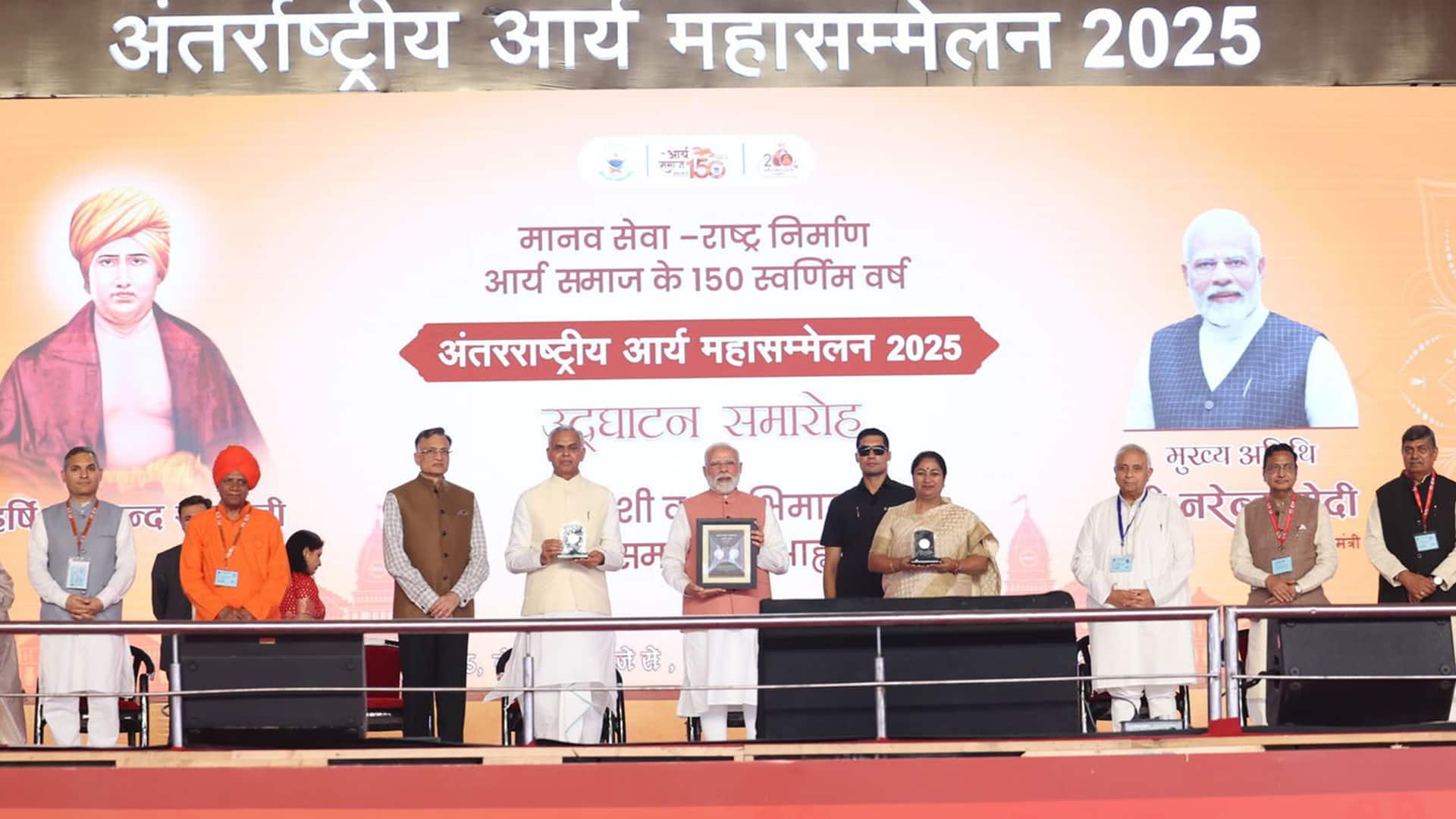
Prime Minister also recalled that during the earlier event, all participants had resolved to continue the bicentenary celebrations of Maharshi Dayanand Saraswati Ji as a ‘Vichar Yajna’ for two years. He expressed happiness that this uninterrupted intellectual offering continued for the full duration. Shri Modi noted that he had been regularly informed about the efforts and programmes undertaken during this period. He stated that today, once again, he had the opportunity to offer his heartfelt tribute during the 150th foundation year celebrations of Arya Samaj. He paid his respects at the feet of Swami Dayanand Saraswati Ji and offered homage. He extended his best wishes to all participants for the international summit. He also remarked that it was a privilege to release the commemorative coin and postal stamp on this occasion.
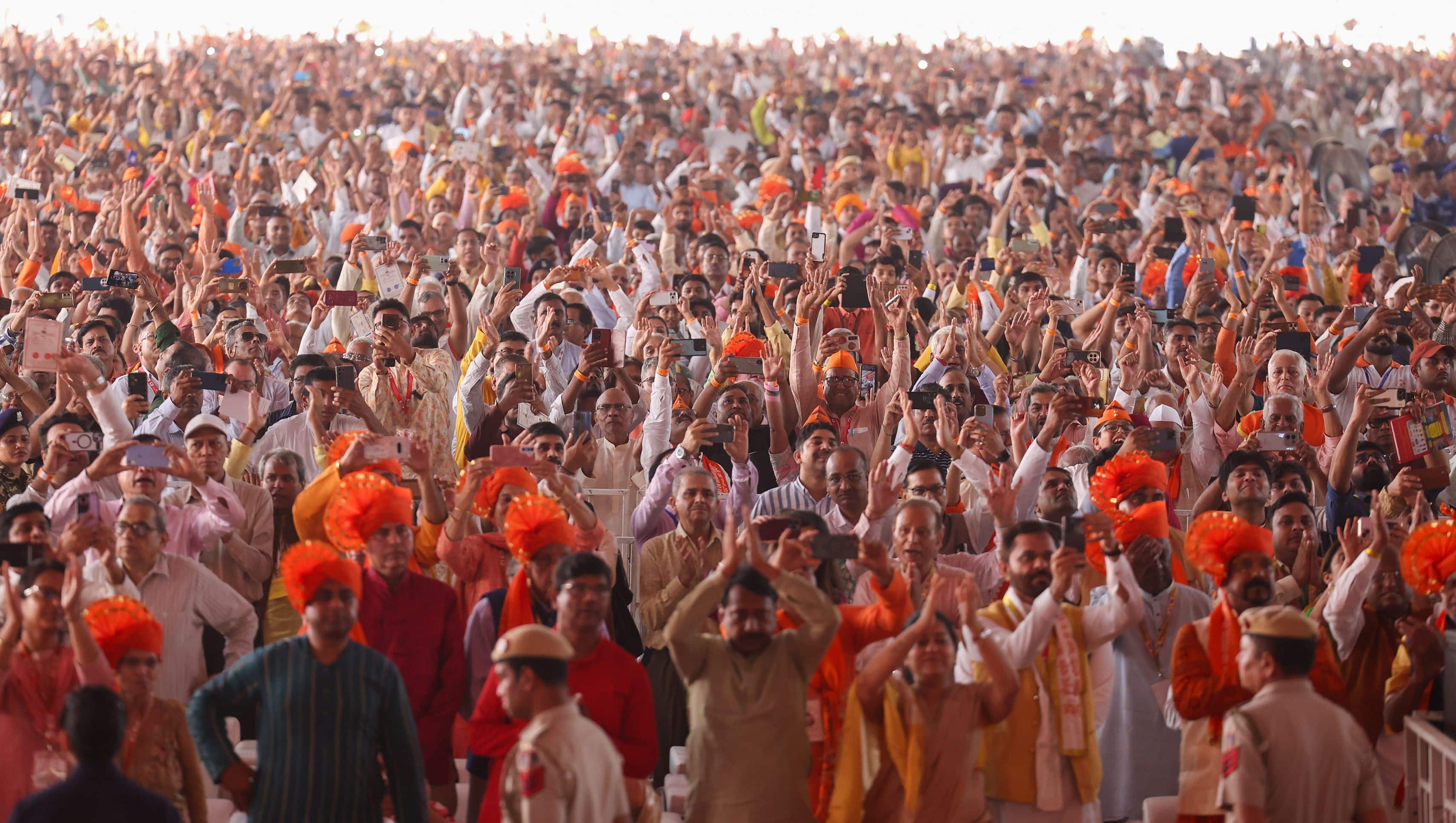
“The 150th anniversary of the Arya Samaj is not merely an occasion for a particular community or sect—it is a celebration deeply connected to the Vedic identity of the entire nation”, exclaimed the Prime Minister. He remarked that it is connected to the Indian philosophical tradition which, like the flow of the Ganga, possesses the strength of self-purification. Shri Modi highlighted that this occasion is rooted in the great legacy of social reform that Arya Samaj has consistently advanced. He noted that the movement provided ideological strength to numerous freedom fighters. He cited examples such as Lala Lajpat Rai and martyr Ramprasad Bismil, among many revolutionaries who drew inspiration from Arya Samaj and dedicated themselves fully to the freedom struggle. The Prime Minister expressed regret that, due to political reasons, Arya Samaj’s significant role in the independence movement did not receive the recognition it truly deserved.
Noting that since its inception, Arya Samaj has been an institution of staunch patriots, Shri Modi emphasized, “the Arya Samaj has fearlessly upheld and promoted the essence of Indianness.” He remarked that whether it was anti-India ideologies, attempts to impose foreign doctrines, divisive mindsets, or efforts to pollute the cultural fabric, Arya Samaj has always stood up to challenge them. The Prime Minister expressed satisfaction that as Arya Samaj marks its 150th year, both society and the nation are paying tribute to the great ideals of Dayanand Saraswati Ji in such a grand and meaningful manner.
Paying tribute to the many scholars of Arya Samaj, such as Swami Shraddhanand, who gave a new direction to the course of history through religious awakening, the Prime Minister stated that the energy and blessings of such great souls are present in this historic moment. From the dais, he offered salutations to these countless noble souls and honoured their memory.

The Prime Minister remarked that India is unique in many ways—its land, its civilization, and its Vedic tradition have remained eternal through the ages. He emphasized that whenever new challenges arise and time poses new questions, some great personality emerges with answers. He noted that some sage, seer, or scholar always comes forward to guide society. Swami Dayanand Saraswati Ji, he said, was one such Maharshi in this grand tradition. Shri Modi recalled that Swami Dayanand Ji was born during the period of colonial subjugation, when centuries of slavery had shattered the nation and society. He observed that superstition and social evils had replaced thought and reflection, and the British demeaned Indian traditions and beliefs to justify colonial rule. In such circumstances, society had lost the courage to express new, original ideas. It was during this difficult time that a young ascetic emerged, undertaking intense spiritual practice in the remote and harsh terrains of the Himalayas, testing himself through rigorous penance. Upon returning, he shook the Indian society trapped in inferiority. At a time when the entire British establishment was engaged in belittling Indian identity, and the decline of social ideals and morality was being presented as modernization, this confident sage called upon his society—“Return to the Vedas!” The Prime Minister described Swami Dayanand Ji as a remarkable figure who reawakened the suppressed national consciousness during the era of colonial rule.
Shri Modi highlighted how Swami Dayanand Saraswati Ji understood that for India to progress, it was not enough to break the chains of colonial rule—India also needed to break the shackles that had bound its society. He emphasized that Swami Dayanand Ji rejected caste-based discrimination and untouchability. He launched a campaign against illiteracy and challenged those who distorted and adulterated the interpretations of the Vedas and scriptures. He confronted foreign narratives and upheld truth through the traditional practice of Shastrarth. The Prime Minister described Swami Dayanand Ji as a visionary sage who recognized the vital role of women in both individual and societal development and challenged the mindset that confined women to the boundaries of the home. Under his inspiration, Arya Samaj schools began educating girls and the girls’ school that started in Jalandhar soon evolved into a full-fledged women’s college. The Prime Minister highlighted that lakhs of daughters educated in such Arya Samaj institutions are now strengthening the foundation of the nation.
Acknowledging the presence of Delhi Chief Minister Smt Rekha Gupta on the dais, Shri Modi highlighted that just two days ago, President of India, Smt Droupadi Murmu flew in a Rafale fighter jet, accompanied by Squadron Leader Shivangi Singh. The Prime Minister remarked that today, India’s daughters are flying fighter jets and promoting modern agriculture as “Drone Didis.” He proudly stated that India now has the highest number of female STEM graduates in the world. He noted that women are increasingly taking on leadership roles in the fields of science and technology. Shri Modi emphasized that women scientists in India’s premier research institutions are playing key roles in space missions such as Mangalyaan, Chandrayaan, and Gaganyaan. He affirmed that these transformative developments indicate that the country is progressing on the right path and fulfilling the dreams of Swami Dayanand Ji.

Prime Minister shared that he often reflects upon one particular thought of Swami Dayanand Ji, which he also frequently conveys to others. Swami Ji had said, “The person who consumes the least and contributes the most is truly mature.” He remarked that these few words contain such profound wisdom that perhaps entire books could be written to interpret them. Emphasizing that the true strength of an idea lies not just in its meaning, but in how long it endures and how many lives it transforms, Shri Modi stated that when we evaluate Maharshi Dayanand Ji’s thoughts on this criterion, and observe the dedicated followers of Arya Samaj, it becomes evident that his ideas have grown even more radiant with time.
Mentioning that Swami Dayanand Saraswati Ji had established the Paropkarini Sabha during his lifetime, the Prime Minister remarked that the seed planted by Swami Ji has grown into a vast tree with many branches, including institutions like Gurukul Kangri, Gurukul Kurukshetra, DAV, and other educational centres, all of which continue to work diligently in their respective domains. He highlighted that whenever the nation faced a crisis, members of Arya Samaj have selflessly dedicated themselves to the service of fellow citizens. Shri Modi further noted Arya Samaj’s significant role in aiding, rehabilitating, and educating refugees who arrived in India after losing everything during the horrors of Partition—a contribution well recorded in history. He added that even today, Arya Samaj remains at the forefront in serving victims during natural disasters.
Emphasising that among the many contributions of Arya Samaj, one of the most vital is its role in preserving the Gurukul tradition of India, Shri Modi recalled that India once stood at the pinnacle of knowledge and science due to the strength of its Gurukuls. During colonial rule, deliberate attacks were made on this system, leading to the destruction of knowledge, erosion of values, and weakening of the new generation. Arya Samaj stepped forward to rescue the collapsing Gurukul tradition. Not only did it preserve the tradition, but it also refined it over time by integrating modern education. The Prime Minister acknowledged that as the country now reconnects education with values and character-building through the National Education Policy, he expresses gratitude to Arya Samaj for safeguarding India’s sacred tradition of knowledge.
Quoting the Vedic verse “Krinvanto Vishwam Aryam,” meaning “Let us ennoble the entire world and guide it towards noble thoughts”, Shri Modi noted that Swami Dayanand Ji adopted this verse as the guiding motto of Arya Samaj. The Prime Minister emphasized that this very verse now serves as the foundational mantra of India’s development journey—where India’s progress contributes to global welfare and its prosperity serves humanity. He stated that India has become a leading global voice in the realm of sustainable development. Drawing a parallel with Swami Ji’s call to return to the Vedas, the Prime Minister highlighted that India is now advocating Vedic ideals and lifestyle on the global stage. He mentioned the launch of Mission LiFE, which has received global support. Through the vision of “One Sun, One World, One Grid,” India is transforming clean energy into a global movement. He added that yoga, through International Yoga Day, has reached over 190 countries, promoting a yogic way of life and environmental consciousness.
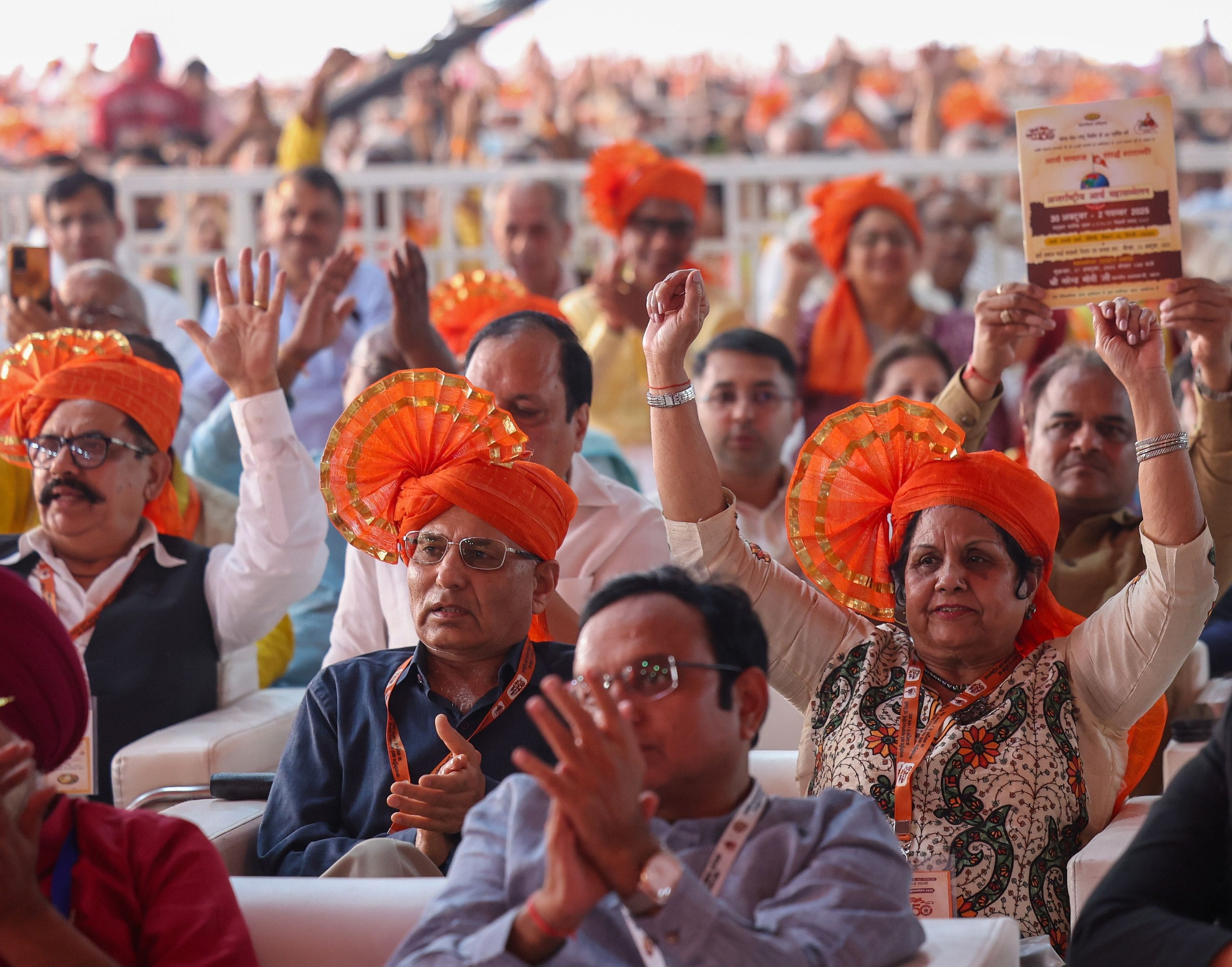
The Prime Minister remarked that global initiatives like Mission LiFE, which are now gaining worldwide interest, have long been integral to the disciplined lives of Arya Samaj members. He praised their commitment to simple living, service-oriented values, preference for traditional Indian attire, environmental concern, and promotion of Indian culture. He affirmed that as India advances global welfare with the ideal of “Sarve Bhavantu Sukhinah” and strengthens its role as a global brother, every member of Arya Samaj naturally aligns with this mission. He commended and appreciated their contributions wholeheartedly.
Underscoring that the torch lit by Swami Dayanand Saraswati Ji has been guiding society for the past 150 years through the Arya Samaj, the Prime Minister affirmed that Swami Ji instilled in all of us a deep sense of responsibility—responsibility to advance new ideas and to break rigid conventions that hinder progress. He acknowledged the affection and support he has received from the Arya Samaj community and expressed that he had come not only to participate but also to make a few requests.
Shri Modi emphasized that while Arya Samaj has already contributed immensely to the nation-building endeavour, he wished to reiterate some of the country’s current priorities. He highlighted the Swadeshi movement, noting Arya Samaj’s historical association with it. As the nation once again embraces the responsibility of promoting indigenous goods and becomes vocal for local, the Prime Minister underscored that Arya Samaj’s role in this mission becomes even more significant.
Recalling the recently launched the Gyan Bharatam Mission, aimed at digitizing and preserving India’s ancient manuscripts, the Prime Minister emphasized that this vast repository of knowledge can only be truly safeguarded when the younger generation connects with it and understands its significance. Shri Modi called upon Arya Samaj to actively participate in this mission, noting that for the past 150 years, Arya Samaj has been engaged in discovering and preserving India’s sacred ancient texts. He acknowledged the multi-generational efforts of Arya Samaj members in maintaining the originality of these scriptures. He stated that Gyan Bharatam Mission will now elevate this endeavour to the national level and urged Arya Samaj to consider it their own campaign. He encouraged them to involve youth in the study and research of manuscripts through their Gurukuls and institutions.

Prime Minister Shri Modi also recalled that on the occasion of Maharshi Dayanand Ji’s 200th birth anniversary, he had spoken about the grains used in yajnas. He emphasized the sacred significance of “Shri Anna,” the coarse grains traditionally used in yajnas, and highlighted the need to promote India’s ancient tradition of Shri Anna. He noted that one of the key attributes of these grains is that they are naturally cultivated. Natural farming, he said, was once a major pillar of India’s economy, and the world is once again beginning to recognize its importance. The Prime Minister urged Arya Samaj to raise awareness about both the economic and spiritual dimensions of natural farming.
Pointing to the issue of water conservation, the Prime Minister stated that the country is working through the Jal Jeevan Mission to deliver clean drinking water to every village, describing it as one of the most unique campaigns in the world. However, he cautioned that water delivery systems will only be effective if sufficient water is preserved for future generations. To this end, the government is promoting drip irrigation and has undertaken the creation of over 60,000 Amrit Sarovars. The Prime Minister called upon society to actively support these efforts alongside the government.
Reflecting on the traditional presence of ponds, lakes, wells, and stepwells in every village, which have been neglected over time and have dried up, Shri Modi stressed the need for continuous public awareness to protect these natural resources. The Prime Minister also highlighted the success of the “Ek Ped Maa Ke Naam” campaign, noting that it is not a short-term initiative but a sustained movement for afforestation. He encouraged members of Arya Samaj to connect as many people as possible with this campaign.
Prime Minister quoted the Vedic verse “Sangachchhadhwam Samvadadhwam Sam Vo Manansi Janatam,” which teaches us to walk together, speak together, and understand one another’s minds—emphasizing mutual respect for each other’s thoughts. He stated that this Vedic invocation must also be seen as a national call to action. Shri Modi urged everyone to adopt the nation’s resolutions as their own and to advance collective efforts through the spirit of public participation. He remarked that Arya Samaj has embodied this spirit consistently over the past 150 years and called for its continued strengthening. The Prime Minister concluded by expressing confidence that the thoughts of Maharshi Dayanand Saraswati Ji will continue to illuminate the path of human welfare. He once again extended heartfelt greetings to all on the occasion of 150 years of Arya Samaj.
The Governor of Gujarat and Maharashtra, Shri Acharya Devvrat, Chief Minister of Delhi, Smt Rekha Gupta were present among other dignitaries at the event.
Background
The International Arya Summit 2025 programme forms a key part of the Jyāna Jyoti Festival commemorating the 200th birth anniversary of Maharshi Dayanand Saraswati Ji and 150 years of Arya Samaj’s service to society.
The Summit will bring together representatives from Arya Samaj units across India and abroad — reflecting the universal relevance of Maharshi Dayanand’s reformist ideals and the organisation’s global outreach. It will also feature an exhibition titled “150 Golden Years of Service”, showcasing Arya Samaj’s transformative journey through its contributions in education, social reform, and spiritual upliftment.
The Summit aims to honour Maharshi Dayanand Saraswati’s reformist and educational legacy, celebrate 150 years of Arya Samaj’s service in education, social reform, and nation-building, and inspire global awareness of Vedic principles and Swadeshi values in alignment with Viksit Bharat 2047.
Click here to read full text speech
आर्य समाज की स्थापना के 150 वर्ष...
— PMO India (@PMOIndia) October 31, 2025
ये अवसर केवल समाज के एक हिस्से या संप्रदाय से जुड़ा नहीं है।
ये अवसर पूरे भारत की वैदिक पहचान से जुड़ा है: PM @narendramodi pic.twitter.com/L4QjO0lMZF
आर्य समाज निर्भीक होकर भारतीयता की बात करने वाली संस्था रही है: PM @narendramodi pic.twitter.com/ScK2zX5KJT
— PMO India (@PMOIndia) October 31, 2025
स्वामी दयानंद जी युगदृष्टा महापुरुष थे: PM @narendramodi pic.twitter.com/ZegYbR8YML
— PMO India (@PMOIndia) October 31, 2025
आज भारत sustainable development की दिशा में एक प्रमुख global voice बन चुका है: PM @narendramodi pic.twitter.com/Wlrow0qHyo
— PMO India (@PMOIndia) October 31, 2025