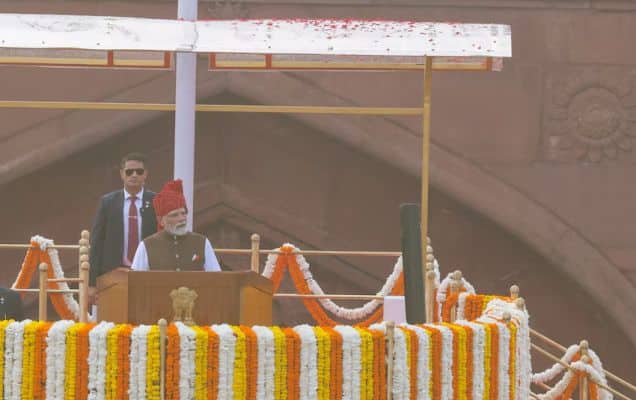
Prime Minister Narendra Modi addressed massive gatherings at Srinagar and Katra in Jammu & Kashmir, emphasizing the region's rapid development and progress. "This is the new Jammu and Kashmir," he said, highlighting the large turnout of young people, the elderly, mothers, and sisters. “Our goal is the rapid development of Jammu and Kashmir," he added.
PM Modi congratulated the people of Jammu and Kashmir on the successful first phase of voting in seven districts, which took place without the shadow of terrorism. "This is a matter of happiness and pride for all of us, that so many people came out to vote," he said, citing voting percentages of over 80% in Kishtwar, 71% in Doda, 70% in Ramban, and 62% in Kulgam. “Today, the world is watching how the people of Jammu and Kashmir strengthen India's democracy. For this, I congratulate the people of Jammu and Kashmir,” PM Modi added.

PM Modi criticized the three families that have ruled Jammu and Kashmir, saying they have "crushed both democracy and the cultural essence of Kashmir." He accused them of depriving the people of their rightful entitlements and promoting violence and chaos. However, he noted that the youth of Jammu and Kashmir are now challenging these families and rising against them.
“The three families were responsible for the ruin of Jammu and Kashmir. These people have been rattled from Delhi to Srinagar. These three families think that no one can question them. They believe that grabbing power and looting you is their birthright. These families have always deprived the people of Jammu and Kashmir of their rightful entitlements, and this has been their political agenda. They only gave Jammu and Kashmir violence and chaos. But now, Jammu and Kashmir will no longer be under the grip of these three families. Now, the youth of Jammu and Kashmir are challenging them. The same youth they held back are now rising against them,” said the Prime Minister.

Taking a sharp dig at Congress and PDP, PM Modi said, “They sold hatred for decades to keep their political shops running. The same fires that burned schools in Kashmir were stoked by their market of hatred. They did not build new schools and gave shelter to those who set schools on fire. You remember the time when even the schools that survived the fires couldn't operate for months. Our youth were kept away from education, while these three families rejoiced in handing them stones. For their selfish gains, they ruined the future of our children.”
The Prime Minister highlighted his government's efforts to provide education and employment opportunities to the youth. "In the past five years, around 50,000 children whose education had been interrupted were re-enrolled in school," he said. Additionally, 250 schools are being upgraded to PM Shri Schools, and numerous degree colleges, and engineering and polytechnic colleges have been built.

“These three families have crushed both democracy and the cultural essence of Kashmir. Think about what they did in the 1980s. They treated the politics of Jammu and Kashmir as their fiefdom. They did not want anyone else to rise politically, otherwise, why would they have halted the elections for Panchayats, BDCs, and DDCs? They feared that new leaders would emerge and challenge their family rule,” said PM Modi highlighting Congress, NC and PDP’s misrule in the state.
Underscoring the government’s dedication to the development and progress that Jammu and Kashmir achieved, PM Modi said, “The Kashmir Valley is now connected by rail. This will benefit apple farmers and other fruit and vegetable growers. Your produce will reach major markets across the country at lower costs. Increased connectivity will boost the tourism sector, and new factories, industries, and businesses will be established here.”

PM Modi emphasized the improved security situation in Jammu and Kashmir, citing the successful organization of events like the G-20 summit, sports car racing, and Khelo India Winter Games. He also highlighted the increased connectivity, including the rail link to the Kashmir Valley, which will benefit farmers and boost tourism.
The Prime Minister outlined the BJP's plans for the poor, farmers, youth, and women, including increased financial support and access to free healthcare. He also reiterated the party's commitment to restoring Jammu and Kashmir's statehood. He said, “In Jammu and Kashmir, we are focused only on development and rapid progress. Today, new playgrounds have been built for children. The new Habba Kadal Bridge, the renovated Zero Bridge and Abdullah Bridge, the Wayil Bridge in Ganderbal, the beauty around Dal Lake and Jhelum, electric buses running on the streets of Srinagar, and the bustling Polo View market, all these are signs of the new and improved Jammu and Kashmir.”

During his second address in Katra, Jammu and Kashmir, PM Modi emphasized the need for change, citing the failures of Congress, NC, and PDP in the region over the years. “These elections are about choosing the future of Jammu and Kashmir. They are about building a stronger and newer Jammu and Kashmir,” said PM Modi. He added that the Congress-NC-PDP alliance represents "Three families who have inflicted wounds and caused pain to this region for decades" and called for an end to their political legacy.

Referring to recent remarks made by Congress leaders, the Prime Minister remarked, "Congress has always been willing to gamble with our faith and culture for a few votes." He criticized the Congress’ stance on religious traditions, labelling it a reflection of their "Naxalite ideology" and foreign influences. Also, PM Modi showcased the BJP government’s achievements in the region, highlighting infrastructure projects, including the construction of the Chenab Bridge, which is now an iconic symbol of Jammu’s progress. “You entrusted this task to Modi and the BJP. Today, this magnificent bridge is not only a convenience but also an attraction,” he said, adding that it is now internationally recognized, with people talking about it in the same breath as Paris’ Eiffel Tower.

Highlighting the boost to tourism, PM Modi spoke of the large influx of tourists and pilgrims to the region, including the 95 lakh pilgrims who visited Mata Vaishno Devi last year. He noted, “This has benefited small shopkeepers, fruit vendors, farmers, and auto and taxi drivers alike.” PM Modi also celebrated the recent GI tag given to Udhampur's ‘Kaladi,’ a local cheese, which will increase demand and provide new opportunities for local farmers and weavers. "I am happy that during the BJP government, Udhampur's “Kaladi’ received a GI tag," said the Prime Minister.

PM Modi reiterated his commitment to providing better opportunities for the youth of Jammu and Kashmir, referencing the successes of para-athletes from the region. The Prime Minister reaffirmed the BJP's stance on Article 370, condemning efforts by Congress, NC, and PDP to restore the provision. He emphasized, "We will not let Pakistan’s agenda be implemented in Jammu and Kashmir. No power in the world can bring back Article 370."

In his closing remarks, PM Modi assured voters that the BJP remains committed to making Jammu and Kashmir a state again, a promise made in Parliament. He called on the people to support the BJP on September 25.
Click here to read full text speech of Srinagar
Click here to read full text speech of Katra
जम्मू-कश्मीर में इस वक्त जम्हूरियत का तवहार चल रहा है।
— narendramodi_in (@narendramodi_in) September 19, 2024
कल ही यहां 7 जिलों में पहले दौर की वोटिंग हुई है... पहली बार दहशतगर्दी के साये के बिना ये वोटिंग हुई: PM @narendramodi pic.twitter.com/zicIT5nNIq
कुछ दिन पहले जब मैं जम्मू-कश्मीर आया था... तो कहा था कि जम्मू-कश्मीर की बर्बादी के लिए तीन खानदान ज़िम्मेदार हैं।
— narendramodi_in (@narendramodi_in) September 19, 2024
तब से, दिल्ली से लेकर श्रीनगर तक, ये लोग बौखलाए हुए हैं: PM @narendramodi pic.twitter.com/IRie816lna
मोदी का इरादा... मोदी का वादा... pic.twitter.com/ETDn3yDO4q
— narendramodi_in (@narendramodi_in) September 19, 2024
मेरे जम्मू-कश्मीर का नौजवान मजबूर नहीं रहा...वो मोदी सरकार में मजबूत हो रहा है: PM @narendramodi pic.twitter.com/5v3xL3dx21
— narendramodi_in (@narendramodi_in) September 19, 2024
तीन खानदानों ने जम्मू-कश्मीर की सियासत को अपनी जागीर समझ रखा है। pic.twitter.com/yHSIytoNPv
— narendramodi_in (@narendramodi_in) September 19, 2024
बरसों तक यहां लोग लाल चौक में आने से डरते थे। लेकिन अब तस्वीर बदल गई है: PM @narendramodi pic.twitter.com/x7id99LVSw
— narendramodi_in (@narendramodi_in) September 19, 2024
बीजेपी, सबको जोड़ रही है। हम दिल और दिल्ली की दूरी मिटा रहे हैं: PM @narendramodi pic.twitter.com/Hm13HXnL1f
— narendramodi_in (@narendramodi_in) September 19, 2024
नेशनल कॉन्फ्रेंस, पीडीपी और कांग्रेस के पास बताने के लिए काम नहीं सिर्फ नाकामियां हैं।
— narendramodi_in (@narendramodi_in) September 19, 2024
इन लोगों ने कश्मीर को सिवाय बर्बादी के और कुछ नहीं दिया। pic.twitter.com/xARmHUA3IK
ये चुनाव जम्मू-कश्मीर का भविष्य चुनने के लिए है।
— narendramodi_in (@narendramodi_in) September 19, 2024
ये नए जम्मू-कश्मीर को और बुलंद बनाने का चुनाव है। pic.twitter.com/2qOCbr5Q7p
कांग्रेस वाले कहते हैं कि देवता, भगवान नहीं होते!
— narendramodi_in (@narendramodi_in) September 19, 2024
कांग्रेस के लोग, ऐसी बातें भूल-चूक से नहीं करते। ये एक नक्सली सोच है... pic.twitter.com/KgWllV05Jp
कांग्रेस का शाही परिवार- देश का सबसे भ्रष्ट परिवार है। ये परिवार, भारत में भ्रष्टाचार की कुरीति का जन्मदाता है, उसका पोषक है। pic.twitter.com/F57VpA7MTC
— narendramodi_in (@narendramodi_in) September 19, 2024
जबसे आर्टिकल-370 की दीवार टूटी है, तबसे आतंक और अलगाव यहां लगातार कमजोर पड़ रहे हैं: PM @narendramodi pic.twitter.com/TSv7tPVAys
— narendramodi_in (@narendramodi_in) September 19, 2024
कांग्रेस-नेशनल कॉन्फ्रेंस को लेकर जम्मू-कश्मीर में भले ही, उत्साह न हो, लेकिन पड़ोसी देश इन्हें लेकर बहुत उत्साह में है। pic.twitter.com/sPZgvIYMEq
— narendramodi_in (@narendramodi_in) September 19, 2024
कांग्रेस-नेशनल कॉन्फ्रेंस की पोल खुद पाकिस्तान ने खोल दी है। pic.twitter.com/k380F13NiI
— narendramodi_in (@narendramodi_in) September 19, 2024
जम्मू-कश्मीर में पाकिस्तान के एजेंडे को लागू नहीं होने देंगे। दुनिया की कोई ताकत जम्मू-कश्मीर में आर्टिकल 370 की वापसी नहीं करा सकती: PM @narendramodi pic.twitter.com/aLaUKisgeU
— narendramodi_in (@narendramodi_in) September 19, 2024