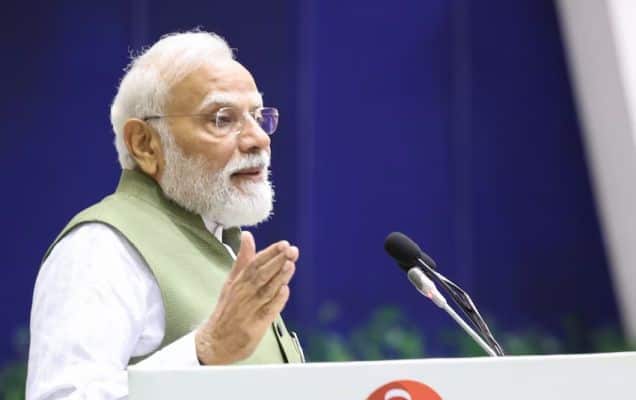
In a powerful address to a massive crowd in Alipurduar, West Bengal, PM Modi ignited the spirit of the people, especially the youth, urging them to take charge of shaping a prosperous future for Bengal and India. With a clear vision for a Viksit Bengal and a Viksit Bharat, PM Modi exposed the failures of the TMC government and called upon the people to defeat divisive and appeasement-driven politics ahead of the 2026 West Bengal Assembly elections.
Addressing the youth, PM Modi asserted, “This is a decisive moment for West Bengal’s young generation. You hold the key to transforming the future of Bengal.” He outlined five critical issues afflicting the state: “Rampant violence and lawlessness, growing insecurity among women, rising youth unemployment, deep-rooted corruption eroding public trust, and TMC’s self-serving politics that deny the poor their rightful benefits.”

Citing incidents in Murshidabad and Malda, he strongly condemned the TMC’s selective inaction and favouritism. He declared, “The people of Bengal have lost faith in the TMC’s governance. Courts are forced to intervene in every matter because the state government has failed to uphold justice. The voice of Bengal is loud and clear: Banglar chitkar, lagbe na nirmam shorkar! (Bengal’s cry: We reject a ruthless government!).”
PM Modi also lambasted the TMC for shielding corrupt leaders, particularly in the teacher recruitment scam, and demanded accountability.
Focusing on the plight of tea garden workers in Alipurduar, he said, “TMC’s misgovernance has led to the closure of tea estates, robbing thousands of their livelihoods. The disgraceful mishandling of workers’ provident funds reflects their disregard for the hardworking people. The BJP is committed to ensuring justice for every tea garden worker.”

He further criticized the TMC for blocking key central welfare schemes such as Ayushman Bharat, Vishwakarma Yojana, and PM JANMAN Yojana. “While the rest of the nation benefits from free healthcare, housing, and skill development, TMC deliberately deny these benefits to Bengal’s poor, SC/ST/OBC communities, and tribal populations,” he said.
On infrastructure development, PM Modi highlighted how the TMC has stalled projects worth over ₹90,000 crore, including railways, metro, highways, and hospitals. “This is nothing short of betrayal. While other states participate in NITI Aayog’s Governing Council meeting to plan for progress, TMC skips crucial meetings, choosing politics over development,” he said.

Touching upon national security and cultural pride, PM Modi invoked Bengal’s spirit. “From the land of Sindoor Khela, India showcased its strength through Operation Sindoor. After the barbaric terror attack in Pahalgam, our forces destroyed terrorist hideouts in Pakistan, sending a clear message—any attack on India will face a decisive response. The roar of Bengal’s tiger echoes: Operation Sindoor is not over.”
In his concluding remarks, PM Modi appealed to the people of Alipurduar and across Bengal to reject the TMC’s oppressive governance. He assured that a BJP-NDA government would bring development, security, and justice to every citizen. He urged the youth to take this message door-to-door and work towards a decisive victory for the state’s future.

Click here to read full text speech
West Bengal is grappling with multiple crises: PM @narendramodi pic.twitter.com/a5dwk2IlxS
— narendramodi_in (@narendramodi_in) May 29, 2025
What happened in Murshidabad and Malda is a glaring example of the cruelty of the TMC government. pic.twitter.com/sTcTYC3gPO
— narendramodi_in (@narendramodi_in) May 29, 2025
The people of West Bengal no longer trust the TMC government or its system. pic.twitter.com/37F6BVzWwg
— narendramodi_in (@narendramodi_in) May 29, 2025
The TMC government's mismanagement has shattered the future of thousands of teachers pic.twitter.com/oYR6NpWuVB
— narendramodi_in (@narendramodi_in) May 29, 2025
Across the country, senior citizens aged 70 years and above are receiving free medical treatment coverage of up to Rs. 5 lakh.
— narendramodi_in (@narendramodi_in) May 29, 2025
However, the TMC government is not implementing it in West Bengal. pic.twitter.com/h82XAQZEw0
The BJP government is building homes for poor families all over India. But in West Bengal, many families still don’t have homes because TMC leaders are asking for bribes. pic.twitter.com/rkY34HE75Z
— narendramodi_in (@narendramodi_in) May 29, 2025
Pakistan, which harbours terrorism, has nothing positive to offer the world. Since its inception, it has only nurtured terror. pic.twitter.com/YFkCGcgF8p
— narendramodi_in (@narendramodi_in) May 29, 2025