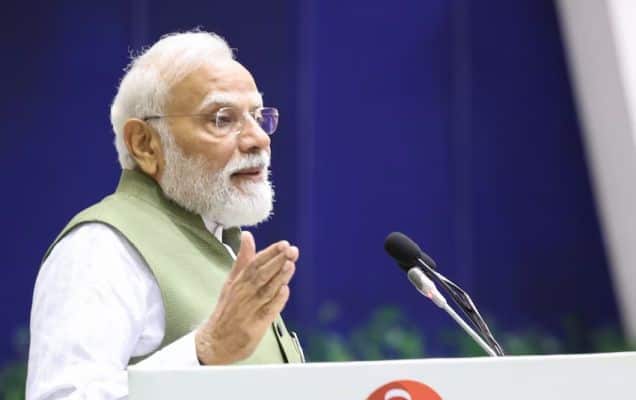
Prime Minister Narendra Modi answered wide-ranging questions in an exclusive interview with ANI.
Here is the full transcript.
PM Modi: Namaskar. Namaskar. I wish you a very happy Navratri. In a few days, the country will celebrate Ram Navami. I wish you a very happy Ram Navami.
ANI: You too. My first question is that you have said in many speeches that 2024 is not your target, it is 2047. What is going to happen by 2047, and is this election just a formality?
PM Modi: I think that both 2047 and 2024 should not be mixed up. There are two different things. I had presented this to people from the beginning, one or two years before. And I used to say that in 2047 we will be celebrating 100 years of the independence of the country. Naturally, during such a milestone, it somehow brings new excitement and creates a new resolution.
And in that sense, it was my motto that there is a chance. We were at 75 years of independence, and we are going to reach 100 years. How do we make use of these next 25 years? In every institution, everyone should have a goal. I am the head of my village, and by 2047, I will do this much in my village.
I recently went to the RBI function where they celebrated 90 years, so I said that the next 10 years is very important. You will have completed 100 years. Think about it from now on.
So, in my mind, 2047 is the 100th anniversary of India's independence. And inspiration should arise in the country. And the 100th anniversary of independence is a great inspiration in itself. So, that is one part.
The second is 2024. 2024 is the year of our election. and I believe that elections are altogether different things. On the one hand, as you see in this election, in a democracy, elections should not be taken lightly. And so, I feel that it should be celebrated as an event. From that, like sports, when there are sports festivals and sports events, they create a sportsman spirit. When there is a game, the spectators, the players create an environment of sportsmanship. Which becomes our culture. If we turn this atmosphere of elections into a festival, turn it into a utsav, then in our veins, in the veins of the coming generations of democracy, it becomes a culture. And it is very important for democracy that democracy should not only be in the limits of the constitution. It should be in our blood. It should be in our culture and in that sense, I see 2024.
It is true that I have a vision of 25 years, and I have done a lot of work on that. And it is not like I am doing it today. Maybe when I was in Gujarat, I used to think in that direction. Now look at the 2024 elections. So there is an opportunity in front of the country that there is a model of Congress government and the BJP government. They have worked for five to six decades. I leave a lot of room for them. They have worked for 5-6 decades, and I have only worked for 10 years. Compare these in any field. Even if there are some shortcomings, there will be no shortcomings in our efforts.
Secondly, in 10 years, at least 2 years, we lost to the battle of COVID. And there were many aftereffects, too. Even then, today, if we compare the country in terms of speed and scale, if we talk about all-encompassing development, then let's talk about that. On every parameter, you can see a model that yes, we will walk on this path with so much speed, and I have to increase the speed. In the next term, I have to increase the speed as well as the scale. That is my goal. Secondly, you will see that when the people of the country take on the responsibility of running the country, then we should have a single-minded focus on the country and the people of the country.
Unfortunately, the political culture of the past was focused on how to make the family strong, and not let anyone take away the roots of the family. Whereas, I am working with the aim of making the country strong. My government is working towards that goal. And when the country is strong, everyone experiences its benefits. Where something is happening, we are working hard, and doing it with honesty, these things have an impact. So 2024 is an election, so we have taken our track record, and they have brought their track record.
ANI: Prime Minister, you have mentioned two things that I would like to ask about. When you say that there is a trailer, in your speeches, you say that there is a trailer and you are going to do a lot. So, there is a part of the population that gets a little nervous about what Modiji is going to do. The other people who have complete faith in you think that more work is yet to be done and Modi is going to execute it. So for both of you, what is your vision for 2047? How will this vision be successful? What is your game plan?
PM Modi: When I say that I have a very big plan in my mind, and I have very big plans, most governments have the habit of saying, We have done everything. I don't believe that I have done everything. I have tried to do as much as possible. I have tried to go in the right direction.
Still, there is a lot that I still have to do. Because I see how much my country needs. Every family's dream, How will that dream come true? This is what I have in my heart. And that is why I say what has happened is a trailer. You liked it. But I want to do a lot more. In that sense, I say that.
The second thing is the question of 2047's vision. First of all, I have been the Chief Minister of Gujarat for a long time. And I used to experience. that if there were elections again and again, then from my state, 30-40 senior good officers used to go as observers, for Election duty. So they used to stay out for 40-50 days. I used to worry how will I run the government? Because in the country, such elections keep happening and my observers keep going. Then I thought if I have an election, I will not take that period as a vacation. I give jobs to the officials in advance. I ask them to do this for the next government. So I used to plan for 100 days even at that time.
ANI: Yes, that's what I wanted to ask. Yes. The elections are still going on. There are no results yet. And you are making a 100-day plan?
PM Modi: I started before going to the elections. I have been working on 2047 for the past 2 years. And for that, I asked for opinions and suggestions from people across the country. I have taken suggestions of more than 15 lakh people on how they want to see India in the coming 25 years. And I contacted all the universities. I contacted different NGOs. And 15-20 lakh people gave their inputs. Then I took the help of AI and classified it subject-wise. I did a lot of technology work.
ANI: Artificial intelligence. Did you do a lot of technology work?
PM MODI: I did a lot of technology work. I made a dedicated team of officers in every department to work on this. How can it be done for the next term? For 25 years. And then I sat with them and they gave presentations for 2-2.5 hours.
And what are the things according to my vision? Which things are doable and which are not doable?
ANI: Can you give us a little trailer?
PM MODI: There is a model code of conduct on, if I say anything it may be taken in the wrong sense I don't want to get caught in it. But there is nothing hidden in it, it will be public soon. Secondly, I said that I want the document that I am making, which is my vision, but that vision is not of Modi. The thoughts of those 15-20 lakh people are somehow included in it. It is the ownership of the country. 15-20 lakh people give input, which means the whole country is giving. What I have done is that I am making it ready as a document.
As soon as the elections are over, it will be sent to the states. I would like the states to work on it. What does the state think? What can be done?
ANI: And it's not just BJP states?
PM MODI: No, the whole country. This is the country's work, not BJP's. Then I will hold a meeting of the Chief Ministers and NITI Aayog. I will discuss this with the Chief Ministers. And then a final thing will be made. Second, I have told the officials that the picture that has been made in front of us, whatever the input has come, I have given my input. Out of that, I have to work in three parts. One, the BJP's manifesto will come. Out of that, how can we do this work immediately?
I need critical input. I don't believe that I should be the only one who understands everything. I tried my best. I spent a lot of time on it. I divided it into three parts. One is 25 years. In light of that, my next five years. And in light of that, my first 100 days. So in this way, I made a design.
ANI: You made a time table.
PM MODI: I put the options to work. Because I don't want to lose even a minute. Now you must remember, in 2019, very few people pay attention. At that time too, I gave 100 days' work and went to the election field. And when I came back, Article 370, I did it in 100 days. With repealing of Triple Talaq, I made my sisters free. I did it in the first 100 days. I plan ahead and put it on the basis.
ANI: Modi ji, you have coined a term which has become very popular, Modi ki guarantee. Now during the elections, many people are saying that the candidate is not important. The vote is only going to Modi ji because he is the guarantee.
PM MODI: The first thing is, not only the candidate the voter is also important, in elections, every candidate is important. In elections, the worker at the booth level is also important. The candidate is equally important.
As far as the question of guarantee is concerned, today in our country, I feel that politicians are not true to their word. In a way, it seems that... ...you can say anything you want. You don't have any responsibility. Now you must have seen these days... ...a politician's old videos... ...are going around. And his one statement is so contradictory to the other. Now people see it together and say... This man used to fool us so much. Now I heard a politician's speech. He said,' I will remove poverty in a jiffy'. Now those who got to rule 5-6 decades, when they say today that I will remove poverty in a jiffy, then the people will raise questions.
So I feel that political leadership is becoming questionable. In such a situation, we should remember that we have a tradition of 'Pran Jaye par Vacchan na Jaye' I believe that politicians should take ownership. They should take responsibility. What I am saying is my responsibility. And I have given the guarantee from that. I also commit and I take ownership. Take the case of Article 370, it has been our parties commitment. When it was my turn, I showed courage. I removed 370. And today, the fate of J&K has changed.
Triple Talaq. So many things went through. Political leadership got scared. People said, why should we trust them? They say one thing and the other. But people started believing. Trust is a very big power. And in a country like India, I consider this trust as my responsibility. And that is why I say this again and again.
ANI: Modi ji, you talk about trust. Wherever our camera teams go, they always say that the candidate or the speaker, they all talk about trust in Modi. So have we come to this situation where earlier it was said that Indira is India, India is Indira, and now Modi is Bharat, Bharat is Modi. Have we reached that level?
PM Modi: And what I myself feel and what I think the people say, is that he is the son of Mother India. He is the child of Mother India. No one thinks of me or speaks for me more than that. He is serving Mother India. That's all there is to it.
ANI: I am talking about Ram Mandir Pran Pratishtha. It should not have been a political issue. But it has happened. And when elections have come, then whether it is the opposition or BJP, they accuse each other of being sinners. Congress says that BJP has done its politics, so they are sinners. BJP says that despite giving an invitation, you did not come to Pran Pratishtha, so you are a sinner. So how do you see this?
PM Modi: The first thing is that who are doing politics? And understand this in today's times. When we were not even born. When our party was not even born. At that time, this matter could have been dealt with in the court. There could have been a solution to the problem. When India was divided, then during the time of partition, they could have decided to do so and so. That was not done. Why? Because this is like a weapon in their hands, is a weapon for vote bank politics. Even, when the case was going on in the court, they tried to delay the judgement of the court. Why? Because for them, it was a political weapon. They kept saying Ram Mandir will be built, they will kill you. It was a way to appease a vote bank. Now what happened? Ram Mandir was built, no untoward incidents happened and that issue has gone out of their hands.
Secondly, their nature. Look at the incidents from Somnath Mandir till now. What was the problem with Somnath Mandir? Dr. Rajendra Babu wanted to go. There was no Jan-Sangh, no BJP. But they refused to let him go.
ANI: The letter from Nehruji.
PM MODI: Yes. Whatever it is. That tradition is still going on, that the invitation of Pran Pratishtha should be given. And you reject it. Truly, you should be proud that the people who have built the Ram Mandir, those who have also struggled for it, they forget all your sins. They come to your house and invite you. And they want to start anew. You also reject them. Then it seems that for you, vote bank has made you helpless. And because of that vote bank, things like this keep happening. And this... showing someone down, insulting someone, this is their nature. Now if I go to the North East, if people there ask me to wear their clothes, I wear them. Making fun of that too. If I go to Tamil Nadu, wear a Lungi, you feel, look, he is doing this, he is doing that. I am surprised, so much hatred.
This does not happen in democracy. It should not happen. Look, for us, I believe that this is neither a political issue for us, nor should it be, nor will it ever be. For us, this is a matter of tremendous faith. And this is not a relationship between Lord Ram and me. It has been for thousands of years and it is in many countries of the world. When the Trust came to me with the invitation of the Ram Mandir Pran Pratishtha, I started thinking that I am being given such a big responsibility, how do I make myself worthy? So I took advice from some saints and some people connected to my spiritual life. I don't take this action as a Prime Minister. I want to do it as a devotee of Lord Ram. What can I do? I got a lot of suggestions from them. But then I also did some research. And I decided that I will do an Anushthaan for 11 days. And I used to sleep on the ground. I used to live on Coconut water. And I decided that wherever Lord Ram had gone, wherever I could go, I would try to go there.
I went to Srirangam Temple in South India. And I studied Kamba Ramayana there. Then the people there told me, Sir, 800 years ago, when Kamba Ramayana was created, the first recitation took place at this very place. And I saw that everyone had tears in their eyes. This experience that I have had, especially in the South, the people sitting here will not be able to understand. What kind of devotion is this? What kind of faith is this? And how much piousness is there in it? My trip was a personal one. But, the people supported me. I see this as a very important 11-days in my spiritual journey.
I had taken Pran Pratishtha very seriously. I had not taken it as an event. It was not an event for me.
ANI: It was a spiritual movement for you.
PM MODI: I used to see the 500 years of struggle. I used to see the faith of 140 crore people and their dreams. And the poor people of the country. They have built temples by giving money. This temple. I see three things. One, 500 years. Second, use of technology its excavation, evidence, this is a very big thing. And fourth, millions and millions of people in India have given whatever they can give, they have built this temple. This temple has not been built because of the government. These are such aspects, that the pride of India, the strength of India, the dreams of India, the determination of India, and will inspire the future generation of India.
ANI: Let's talk about South India. First, I will talk about some issues of South India. BJP leader has come to Tamil Nadu, for whom there is a lot of media attention, and that is Mr. Annamalai. He is very confident that BJP will get a double-digit figure in Tamil Nadu. Do you share this?
PM MODI: I would say that five generations of our party have been working here. So continuous work has been going on. When people were disappointed with the Congress, they went towards the regional parties. Now people are disappointed with these parties. In this atmosphere of disappointment, they saw the model of the BJP government in Delhi. They saw the model of the BJP government in other states in India. The Tamils who live across the country, they went to their homes and said that this is happening in the state where we live. So people naturally started to compare. Like I did, the Tamil Kashi Sangam.
So in Tamil Nadu, the people of the DMK party used to make fun of us calling us Panipuri wallahs. But when the people of Tamil Nadu came to the Kashi Sangam and saw the form of Kashi, they said, this is not what we used to hear. This looks very developed. There is a lot of progress.
And because of that, a lot of anger has arisen against DMK. That anger is diverting towards the BJP in a positive way. And Annamalai is a very good leader, articulate. He is young. He has left a very famous job in his IPS cadre. Other people think that he left such a big career and came here. If he goes to DMK, he would have become a big name. He didn't go there. He came to BJP. People think that he has gone to BJP because he has faith in the party. So it has become a source of attraction. And the specialty of my party is that we give an opportunity to every level, every small and big worker who has the capacity. We don't have any family-based party. There is no party that is run by the family. The parties that have of the family, by the family and for the family. And that's why everyone gets an opportunity here.
ANI: If we talk about family-based politics, then in Tamil Nadu, DMK has given a lot of statements against Sanatan. And they have been doing this for a long time. But now, people seem to be a bit agitated. So, what do you think, is it because of awareness that people are turning towards BJP? Or is it because of his statements against Sanatan that are spreading in other states as well?
PM MODI: I look at this question in a different way. The question should be asked to the Congress. The Congress with which Mahatma Gandhi's name was associated. The Congress where Indira Gandhi used to wear a garland around her neck.
ANI: Rudraksha garland.
PM MODI: Indira Gandhi used to wear a Rudraksha garland around her neck. The question should be asked to the Congress. What is your helplessness? Why are you sitting with people who are so vicious against Sanatan? Will your politics remain incomplete? What is this Congress thinking? This is the topic of concern. The birth of DMK must have been born in this hatred.
The question is not theirs, the question is of a party like Congress. That has it lost its original character? When the people who were sitting in the Constitutional Assembly, most of them were Gandhian people, most of them were people associated with Congress. And the first Constitution was made. The painting on every page of it, they are connected to the tradition of Sanatan. So your constitution was made. In that constitution, Sanatan was a part of the government. And today, if someone has the courage to abuse Sanatan so much, and if you do the politics of elections with him, if you support that party it is a matter of concern for the country.
ANI: And the Chief Minister of Tamil Nadu and some other there are ministers and chief ministers of the South. They say that the South is a separate unit and the North is a separate unit. The South India and the North India. And BJP can't meddle in the South India. Rahul Gandhi had also said in the parliament that if you look at it from the East, from Bengal to Orissa, Andhra Pradesh, Telangana, Tamil Nadu, Kerala, BJP won't be able to meddle in the whole area. Are there two separate units, South India and North India?
PM Modi: The first thing is that India is very beautiful. India is a country full of diversity. There is a desert here, there is a sea here, there is the Himalayas here, there is the Sahyadri here, there is the Ganga here and there is the Cauvery too. So seeing India in pieces is a misinterpretation of India. If it was the same feeling, if you see in India, where are the villages associated with the name of Lord Ram, then it is Tamil Nadu. There are so many village names that there must be Ram in it. Now how can you call it separate? But there is a diversity in India. Nagaland will not be like Punjabi. Gujarati will not be the same as Kashmir. So diversity is our strength. We should celebrate diversity. We have such a quality of India that every flower in the bouquet of India blossoms. This should happen.
ANI: Congress says that BJP and especially Modi ji don't appreciate this diversity. They want to put it potray it as one colour. And if BJP wins 400 then there will be only one language and one religion and that too what Modi says.
PM Modi: I don't understand that a person who goes to the UN and for the first time praises the oldest language of the world, Tamil, on what basis are you accusing that person?
I have a thinking and when I wear clothes from different states, they are the ones who have a problem. They want to put the country in a singular structure.
We worship diversity we celebrate diversity. And I tell everyone, like I said, to become a doctor, to become an engineer why can't you become one in your mother tongue? When I talk about becoming a doctor or engineer in the mother tongue, what does it mean? I was celebrating the mother tongue, i was increasing its importance.
I was sitting with all these children who are gamers. Someone asked me for a message. So I said, do one thing, whenever you sign a letter, sign it in your mother tongue. Be proud of it. Now I am trying to bring diversity. Now they have to make accusations. What will they do?
ANI: There are some Chief Ministers who say that they don't get support from the Centre. There are some Chief Ministers from the South as well. You have also been the Chief Minister. Now you are the Prime Minister in the last 10 years. Have your thoughts about cooperative federalism changed when you were the Chief Minister and now you are the Prime Minister? Actually... And don't they get support?
PM Modi: Regional aspirations should be given the most attention. This is the philosophy of my party. If you reject the regional aspirations, you can't make the dream of a developed India come true. I have been the Chief Minister in Gujarat for a long time. And I am fortunate that I am the first Prime Minister in the country who has such a great experience of being the Chief Minister of the state.
So as a Chief Minister, what are the expectations from the Central Government? What are the problems faced by the Central Government? I have experienced it well. I have understood it well. And that is why I will never want that if there is any obstacle in the development of my country, if I can remove that obstacle and I can help them in that, I will do that too. Because I want to make a country.
Secondly, when I was in Gujarat, even then I had a mantra. The government here was of UPA. Even then I had a mantra, for the development of India, Gujarat should be developed. I will develop Gujarat. Why? Because I want to develop my country. There should be an environment in our country. And we imagined an aspirational district. In every state, we said that this is equal to the parameters of the state. We made a 12-hour plan to help it. All the states are working together in our aspirational district and aspirational box. And we are seeing very good results.
Now look at Corona. I have met the Chief Ministers of states so many times, maybe 20-25 times, and we used to make joint decisions on everything. So we came together and we managed to win the war against Corona. And I say this publicly, that in the fight against Corona, India's success is the same as that of all the states. I recognize this. And that is why I have always said that we have to take the country forward. then we need competitive, cooperative federalism. We should have a competition, a strong competition for development.
See G20. I could have hosted G20 in Delhi. I didn't do that. I did a G20 summit in every state of India. Because in every state, G20 got the most opportunities. People should get the opportunity to see that state. The state should get a global platform for its exposure. Why? Because for me every corner of my country is my country.
ANI: Mr. Modi, I wanted to ask you two questions about G20. One is about the classic shot of President Biden and Prince Salman, the handshake shot. Secondly, there were a lot of articles in the Western media at that time that there will be no consensus, there will be no declaration. But there was a declaration. So, tell us the back story of these two things. First, how did you get that handshake done? And secondly, how did the declaration happen?
PM Modi: When we work for the global good, there are no personal ifs and buts, then you can take the world on board. And my attempt was that tell me how G8 and G20 were born. The issues for which these were formed we should never divert from those issues. And in that, everyone was convinced by me. For some people, I needed to talk personally. I did that too. Secondly, my intention was that I will not bring the resolution on the last day, in the last session. I will do it so soon that people will be surprised. And so I completed the declaration work on the second day, on the first day itself. So that was my strategy. And that strategy worked. And I am happy.
As far as why and how did it bring those countries of the world together? Look, we have been hearing about the Silk Route for a long time. Who made the Silk Route? How was it made? There is no history available. The Silk Route evolved.
We have worked on the IMEC which is going to be a big game changer like the silk route was a game changer. There was a positive and proactive role of the Gulf countries. India got an opportunity to play a good role. The US and Europe were with us. And everyone thought that there would be a concrete positive outcome. So we used to meet on that. So there was an opportunity to get the Saudi King and President Biden together, and I had a good friendship with both.
ANI: There is also personality politics in this. Because if we talk about foreign policy, our relations with Gulf have improved. For that, many people say that it is because of your personal intervention. You were also given respect there. So, whether it is East Asia or West Asia, how important is personality politics in this? Whether it is President or PM, you vibe with them, you talk to them and it gets filtered down. How far is there personality poltics in this. What type of equation PM has with Presdient....
PM Modi: I understand that there can be different views on this, and they can all be correct. One is strong, that personality cult, or personal relations, they are very much in these things. There is a strong feeling on this. I feel that if our diplomacy is stuck in the protocol, then we will not be able to perform. The power of diplomacy is also there in the informal. It is not the same in the protocol. There is more positioning in the protocol, who will come first, who will shake hands first, etc.
That is what we understand. So I saw from the beginning that my oath was very interesting. I decided that I will make SAARC countries. In the oath of 2014. And there was no reason behind it because I had only one objection in my election campaign. That this Modi has come from a state. What will the politics of this country understand? What foreign policy will he understand? First day. We didn't even have a foreign minister. And I was completely new to all these things. I decided to go to the gate to receive them. So the whole system was shaken. Will our Prime Minister go to the gate? For the whole world of protocol of my MEA, that first day was amazing.
And for me, that one action opened all the doors for me. And that's why instead of being stuck in protocol, I focused on performance. I have tried to shift the level of diplomacy. And I have succeeded in that.
ANI: President Obama, President Biden, President Trump, you have worked with these three. And the US-India-US relations are on an upward trajectory. But there are many countries that are troubled by the upward trajectory of India. It is understood that it is like China, because They used to think that it will be a group of two. One side China and the other side America. There will be two power centres. I am giving China as an example. But the countries around us are also in a dilemma that India's trajectory is going up so fast. Can't we make our neighbourhood a part of our success story?
PM Modi: You asked a good question. We have a policy from day one. One, Neighbour first. Second, Act East. In the eastern part of our ASEAN country, we have taken the Act East policy. Here, Neighbourhood first. But secondly, today even if there is country hundreds of miles away from the world. They feel that we have some benefit in the progress of India. So why won't the neighbours see? Today the neighbours are the happiest. Because India is one of their best. Like in the era of Covid, there is no neighbouring country that we have not helped. Natural calamity. There is no such country like Nepal where there was an earthquake. We were the first responders. There was a huge crisis in Sri Lanka. During that crisis, we have done the most work to get them out of trouble. They recognize it publicly. They say it. And that is why, I am experiencing another thing. They expect a lot from us. And I say it in a positive way. They look at it in a good way. And India has also said that we want to see our neighbouring countries strong and prosperous.
ANI: You had extended the hand of friendship with Pakistan in 2014 ...You had done the same with China. But when you talk about success stories or your neighbourhood first, then Pakistan, China, Maldives also come. And if you talk about them, there are some issues?
PM Modi: In that, their internal policy is important. More than the relations between India and those countries, some things are important for their internal politics.
ANI: Foreign media always says that Modi is the most popular Prime Minister in India. There is no doubt about this. But it also says that a strong Modi means democracy starts sliding. That is, there is a danger for democracy if Modi becomes stronger. But there is something else in India. The same ratings, the same agencies say that the people are happy that if Modiji becomes strong. So these are their ratings. What would you say about this?
PM Modi: The first thing is that what is their terminology and what is the basis of their coming to this conclusion. This is a matter of research in itself. But I don't understand this. that in a country where 6 lakh panchayats are run by the elected people, and where elections are held on a regular basis, there are so many states and so many party governments. In our country, there might hardly be a political party that is not in power somewhere. So despite all this, if he says that someone is becoming the supreme leader, then I think he has a lack of knowledge. Secondly, if Modi lives in the form of the supreme leader, then he would have hosted G20 near him
ANI: There was a question. When the war was going on in Ukraine, the students of India were brought back to India safely. This was heartbreaking. In this, you had done a personal intervention to stop hostilities. I have come to hear this. Will you tell us something about this?
PM Modi: Look, there has been a lot of discussion about Ukraine, but I have seen many such incidents since 2014. If you have seen an interview with Sushma Swaraj, you will see how we brought the people of India from Yemen. And I spoke to the Saudi King and told him that I want to bring people from Yemen there.
So your bombarding is going on, we are not able to do it, how will you help us? So he said, please try to understand me. And Sushma ji has said all these things in her interview. There used to be a period on the request of India in which there was no bombarding. And at that time, we used to take our people out in aircrafts. We brought about 5000 people from Yemen. It was the same in Ukraine. I have a similar relationship with Russia. I have been very friendly with both the presidents. I can publicly say to President Putin that this is not the time for war. I can also say publicly to Ukraine that we should follow the path of dialogue.
And this is because, I have credibility. And when I said that so many people from India our youths are trapped. And I need your help. And what can I do for you? Then I said, I have arranged so much. You help me so much. They helped. And the strength of the Indian flag was so much that even a foreigner used to hold the Indian flag in his hand. So there was a place for him. So my flag became my guarantee.
ANI: Modi ji, I will come back to domestic politics. One question is about electoral bonds. Rahul Gandhi says in every speech and the opposition leader also says that there is a flaw in this. People of your party also say that if there is a fault, if there is a possibility of improvement, then they can do it. Was the decision on electoral bonds wrong?
PM Modi: The first thing is that there has been a discussion in our country for a long time that black money in elections is a very big and dangerous game. The country's elections should do something to get rid of black money. This discussion has been going on for a long time. There are costs in elections. No one can refuse. My party also does this. All parties do this. Candidates also do this. And money has to be taken from people. All parties agree. I wanted to try something. How can our elections be free from this black money? How can there be transparency? I had an honest and pure thought. We were looking for a way. We found a small way.
The same was an absolute route we didn't claim it even at that time. How did we work? For example, we used to finish the notes of Rs. 1000 and Rs. 2000. These notes were used in large quantities during the elections. Why? So that the black money gets finished. There was a ruling that political parties can take cash up to Rs. 20,000. I changed the rules .... Rs. 20,000 to Rs. 2,500. Why? Because I didn't want this to be a cash business. Then I said that the electoral bond is for donors who want to maintain secrecy.
Earlier in BJP, we decided to take money from cheques. So all the businessmen came to us and said, Sir, we can't give money from cheques. We said why can't you give? They said if we give with cheque then we will have to write. If we write, then the government will see that we have given so much money to the opposition. So they will trouble us. They said we are ready to give money but not with cheque. I remember during the elections in the 90s, we had a lot of problems. We didn't have money. And we had a rule that we will take with cheque. They were ready to give, but they didn't have the courage to do so.
Look, if there were no electoral bonds, then in which system of power would they have been able to find out where the money came from and where it went?
This is the success story of electoral bonds. If there were no electoral bonds, then how are you getting a trail of money. Which company gave it? How did they give it? Where did they give it? Now, it could be a matter of good or bad. The concern I have is that I never say that there is no shortcoming in decision making. In decision making, we learn and improve. It is very possible to improve in this too. But today we have completely pushed the country towards black money. And that is why I say Everyone will regret it. When they will think honestly, everyone will regret it. Now see, the speciality of the electoral bond, see how the lie is going on.
In total, 3000 companies in the country have given electoral bonds. Out of those 3000, 26 companies are such, on which investigation has been done. They say, ED-VD etc. There are 3000 donors out of which only 26 were being investigated and out of those there were 14 where there were raids, at that time, the bonds were bought.
Can someone correlate this? ... it is believed that out of the 16 companies that bought the bonds, an amount of 37 per cent was donated to BJP. 63 per cent went to BJP's opposition parties. I am talking about these 16 companies who were being probed by EDI, CBI, etc. at some point got accepted and a bond was also issued.
BJP has 37 per cent amount. 63 per cent to the opposition.
Will the EDI raid and do the work of donating to the opposition? Will BJP do this? This means that 63% of the money should go to the opposition and you put up an appeal but they have to say that it is cheap and run away.
ANI: When we talk about transparency, the opposition says that ED, CBI, IT, all the institutions, they also join the election commission, BJP is in control of all the institutions and there is no level playing field. Meaning they are already making the ground that elections It can't be fair.
PM Modi: None of the laws in this have been made by my government. Whether it's the ED, the CBI or the Election Commission. On top of that, we have improved in the Election Commission.
If the Election Commission is formed today, then the opposition is also in it. Earlier, the Prime Minister used to sign a file and form the Election Commission. And those who were close to their families, such people became election commissioners. Such people became election commissioners, who after leaving from there, became members of the Rajya Sabha, became ministers of their government. Such election commissioners were chosen who became Congress candidates. And that is why we cannot play at that level. So our level play cannot happen, we cannot become like this. We want to go on the right path, we don't want to go on the wrong path.
Secondly, how did the CBI and ED come about? You will see about the ED or the election commission, there is a saying--Naach na jaan aangan tera.
That's why sometimes they will make excuses for the EVM. Basically, for the defeat, they have started to set some reasoning from now. So that the loser doesn't fall into their trap.
ANI: They say, how did they fight? Either you are putting opposition leaders in jail, or if they come to your party, then all the sins are washed away.
PM Modi: How many opposition leaders are in jail? No one tells me. And is this the same opposition leader who used to run their government?
ANI: Or is it the fear of jail?
PM Modi: There is fear of sin (paap ka dar hai). What fear does an honest person have? They had put my Home Minister in Jail when I was CM.
Now on ED: the country should understand that political leaders are involved in only 3 per cent of the ED cases and 97 per cent of cases are registered against the ones who do not belong to the politics. They are either drug mafia, officers who are involved in corruption, against some of the officers who have created benami assets and they have been sent to jail.
Shouldn't we let the ED work independently when it is supposed to do so? Before to 2014, the ED attached only Rs 5000 cr. Who used to stop it to take actions and who were getting benefitted. In my tenure, assets worth Rs 1 lakh crore has been attached. Is it not the money of the people of the country?
Before 2014, the same ED had recovered Rs 34 lakh in cash, the money that can be kept in a school bank from across the country. In the last ten years, we have recovered Rs 2200 crore in cash. Rs 34 lakh can be carried in a bag while 70 small trucks (chota haathi) will be needed to keep Rs 2200 cr. It means that the ED is doing its job well. They have captured people and cash as well and I am convinced that the corruption has destroyed the country. We should fight against corruption with our full strength. And this is my personal conviction.
ANI: On the issue of wealth that when Elon Musk is going to come to India and when he met you in America, he said that he is a fan of yours. Will we see Tesla cars, Starlink in India? And one question related to this was that when such companies will come to India, will the jobs increase? Because a lot of people want, and there is a little fear that when International companies will come to India. So will there be jobs in India or not? I want to ask both of them.
PM Modi: Look, the first thing saying that Elon Musk is supporter of Modi is one thing, basically, he is a supporter of India. And I just met him. It's not like that. I went to see his factory in 2015. He was out somewhere and returned especially after cancelling all his work. He showed me everything in his factory. And I understood his vision from him.
I went there just now and met him again. And now he is about to come to India.
See, in India, in the last 10 years, all over the world, in every region, lot of money is being invested. Now our EV market, the electric vehicle market is so big. You will be surprised to know that how much change has come that people are unable to catch.
In 2014-15, in our country, there were 2000 electric vehicles. In 2014-15, 2000 electric vehicles were sold. In 2023-24, 12 lakh electric vehicles have been sold. Not 2,000, but 12 lakhs. This means a network of such a big charging station has been created. It has helped the environment and we have made policies regarding this.
We have told the world that India is moving very fast on EVs. If you want to do manufacturing, you should come. Come. Not just that. I want investment to come in India because in India, Doesn't matter who has invested money, that work should be done by our own people. there should be smell of our soil so that our youth in the country will get jobs You can see the example of Google, Samsung came here. Apple came here in a very large quantity. In our Vadodara, work started for the manufacturing of the aircraft. For the semiconductor, a very good statement of a leader of Taiwan has also come. That means we are in every field. We want people to transfer technology.
We want people to invest in capital. We want the youth of our country to get employment. I do not agree with this. that my country's wheat should be exported and we should buy bread from abroad. I will not do that. Whatever I do, I will do it in my country. I will do it for the benefit of my country. And I also make policies for this. I make it with courage. And people are trusting me.
ANI: Prime Minister, I would like to ask two questions at the end. Firstly, what is your message for the first-time voters? And secondly for the millions of honest middle class taxpayers what can Modi 3.0 do for them?
PM Modi: Look, the developed India that I am talking about, who has a simultaneous future with it? Those who are 20 years old today, is in 2047. This is the time frame of his entire life, in a way. he will be 40, 45 years old. This means that the process of India's development and the process of his life are both the same. There is a golden opportunity for him. This is the biggest beneficiary of the current first time voter. He is going to be the biggest beneficiary of 2047. This is what I am explaining to him. That I am making your future. You join with me. And I believe that they will join. Secondly, the first time voter wants to come out of the traditional things.
Now you see, there is a manifesto of opposition. This manifesto completely fails the economy. In a way, the manifesto of opposition, destroys the aspiration of the first time voter of the country. If you do the complete analysis, then the biggest loss is for the people who are less than 25 years old. This manifesto will destroy their future. I want to make their lives better. I want to give strength to innovation in the country. Look at the patent that has been registered in the country these days. There is a historical record of patent.
The young generation thinks that our lives are getting better. Today, the data of my country is so cheap. I know that there is a financial loss to my country. But, the result of cheap data is that I have given strength to my youths to bring digital revolution in the country. Today, I just met the gamers. They say, sir, we go to play in the country of the world. Data is so expensive there. We have so many opportunities for us in India. Education. Today, because the data is cheap, how much benefit should it have? Long distance learning. Yes, in everything. In telemedicine.
The way we have controlled these things, it has been very beneficial. There is a big revolution happening.
ANI: And for the middle class tax payers...
PM Modi: Look, as far as tax payers are concerned, there should really be respect for tax payers. There should be respect for tax payers. will keep abusing every taxpayer on the way. Then how will the country run? I don't understand what kind of thinking this is. See what has changed. I will talk about taxpayers. In the last 10 years, the number of ITR file holders has increased by two times. Earlier, less than 4 crore people used to file ITR. Today more than 8 crore people are filing ITR. Tax collection has increased three times. That means earlier the net tax collection used to be 11 lakh crores. Today the net tax collection is 34 lakh crore. Why is this happening? It is because of trust. that the money he is giving is being used in the right place. For the sake of development, not for theft and looting. That is why he has come to give because of his faith.
Secondly, we have not taxed the income up to 7 lakh. Even then the tax collection is increasing here. Isn't it? And that is why I believe I thank every taxpayer with all my heart. Because whatever dreams I have to fulfil, the money that the taxpayer gives me, is going to be from that. And I believe that for the progress of the country, the number of tax payers should increase and the burden of the tax payers should be reduced.
I want to move forward towards this strong philosophy. I will also make a request to the tax payers. that for the sake of the country, what can a tax payer do for a developed India? I will tell them that you should inspire at least three people who do not pay taxes to start paying taxes. Every taxpayer should inspire only three people. And I explain to them that when I build a house for the poor, the bricks that are put in it, that is paid by some taxpayer. His virtue, the family that lives in it, the happy person, his virtue goes to that taxpayer. When I give free ration to a poor person, when he cooks food and feeds his children, then if any taxpayer thinks that he gave the tax, that hungry child is eating food, he will be happy to give the tax.
And that's why I want to co-relate the wealth of the taxpayer with the welfare of the people. So that the giver is satisfied that this is happening with my money. This is a very big necessity. And I say it again and again that this plate of the poor's house, the wealth of its satisfaction, someone is entitled to it, someone is the taxpayer of the country.
ANI: Mr. Modi, you took out your time during the elections and spoke to us about so many things. Thank you for that.
PM Modi: Thank you very much. And I appeal to my countrymen, the first-time voters, to vote in the name of the country. I am not asking them to vote for politics. Vote in the name of the country. They should vote for the future of the next 25 years.
I will urge them to do so. Secondly, I will tell the people of the country I would also like to say to all the political party workers that there is a lot of heat. All the party workers are running in the sun. I would say to all the party workers, drink a lot of water. Drink a lot of water. Run a lot, but drink a lot of water. So that in this heat, I would also say to the voters, that you must vote, enjoy the elections in the form of a celebration. This is my request to the citizens of the country.
ANI: Do the next elections in the winter and the one nation one election.
PM Modi: You have raised the right point. One nation one election is our commitment. We have spoken in the parliament as well. We have also made a committee. The committee report has also come. So in terms of one nation one election, many people have come on board in the country. All parties. Many people have given their suggestions to the committee. Very positive suggestions have come and very innovative suggestions have come. And the country will benefit a lot if we are able to implement this report.
Source: ANI