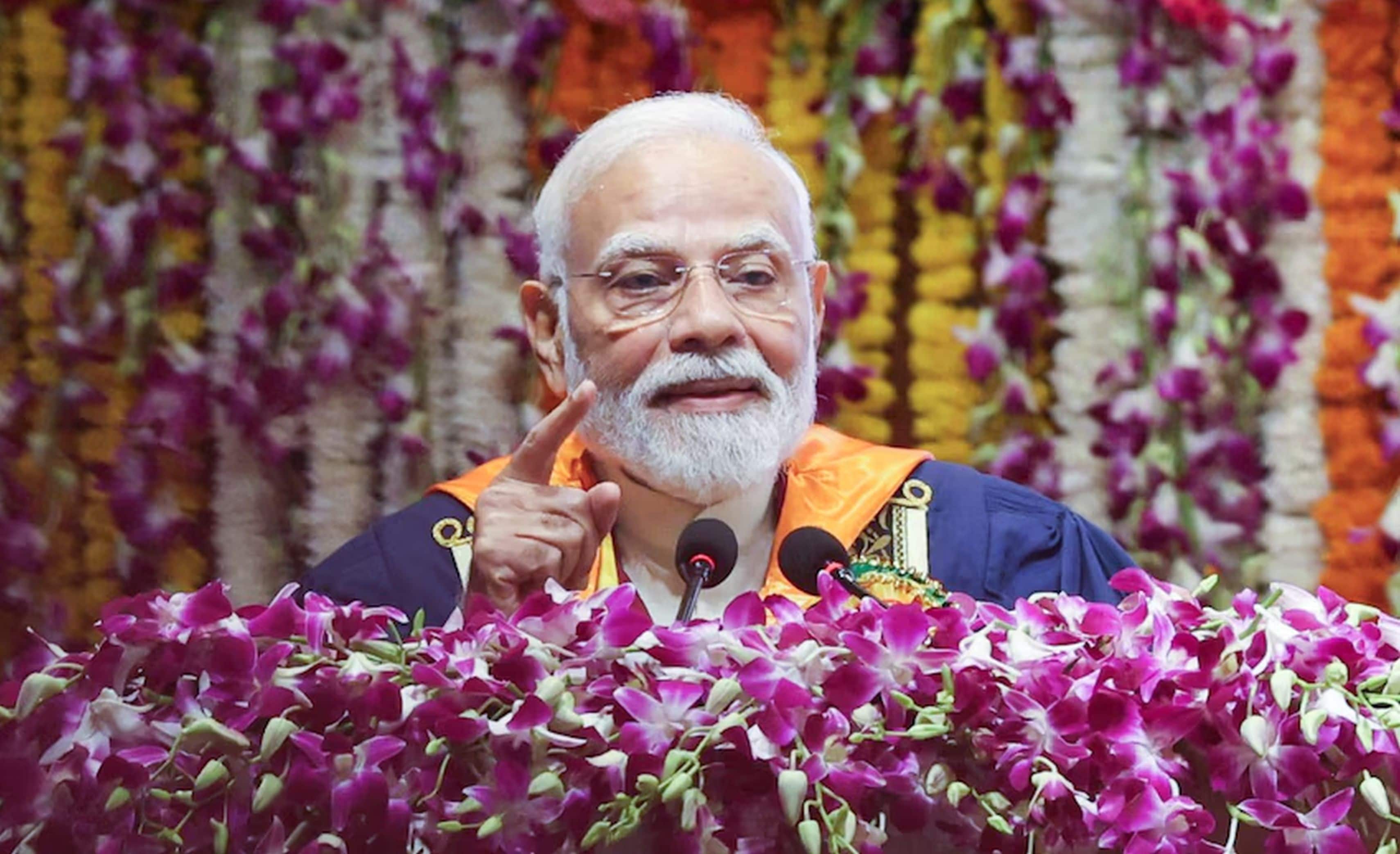
Ladies and Gentlemen!

It is a matter of great pleasure for me to address the India Leadership Forum of NASSCOM. I would have been happy to come there personally. But for want of time, I could not make it. But your technology has enabled me to reach to you. I have also received a number of questions from you. I will try to cover them in my talk itself.

Let me congratulate NASSCOM on completing 25 years of its fruitful activities. The India Leadership Forum has been organized at a time when the whole country is thinking of the roadmap for speedy and all-round development of India. We are faced with demographic, fiscal and technological challenges. However, I have always believed that these challenges can be converted into golden opportunities. We can, we should and we will put the country on the road to faster and inclusive development. Information Technology can be a great enabler in this process. I hope and wish that your deliberations will show us the way.

Friends! We are one of the youngest nations in the world. Nearly 65% of our population is below the age of 35 years. Just imagine the energy and potential of this Talent Pool. It can write a new history for our Nation. In fact for the whole world.  We just need to empower our youth with skills so that they can ensure their own development and growth of India. NASSCOM can play a very big role in this process. Our IT industry and IT manpower have enhanced the image of the country in the world. Now, it is time the IT revolution takes place in India.

NASSCOM, as the leader of the Industry should engage actively in this process. This can be done as your CSR activity. We have all the basics available. We have 85 crore mobile phones in the country. Almost one fourth of the population is already connected with internet. However, people don’t have the necessary applications or knowledge which can help in their day-to-day life. If you make IT work in people’s lives, the market size of your industry goes up automatically. To start this process, training in the field of ICT is a major requirement. In Gujarat, we have launched a programme called eMPOWER for this purpose.

You will be happy to know that in the very first year, over one lakh youth have registered.  This includes the women and youth from rural areas. The Government, the institutions and IT industry will have to create stronger ties to bring the results on ground.

Friends!

I see the role of IT as a change agent. It empowers. It connects.

  • IT can bind isolated parts of a country;
  • IT can create harmony in society;
  • IT can join people with Governments;
  • IT can converge schemes and programmes ;
  • IT can reduce the gap between demand and supply
  • IT can bring us closer to precious knowledge;
  • IT can help us monitor what is critical;

So, what is lacking is the necessary skills and systems to empower us. I request NASSCOM to focus on this on its Silver Jubilee. After eight years, India will be celebrating the Diamond Jubilee of its Independence. By that time, we must be a different Nation.

Information Technology can be the Growth Engine of this New India. My vision is that by that time, India should become ‘DIGITAL INDIA’. We must be a knowledge based society and economy.

Our Markets should become Knowledge Markets where every seller and purchaser knows everything. Our Villages will be Knowledge Villages. Our workers will be Knowledge Workers. Our farmers will be Knowledge farmers. Use of Satellite Technology can further enhance grass root information and services. That is why I keep saying: IT + IT = IT (INDIAN TALENT + INFORMATION TECHNOLOGY = INDIA TOMORROW). Thus, internally and globally, our IT sector can become the shining light of Brand India.

Friends! Good Governance has become a very heavy subject today. People don’t know how to get the information and services. The road to grievance redressal is quite unknown. We don’t know the relation between outlay, output and outcome. We don’t know how to track a child for his education or health. Unfortunately, we have leaders who, instead of bringing solutions, are further confusing the issues.

I have always said that e-governance is the most easy, effective and economical governance. It is one of the most useful fields of information technology.

E-Governance has the potential to become the greatest problem solver for the people. It brings about Empowerment, Equity, Efficiency and is Economic. It has the ability to deliver the desired goal of ‘Minimum Government and Maximum Governance’.

We have been talking of the DIGITAL DIVIDE. What does it mean? Is it relevant only for seminars and conferences? To my mind, Digital Divide means that what a person can get through IT in a city is not available to the person in a remote village.

For this, the software is as responsible as the hardware. We have marketed hardware a lot. From phones to laptops. We see strength in that. But real strength lies in software utility. What are we doing about that?

Why can’t the parents get information of their children dropping out from a school? It comes to knowledge after six months. We can make it instant. Similarly, in health sector a pregnant woman can be alerted through SMS about the necessary periodical check- up.

In Gujarat, we have found ways to partly bridge this digital divide.  Our 14,000 e-Gram Centres provide a basket of services to the rural citizens. Our One day Governance centers give the experience of a VISA office. You deposit the documents in the morning and get the certificates by evening. We are using IT for delivering value in areas like education, health-care, public distribution system and agriculture.

The ease with which information can be published over internet allows for more transparent, democratic and participatory processes. Social Media has further enhanced this. We have to bring the features and feelings of ‘Like’ and ‘Share’ in governance. Social Media can be used effectively to ensure that every citizen is engaged in policy making. That he is duly heard and responded to. NASSCOM and the Indian IT industry have taken some leaps which are noteworthy. A recent example is the Green IT Initiative.

So far, software and internet had been limited to people. When it reaches to things and activities, the digital divide will truly go away. The IT industry will flourish. Your market will expand. Our country will progress.

Friends! Today, security has become an equally important issue. Those who don’t know IT, don’t know its security hazards. But those who know, they know that Cyber security is a very important matter. We are living in a time where wars will be fought in the Cyber Space. Your pocket will be picked through cyber mediums. Your homes may be broken in through the same. We have to work on this.

Our cities, roads, societies and banks can be equipped with cheaper and higher resolution CCTV cameras. This will be yet another way to bridge the Digital Divide, and take IT to the people.

Some of your questions relate to Manufacturing in electronics. This is very important. Already our electronics imports are a big share in the import basket. In a few years from now, it is estimated that their import bill will become bigger than even Oil. The hunger for electronics goods is going up. Thus, you can understand the challenge.  We must focus on manufacturing.

We have to particularly hurry up on manufacturing in strategic sectors like defence. We cannot afford to keep importing for all our needs.

Friends! To conclude, I would like to say that I am personally a great advocate of Technology. I know that IT can and will transform our lives. It is an inevitable force in the modern world. The sooner we adopt it; the better. The sooner we deploy it; the better. The sooner we master it; the better.

Once again, I wish you the very best.  

THANK YOU   

Explore More
अयोध्येत श्री राम जन्मभूमी मंदिर ध्वजारोहण उत्सवात पंतप्रधानांनी केलेले भाषण

लोकप्रिय भाषण

अयोध्येत श्री राम जन्मभूमी मंदिर ध्वजारोहण उत्सवात पंतप्रधानांनी केलेले भाषण
India’s economy resilient despite West Asia headwinds

Media Coverage

India’s economy resilient despite West Asia headwinds
NM on the go

Nm on the go

Always be the first to hear from the PM. Get the App Now!
...
Our united voice for peace and dialogue should resonate across the world: PM Modi in Rajya Sabha on West Asia conflict
March 24, 2026
Many ships are stranded in the Strait of Hormuz, with a large number of Indian crew members on board. This is a major cause of concern for India: PM
In such a critical situation, it is essential that a united voice of peace and dialogue goes out to the entire world from this Upper House of India's Parliament: PM
Around one crore Indians live and work in the Gulf countries, The safety of their lives and livelihoods is also a very big concern for India: PM
More than three weeks have passed since this war began in West Asia , This war has created a serious energy crisis across the entire world: PM
Attacks on commercial ships and disruption of international waterways like the Strait of Hormuz is unacceptable: PM
India has condemned attacks on civilians, on civil infrastructure, and on energy and transport-related infrastructure: PM
Since the start of the war, I have held two rounds of phone conversations with the heads of state of most countries in West Asia: PM
We are in constant touch with all the Gulf countries, We are also in contact with Iran, Israel, and the United States: PM
Our goal is to restore peace in the region through dialogue and diplomacy: PM
We have also discussed de-escalation and the reopening of the Strait of Hormuz with them: PM
India is making continuous efforts, through diplomacy, to ensure the safe passage of Indian ships even in this atmosphere of war: PM
Since the war began, ship movement through the Strait of Hormuz has become very challenging, but the government is seeking a way forward through dialogue and diplomacy: PM
The effort is to ensure that oil and gas supplies reach India from wherever possible, The country is witnessing the results of every such effort: PM
In the past few days, ships carrying crude oil and LPG have arrived in India from many countries around the world, Our efforts in this direction will continue in the coming days: PM
The fundamentals of our economy are strong,the government is closely monitoring the rapidly changing situation: PM
The government is working with a strategy to address every impact in the short term, medium term, and long term: PM
The government has made the necessary preparations to ensure an adequate supply of fertilizers: PM
The government is making continuous efforts to ensure that farmers do not bear the burden of any crisis: PM
I would like to reassure the farmers of the country once again that the government stands with them to resolve every challenge: PM

Honourable Chairman,

We are all familiar with the war currently taking place in West Asia and the circumstances arising from it. Today, I stand before the Upper House of Parliament and before my fellow citizens to share the government’s position on these grave circumstances. This war has now continued for more than three weeks. It has created a severe energy crisis across the world. For India too, this situation is worrisome. Our trade routes are being affected. Routine supplies of essential goods such as petrol, diesel, gas, and fertilizers are disrupted. Nearly one crore Indians live and work in Gulf countries. Ensuring their safety and livelihood is a major concern for India. Many ships are stranded in the Strait of Hormuz, with a large number of Indian crew members aboard. This too is a matter of serious concern for India. In such dire circumstances, it is essential that from this Upper House of Parliament, a united voice for peace and dialogue reaches the entire world.

Honourable Chairman,

Since the beginning of the war, I have spoken twice on the phone with the heads of most countries in West Asia. We are in continuous contact with all Gulf countries. We are also in touch with Iran, Israel, and the United States. Our goal is to restore peace in the region through dialogue and diplomacy. We have spoken with them about de-escalation and reopening the Strait of Hormuz. Attacks on commercial ships and obstruction in international waterways like the Strait of Hormuz are unacceptable. India has opposed attacks on civilians, civil infrastructure, and energy and transport-related infrastructure. Through diplomacy, India is making continuous efforts to ensure the safe passage of Indian ships even in this war-like environment. India has suggested dialogue as the only path to resolving this problem. Any threat to human life in this war is not in the interest of humanity. Therefore, India’s constant effort is to encourage all parties to reach a peaceful solution as soon as possible.

Honourable Chairman,

In times of crisis, the safety of Indians both at home and abroad is our highest priority. Since the war began, more than 375,000 Indians have safely returned to India. From Iran alone, more than 1,000 Indians have returned safely, including over 700 young students pursuing medical education. Our government is working with full sensitivity during this crisis. All countries have assured us of the safety of Indians present there. However, it is deeply saddening that some Indians have lost their lives due to attacks, and some have been injured. In such difficult circumstances, necessary assistance is being provided to their families. Those injured are being ensured the best possible medical treatment.

Honourable Chairman,

The Strait of Hormuz is one of the largest routes of global trade. In particular, the transport of crude oil, gas, and fertilizers takes place in huge quantities through this region. Since the war began, the movement of ships through the Strait of Hormuz has become highly challenging. Yet, despite adverse circumstances, our government has tried to create pathways through dialogue and diplomacy. Our effort is to ensure that oil and gas supplies reach India from wherever possible. The results of these efforts are visible to the nation. In recent days, ships carrying crude oil and LPG from many countries have arrived in India. Our efforts in this direction will continue in the coming days as well.

Honourable Chairman,

India’s effort is to ensure that ships carrying essential goods such as oil, gas, and fertilizers reach India safely. But if the global circumstances created by this war persist for a long time, serious consequences are inevitable. Therefore, India is accelerating the resilience-building measures it has undertaken in recent years.

Honourable Chairman,

Every crisis tests both our courage and our efforts. To enable the country to face such crises better, continuous decisions have been taken over the past 11 years. Diversification of energy imports is part of these efforts. Earlier, India imported crude oil, LNG, and LPG from 27 countries. Today, India imports energy from 41 countries. In the past decade, India has also prioritized crude oil reserves for times of crisis. Our oil companies maintain significant reserves of petrol and diesel for emergencies. Over the past 11 years, more than 5.3 million metric tonnes of strategic petroleum reserves have been developed, and the country is working on arrangements for reserves exceeding 6.5 million metric tonnes. Alongside this, India’s refining capacity has also been substantially increased in the past decade. Through you, I wish to assure the House and the nation that India has adequate crude oil storage and arrangements for continuous supply.

Honourable Chairman,

Our government is striving to ensure that there is no excessive dependence on any single source of fuel. Alongside LPG, the government is also emphasizing PNG for domestic gas supply. In the past decade, unprecedented work has been done to expand PNG connections, and this effort has been further accelerated in recent days. At the same time, large-scale efforts are being made to increase domestic production of LNG.

Honourable Chairman,

In recent years, the government has consistently worked to minimize dependence on other countries in every sector. Becoming increasingly self-reliant is the only option. For example, more than 90% of India’s oil is transported on foreign ships, which makes India’s situation even more serious during any global crisis. Therefore, the government has launched a campaign worth about 70,000 crore rupees to build Made in India ships. India is now rapidly developing facilities for shipbuilding, shipbreaking, maintenance, and overhauling. India is also making its defense sector more resilient. Due to efforts made in the past decade, India today manufactures most of the weapons it needs domestically. There was a time when India was heavily dependent on other countries even for raw materials of life-saving medicines, namely APIs. In recent years, the country has made many efforts to build an API ecosystem within India itself. Similarly, major steps are being taken to reduce foreign dependence in rare earth minerals.

Honourable Chairman,

The current crisis has shaken the global economy. The damage already caused in West Asia will take the world a long time to recover from. Continuous efforts are being made to ensure that India suffers the least possible impact. The fundamentals of our economy are strong, and the government is closely monitoring the rapidly changing situation. The government is working with a strategy to address short-term, medium-term, and long-term impacts. An inter-ministerial group has also been formed, which meets regularly to assess every difficulty arising in our imports and exports, and continuously works on necessary solutions. Just as empowered groups of experts and officers were formed during the pandemic to tackle challenges in different sectors, yesterday seven new empowered groups were also constituted. These groups will act swiftly and strategically on issues such as supply chains, petrol and diesel, fertilizers, gas, and inflation. I am confident that through these collective efforts, we will be able to face the circumstances more effectively.

Honourable Chairman,

The government is also working to ensure that farmers receive adequate fertilizer in the upcoming sowing season. Necessary preparations have been made for sufficient supply of fertilizers. The government’s constant effort is that farmers should not bear the burden of any crisis. I once again assure the farmers of the country that the government stands with them in finding solutions to every challenge.

Honourable Chairman,

This is the House of States. In the coming times, this crisis will be a major test for our country, and the cooperation of states will be crucial for success. Therefore, through this House, I would like to make a few requests to all state governments. In times of crisis, the poor, workers, and migrant companions are most affected. Therefore, it must be ensured that the benefits of the PM Garib Kalyan Anna Yojana reach them on time. Proactive steps should be taken to ease the difficulties of migrant workers wherever they are employed. If state governments make special arrangements to monitor such situations, it will provide significant relief. State governments must also pay close attention to another challenge: in such times, black-marketeers and hoarders become very active. Wherever such complaints arise, immediate action must be taken. Ensuring uninterrupted supply of essential goods must be the top priority of every state.

Honourable Chairman,

I would also like to make another request to all state governments. No matter how severe the crisis, maintaining India’s rapid growth is our collective responsibility. For this, every necessary step and every necessary reform must be carried out swiftly. This is also a great opportunity for state governments. This is a major test for Team India. During the great crisis of the pandemic, the Centre and the states together presented an excellent model of COVID management. Despite governments of different political parties, testing, vaccination, and supply of essential goods were ensured through Team India’s efforts. We must continue to work in the same spirit. With the combined efforts of all state governments and the central government, the country will be able to face this grave global crisis effectively.

Honourable Chairman,

This crisis is of a different nature, and its solutions are also being determined in a different way. We must face every challenge with patience, restraint, and a calm mind.

Honourable Chairman,

As we can see, the situation regarding this war is changing moment by moment. Therefore, I would also say to my fellow citizens that we must be prepared for every challenge. There is a strong possibility that the adverse effects of this war will last for a long time. But I assure the people of the country that the government is alert, ready, and working with full seriousness on strategy, taking every necessary decision. The welfare of the people is paramount for us. This is our identity, this is our strength. With this spirit, I conclude my statement.

Thank you very much!