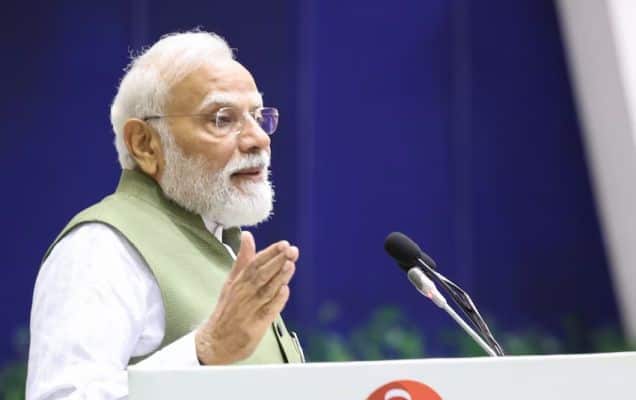
Our endeavour is to empower the youth with skills that make them self-reliant and position India as a global innovation hub: PM
We are modernizing the country's education system according to the needs of the 21st century: PM
A new National Education Policy has been introduced in the country, It has been prepared keeping in mind the global standards of education: PM
One Nation, One Subscription has given the youth the confidence that the government understands their needs, today students pursuing higher education have easy access to world class research journals: PM
India's university campuses are emerging as dynamic centres where Yuvashakti drives breakthrough innovations: PM
The trinity of Talent, Temperament and Technology will transform India's future: PM
It is crucial that the journey from idea to prototype to product is completed in the shortest time possible: PM
We are working on the vision of Make AI in India, And our aim is- Make AI work for India: PM

Union Education Minister Shri Dharmendra Pradhan ji, Dr. Jitendra Singh ji, Shri Jayant Chaudhary ji, Dr. Sukanta Majumdar ji, my friend Shri Romesh Wadhwani ji and Dr. Ajay Kela ji who are connected through technology, all colleagues from the world of science, technology, and education, other distinguished guests, ladies and gentlemen!

Today, people from various fields connected with the government, academia, science, and research are present here in large numbers. This unity, this confluence, is what we call YUGM. A YUGM where all stakeholders related to the future tech of a ‘Viksit Bharat’ (Developed India) are gathered and engaged together. I believe that this event will further strengthen the efforts we are making to enhance Bharat’s innovation capacity and its role in deep-tech. Today marks the beginning of super hubs in AI, Intelligent Systems, and Biosciences, Biotechnology, Health & Medicine at IIT Kanpur and IIT Bombay. Today also marks the launch of the Wadhwani Innovation Network. A pledge has also been taken to advance research in collaboration with the National Research Foundation. I extend my heartfelt congratulations to the Wadhwani Foundation, our IITs, and all other stakeholders for this initiative. In particular, I commend my friend Romesh Wadhwani ji. The private and public sectors together have brought many positive changes to the country's education system due to your dedication and proactive efforts.

Friends,

Our scriptures say: ‘परं परोपकारार्थं यो जीवति स जीवति’, which means—he who lives for the service and welfare of others, truly lives. That is why we consider science and technology as a medium of service as well. When I see institutions like the Wadhwani Foundation in our country, when I witness the efforts of Romesh ji and his team, I feel joy and pride that we are advancing science and technology in the right direction in Bharat. We all know that Romesh ji has shaped his life through immense struggle and dedicated it to service. Just a few days after his birth, he had to face the horrors of Partition, was forced to leave his birthplace, contracted polio in early childhood, and from those difficult circumstances, he went on to build a vast business empire. This in itself is an extraordinary and inspiring life journey. And to dedicate such success to the education and research sector of Bharat, to the youth of Bharat, and to the bright future of Bharat—this is truly a motivating example. The Wadhwani Foundation is also doing significant work in school education, technology in Anganwadi services, and agri-tech. I have previously joined you all on the occasion of the establishment of the Wadhwani Institute of Artificial Intelligence. I am confident that in the times to come, the Wadhwani Foundation will continue to achieve many such milestones. My best wishes are with your organization and your initiatives.

Friends,

The future of any country depends on its youth. Therefore, it is essential that we prepare our youth for their future and for building a brighter future for Bharat. The country’s education system plays a major role in this. That is why we are modernizing the country’s education system to meet the needs of the 21st century. A new National Education Policy has been introduced in the country, developed with a focus on global standards in education. Since the launch of the new education policy, we are witnessing significant changes in the Indian education system. The National Curriculum Framework, learning-teaching materials, and new textbooks for classes 1 to 7 have already been prepared. Under PM e-Vidya and the DIKSHA platform, a ‘One Nation, One Digital Education Infrastructure’ has been created. This infrastructure is AI-based and scalable. It is being used to prepare textbooks in over 30 Indian languages and 7 foreign languages. Through the National Credit Framework, it has become easier for students to study multiple subjects simultaneously. This means that students in Bharat are now getting access to modern education, and new career pathways are opening up for them. To maintain momentum toward Bharat’s developmental goals, it is necessary to strengthen the country's research ecosystem. In the last decade, significant progress has been made in this direction, and necessary resources have been enhanced. In 2013–14, the gross expenditure on R&D was only 60,000 crore rupees. We have more than doubled it to over 1.25 lakh crore rupees. Several state-of-the-art research parks have been established across the country. Research and Development Cells have been set up in about 6,000 higher education institutions. Because of these efforts, a culture of innovation is growing rapidly in the country. In 2014, around 40,000 patents were filed in Bharat. That number has now increased to over 80,000. This shows how much support the country’s youth are getting from our intellectual property ecosystem. To further promote research culture, the National Research Foundation has been established with a budget of 50,000 crore rupees. The ‘One Nation, One Subscription’ initiative has reassured young people that the government understands their needs. This scheme has made access to world-class research journals easier for students pursuing higher education. The Prime Minister’s Research Fellowship has been introduced to ensure that talented individuals face no barriers in advancing their careers.

Friends,

As a result of these efforts, today’s youth are not just excelling in R&D— in fact, they have become R&D. And when I say they are R&D, I mean Ready and Disruptive! Bharat is setting new milestones in research across various sectors. Last year, Bharat commissioned the world’s longest Hyperloop test track. This 422-meter Hyperloop was developed at IIT Madras in collaboration with Indian Railways. Scientists at IISc Bangalore have developed a technology that can control light at the nanoscale. At the same institute, researchers have also developed ‘Brain on a Chip’ technology—capable of storing and processing data across more than 16,000 conduction states within a single molecular film! Just a few weeks ago, the country also developed its first indigenous MRI machine. These are just a few of the many path-breaking R&D achievements taking place in our universities. This is the youth power of a ‘Viksit Bharat’—Ready, Disruptive, and Transformative!

Friends,

University campuses in Bharat are becoming new dynamic centres of innovation—where the power of youth is driving breakthrough discoveries. Recently, in the Higher Education Impact Rankings, Bharat had the highest global representation, with over 90 universities ranked among 2,000 institutions from 125 countries. In 2014, Bharat had only 9 institutes and universities in the QS World Rankings. In 2025, that number has increased to 46. The number of Indian institutions ranked among the world’s top 500 higher education institutions has also seen a sharp rise in the last 10 years. Now, Indian institutions are opening campuses abroad—like IIT Delhi in Abu Dhabi and IIT Madras in Tanzania. Preparations are underway to open an IIM Ahmedabad campus in Dubai. And it’s not just that our top institutions are going global; top global institutions are also coming to Bharat. The process of opening campuses of some of the world’s top universities in Bharat has already begun. This will boost academic exchange, foster collaboration in research, and give our students valuable exposure to cross-cultural learning.

Friends,

The trinity of Talent, Temperament, and Technology will transform Bharat’s future. To support this, we are providing children with the necessary exposure from an early age. Just now, our colleague Dharmendra ji elaborated on initiatives like Atal Tinkering Labs. So far, 10,000 Atal Tinkering Labs have been established across the country. In this year’s Budget, the government has announced the opening of 50,000 more Atal Tinkering Labs. The PM Vidya Lakshmi Yojana has also been launched to provide financial support to students. We have also established internship cells in over 7,000 institutions so that students can convert their learning into hands-on experience. Every possible effort is being made to help youth develop new skills. This strength of our youth -- their talent, temperament, and technology -- will lead Bharat to the pinnacle of success.

Friends,

We have set a 25-year timeline to achieve the goal of a ‘Viksit Bharat’. Time is limited, and the goals are ambitious. I'm not saying this due to the current situation alone—but because of this, it’s crucial that the journey from idea to prototype to product happens in the shortest possible time. When we reduce the distance from lab to market, the results of research reach people faster. This also motivates researchers, as they see the direct impact and rewards of their work. It fuels the cycle of research, innovation, and value addition even further. To make this happen, it is essential that our entire research ecosystem—academic institutions, investors, and industry—stand by our researchers and guide them. Industry leaders can go a step further by mentoring youth, arranging funding, and co-developing new solutions. That is why the government is also accelerating efforts to simplify regulations and fast-track approvals.

Friends,

We must continuously promote AI, quantum computing, advanced analytics, space-tech, health-tech, and synthetic biology. Today, we are seeing Bharat emerge as one of the leading countries in AI development and adoption. To support this growth, the government has launched the India-AI Mission, which will help create world-class infrastructure, high-quality datasets, and cutting-edge research facilities. The number of AI Centres of Excellence in the country is also being increased. These Centres of Excellence are being propelled by collaboration among Bharat’s premier institutions, industries, and start-ups. We are working with the vision of “Make AI in India”, and our goal is to “Make AI work for India.” In this year’s Budget, we have decided to increase the number of seats and capacity in IITs. Several Meditech—that is, medical plus technology—courses have been introduced with the collaboration of IITs and AIIMS. We must complete this journey within time. In every future technology, Bharat must feature among the best in the world. Through initiatives like YUGM, we can bring new energy to these efforts. With this joint initiative by the Ministry of Education and the Wadhwani Foundation, we have the potential to transform the innovation landscape of the country. Today’s event will be a great help in furthering that mission. Once again, I express my heartfelt gratitude to the Wadhwani Foundation for the YUGM initiative. I extend my best wishes to my friend Romesh ji.

Thank you very much.

Namaskar!

Explore More
প্রধান মন্ত্রীনা শ্রী রাম জন্মভুমি মন্দির দ্বাজরোহন উৎসবতা পীখিবা ৱারোলগী মৈতৈলোন্দা হন্দোকপা

Popular Speeches

প্রধান মন্ত্রীনা শ্রী রাম জন্মভুমি মন্দির দ্বাজরোহন উৎসবতা পীখিবা ৱারোলগী মৈতৈলোন্দা হন্দোকপা
 PLI schemes attract over Rs 2.16 lakh crore investment, generate 14.39 lakh jobs

Media Coverage

PLI schemes attract over Rs 2.16 lakh crore investment, generate 14.39 lakh jobs
NM on the go

Nm on the go

Always be the first to hear from the PM. Get the App Now!
...
PM Modi inaugurates Phase I of Noida International Airport, developed with an investment of around ₹11,200 crore
March 28, 2026
The inauguration of Phase-I of Noida International Airport marks a major step in Uttar Pradesh’s growth story and India’s aviation future: PM
UP has now emerged as one of the states with the highest number of international airports in India: PM
Airports are not just basic facilities in any country, they give wings to progress: PM
Our government is making unprecedented investments in modern infrastructure to build a Viksit Bharat: PM

The Prime Minister, Shri Narendra Modi, today inaugurated the Noida International Airport at Jewar in Uttar Pradesh. Expressing his pride and joy on the occasion, the Prime Minister said that today marks a new chapter in the Viksit UP, Viksit Bharat Abhiyan. He noted that India's largest state has now become one of the states with the highest number of international airports. PM Modi shared that he felt doubly proud , first, for having laid the foundation stone of this airport and now inaugurating it, and second, because the name of this grand airport is linked to Uttar Pradesh. "This is the state that chose me as its representative and made me a Member of Parliament, and its identity is now associated with this magnificent airport," remarked Shri Modi.

Highlighting the far-reaching impact of the new airport, the Prime Minister said that the Noida airport will benefit a vast region encompassing Agra, Mathura, Aligarh, Ghaziabad, Meerut, Etawah, Bulandshahr, and Faridabad. He emphasised that the airport will bring numerous new opportunities for the farmers, small and medium enterprises, and the youth of western Uttar Pradesh. "Aircraft will fly from here to the world, and this airport will also become a symbol of a developed Uttar Pradesh taking flight," said Shri Modi, extending his heartfelt congratulations to the people of the state, especially western UP.

Speaking about the current global situation, the Prime Minister observed that the entire world is deeply concerned today, with a war raging in West Asia for over a month, creating crises of essential commodities including food, petrol, diesel, gas, and fertilizers in many countries. He noted that India imports a very large quantity of crude oil and gas from the conflict-affected region. "The Government is taking every possible step to ensure that the burden of this crisis does not fall on ordinary families and farmers," affirmed Shri Modi.

Underscoring India's continued momentum of rapid development even during times of global crisis, the Prime Minister noted that in Western Uttar Pradesh alone, this is the fourth major project to be either inaugurated or have its foundation stone laid in recent weeks. "During this period, the foundation stone of a major semiconductor factory in Noida was laid, the country's first Delhi-Meerut Namo Bharat train gained speed, the Meerut Metro was expanded, and today the Noida International Airport is being inaugurated," highlighted PM Modi.

The Prime Minister credited the current Government for these remarkable achievements in UP's development. He noted that the semiconductor factory is making India self-reliant in technology, the Meerut Metro and Namo Bharat Rail are providing fast and smart connectivity, and the Jewar Airport is connecting entire North India to the world. " Today under the current government, the same Noida is becoming a powerful engine of UP's development," asserted Shri Modi.

Elaborating on the history of the airport project, The Prime Minister recalled that the Jewar Airport was approved by Atal ji as early as 2003. And as soon as the current government was formed here, the foundation was laid, construction happened, and now it has started operations," said Shri Modi.

Drawing attention to the region's emerging role as a logistics hub, the Prime Minister pointed out that this area is becoming the hub of two major freight corridors , special railway tracks laid for goods trains, which have enhanced North India's connectivity with the seas of Bengal and Gujarat. He noted that Dadri is the strategic point where both these corridors converge, meaning whatever farmers grow and industries produce here can now reach every corner of the world swiftly, by land and by air. "This kind of multi-modal connectivity is making UP a major attraction for investors worldwide," explained PM Modi.

Addressing the transformation of the region's image, the Prime Minister said. "Today, Noida is ready to welcome the entire world. This whole area is strengthening the resolve of Aatmanirbhar Bharat”.

The Prime Minister expressed his gratitude to the farmers who gave up their lands to make this project a reality, noting that agriculture and farming hold great importance in the region's economy. Shri Modi noted that the expansion of modern connectivity will further boost food processing prospects in Western UP, adding, "The agricultural produce from here will now reach global markets more efficiently."

Acknowledging the contribution of sugarcane farmers to reducing India's dependence on crude oil, the Prime Minister highlighted the significant role of ethanol produced from sugarcane. PM Modi highlighted that without the increase in ethanol production and its blending with petrol, India would have had to import an additional four and a half crore barrels,approximately 700 crore litres of crude oil annually, adding, "The hard work of our farmers has given the country this enormous relief during the time of crisis."

The Prime Minister further elaborated that ethanol has not only benefited the nation but has also greatly benefited farmers, with approximately Rs 1.5 lakh crore worth of foreign exchange being saved. He recalled the earlier days when sugarcane farmers had to wait for years for their dues. "Today, thanks to the efforts of the current Government, the condition of sugarcane farmers has improved significantly," affirmed Shri Modi.

Emphasizing that airports are not merely amenities but catalysts for progress, the Prime Minister pointed out the remarkable expansion of India's aviation infrastructure. Highlighting that today, there are more than 160 airports, PM Modi remarked that the Air connectivity is now reaching not just metropolitan cities but also smaller towns. “ The current government has made air travel accessible for the common Indian," asserted Shri Modi, adding that the number of airports in Uttar Pradesh has been increased to seventeen.

Highlighting the impact of the UDAN scheme, the Prime Minister said that the government has consistently strived to ensure that while airports are built, airfares remain within the reach of ordinary families. Noting that more than one crore sixty lakh citizens have travelled by air at affordable rates by booking tickets under the UDAN scheme, Shri Modi remarked, “ Recently, the Central Government has further expanded the UDAN scheme with an approval of approximately Rs 29,000 crore, under which 100 new airports and 200 new helipads will be built in smaller cities in the coming years. UP will also benefit immensely from this."

Speaking about India's rapidly growing aviation sector, the Prime Minister noted that as new airports are being built, the demand for new aircraft is also rising, with various airlines placing orders for hundreds of new planes. Shri Modi observed that this creates tremendous opportunities for the youth, including pilots, cabin crew, and maintenance professionals, adding that "our government is also expanding training facilities in the aviation sector" to meet this growing demand.

Addressing a critical gap in India's aviation ecosystem, the Prime Minister drew attention to the Maintenance, Repair, and Overhaul (MRO) sector, noting that 85 per cent of Indian aircraft still have to go abroad for MRO services. PM Modi noted that the government has resolved to make India self-reliant in the MRO sector as well and highlighted that today, the foundation stone of an MRO facility has been laid here at Jewar. “When ready, it will serve aircraft from India and abroad , generating revenue for the country, keeping our money within India, and creating numerous jobs for the youth," announced Shri Modi.

Underlining the government's priority of ensuring citizen convenience and saving their time and money, the Prime Minister spoke about the expansion of modern rail services such as Metro and Vande Bharat. "The Delhi-Meerut Namo Bharat Rail has already been used by over two and a half crore passengers. The journey between Delhi and Meerut that used to take hours is now completed in minutes," said PM Modi.

Underscoring the unprecedented investment in modern infrastructure for a Viksit Bharat, the Prime Minister shared that over the past eleven years, the infrastructure budget has been increased more than six-fold, with Rs 17 lakh crore spent on highways and expressways and over one lakh kilometres of highways constructed. He noted that railway electrification has expanded from 20,000 kilometres before 2014 to over 40,000 kilometres since then, with nearly 100 per cent of the broad-gauge network now electrified. The Prime Minister highlighted that for the first time, the Kashmir Valley and the capitals of the North-East are being connected to the rail network, while port capacity has more than doubled in the past decade and the number of inland waterways continues to grow. "India is working at a rapid pace in every sector necessary for building a Viksit Bharat," stated Shri Modi.

Calling for collective effort and national unity in the face of global challenges, the Prime Minister said he had spoken at length in Parliament and held detailed discussions with Chief Ministers about tackling the crisis arising from the ongoing conflict. He appealed to the people to face this crisis with a calm mind and patience, calling it the greatest strength of Indians. PM Modi reiterated that what is in the interest of Indians and in the interest of India, that alone is the policy and strategy of the Government of India." I am fully confident that all political parties will lend strength to the country's united efforts”, concluded Shri Modi.