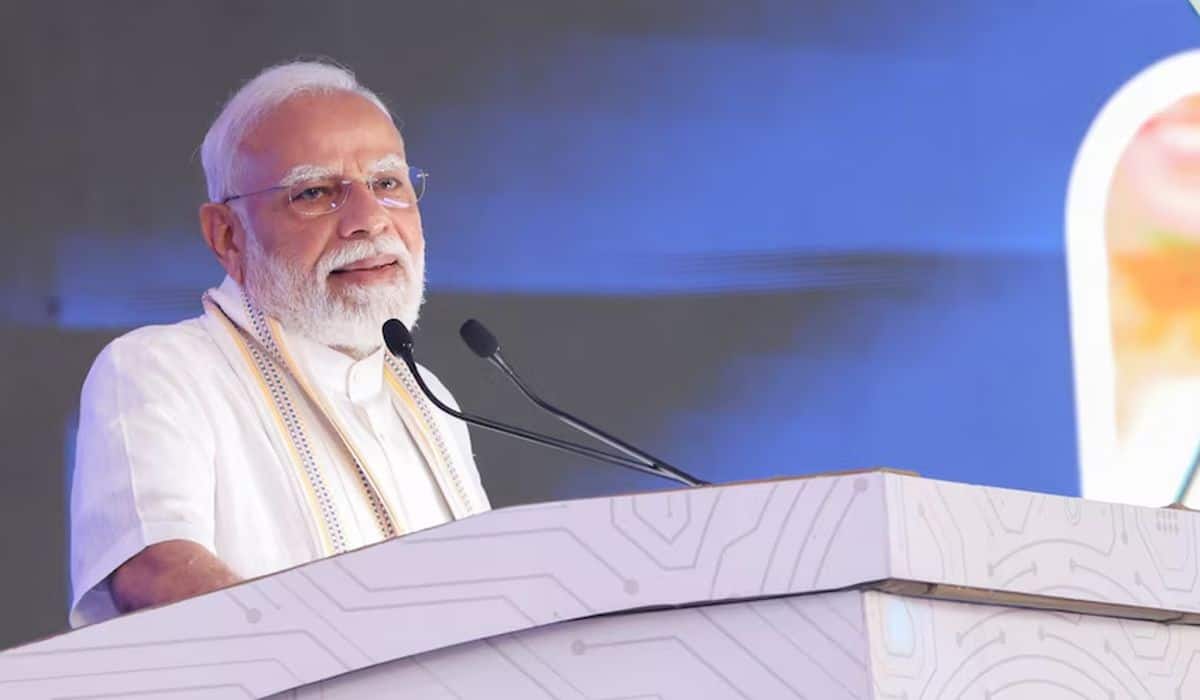
Prime Minister Narendra Modi today addressed vibrant public meetings in Maharashtra’s Solapur, Satara and Pune. Speaking to a large audience, PM Modi said, “In this election, you will choose the guarantee of development for the next 5 years. On the other hand, there are those who plunged the country into the abyss of corruption, terrorism, and misrule before 2014. Despite their tainted history, the Congress is once again dreaming of seizing power in the country.”
Slamming the INDI Alliance for ‘5 years, 5 PMs’ formula, PM Modi said, “On one hand, there's Modi, who has been tested for 10 years. On the other hand, within the INDI-Agadhi, there's a fierce battle going on in the name of the leader. Now these people have come up with a formula of ‘5 years, 5 PMs’. You might have heard, the fake Shiv Sena has said that the Prime Minister's post is not limited to one, there are several claimants in every party. Can you tell me, can the country function with a formula like ‘5 years, 5 PMs’?”

Talking about how the centre has given unprecedented strength to social justice, PM Modi stated, “In its 60 years, the Congress continuously attempted to hinder every right of the SC/ST/OBC categories. But Modi's connection with you is from the heart. We have accorded constitutional status to the OBC Commission. Reservation for OBCs has been implemented in medical exams. It is the BJP that has extended reservations for SC/ST for 10 years. Without taking away anyone's rights, we have also provided 10% reservation to the poor. In medical and engineering studies, we have provided options for Indian languages like Marathi, so that the dreams of poor, SC/ST/OBC youths can also be fulfilled.”
PM Modi further lashed out at Congress over vote bank politics and cited, “For decades, the way Congress betrayed SC/ST/OBC communities, they have completely distanced themselves from both Congress and the INDI-Agadhi. That's why these people are continuously spreading lies that they will change the Constitution, end reservations. I have already said that even if Baba Saheb himself came and said to end reservations, change the Constitution, it would not happen. And if our government's intention was to end reservations, then we already have enough numbers. Today, I am demanding more seats from the country so that I have more power to destroy the conspiracies of Congress and the INDI-Agadhi.”

PM Modi spoke about several schemes brought for the welfare of the poor. He remarked, “In the past 10 years, all the schemes we have implemented for the welfare of the poor have benefited the Dalits, Adivasis, and the marginalized the most. Free ration, free healthcare, pucca houses, toilets, electricity, gas, water—all of these have predominantly reached the most deprived sections of society. Our government has reached every household, every village to connect SC/ST/OBC families with these schemes.”
Taking a tough stance against Congress, PM Modi reiterated, “Congress didn't even let Baba Saheb's Constitution be implemented in Jammu and Kashmir. By implementing Article 370, Congress insulted the country's Constitution. When the NDA government removed Article 370, it became the biggest guarantee of social justice. For the first time in Jammu and Kashmir, SC/ST/OBCs and women have received the same rights that Baba Saheb envisioned for the country. This is Modi's track record of social justice. That's why the entire INDI-Agadhi is panicking.”

In his second rally of the day in Satara, PM Modi said, “The country gained independence in 1947, but Congress allowed the mentality of slavery to flourish. The whole world used to respect Chhatrapati Shivaji Maharaj's navy. However, for so many years, the flag of Britishers was reflected in the flag of independent India's navy. The NDA government, by removing the British flag, has now placed the symbol of Chhatrapati Shivaji Maharaj in our navy's flag. But Congress is troubled by why Modi is doing all this. Our government has also nominated historic forts built by the Maratha warriors for inclusion in UNESCO's World Heritage Sites."

Strongly rebuking the opposition’s misuse of social media platforms, PM Modi reiterated, “I have been a strong supporter of technology. However, recent events are troubling. People who cannot engage in direct political battles with BJP, NDA, are now spreading fake videos on social media. These people are misusing AI to spread false information by mimicking my voice or that of my colleagues. You need to be very cautious of such news, videos, and messages. If you receive any such video, any image on WhatsApp, or see it on any social media platform, you should immediately inform the police or the party. Strong action will be taken against such people.”
Highlighting the centre’s efforts in providing better healthcare services, PM Modi said, “Through Ayushman Bharat centers, healthcare services are expanding to every village today. Today, millions of people have Ayushman cards for free treatment up to Rs. 500,000. And now Modi has guaranteed that this facility of free treatment will be available to all elderly people above the age of 70. It means whether poor, middle class, or upper class, if they are above 70 years old, they will come under the Ayushman scheme.”

He added, “Today, our government provides free grains to 80 crore needy people every month. But when the Congress government was there, millions of tons of grains used to rot in government godowns. The Supreme Court had observed that the Congress government was not distributing this grain among the poor! But then what did the Prime Minister of the Congress government, Manmohan Singh ji, say? He said that the Supreme Court should not interfere in this matter. It means if the grain rots, let it rot! But the Congress government was not willing to give grains to the poor. This was the level of Congress' insensitivity.”

In another blistering attack at the Congress, PM Modi accused it of indulging in dangerous vote bank politics. The PM alleged, “Congress’s Shehzaada has brought an X-ray machine. He publicly says that after their government is formed, they will conduct an X-ray of the country and they will examine your wealth and distribute it amongst their vote bank. Modi has ensured to make 3 crore ‘Lakhpati Didi’. However, if the Congress’s Shehzaada comes to power, Congress will not spare the earnings of mothers and sisters, nor will they spare their jewelry." he said.
In his concluding remarks, PM Modi urged everyone to vote in large numbers on May 7th, emphasizing that there should be a lotus blooming at every booth and a heavy voter turnout. "My 24X7 commitment for 2047 is for the future of your children. You go door to door and tell them that Modi has greeted you.”
PM Modi, during his third public address in Pune, Maharashtra, unveiled a comprehensive vision for the development of the region, highlighting the achievements of the BJP-NDA government and contrasting it with the model of the Congress and its allies.

Reflecting on the development journey of India, PM Modi pointed out the stark contrast between the 60 years of Congress rule and the progress achieved in the last 10 years under the BJP-NDA government. He emphasized that while Congress failed to provide even basic facilities to half of the country's population, his government has not only fulfilled these necessities but also worked to fulfill the aspirations of every section of society.
Speaking on economic development, PM Modi emphasized that his government has opened every sector for youth innovation and entrepreneurship, promoting a culture of innovation through initiatives like the National Education Policy. Also, PM Modi underscored his government's commitment to the welfare of the poor and middle class, citing schemes like Jan Aushadhi centers and Ayushman Yojana, which have saved them significant amounts of money in healthcare costs. He announced the extension of the Ayushman scheme to cover all elderly individuals above 70 years, ensuring free treatment up to five lakh rupees.

The Prime Minister also highlighted the government's efforts to empower street vendors and cart-pullers through schemes like PM-SVANidhi, providing them access to formal banking and credit without guarantees. He emphasized that such initiatives reflect the BJP's development model of Aspiration and Growth.
PM Modi criticized the Congress and its allies for their outdated policies and divisive tactics, contrasting their approach with the BJP's inclusive vision of 'Sabka Saath, Sabka Vikas'. He warned against Congress's plans for higher taxes and reservations based on religion, which he deemed unconstitutional. PM Modi condemned the Congress for its leniency towards terrorists during its rule, contrasting it with the improved security situation under the BJP-NDA government.

During his concluding remarks, PM Modi urged the people of Pune and Maharashtra to support the BJP-NDA coalition in the upcoming elections, promising continued development and prosperity for the region.
Click here to read full text speech of Solapur
Click here to read full text speech of Satara
Click here to read full text speech of Pune
अपने कलंकित इतिहास के बाद भी काँग्रेस फिर से देश की सत्ता हथियाने का सपना देख रही है। pic.twitter.com/km5pNrVobt
— narendramodi_in (@narendramodi_in) April 29, 2024
कांग्रेस के 60 वर्षों के राज में देश में सबसे ज्यादा SC/ST/OBC परिवार ही सबसे खराब स्थिति में जीने के लिए मजबूर थे।
— narendramodi_in (@narendramodi_in) April 29, 2024
मोदी ने इन परिवारों को ही अपनी प्राथमिकता बनाया: PM @narendramodi pic.twitter.com/lMolvFd5Cf
जब नीयत सही होती है, तो नतीजे भी सही मिलते हैं। pic.twitter.com/ijAhFs2aEq
— narendramodi_in (@narendramodi_in) April 29, 2024
कांग्रेस ने बरसों तक गांवों और शहरों में खाई बनाकर रखी, कुछ ही शहरों के विकास पर फोकस किया।
— narendramodi_in (@narendramodi_in) April 29, 2024
NDA सरकार, देश के हर कोने के विकास को लेकर प्रतिबद्ध है। pic.twitter.com/25CVLgI0YU
NDA सरकार ने अंग्रेज़ी निशान हटाकर, हमारी नौसेना के झंडे में अब छत्रपति शिवाजी महाराज के प्रतीक को स्थान दिया है। pic.twitter.com/6bPidHqqcR
— narendramodi_in (@narendramodi_in) April 29, 2024
हमने OBC कमीशन को संवैधानिक दर्जा दिया: PM @narendramodi pic.twitter.com/q8u9r6Bq4p
— narendramodi_in (@narendramodi_in) April 29, 2024
मोदी ने स्वास्थ्य सेवाओं से जुड़ी परेशानियों को भाग्य के नाम पर नहीं छोड़ा।
— narendramodi_in (@narendramodi_in) April 29, 2024
मोदी ने हर देशवासी को बेहतर स्वास्थ्य सेवाएँ देने का संकल्प लिया: PM @narendramodi pic.twitter.com/dtuvHG2IX0
बीजेपी का संकल्प... pic.twitter.com/qyjmMux7Y8
— narendramodi_in (@narendramodi_in) April 29, 2024
2014 में सरकार बनाने के बाद हमने महंगाई पर भी नियंत्रण लगाया और भ्रष्टाचार पर भी कार्रवाई की: PM @narendramodi pic.twitter.com/wAy655Uz1z
— narendramodi_in (@narendramodi_in) April 29, 2024
बीजेपी-एनडीए सरकार, महाराष्ट्र को विकास की नई ऊंचाई पर ले जाने के लिए काम कर रही है।
— narendramodi_in (@narendramodi_in) April 29, 2024
लेकिन दूसरी तरफ कांग्रेस और अघाड़ी वालों का मॉडल क्या है? pic.twitter.com/OGUiH0GuE2
दुनिया आज कह रही है कि इंडस्ट्री 4.0 को भारत लीड करेगा।
— narendramodi_in (@narendramodi_in) April 29, 2024
लेकिन कांग्रेस भारत को लाइसेंस-कोटा राज की तरफ धकेलने में जुटी है। pic.twitter.com/xOxeVTpjOz
मोदी आज जो कुछ भी है, बाबा साहब आंबेडकर के बनाए संविधान की वजह से है।
— narendramodi_in (@narendramodi_in) April 29, 2024
कांग्रेस ने हमेशा बाबा साहेब का अपमान किया, वहीं मोदी के लिए बाबा साहेब और उनका संविधान किसी ईश्वर से कम नहीं है: PM @narendramodi pic.twitter.com/Zm0ZmxFjeW
कांग्रेस शासन की एक और पहचान रही है- आतंकवादियों को खुली छूट। pic.twitter.com/3GL1ZwjCWj
— narendramodi_in (@narendramodi_in) April 29, 2024
जब कांग्रेस और इंडी अघाड़ी के तुष्टिकरण के कारण आतंकवाद से देश में हाहाकार मचने लगा तो कांग्रेस ने एक गहरी साजिश रची थी: PM @narendramodi pic.twitter.com/hNR5AalCkS
— narendramodi_in (@narendramodi_in) April 29, 2024