Launches two major initiatives designed to support and uplift MSMEs in the Indian automotive industry
“MSMEs are key players in propelling the automotive industry forward and are vital to the nation's economic growth”
“Automobile industry is a powerhouse of the economy
“Today our MSMEs have a great opportunity to become a strong part of the global supply chain”
“Country is seeing the future of MSME as the nation's MSME”
“Government of India is standing shoulder to shoulder with every industry today”
“Take innovation and competitiveness forward. The government is completely with you”

The Prime Minister, Shri Narendra Modi participated in the program ‘Creating the Future – Digital Mobility for Automotive MSME Entrepreneurs’ in Madurai, Tamil Nadu today and addressed thousands of Micro, Small and Medium enterprises (MSMEs) entrepreneurs working in the automotive sector. The Prime Minister also interacted with Gandhigram-trained women entrepreneurs and schoolchildren

Addressing the occasion, the Prime Minister said that it is a delightful experience to be present among minds of the technology and innovation sector and remarked that the feeling is similar to visiting a laboratory that crafts the future. He underlined that Tamil Nadu has proved its mettle on the global stage when it comes to technology, especially in the automotive sector. He expressed happiness at the theme of the event ‘Creating the future - Digital Mobility for Automotive MSME Entrepreneurs’ and congratulated TVS company for bringing together all the MSMEs and the aspirational youth on a single platform. The Prime Minister expressed confidence that the development of Viksit Bharat along with the automobile industry will get the required push.

The Prime Minister mentioned that 7 percent of the country’s GDP comes from the automobile industry which makes it a major part of the nation’s autonomy. The Prime Minister also acknowledged the role of the automobile industry in promoting manufacturing and innovation.

Noting that the contributions of the automobile industry towards India are similar to that of the contributions of MSMEs in the automobile industry itself, the Prime Minister informed that more than 45 lakh cars, 2 crore two-wheelers, 10 lakhs commercial vehicles and 8.5 lakh three-wheelers are produced in India every year. He also acknowledged the use of 3000-4000 different automotive parts in every passenger vehicle and said that lakhs of such parts are used every day in the manufacturing process. “It is the MSMEs of India that are responsible for the manufacture of these parts”, the Prime Minister said, noting their presence in most Tier I and II cities of India. “Many cars in the world use components manufactured by Indian MSMEs”, the Prime Minister said underlining the global possibilities knocking on our doors.

“Today our MSMEs have a great opportunity to become a strong part of the global supply chain”, the Prime Minister said emphasizing the need to work on quality and durability and reiterated his philosophy of ‘zero defect-zero effect’ covering quality and environmental sustainability..

The Prime Minister acknowledged the potential of India’s MSMEs during the pandemic. “Country is seeing the future of MSME as the nation's MSME”, he added. Explaining the government’s multi-pronged push for MSME, the Prime Minister mentioned PM Mudra Yojana and PM Vishwakarma Yojana. Furthermore, MSME Credit Guarantee Scheme saved lakhs of jobs in MSME during the pandemic.

Prime Minister Modi affirmed that low-cost loans and facilities for working capital are being ensured for MSMEs in every sector today, thereby expanding their scope. He noted that the government’s emphasis on the upgradation of the country’s small enterprises is also proving to be a strengthening factor. “The government of today is taking care of the MSMEs’ need for new technology and skills”, the Prime Minister said, highlighting the skill development programs underway in the country. Underlining the role of skill development in shaping the future, the Prime Minister highlighted the special emphasis given to skill development and further added that a new Ministry has been created since coming to power. “Advanced skill universities with room for upgradation is the need of the hour for India”, he added.

The Prime Minister requested the entrepreneurs to enhance their capacity in line with the growing demand for EVs. PM Modi mentioned the recently launched PM Suryaghar Yojana for rooftop solar which will provide free electricity and extra income to the beneficiaries. With an initial target of 1 crore households, the Prime Minister said that EV vehicles will get more accessible charging stations in the houses.

The Prime Minister also dwelled on a 26,000 crore rupees worth PLI scheme for auto and auto components which is promoting hydrogen vehicles along with manufacturing. More than 100 advanced automotive technologies are being promoted through this. “When new technologies develop in the country, global investment in those technologies will also come to India” " the Prime Minister said, exhorting the entrepreneurs to expand their capacity and explore new areas.

Acknowledging the presence of challenges along with opportunities, the Prime Minister mentioned digitalization, electrification, alternative fuel vehicles and market demand fluctuation as key issues. He stressed the need to work with the right strategy to convert these into opportunities.

The Prime Minister also pointed out steps in the direction of formalization of MSMEs like amendment in the definition of MSME, clearing the way for the growth in size for MSMEs.

“Government of India is standing shoulder to shoulder with every industry today”, PM Modi remarked. He said that earlier, one had to visit government offices for even the smallest matters, be it an industry or an individual, but the government of today is tackling all the issues faced by every sector. He mentioned eliminating more than 40,000 compliances and decriminalizing many minor business-related mistakes in the last few years.

“Be it the new logistics policy or GST, all these have helped the small-scale industries of the automobile sector”, the Prime Minister said. He underlined that The government has given a direction to infrastructure development in India by making PM Gatishakti National Master Plan under which, the infrastructure of the future is being created by processing data in more than one and a half thousand layers giving huge power to multi-modal connectivity. He also emphasized developing support mechanisms for every industry and urged the stakeholders of the Automobile MSME sector to take advantage of this support mechanism. “Take innovation and competitiveness forward. The government is completely with you. I am sure, this effort of TVS will also help you in this direction”, the Prime Minister said.

Prime Minister Modi also touched upon the scrapping policy of the government and expressed the desire to replace all old vehicles with new modernized ones and urged the stakeholders to take maximum advantage. He also spoke about coming forward with innovative and planned ways of shipmaking and the market for recycling its parts. Concluding the address, the Prime Minister also threw light on the challenges faced by drivers and mentioned creating 1,000 centers for facilities for drivers on the highway. The Prime Minister conveyed his best wishes and said that the government stands by them in their plans to take the nation to new heights.

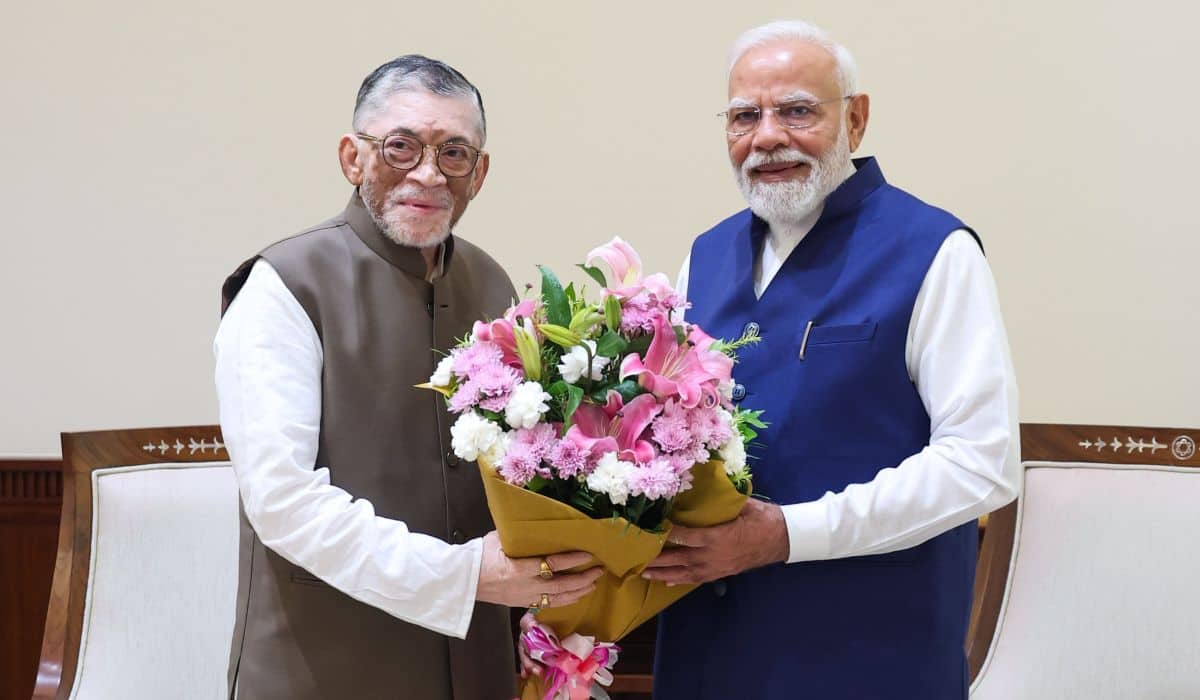
Union Minister of State, Dr L Murugan and Chairman of TVS Supply Chain Solutions Ltd, Shri R Dinesh were present on the occasion among others.

Background

In Madurai, the Prime Minister participated in the program ‘Creating the Future – Digital Mobility for Automotive MSME Entrepreneurs’, and addressed thousands of Micro, Small and Medium enterprises (MSMEs) entrepreneurs working in the automotive sector. The Prime Minister also launched two major initiatives designed to support and uplift MSMEs in the Indian automotive industry. The initiatives include the TVS Open Mobility Platform and the TVS Mobility-CII Centre of Excellence. These initiatives are a step towards realizing the Prime Minister’s vision of supporting the growth of MSMEs in the country and helping them to formalize operations, integrate with global value chains and become self-reliant.

Click here to read full text speech

Explore More
প্রধান মন্ত্রীনা শ্রী রাম জন্মভুমি মন্দির দ্বাজরোহন উৎসবতা পীখিবা ৱারোলগী মৈতৈলোন্দা হন্দোকপা

Popular Speeches

প্রধান মন্ত্রীনা শ্রী রাম জন্মভুমি মন্দির দ্বাজরোহন উৎসবতা পীখিবা ৱারোলগী মৈতৈলোন্দা হন্দোকপা
India sees record surge in new company and LLP registrations amid strong investor confidence

Media Coverage

India sees record surge in new company and LLP registrations amid strong investor confidence
NM on the go

Nm on the go

Always be the first to hear from the PM. Get the App Now!
...
The government places great emphasis on bringing a 'technology culture' to agriculture: PM Modi
March 06, 2026
This year’s Union Budget gives a strong push to agriculture and rural transformation : PM
Government has continuously strengthened the agriculture sector ,major efforts have reduced the risks for farmers and provided them with basic economic security: PM
If we scale high-value agriculture together, it will transform agriculture into a globally competitive sector: PM
As export-oriented production increases, employment will be created in rural areas through processing and value addition: PM
Fisheries can become a major platform for export growth, a high-value, high-impact sector of rural prosperity: PM
The government is developing digital public infrastructure for agriculture through AgriStack: PM
Technology delivers results when systems adopt it, institutions integrate it, and entrepreneurs build innovations on it: PM

Prime Minister Shri Narendra Modi addressed the third post Budget Webinar today, focusing on " Agriculture and Rural Transformation ". Reflecting on the previous sessions regarding technology and economic growth, the Prime Minister noted that stakeholders had provided valuable cooperation during the budget formulation. "Now, after the budget, it is equally important that the country reaps the benefits of its full potential, and your suggestions in this direction and this webinar is thus important ", Shri Modi emphasised.

The Prime Minister highlighted that agriculture remains the mainstay of the Indian economy and a strategic pillar for the nation's long-term developmental journey. Shri Modi emphasized several programs, such as the ‘PM Kisan Samman Nidhi’, and ‘Minimum Support Price (MSP)’ reforms that provide farmers with 1.5 times returns. " Our government has continuously strengthened the agriculture sector”, Shri Modi remarked.

Providing data on the success of existing schemes, the Prime Minister noted that 10 crore farmers have received over ₹4 lakh crore as PM Kisan Samman Nidhi, and nearly ₹2 lakh crore in insurance claims have been settled under ‘PM Fasal Bima Yojana’. Siri Modi also noted that the institutional credit coverage has become more than 75%. "Such numerous efforts have reduced the risks for farmers and provided them with basic economic security," Shri Modi affirmed.

On record production in food grains and pulses, the Prime Minister called for infusing the sector with new energy as the 21st century's second quarter begins. Highlighting that renewed efforts have been made in this direction in this year’s Union Budget, Shri Modi expressed confidence that the webinar's deliberations would fast-track the implementation of budget provisions. "I am confident that the discussion among you in this webinar and the resulting suggestions will help in implementing the budget provisions on the ground as quickly as possible", Shri Modi asserted.

The Prime Minister highlighted the shifting global demand and the necessity of making Indian agriculture export-oriented. He urged the full utilization of India's diverse climate to increase productivity and export strength. "In this webinar, it is essential to have maximum discussion on making our farming export-oriented.", Shri Modi remarked,

Focusing on high-value agriculture, the Prime Minister detailed budget proposals for region-specific promotion of crops like cocoa, cashew, and sandalwood. Shri Modi also highlighted the budget proposal of promotion of Agarwood in the North East,and Temperate Nut crops in the Himalayan states.The Prime Minister noted that export oriented production would lead to rural employment through processing and value addition. "If we scale high-value agriculture together, it will transform agriculture into a globally competitive sector",Shri Modi asserted.

The Prime Minister called for a unified approach involving experts, industry, and farmers to meet global branding and quality standards. He stressed the importance of setting clear goals to connect local farmers with global markets. "Discussions on all these topics will further enhance the importance of this webinar.", Shri Modi remarked.

Turning to the fisheries sector, the Prime Minister stated that India is the world's second-largest fish producer. Shri Modi further highlighted that while approximately 4.5 lakh tonnes of fish are currently produced in our various reservoirs and ponds, there exists a potential for an additional 20 lakh tonnes of production. "Fisheries can become a major platform for export growth.”, Shri Modi remarked.

The Prime Minister emphasized the need for new business models in hatcheries, feed, and logistics to realize the potential of the Blue Economy. He encouraged strong coordination between the fisheries department and local communities. "This can become a high-value, high-impact sector for rural prosperity, and you must deliberate on this together.", Shri Modi emphasised.

The Prime Minister stated that India is the world's largest milk producer today and ranks second in egg production. He highlighted that to take this further, the focus must be on breeding quality, disease prevention, and scientific management. Shri Modi further emphasized that the health of livestock is a crucial subject, noting, "When I speak of 'One Earth, One Health,' it includes the health of livestock."

Highlighting India's self-reliance in vaccine production, the Prime Minister noted the expansion of technology under the National Gokul Mission and the availability of Kisan Credit Cards for animal husbandry farmers. The Prime Minister stated that more than 125 crore doses have already been administered to protect animals from Foot and Mouth Disease. "To encourage private investment, the Animal Husbandry Infrastructure Development Fund has also been started," the Prime Minister added.

To mitigate risks, the Prime Minister advocated for crop diversification over single-crop dependency. He cited missions for edible oils, pulses, and natural farming as tools to boost the sector's strength. Shri Modi emphasized, "Therefore, we are focusing on crop diversification."

The Prime Minister reminded participants that since agriculture is a state subject, states must be inspired to fulfill their budgetary responsibilities. He called for strengthening budget provisions at the district level for maximum impact.

The Prime Minister spoke extensively on the "technology culture" in agriculture, referencing e-NAM and the development of digital public infrastructure. He noted the creation of Kisan IDs and digital land surveys as transformative steps. Shri Modi asserted, "The government places great emphasis on bringing a 'technology culture' to agriculture."

Highlighting the role of AI-based platforms and digital surveys, the Prime Minister stated that technology only yields results when it is integrated by institutions and entrepreneurs. He called for suggestions on how to effectively merge technology with traditional systems. The Prime Minister remarked, "The suggestions emerging from this webinar will play a major role in how we correctly integrate technology."

The Prime Minister reiterated the government's commitment to rural prosperity through schemes like PM Awas Yojana and PM Gram Sadak Yojana. He specifically noted the impact of Self-Help Groups on the rural economy. Shri Modi affirmed, "Our government is committed to building rural prosperity."

Discussing the 'Lakhpati Didi' campaign, the Prime Minister set a target of creating 3 crore more such successful women entrepreneurs by 2029. He sought suggestions on how to achieve this goal with greater speed. The PM stressed, "Your suggestions on how to achieve this goal even faster will be significant."

Closing his address, the Prime Minister pointed to the massive storage campaign and the need for innovation in agri-fintech and supply chains. He urged entrepreneurs to increase investment in these critical areas to energize the rural landscape. The Prime Minister concluded, "I am confident that the nectar emerging from your deliberations today will provide new energy to the rural economy."