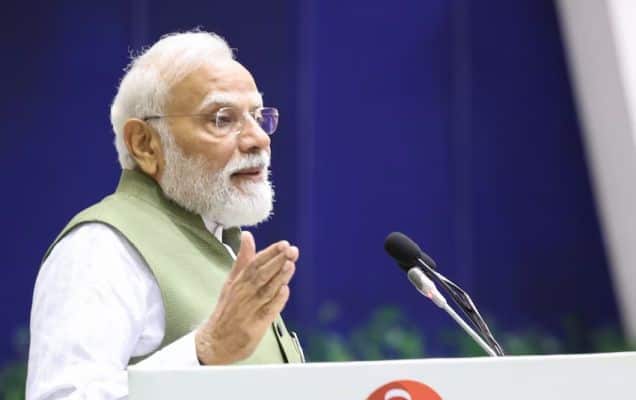
Giving a major boost to the pro-farmer initiatives of the Government and in keeping with its commitment and dedication for the Annadata, the Union Cabinet chaired by Prime Minister Shri Narendra Modi has approved a new Umbrella Scheme “Pradhan Mantri Annadata Aay SanraksHan Abhiyan’ (PM-AASHA). The Scheme is aimed at ensuring remunerative prices to the farmers for their produce as announced in the Union Budget for 2018.
This is an unprecedented step taken by Govt. of India to protect the farmers’ income which is expected to go a long way towards the welfare of farmers. Government has already increased the MSP of kharif crops by following the principle of 1.5 times the cost of production. It is expected that the increase in MSP will be translated to farmer’s income by way of robust procurement mechanism in coordination with the State Governments.
Components of PM-AASHA:
The new Umbrella Scheme includes the mechanism of ensuring remunerative prices to the farmers and is comprised of
Price Support Scheme (PSS),
Price Deficiency Payment Scheme (PDPS)
Pilot of Private Procurement & Stockist Scheme (PPPS).
The other existing schemes of Department of Food and Public Distribution (DFPD) for procurement of paddy, wheat and nutri-cereals/coarse grains and of Ministry of Textile for cotton and jute will be continued for providing MSP to farmers for these crops.
Cabinet has also decided that participation of private sector in procurement operation needs to piloted so that on the basis of learnings the ambit of private participation in procurement operations may be increased. Therefore in addition to PDPS.
It has been decided that for oilseeds, states have the option to roll out Private Procurement Stockist Scheme (PPSS) on pilot basis in selected district/APMC(s) of district involving the participation of private stockiest. The pilot district/selected APMC(s) of district will cover one or more crop of oilseeds for which MSP is notified. Since this is akin to PSS, in that in involves physical procurement of the notified commodity, it shall substitute PSS/PDPS in the pilot districts.
The selected private agency shall procure the commodity at MSP in the notified markets during the notified period from the registered farmers in consonance with the PPSS Guidelines, whenever the prices in the market fall below the notified MSP and whenever authorized by the state/UT government to enter the market and maximum service charges up to 15% of the notified MSP will be payable.
Expenditure:
The Cabinet has decided to give additional government guarantee of Rs.16,550 crore making it Rs. 45,550 crore in total.
In addition to this, budget provision for procurement operations has also been increased and Rs. 15,053 crore is sanctioned for PM-AASHA implementation. The scheme henceforth is a reflection of Government’s commitment and dedication to our ‘Annadata’.
Procurement over the years:
During financial years 2010-14 total procurement was Rs. 3500 crore only whereas during financial years 2014-18, it has risen 10 times and reached to Rs. 34,000 crore. For procurement of these agri-commodities during 2010-14, Government Guarantee of Rs. 2500 crore was provided with expenditure of only Rs. 300 crore; while during 2014-18, Guarantee amount has been increased to Rs. 29,000 crore with expenditure of Rs. 1,000 crore.
Details:
Government of India is working with the holistic approach of solving any issue rather than in fragments. Increasing MSP is not adequate and it is more important that farmers should get full benefit of the announced MSP. For this, government realizes that it is essential that if price of the agriculture produce market is less than MSP, then in that case State Government and Central Government should purchase either at MSP or work in a manner to provide MSP for the farmers through some other mechanism. With this approach, Cabinet has approved the Umbrella Scheme of PM-AASHA with three sub-schemes i.e. Price Support Scheme (PSS), Price Deficiency Payment Scheme (PDPS) and pilot of Private Procurement & Stockist Scheme (PDPS).
In Price Support Scheme (PSS), physical procurement of pulses, oilseeds and Copra will be done by Central Nodal Agencies with proactive role of State governments. It is also decided that in addition to NAFED, Food Cooperation of India (FCI) will take up PSS operations in states /districts. The procurement expenditure and losses due to procurement will be borne by Central Government as per norms.
Under Price Deficiency Payment Scheme this scheme (PDPS), it is proposed to cover all oilseeds for which MSP is notified. In this direct payment of the difference between the MSP and the selling/modal price will be made to pre-registered farmers selling his produce in the notified market yard through a transparent auction process. All payment will be done directly into registered bank account of the farmer. This scheme does not involve any physical procurement of crops as farmers are paid the difference between the MSP price and Sale/modal price on disposal in notified market. The support of central government for PDPS will be given as per norms.
Pro-farmer initiatives of the Government:
The Government is committed to realizing the vision of doubling farmers’ income by 2022. The emphasis is on enhancing productivity, reducing cost of cultivation and strengthening post-harvesting management, including market structure. Several market reforms have been initiated. These include Model Agricultural Produce and Livestock Marketing Act, 2017 and Model Contract Farming and Services Act, 2018. Many States have taken steps to adopt these through legislation.
Efforts are on for a new market architecture, so as to ensure that farmers get remunerative prices on their produce. These include setting up of Gramin Agricultural Markets (GrAMs) so as to promote 22,000 number of retail markets in close proximity of farm gate; competitive and transparent wholesale trade at APMC through eNAM and a robust and pro-farmer export policy.
Besides, several other pro-farmers’ initiatives such as implementation of Pradhan Mantri Fasal Bima Yojana, Pradhan Mantri Krishi Sinchai Yojana, Paramparagat Krishi Vikas Yojana and distribution of Soil Health Cards have been undertaken. The commitment for farmer welfare is also reflected by unprecedented decision of announcing minimum support price based on the formula of 1.5 times the cost of cultivation.