Place :Gandhinagar Speech Date :12-01-2011
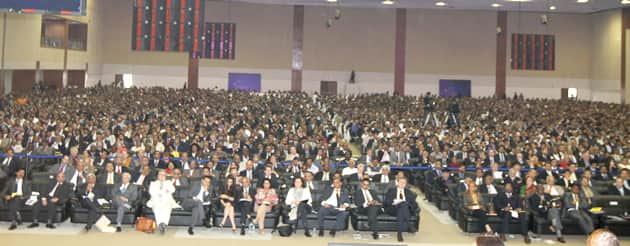
- Not only the event which you are witnessing is global; but also the venue where you are sitting is global. More than one third of the countries of the world are represented here from several continents.
- Investment flow into the State is only a small part of the objective of this event. The greater objective is to energize global networking for knowledge and technology sharing.
- I have personally been committed to 'Gujarat's Growth for India's Growth'. Achievements of Gujarat are all-pervasive. They are not region specific, sector specific or community specific.
- This summit is special to us, not only because it is the biggest summit so far hosted, but also because it is happening in the Golden Jubilee year of Gujarat.
Distinguished Guests, Ladies and Gentlemen!
It is a matter of great pleasure and rare privilege to welcome you all to this event, to the Mahatma Mandir and to Gujarat. This is the 5th Vibrant Gujarat Global Investors' Summit. From a humble beginning in 2003, we have come a long way to hold this grand event, the biggest of its kind in the country so far. This venue, where we are sitting, is a lasting tribute to the life and ideals of Mahatma Gandhi, a son of this soil. This entire construction work which you are seeing is a work of just eight months. The full project will take another year to get completed. It is going to be a monument of peace, brotherhood and tolerance. You will be glad to know that the foundation of this building has been blessed with the soil and water from all the villages of Gujarat and all the States of India. It is also enriched with soil and water from twenty-two countries of the world and their various provinces. Thus, not only the event which you are witnessing is global; but also the venue where you are sitting is global. I can foresee a day when international peace talks will be held at this place and they will invariably be successful. I welcome you all to the first event at this Mahatma Mandir. Today is also the birthday of Swami Vivekananda, one of the greatest visionaries the world has ever produced. He envisioned a world which is driven by "spiritual humanism" that will enable everyone to have freedom, knowledge and happiness. Through these Summits and through all our thoughts and actions, we consistently aim at achieving these ideals, not only for ourselves but for the entirety of humanity.
On this august occasion, at the very outset, I would like to thank the people, the Government and the companies of Japan who have been our active partners since the last event. I sincerely welcome His Excellency the Ambassador of Japan and his political and business delegation. I also thank the Government and the people of Canada for partnering with this event this time. I welcome the Canadian delegation which is led by His Excellency the High Commissioner of Canada. I particularly welcome His Excellency the Prime Minister of Rwanda, and various other political dignitaries, Excellencies, business and institutional delegations. Once again, I join the people of Gujarat in welcoming and thanking all the international delegations, all companies and participants who have travelled long distances to be part of this summit. As per initial estimates, more than one third of the countries of the world are represented here from several continents. We are really honored that you have accepted our invitation. The participation of such a large number of countries and other Indian States has given this Summit a new Vibrancy. I welcome you all once again and hope that your stay here will be comfortable, enjoyable and rewarding.
Friends! India is an emerging power, or as President Obama famously said, "it has already emerged". India has unlimited potential for growth. The 21st century is not only the century of India but also that of Asia. Therefore, we have to look at the role of Gujarat not only in the context of India but also of Asia. Whenever India led the world, the welfare of human beings was at the center. The cultural heritage of India has compassion, equity and love at its core. This is the land where Buddha and Mahavir walked. Whenever India suffered a setback, humanity did too. Today, there is imbalance in the world. The gap between rich and poor is increasing. The gulf between the developed and developing countries is widening. The separation between nature and human beings has never been as pronounced as it is today. To come out of these, what sort of paradigm shift is needed?
Before I talk about the Summit, it is necessary to place it in the context of the times in which this is happening. Only a few days back, we celebrated the birth of the second decade of 21st century. There is a vast difference between the last century and the present one in terms of the approach towards development and growth. The development process in the 20th century was based on exploitation. The model of development was exploitation of the weak by the strong, exploitation of the laborers of the poor countries; nations exploiting one another. The mindset was unlimited exploitation and use of natural resources, as if they would last forever. Therefore, in this century, it has become necessary to bring about a change in our thinking, in our institutions and mechanisms.

Friends! in this century, when technology has taken off by leaps and bounds, the challenge is to have technology with a human face. In the last century, international organizations like the UNO were created mainly for dispute resolution. Now this century should not be a century of disputes or exploitation but one of understanding and nourishment. It should be environmentally-friendly and help us to adapt and mitigate climate change impacts, using our natural resources minimally and getting the maximum benefits out of them. The institutional mechanisms should be development - oriented with sensitivity towards human beings. Human beings should not be reduced to robots but should be made free partners in development. In the last century, we worked for awareness about the rights of women, but now they are equal partners in the development process. Gujarat is charting out its future role based on the above required paradigm shift.
There are two important drivers of this century. One is the power of youth and the other is the power of knowledge. India has the maximum number of young people in the world with 72 per cent of India's population below the age of 40; 47 per cent under 20. And in fact, 10 per cent of the world population is an Indian under 25. India is also known for its wisdom and knowledge which it gave to humanity. In today's world, though we are talking about Intellectual Property Rights and Patents, the question is how to bring creativity out of these narrow confines so that everyone benefits. The inspiration should come again from India whose heritage stretches from the Vedas to Vivekananda, from Upanishads to satellites. In this context, we are determining the role that Gujarat needs to play in the larger context. Gujarat cannot look at its own development. It should provide a model, a model not only for India, but also for the rest of the developing world. Hence this summit, where business leaders, academic minds, entrepreneurs, political leaders and bureaucrats have assembled in large numbers, becomes significant.
Friends! Gujarat's model of Governance, in recent years, is characterized by an organized and holistic approach towards development. We have moved out of the traditional approach of piecemeal actions and knee - jerk reactions. We now look at fundamental changes and aim at qualitative and quantitative leaps. One of these steps was to institutionalize various activities under the banner of Vibrant Gujarat. The Vibrant Gujarat events were conceived and organized to highlight the culture and creativity of the State and unleash the energy and enterprise of its people. The scope of this biennial event has moved further from investments in industry and infrastructure to investments in human beings. It started as a State level event in 2003. Amidst many uncertainties, even this first event was a huge success. Therefore, we realized that our direction was right. In 2005, we further reorganized ourselves and went around the world to invite participation from countries and companies. The result was again a great response. However, it was 2007 when this event started acquiring a global character. In 2009, with greater participation of countries, I could see its real global character. This was the year when Japan formally joined as our partner country. In the 2009 event, there was participation from heads and representatives of forty seven countries. This event, which was held in the backdrop of a global recession, surprised everyone with investment agreements of US Dollars 240 billion. In fact, the cumulative figure of the investment flow through all previous events is to the tune of US Dollars 370billion.
However, investment flow into the State is only a small part of the objective of this event. The greater objective is to energize global networking for knowledge and technology sharing; to learn the best practices and to encourage the people to think big and take up challenging projects. Gujarat is a land of entrepreneurs and these events have further fuelled the enterprising spirit of the Gujarat is. But rather than resting here, our endeavor has been to further expand the scope of the event. This time, we have invited Indian States and other countries to make use of our platform for business and technology tie-ups through agreements for their respective locations. We are particularly encouraging our own companies to establish national and global partnerships through this Summit.
After having a feel of today's proceedings, you will agree with me that this is no longer a State or National level event; it has become a Global Event. It is no longer a mere investment promotion event; it has become a growth propelling event. It is also no longer just a business meet; it has become an international knowledge - sharing platform. It is critical that we provide an active space for the flow and exchange of ideas on how to take the process of development forward. Particularly for India, which is a Nation of myriad cultures and different models of development, a three-way engagement with politicians, thought leaders and business leaders is the need of the hour. The same is true for many other countries, particularly in the developing world. I am sure this Summit will show us the way and will help forge a consensus on what kind of growth we want to see. This is why we have incorporated a plethora of discussion for aand seminars into the programme of this Summit. I take this opportunity to sincerely thank all those who have contributed to the evolution of this Summit.
Friends! it was the famous Canadian communication theorist, Marshal McLuhan, who spoke in the early 1960s of a world that is increasingly becoming a "global village". Along with "global village", another term that has entered the lexicon is the term "glocalisation". Its origins are in the Japanese word "dochakuka". It means global localization and had emerged as a key business strategy in Japan in the 1980s and 1990s. Essentially, it was the adaptation of products and services to the needs of specific markets, especially in the developing world. I take pride in saying that Gujarat epitomizes the best of both the terms which our Japanese and Canadian partners gave to the world. Gujarat has, in fact, always been a Global Community with its diaspora spread throughout the world. For centuries, our people have settled all across the world and have proved their acumen. They bring back home the global experience and mix it with the enterprising spirit of the State. Over the years, Gujarat has turned into a Global Economy with the presence of global companies here and our products available all around the world. Today, you will see how we are moving towards becoming a Global Hub. When we talk of a global hub, we mean that we are in the process of making Gujarat a globally preferred place to live in and to do business. Thus, I can say that Gujarat has inherently believed and sincerely practiced what Canada and Japan believed in and practiced. Therefore, there is lot of sense why the three are partners in this Summit.
I have often been saying that in this era of globalization, the physical boundaries of nations will disappear. Also, more than the physical resources, the intangibles like Governance, the scope of opportunities and the standards of processes will become important. I have thought on this issue further and I feel that for a strongly globalized and performing economy, what is important is the five Ms: First and foremost of these five Ms is Man. When I talk of Man, it includes all genders, their minds, their skills, their spirits, and their ways of working and living. The second important M is Materials: which of course includes the natural resources and physical assets. Another important M is Machines which include the technological prowess as well as the R & D capabilities. Yet another M is Maritime links in which I also include all other forms of connectivity including Roads, Railways, Airways and Information Highways. The last and the most important M, to my mind, is the aspect of Management which includes the quality and nature of political, administrative and corporate governance. Friends! On all these five Ms, I am proud to say that Gujarat represents not only the best of India but it offers a global edge. To put it in short, Gujarat represents a state of business both in the physical and mental form. Its strength lies in catching the ideas and converting them into business propositions. We house some of the biggest and the best industries, the world over. We are monopoly producers in the country in several sectors and a global leader in a number of products. Our industrial infrastructure including the environmental infrastructure is regarded as the best in the country. We provide a hassle-free environment for business which starts right from the effective handholding for setting up projects. Transaction costs and the cost of living are low; labour problems are almost zero and there is absolutely no shortage of critical inputs like power and water. It is these features which have made Gujarat a preferred business destination.
Friends! India is on the path of becoming a major economic power in the world. I have personally been committed to 'Gujarat's Growth for India's Growth'. We have re-oriented the approach of the development process in general and of industrialization in particular. We have made the development process a mass movement with people's participation. This decade of Gujarat has been a decade of phenomenal growth. We have not only registered overall double-digit GDP growth but our important sectors have also registered double-digit growth. Our Industry has grown at 13% in the last decade. Our agriculture has grown at 9.6% over last seven years. The per capita income of the people has grown at 13.8%. With these and several similar indicators, we are already regarded as the "Growth Engine of India".
However, we want to go far ahead. Our eyes are on the global benchmarks. Our eyes are on global excellence in all possible spheres. Also, we are equally keen that these achievements benefit our people and raise their standard of living. We have taken definite steps to achieve this kind of performance. To give you a few examples: We have tripled the number of seats in our technical and management colleges on the one hand and on the other, we have set up seven new world class universities and an NT. As part of this very Summit, we have entered into agreements with several renowned universities of the world. Understanding the importance of knowledge in this century, we have organized exchange programmes with the best brains and institutions in the country and abroad. Similarly, we have made substantial progress in oil and gas exploration. At the same time, we have laid down a 2,200 km long gas grid to fuel the industries and households. We have made hundreds and thousands of water - harvesting structures, and also successfully implemented one of the world's biggest dams, the longest canal system and a State wide water grid. We have added substantial Megawatts to our electricity generation; and at the same time connected each and every village with electricity making Gujarat the only State to supply round the clock power to all the households of the State. We have set up world class - hospitals making Gujarat a global medical tourism destination, and at the same time, have ensured access for mothers and children to medical facilities. We already had the biggest Wide Area Network in Asia and the Pacific. But we have further strengthened our connections to the world by taking the broadband right up to the village level. Our primary and secondary schools have been equipped with the best physical and ICT infrastructure.
Friends! with careful planning and aggressive execution, we have broken away from the traditional pattern of governance of a developing country where the pace of progress was slow, the delivery was sluggish and the results were invisible. In the infrastructure sector, we have redefined the approach and the level of thinking. We have been creating a very futuristic infrastructure and implementing some of the most ambitious projects. Many of our cities have been rated as the environmentally best cities and economically fastest-growing in the world. We are converting many of our roads to expressway standards. We are laying down seamless and robust connectivity to and from our ports, industrial clusters and agri-marketing centres. To connect such economic centers, we have also implemented railway lines through the private sector. We have established India's first two LNG terminals; to which we are going to add two more very shortly.
We are not only upgrading our ports to make them world class, we are also adopting a holistic coastal development approach including the development of new coastal cities with global standards. To develop the infrastructure, we have perfected the mechanism for Public-Private Partnerships. Our PPP model is time tested now and has been consistently admired in the country.
The above are just a few illustrations but they elaborate the reasons that a large number of national and multi-national companies have made Gujarat their base. This is the reason that our contribution to industrial output is around 16%, consistently for a decade. This is the reason that we contribute 22% of India's exports. This is also the reason that we account for 30% of India's market capitalization. We are committed to not only retain this position but to further improve it. With General Motors, Tata Nano and Bombardier, we are emerging as a new auto and transportation manufacturing hub. With our limestone reserves, we are emerging as the biggest cement producer in the country. We have already emerged as a big steel and pipe producer in the country. Now, we are going to become global players in these fields. And the best infrastructure strength which we have is our 1600 km long coastline dotted with world class ports. These ports are the gateways to Gujarat's prosperity, highways for global trade and expressways for the progress of the country particularly its northern hinterland.
However, friends! we are not going to rest with this. We are committed to make India emerge stronger even stronger. If India has to become a premier economy in the world, as its prime economic constituent, we have to do even better. We are constantly expanding the horizon of our physical, social and industrial infrastructure, our governance, our policies and processes. On the industrial infrastructure front, we moved from our traditional industrial clusters to industrial estates and advanced further to establish 60 SEZs which is the largest number in the country. We are further moving to set up truly world-class and huge-sized Special Investment Regions which we call the SIRs. We have planned for 12 SIRs which will be Global Hubs of Economic Activity. They will be supported by world-class infrastructure, premium civic amenities and an exemplary policy environment. Setting up of these SIRs is in line with the upcoming Dedicated Freight Corridor between Delhi and Mumbai (DFC) and the Delhi-Mumbai Industrial Corridor (DMIC). Similarly, these SIRs will have a great synergy with our upcoming International Finance TechCity popularly known as GIFT. I am fond of saying that each of these SIRs is going to become "a new Gujarat within Gujarat". These developments are historic. These developments have the potential to fundamentally change our State's economy, to give a quantum jump to the Indian economy and to influence the global economy.
I must also add here that the achievements of Gujarat are all-pervasive. They are not region specific, sector specific or community specific. Our people are not only beneficiaries but they are active partners in the process of development. The State Government is playing the role of a catalyst and facilitator. Gujarat has, in fact, emerged as a model of Good Governance not only in the country but in the entire world. Our Mantra is: P2-G2 which means Pro-active Pro-people Good Governance. Our innovations range from multi-faceted and multi-level infrastructure to mass campaigns for girl child education, to evening courts for speedy delivery of justice, additional shifts in engineering colleges, a movement away from water scarcity to water management and self-sufficiency in power through generation and reduction of losses. These are just some of the steps that have been taken in various fields in a very innovative manner. That is why, almost on a weekly basis, we have been receiving national and international awards in various areas of governance, scheme formulation and their outcome. A few months back, the United Nations Organization gave to my office the coveted Public Service Award for improving the effectiveness, efficiency and quality of Public Service. However, we are constantly trying to achieve higher and higher standards. Many of our Government offices, including my own office, are ISO certified. These awards, the successive support of the people to my Government, and the overwhelming response of the global community are testimony that we are moving in the right direction.
Friends! we are presently celebrating the Golden Jubilee year of the formation of the Gujarat State. We are working hard to make this era of Gujarat a golden era. With that objective, we are bringing in changes in our systems. We are re-visiting our priorities and processes. We are re-orienting our aspirations and energies. During this year, we all have taken the pledge to bring quality changes in our lives and professions. The people of Gujarat have always been cost conscious and quality conscious in their occupations. Now, we are increasingly becoming carbon conscious too. One of the biggest changes that we are bringing in is to ensure that whatever we do, we do in a manner that the environmental impacts are minimum. I know for sure that managing climate change is very critical to human existence. To tackle it, Gujarat was the first Country or State in Asia to establish a separate Department of Climate Change. We saw the need to promote an understanding that communities are pivotal to changing attitudes towards our fragile planet. No one can doubt that the time to act is now. It is now that timely action can avert disaster. We have taken concrete action in the last few years to show how the dangers to climate change can be averted. I have listed some of these actions in my latest book 'Convenient Action1. These actions range from water conservation and waste management to the generation of Solar and Wind energy. Our action flows from Mahatma Gandhi's concept of trusteeship- that wealth belongs to the community and must be used for the welfare of the community. My understanding of this teaching is that we must ensure the same or better level of wealth to our future generations.
I always say that good infrastructure is the backbone of good life, good opportunities and good investments. And, Good Governance is the enabler for all of them. Gujarat is a rare combination of all these enablers. In addition, Gujarat has a unique spirit of business. This combined with the Government's pro-active and business friendly role, has made Gujarat one of the most preferred business locations in India. We are constantly on the job to further improve this ecosystem. Our existing potential and future strategy offer enormous opportunities for you. We have assembled here to work in mutual interest and in the interest of humanity. I invite you to be part of our development process which is robust and yet uniform; fast and yet sustainable. You may have a lot to benefit from it. You may find a lot to share in it. This summit is special to us, not only because it is the biggest summit so far hosted, but also because it is happening in the Golden Jubliee year of Gujarat. In a short span of 50 years, the State has become a leader in the country and a global icon in many aspects. This phenomenal success could be achieved because people of Gujarat basically believe in a value system. They also believe in business ethics and sincere standards in whatever they do. That is the primary reason why Gujarat has done so well on a consistent basis in almost all sectors.
Friends! as I said earlier, the objective of this global summit is not merely to attract monetary investments. This is an attempt to unite all those who are concerned about the well being of humanity and want to evolve new parameters for human welfare on a sustainable basis. I assure you that we will keep up our efforts in this direction and will make a difference. Gujarat Can and Gujarat Will. This Summit is also not a one-time affair for us. It is just a beginning of building relationships. Similarly, for you, it should not be a one-time affair. You should keep coming to it again and again. And I wish that every time you come, you gain from it much more than you did on the previous occasion. I once again welcome you all. I am sure that now once you are here, you will develop lasting ties with our State, its people, its potential and its opportunities.
On my part, I assure you that I will be there to help you reach where you want to reach. In fact, from now onwards, we will pursue your dreams and make you realize them faster than you even anticipated.