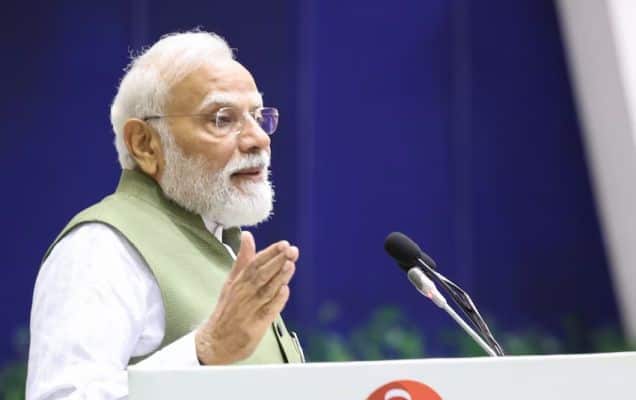
“Exactly 8 years ago we started implementing new mantras of good governance in India following the path of minimum government - maximum governance”
“Technology has helped a lot in furthering the vision of saturation and in ensuring last-mile delivery”
“We have made technology a key tool to impart new strength, speed and scale to the country”
“Today we are making technology available to the masses first”
“When technology goes to the masses, possibilities of its use also increase accordingly”
“Promotion of drone technology is another medium of advancing our commitment to good governance and ease of living”

Present on the dais are my colleagues from the Union Cabinet, all the guests gathered from across the country at the Bharat Drone Mahotsav, other dignitaries present here, and ladies and gentlemen!

I congratulate all of you for organizing this Bharat Drone Mahotsav. I can see all the senior people sitting in front of me. I got late. It was not because I came late. I came here on time, but I was so engrossed at the exhibition of drones that I could not keep track of time. I came here late, yet I could hardly see ten percent of the exhibits, but I was very impressed. Wish I had more time, so that I could go to each stall and watch the works of the youth and listen to their stories. Though I could not visit all the stalls, yet I would urge all the government departments and officers at different levels who play a role in policy making to spend at least two-three hours here and try to understand each and every thing. They can find many technologies which can be used in their offices. There are many such initiatives which we can adopt in governance. However, it was a very pleasant experience for me as the youths at different stalls proudly claimed their products were made in India and they had developed them indigenously.

Friends,

Our farmers, drone engineers, start-ups and leaders of various companies from across the country are also present in this Mahotsav. And I am sure that thousands of people are going to be a part of it in the next two days. At one of the exhibitions, I saw those who actually run their business with drones. I was also fortunate to meet many young farmers who are using drone technology in agriculture. I also met young engineers who are promoting drone technology. Today 150 drone pilot certificates have also been given here. I extend my best wishes to all those drone pilots and everyone involved in it.

Friends,

It is amazing to see the enthusiasm regarding drone technology in India. The energy that is visible is a reflection of the quantum jump in the drone services and drone-based industries in India. It shows the enormous possibilities of employment generation in India. Today, India is moving at a fast pace towards becoming the doyen in drone technology in the world on the back of its start-up strength.

Friends,

This festival is not only a celebration of technology but also of new governance of new India and unprecedented positivity towards new experiments. Incidentally, this was the time eight years ago when we started implementing new mantras of good governance in India. We made ease of living and ease of doing business our priority following the path of Minimum Government, Maximum Governance. Following the mantra of ‘Sabka Saath, Sabka Vikas’, we chose the path of connecting every citizen and every region of the country with the government. We relied on modern technology and made it a part of the system to bridge the divide of accessibility and delivery of services in the country. A very small section of the country had access to technology and it was assumed that technology was meant only for the rich. It has no place in the life of an ordinary human being. By changing that whole mindset, we have taken many steps towards making technology accessible to all and we are going to take further steps.

Friends,

We have often seen some people try to create fear to shun technology. ‘It will lead to this or that if new technology comes’. It is true that there used to be a clock tower in the whole city once upon a time. The village was dependent on time when its clock rang. Who would have thought then that there would be a watch on every wrist? They would have found it strange when the change happened. There would still be some people wishing to install a clock tower in their villages. It was useful at some point. In other words, we need to change ourselves and the systems accordingly and only then progress is possible. We have also experienced this during the corona vaccination drive. Technology was considered a part of the problem during the earlier governments and efforts were also made to prove that it was anti-poor. As a result, there was an atmosphere of indifference regarding the use of technology in governance before 2014. Only a handful people adopted it according to their interest, but it did not become a part of the system. The country's poor, underprivileged and the middle-class people suffered the most and the people who were full of aspirations were forced to live in despair.

Friends,

There is no denying that new technology causes disruption. It seeks new mediums, writes new chapters and creates new paths and new systems. We all have seen how simple things were turned out to be difficult. I don't know how many of you would have stood in a queue for food grains, kerosene and sugar at the ration shop in your childhood. There was a time when one spent hours in the queue for this. I remember that I had this fear in my childhood that what if the grains run out of shortage or the shop closes by the time my number comes. The same fear existed among the poor seven-eight years ago. But I am satisfied that we have put an end to this fear today with the help of technology. Now there is a belief among the people that they will get what they deserve. Technology has played a huge role in ensuring last mile delivery and taking forward the vision of saturation. And I know that we can achieve the goal of ‘Antyodaya’ (welfare of all) by moving forward at the same pace. The experience of the last 7-8 years strengthens my faith further. My confidence is growing. It is due to the trinity of JAM -- Jan Dhan, Aaadhar and Mobile that today we are able to deliver ration to the poor with complete transparency across the country. We ensured free ration to 80 crore poor even during this pandemic.

Friends,

It is our power to correctly design, efficiently develop and implement our technology solutions that today India is successfully running the world's largest vaccination campaign. With the help of the robust UPI framework developed by the country, lakhs of crores of rupees are being transferred directly to the bank account of the poor. Women, farmers and students are now getting help directly from the government. In the new India of the 21st century, we have made technology an important tool to give new strength, speed and scale to the country. Today we are developing the right solutions related to technology and we have also developed the skill to scale up them. Promoting drone technology in the country is another means of taking forward this commitment of good governance and ease of living. We have got another such smart tool in the form of a drone, which is going to become a part of the life of ordinary Indians very soon. Be it our cities or remote villages and countryside areas, farms or playgrounds, work related to defence or disaster management, the use of drones is going to increase everywhere. Similarly, whether it is the tourism sector, media, or film industry, drones will help in increasing both quality and content there. We are going to see more use of drones in the coming days than what is being used now. I hold a PRAGATI meeting every month. The Chief Secretaries of all the states are on the screen and there are discussions on many topics. I urge them to give me a live demonstration of the project going on with the drone. So, it becomes very easy to coordinate things and it also facilitates decision making. When the reconstruction of Kedarnath started, it was difficult for me to go to Kedarnath every time, but I used to regularly monitor the development work through drones during the review meetings in my office. Now-a-days, if one has to check quality in the government works, it is not necessary to inform them in advance that I am coming for inspection. Then everything will be fine. If I send a drone, it comes with all the information without their knowledge.

Friends,

Drone technology is also going to play an important role in making the life of the farmer in the village more convenient and prosperous. Today, there are good roads, electricity and water in the villages, optical fiber is reaching and digital technology has expanded unprecedentedly, but still most of the work related to land and agriculture in the villages happens with the old system. There is every kind of wastage in that old system, there are many problems too, and productivity is not known. The people of our villages and our small farmers suffer the most. The land and resources of the small farmers are not enough to challenge the disputes and they can make rounds of courts. You see, the administration is entirely dependent on the employees of the revenue department from land records to assessing crop damage during droughts or floods. The greater the human interface, the greater the lack of trust, and rise of conflicts. If there are disputes then there is also a waste of time and money. If a person makes estimates then accurate estimates are not possible. A new tool in the form of drone has come as a powerful and effective means to overcome all these problems.


Friends,

The PM Svamitva Yojana is also an example of how drone technology is becoming the basis of a big revolution. Under this scheme, digital mapping of every property in the villages of the country is being done and digital property cards are being given to the people for the first time. Human intervention has reduced and as a result the scope for discrimination has ended. Drones have played a big role in this. A while back I also got an opportunity to understand the technology of flying a Svamitva drone. I got late because of that also. I am happy that about 65 lakh property cards have been generated in the country so far with the help of drones. And the ones who have got this card are satisfied that they have got the correct details of their lands. They have said this with complete satisfaction. Otherwise, it takes years to reach a consensus if we have to measure a small piece of land.

Friends,

Today we can see our farmers are increasingly attracted towards drone technology, there is an enthusiasm and they are ready to adopt it. This has not happened all of a sudden. This is because the use of technology has increased in the agriculture sector in the last 7-8 years. Now technology is not a stranger to the farmers. Once they see it and check it and if they have faith they do not make delays in adopting it. While I was talking to farmers, an engineer from Madhya Pradesh told me that people now call him ‘drone wala’. He is an engineer, but he is known for drones. He said once the farmers told him that the cultivation of pulses can be increased if there is a drone. They told him that it is difficult to spray pesticides in the field of pulses because of the height of the crop. Half of the pesticides get sprayed on their body. He said it would now become easy to take care of the crops and spray pesticides on crops higher than the height of humans because of drones. It will now be easier to cultivate pulses. How things change if a person works with the farmers in the villages.

Friends,

Today, we have made efforts to bring technology in the agriculture sector and Soil Health Card has emerged as a great force in itself for our farmers. These drone services can become soil testing labs in villages and there can be new employment avenues. The farmers can get their soil tested every time to know the requirements needed for their soil. Micro irrigation and sprinkler are becoming part of the modern irrigation system. Look at the use of GPS technology in crop insurance scheme, digital market like e-NAM, neem coated urea, or direct money transfer in the account of farmers through technology! The efforts made in the last eight years have greatly strengthened the confidence of the farmers in technology. Today the farmers of the country are more comfortable with technology and adopting it effortlessly. Now drone technology is going to take our agriculture sector to another level. So far, how much and which manure has to be put on soil, what is deficient in the soil and the amount of irrigation have been based on rough estimates. This has been a major reason for low yields and crop failure. But smart technology-based drones can be of great use. Drones can also identify which plant, or which part of the plant, is affected. And that's why it doesn't spray indiscriminately, but sprays smartly. This also saves the cost of expensive pesticides. In short, the small farmers will also get power and speed and their progress will also be ensured with the help of drone technology. As we celebrate the Amrit Mahotsav of freedom, it is my dream that everyone in India should have a smartphone, a drone in every field and prosperity in every home.

Friends,

We are strengthening the network of health and wellness centers in every village of the country and promoting telemedicine. The delivery of medicines and other items in villages has been a major challenge and there is going to be a possibility of delivery by drone in a very short time and at a faster speed. We have also experienced the benefit of the delivery of the Covid vaccines by drone. It can prove to be very helpful in providing quality health services to remote tribal, hilly and inaccessible areas.

Friends,

There is another aspect of technology to which I would like to draw your attention. In the past, technology and its inventions were considered for the elite class. Today we are making technology available to masses first. Drone technology is also an example. There were a lot of restrictions on drones till a few months back. We have removed most of the restrictions in a very short time. We are also moving towards creating a strong drone manufacturing ecosystem in India through schemes like PLI. When technology goes to the masses, then the possibilities of its use also increase. Today our farmers, students and start-ups are looking for new possibilities with drones. With the drone technology available to the farmers in the villages, the possibility of using it more in various fields has also increased. You will see that different types of uses of drones will emerge not only in the cities but also in the countryside and our countrymen will innovate more in this regard. I believe there will be more experiments in drone technology and it will have new uses in the near future.

Friends,

Today I invite all the investors of the country and the world to tap similar possibilities in India. This is the right time for India and the world to develop the best drone technology from here. I would appeal to the experts and to the people of the world of technology to expand drone technology as much as possible and take it to as many people as possible. I also call upon the youth of the country to come forward with new start-ups in the field of drones. I am sure together we will play our part in empowering common people with the drone technology. It can also help the police in terms of security. Drones can also be useful in occasions like Kumbh Mela. Drones can provide solutions to the problems of traffic jams. It can be used in so many ways. We need to integrate our systems with these technologies. Today I was watching drones dropping seeds for trees in the forests through bullets. When drones were not there, I did an experiment. I do local experiments. There was no such technology then. When I was the Chief Minister of Gujarat, I found that it was difficult to plant trees in mountains. What did I do? I took the help of those involved in gas balloons. I told them to put seeds in the balloons and release them on the mountains. When the balloons would hit the ground, seeds would scatter. And when the rains come, the seeds would hopefully grow into trees. Today drones are doing the same thing effortlessly. The seeds can be geo-tracked, or whether they are turning into trees or not. We can also monitor forest fires through the use of drones. We can take prompt action even in the event of a small incident. That is we can use drones for imaginary things and expand our systems. I am sure that this Drone Mahotsav will be useful to many from the point of view of curiosity. Moreover, those visiting the exhibition would be prompted to do something new, would attempt to bring changes and try to introduce them to various systems so that we can achieve the technology-driven delivery ultimately. With this belief, I once again wish you all the very best.

Thanks a lot!


Explore More
ಶ್ರೀರಾಮ ಜನ್ಮಭೂಮಿ ಮಂದಿರದ ಧ್ವಜಾರೋಹಣ ಉತ್ಸವ ಉದ್ದೇಶಿಸಿ ಪ್ರಧಾನಮಂತ್ರಿ ಅವರ ಭಾಷಣ

ಜನಪ್ರಿಯ ಭಾಷಣಗಳು

ಶ್ರೀರಾಮ ಜನ್ಮಭೂಮಿ ಮಂದಿರದ ಧ್ವಜಾರೋಹಣ ಉತ್ಸವ ಉದ್ದೇಶಿಸಿ ಪ್ರಧಾನಮಂತ್ರಿ ಅವರ ಭಾಷಣ
Why global AI leaders are flocking to the India AI Impact Summit in New Delhi

Media Coverage

Why global AI leaders are flocking to the India AI Impact Summit in New Delhi
NM on the go

Nm on the go

Always be the first to hear from the PM. Get the App Now!
...
In this decade of the 21st century, India is riding the Reform Express: PM Modi at ET Now Global Business Summit
February 13, 2026
Amid numerous disruptions, this decade has been one of unprecedented development for India, marked by strong delivery and by efforts that have strengthened our democracy: PM
In this decade of the 21st century, India is riding the Reform Express: PM
We have made the Budget not only outlay-focused but also outcome-centric: PM
Over the past decade, we have regarded technology and innovation as the core drivers of growth: PM
Today, we are entering into trade deals with the world because today's India is confident and ready to compete globally: PM

You are all welcome to this Global Business Summit; I extend my greetings to each one of you. We are here to discuss the theme “A Decade of Disruption, A Century of Change.” After listening to Vineet ji’s speech, I feel my task has become much easier. But let me make a small request-since you know so much, it should sometimes also be reflected in ET.

Friends,

The past decade of the 21st century has been one of unprecedented disruption. The world has witnessed a global pandemic, tensions and wars in different regions, and supply chain breakdowns that shook the global balance, all within a single decade. But friends, it is said that the true strength of a nation is revealed in times of crisis, and I take great pride in the fact that amid so many disruptions, this decade has been one of unprecedented development for India, marked by remarkable delivery and the strengthening of democracy. When the previous decade began, India was the eleventh-largest economy. Amid such turbulence, there were strong apprehensions that India might slip further down. But today, India is moving rapidly toward becoming the world’s third-largest economy. And the “Century of Change” that you speak of will, I say with great responsibility, rest significantly on India. Today, India contributes more than 16 percent to global growth, and I am confident that in every coming year of this century, our contribution will keep increasing steadily. I have not come here like an astrologer making predictions. India will drive global growth; it will emerge as the new engine of the world economy.

Friends,

After the Second World War, a new global order took shape. But after seven decades, that system is breaking down. The world is moving toward a new world order. Why is this happening? It happened because the foundation of the earlier system was based on a “One Size Fits All” approach. It was believed that the world economy would be centered in the core and that supply chains would become strong and dependable. Nations were seen merely as contributors within that framework. But today, this model is being challenged and is losing its relevance. Every country now realizes that it must build its own resilience.

Friends,

What the world is discussing today, India made part of its policy as early as 2015, ten years ago. When NITI Aayog was established, its founding document clearly articulated India’s vision: India would not import a single development model from any other country. We would pursue an Indian approach to India’s development. This policy gave India the confidence to make decisions according to its own requirements and in its own national interest. That is a key reason why, even during a decade of disruption, India’s economy did not weaken but continued to grow stronger.

Friends,

In this decade of the 21st century, India is riding on a Reform Express. The greatest feature of this Reform Express is that we are accelerating it not out of compulsion but with conviction, and with a commitment to reform. Many distinguished experts and stalwarts of the economic world are present here. You have seen the period before 2014. Reforms were undertaken only when circumstances forced them, when crises struck, when no other option remained. The reforms of 1991 happened when the country faced the danger of bankruptcy and had to pledge its gold. That was the approach of earlier governments-they undertook reforms only out of compulsion. After the 26/11 terrorist attack, when the Congress government’s weaknesses were exposed, the NIA was formed. When the power sector collapsed and grids began to fail, only then did reforms in the power sector occur out of necessity.

Friends,

There is a long list of examples reminding us that when reforms are made under compulsion, neither the correct results nor the desired national outcomes are achieved.

Friends,

I am proud that in the last eleven years, we have carried out reforms with complete conviction-reforms in policy, in process, in delivery, and even in mindset. Because if policy changes but processes remain the same, if the mindset remains unchanged, and if delivery does not improve, reforms remain merely pieces of paper. Therefore, we have made sincere efforts to transform the entire system.

Friends,

Let me speak about processes. A simple yet crucial process is that of Cabinet notes. Many here would know that earlier, it would take months just to prepare a Cabinet note. How could a nation develop at that speed? So we changed this process. We made decision-making time-bound and technology-driven. We ensured that a Cabinet note would not remain on any officer’s desk beyond a fixed number of hours-either reject it or take a decision. The nation is witnessing the results today.

Friends,

Let me also give the example of approvals for railway overbridges. Earlier, it would take several years to get a single design approved. Multiple clearances were required, and letters had to be written at various levels-and I am speaking not about the private sector, but about the government. We changed this as well. Today, see the pace at which road and railway infrastructure is being built. Vineet ji elaborated on this extensively.

Friends,

Another interesting example is border infrastructure, which is directly linked to national security. There was a time when even constructing a simple road in border areas required permissions from Delhi. At the district level, there was practically no authority empowered to make decisions; there were wall upon walls, and no one could take responsibility. That is why, even decades later, border infrastructure remained in poor condition. After 2014, we reformed this process, empowered local administration, and today we are witnessing rapid development in border infrastructure.

Friends,

One reform in the past decade that has created a stir worldwide is UPI, India’s digital payment system. It is not merely an app; it represents an extraordinary convergence of policy, process, and delivery. Those who could never even imagine accessing banking and financial services are now being served by UPI. Digital India, the digital payment system, the Jan Dhan-Aadhaar-Mobile trinity-these reforms were not born of compulsion but of conviction. Our conviction was to ensure the inclusion of citizens whom previous governments had never reached. Those who were never cared for, Modi honors and empowers. That is why these reforms were undertaken, and our government continues to move forward with this same spirit.

Friends,

This new mindset of India is also reflected in our Budget. Earlier, when the Budget was discussed, the focus was only on outlay-how much money was allocated, what became cheaper or costlier. On television, budget discussions would revolve almost entirely around whether income tax had increased or decreased, as if nothing beyond that existed in the country. The number of new trains announced would dominate headlines, and later no one would ask what happened to those announcements. Therefore, we transformed the Budget from being merely outlay-centric to being outcome-centric.

Friends,

Another significant change in the Budget discourse is this: before 2014, there was extensive discussion about off-budget borrowing. Now, there is the discussion about off-budget reforms. Beyond the Budget framework, we implemented next-generation GST reforms, replaced the Planning Commission with NITI Aayog, removed Article 370, enacted legislation against triple talaq, and passed the Nari Shakti Vandan Act.

Friends,

Whether announced within the Budget or beyond it, the Reform Express continues to gather speed. In just the past year, we have carried out reforms in the ports and maritime sector, taken numerous initiatives for the shipbuilding industry, advanced reforms under the Jan Vishwas Act, enacted the Shanti Act for energy security, implemented labor law reforms, introduced the Bharatiya Nyaya Sanhita, reformed the Waqf law, and introduced a new GRAM G Act to promote rural employment. Numerous such reforms have been undertaken throughout the year.

Friends,

This year’s Budget has propelled the Reform Express even further. While the Budget has many dimensions, I will speak about two important factors-Capex and Technology. As in previous years, infrastructure spending has been increased to nearly ₹17 lakh crore in this Budget as well. You are aware of the significant multiplier effect of capex; it enhances the nation’s capacity and productivity and generates large-scale employment across numerous sectors. The construction of five university townships, the creation of city economic regions in Tier-2 and Tier-3 cities, and seven new high-speed rail corridors, such Budget announcements are, in the truest sense, investments in our youth and in the nation’s future.

Friends,

Over the past decade, we have regarded technology and innovation as core drivers of growth. With this vision, we promoted a start-up culture and a hackathon culture across the country. Today, India has more than two lakh registered start-ups operating across diverse sectors. We encouraged our youth and fostered a spirit that rewards risk-taking. The results are evident before us. This year’s Budget further strengthens this priority. Significant announcements have been made, particularly for sectors such as biopharma, semiconductors, and AI.

Friends,

As the country’s economic strength has grown, we have also empowered the States proportionately. Let me share another figure. Between 2004 and 2014, over ten years, the States received around ₹18 lakh crore as tax devolution. In contrast, from 2014 to 2025, States have been given ₹84 lakh crore. If I add the approximately ₹14 lakh crore proposed in this year’s Budget, the total tax devolution to States under our government will reach nearly ₹100 lakh crore. This amount has been transferred by the Union Government to various State governments to advance development initiatives in their respective regions.

Friends,

These days, there is considerable discussion about India’s FTAs-Free Trade Agreements. As I entered here, the conversations had already begun, and analyses are taking place across the world. Today, however, let me present another interesting perspective-perhaps not the angle the media seeks, but one that may be useful. I firmly believe that what I am about to say may not have crossed your minds either. Have you ever wondered why such extensive free trade deals with developed nations did not materialize before 2014? The country was the same, the youthful energy was the same, the government system was the same-so what changed? The change came in the government’s vision, in its policy and intent, and in India’s capabilities.

Friends,

Reflect for a moment-when India was labeled among the “Fragile Five” economies, who would have engaged with us? In a village, would a wealthy family agree to marry their daughter into an impoverished household? They would look down upon it. That was our situation in the world. When the country was gripped by policy paralysis, surrounded by scams and corruption, who could have placed their trust in India? Before 2014, India’s manufacturing base was extremely weak. Earlier governments were hesitant; hardly anyone approached India, and even if efforts were made, they feared that deals with developed nations would result in those countries flooding our markets and capturing them. In that atmosphere of despair, before 2014, the UPA government managed comprehensive trade agreements with only four countries. In contrast, the trade deals concluded by India over the past decade cover 38 countries across different regions of the world. Today, we are entering trade agreements because India is confident. Today’s India is prepared to compete globally. Over the past eleven years, India has built a robust manufacturing ecosystem. Therefore, India today is capable and empowered, and that is why the world trusts us. This transformation forms the foundation of the paradigm shift in our trade policy, and this paradigm shift has become an essential pillar in our journey toward a Developed India.

Friends,

Our government is working with full sensitivity to ensure that every citizen participates in development. Those left behind in the race for progress are being prioritized. Previous governments only made announcements for persons with disabilities; we too could have continued that path. But sensitivity defines governance. The example I am about to give may seem small to some of you. Just as our country has linguistic diversity, sign language too was fragmented-one form in Tamil Nadu, another in Uttar Pradesh, a third in Gujarat, a fourth in Assam. If a differently-abled person from one state travelled to another, communication became difficult. This may not appear to be a major task, but a sensitive government does not consider such matters trivial. For the first time, India has institutionalized and standardized Indian Sign Language. Similarly, the transgender community had long struggled for their rights; we enacted legislation granting them dignity and protection. In the past decade, millions of women were freed from the regressive practice of triple talaq, and reservation for women in the Lok Sabha and State Assemblies was ensured.

Friends,

The mindset within the government machinery has also transformed, becoming more sensitive. This difference in thinking is visible even in schemes like providing free food grains to the needy. Some in the opposition mock us; certain newspapers amplify such mockery. They ask why free rations are given when 250 million people have supposedly risen out of poverty. It is a peculiar question. When a patient is discharged from a hospital, does the doctor not still advise precautions for several days? Yes, the person has come out of poverty, but that does not mean support should immediately cease. Those with narrow thinking fail to understand that lifting someone out of poverty is not sufficient; we must ensure that those who have entered the neo-middle class do not slip back into poverty. That is why continued support in the form of free food grains remains necessary. Over the past years, the Central Government has spent lakhs of crores on this scheme, providing immense support to the poor and the neo-middle class.

Friends,

We also observe a difference in thinking in another context. Some people question why I speak of 2047. They ask whether a Developed India will truly materialize by then, and whether it matters if we ourselves are not present at that time. This, too, is a prevalent mindset.

Friends,

Those who fought for India’s independence endured lathi charges, imprisonment in Cellular Jail, and even mounted the gallows. Had they thought that independence might not come in their lifetime and questioned why they should suffer for it, would India ever have attained freedom? When the nation comes first, when national interest is paramount, every decision and every policy is shaped for the country. Our vision is clear-we must continue working tirelessly to build a Developed India. Whether we are present in 2047 or not, the nation will endure, and future generations will live on. Therefore, we must dedicate our present so that their tomorrow is secure and bright. I sow today so that the generations of tomorrow may reap the harvest.

Friends,

The world must now prepare to live with disruption. Its nature may evolve over time, but rapid change in systems is inevitable. You can already witness the disruption brought by AI. In the coming years, AI will usher in even more revolutionary transformations, and India is prepared. In a few days, India will host the Global AI Impact Summit. Nations and technology leaders from across the world will gather here. Together with all of them, we will continue striving to build a better world. With this confidence, I once again extend my best wishes to all of you for this Summit.

Thank you very much.

Vande Mataram.