



Her Excellency Ms. Mette Frederiksen, Prime Minister of the Kingdom of Denmark and His Excellency, Mr. Narendra Modi, Prime Minister of the Republic of India, co-chaired a Virtual Summit between India and Denmark on 28 September 2020.
2. Prime Minister Modi and Prime Minister Frederiksen held an in-depth exchange of views in a warm and friendly atmosphere on bilateral relations, discussed the Covid-19 pandemic and global matters of interest to both sides, including climate change and green transition and reached common understanding with a view to accelerating sustainable economies and societies.
3. They further noted with satisfaction the continued development of bilateral relations based on historical links, common democratic traditions and shared desire for regional, as well as international peace and stability.
4. Given the shared desire to remain trusted partners, the two Prime Ministers agreed to elevate India-Denmark relations to a Green Strategic Partnership. This partnership would build on and consolidate the existing agreement establishing a Joint Commission for Cooperation (signed 6 February 2009) between India and Denmark which envisaged cooperation within the political field; economic and commercial field; science and technology; environment; energy; education and culture. In addition, it builds on and complements the existing Joint Working Groups on Renewable Energy, Urban Development, Environment, Agriculture and Animal Husbandry, Food Processing, Science, Technology and Innovation, Shipping, Labour Mobility and Digitization.
5. The Green Strategic Partnership is a mutually beneficial arrangement to advance political cooperation, expand economic relations and green growth, create jobs and strengthen cooperation on addressing global challenges and opportunities; with focus on an ambitious implementation of the Paris Agreement and the UN Sustainable Development Goals.
6. The two Prime Ministers acknowledged the importance of establishing the Green Strategic Partnership, under which India and Denmark will cooperate through relevant Ministries, institutions and stakeholders.
Energy and Climate Change
7. The two Prime Ministers confirmed the close partnership in addressing global challenges and solutions on green energy transition and climate change. The Strategic Sector Cooperation on offshore wind and renewable energy, as well as the India-Denmark Energy Partnership (INDEP) on capacity building, knowledge-sharing and technology transfer on wind energy; energy modeling and integration of renewable energy illustrate the shared commitment to address some of the common global challenges on the path towards global energy transition, green growth and sustainable development. The two sides envisage the energy partnership to be further strengthened over the coming years.
8. India and Denmark agree to be at the forefront in the global fight against climate change. Both countries have set very ambitious national targets on climate and energy that will contribute to an ambitious implementation of the Paris Agreement. Together, the two countries will show the world that delivering on ambitious climate and sustainable energy goals is possible.
9. The two countries agreed to hold regular consultations and dialogue on climate change and renewable energy at various levels.
Environment/Water and Circular Economy
10. The two Prime Ministers agreed to work towards further expanding and strengthening the existing Government-to-Government cooperation on environment/water and circular economy. They further agreed to cooperate in water efficiency and non-revenue water (water loss) and in this context tasked the Indian Ministry of Jal Shakti and the Danish Environmental Protection Agency and the Danish Ministry of Environment and Food to develop a Work Plan for an initial period of three years (2021-23).
11. The two Prime Ministers expressed their joint wish to enhance cooperation in the specific areas of water supply, water distribution, wastewater treatment, sewerage systems, re-use of treated wastewater, water management and energy optimization in the water sector through the Indo-Danish Water Technology Alliance.
Sustainable Urban Development including Smart Cities
12. Both sides noted the holding of 2nd India-Denmark JWG on Sustainable Urban Development virtually on 26 June, 2020 and agreed to strengthen bilateral cooperation in sustainable urban development, including in smart cities through the Urban Living Lab in Goa.
13. Both sides also agreed to strengthen existing City-to-City cooperation between Udaipur and Aarhus and Tumakuru and Aalborg.
14. They noted that Danish companies are contributing to designing infrastructure projects in India and welcomed greater engagement of Danish side in all fields of sustainable urban development.
Business, Trade and Shipping
15. The two Prime Ministers welcomed the idea of developing partnerships between Governments, institutions and businesses of the two countries with special focus on green and climate-friendly technologies. They recognized the importance of regulatory framework conditions to support public and private investments in green energy.
16. Both leaders appreciated the deep cooperation on maritime affairs and noted the potential for enhancing cooperation in ship-building and design, maritime services and Green shipping, as well as port development.
17. The two Prime Ministers underlined that they would encourage business delegations, market access activities for SMEs and enhance ease of doing business.
18. India and Denmark confirmed the emerging cooperation in Intellectual Property Rights, which will help to modernize and strengthen their national intellectual property systems to promote innovation, creativity and technological advancement.
Science, Technology, Innovation and Digitization
19. India and Denmark recognize the importance of promoting and facilitating investments in science, technology and innovation (STI) via strong public-private partnerships as an important way to accelerate technology development and the implementation of new solutions. Collaboration in STI supports the Green Strategic Partnership by promoting and strengthening relations between authorities, small and large companies and research and higher education institutions in India and Denmark. The two sides agree to build on existing strong bilateral STI partnerships with joint calls for projects in areas such as energy, water, bio-resources and ICT.
20. The two leaders recognized their shared interest in digitization and digital solutions and business models in the green transition and decided to collaborate for enhancement of development, innovation and demonstration in the field of digital technologies to support green sustainable growth.
Food and Agriculture
21. Given the immense potential to collaborate in the agricultural sector, the two Prime Ministers encouraged fostering deeper and closer cooperation between authorities, businesses and research institutions in the sectors of food processing and food safety, as well as animal husbandry and dairying.
Health and Life Science
22. Both sides emphasized the potential and their common desire to strengthen the dialogue and cooperation in the health sector. They confirmed their interest in expanding dialogue and sharing best practices on health policy issues, including on epidemics and vaccines, especially to combat Covid-19 and future pandemics. They agreed to work on expanding commercial opportunities for businesses by creating more favorable environments for the life science sector, including research collaborations.
Cultural Cooperation, People-to-People contacts and Labour Mobility
23. The two Prime Ministers acknowledged that the richness of the relationship between India and Denmark is a result of the long standing people-to-people contacts and agreed to further promote greater awareness and mutual understanding between the peoples of the two countries through cultural cooperation.
24. Both sides agreed to examine the possibilities for labour mobility, as well as to consider ease of travel between the two countries to facilitate greater people-to-people interaction and strengthen cooperation in the tourism sector
Multilateral Cooperation
25. The two Prime Ministers agree to join efforts and initiatives to support and promote a rule-based multilateral system. This includes strong multilateral cooperation to face the urgency to step up global efforts to combat the global challenges on energy and climate change and common commitment to the International Energy Agency, the International Renewable Energy Agency and the International Solar Alliance.
26. Both sides supported the need for cooperation on promotion of an open, inclusive and rule-based multilateral trading system under the WTO at its core to promote global growth and sustainable development.
27. Both sides expressed their support for the ongoing discussions to reform the WTO. Both sides reaffirmed their determination to strengthen cooperation and contribute for comprehensive reforms of the WTO. Both sides agreed that the reforms need to be inclusive and to be carried out in a transparent manner, high priority being restoration of a full strength Appellate Body as part of the two-tiered Dispute Settlement System of the WTO.
28. Both sides expressed their commitment for working towards an ambitious, fair, and mutually beneficial Trade and Investment Agreement between EU and India to further strengthen and deepen the EU-India ties.
29. Both sides agreed that the Arctic Cooperation within the framework of Arctic Council has a global dimension and is essential for addressing the need of environmental protection and combating climate change. In this spirit, both sides expressed their willingness for collaboration within the framework of the Arctic Council in the area of climate change.
30. The two leaders acknowledged the shared values of human rights, democracy and rule of law and agreed to cooperate in multilateral fora to advance democracy and human rights.
CONCLUSION
31. The two leaders expressed their conviction that a decision of the two countries to establish Green Strategic Partnership between the Kingdom of Denmark and the Republic of India has opened a new chapter in the friendly and cooperative relations between them.
32. Ambitious goals and actions will be identified within the areas and outlined in an Action Plan that will be worked out and endorsed as soon as possible.
Published By : Admin |
September 28, 2020 | 17:02 IST
-
Share
-

-

-


Login or Register to add your comment
Explore More


Popular Speeches
Today, the entire country and entire world is filled with the spirit of Bhagwan Shri Ram: PM Modi at Dhwajarohan Utsav in Ayodhya
Media Coverage
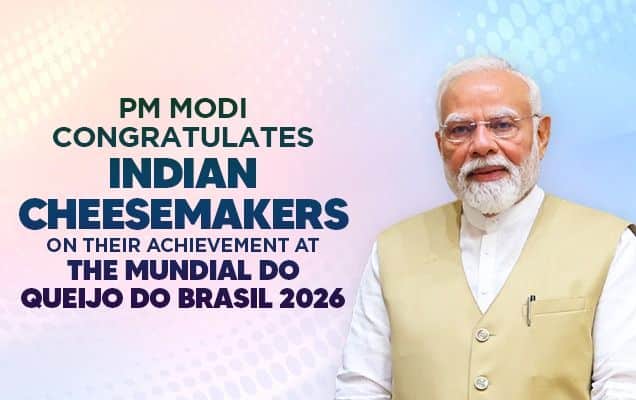
‘Cheese from India makes its mark globally’: PM Modi lauds Indian winners at Mundial do Queijo

Nm on the go
Always be the first to hear from the PM. Get the App Now!

Social Media Corner 23rd April 2026
April 23, 2026
-
Share
-
-
-
Inclusive Innovation: Empowering Every Citizen in the New India Under the Leadership of PM Modi
PM Modi's reforms shine: India's agriculture exports touch USD 52.55 billion in FY26, up 2.8% YoY. Strong performance in fruits, pulses & value-added items—celebrating our farmers' success on the global stagehttps://t.co/My5Culup8p
— Muskan Aggarwal (@AggarwalMahi586) April 23, 2026
Kudos PM @narendramodi Ji biofuel & agri sector reform vision
— Zahid Patka (Modi Ka Parivar) (@zahidpatka) April 23, 2026
Govt overhauls six-decade-old sugarcane law; with modern framework bringing ethanol production, digital systems &,cane value chain under one policy
Seeks comments on draft by May 20https://t.co/uhlvDMSQ2p@PMOIndia pic.twitter.com/WZNSrBNHDG
PM Modi's humble 'Jhalmuri' moment in Jhargram melts hearts,Amid scorching summer, he connects deeply with people of Bengal by enjoying the iconic local snack. True leader who speaks the language of the common man. #ModiInBengal pic.twitter.com/mDhQQvg5WK
— Sajan (@HeySajan) April 23, 2026
Smartphones lead India’s electronics exports to a record $47.96 billion in FY26, up 24%. Strong demand from the US and success of PLI & Make in India show how PM Modi’s policies are turning India into a global manufacturing hub. pic.twitter.com/hOpDfW174f
— Jay Singh (@ajay_janghu7700) April 23, 2026
Kudos PM Modi ji for celebrating India's cheese victory! Four medals at Mundial do Queijo 2026—Super Gold for Brie-style, Golds for Yak Churpi & Whey Cheese. Artisanal excellence from remote India reaches international heightshttps://t.co/0nniAW2UNi
— Shrayesh (@shrayesh65) April 23, 2026
PM Modi's vision in AI,is on transforming 🇮🇳 frm a technology consumer 2a global leader in Defence AI @DRDO_India's indigenous AI-powerd satellite imaging systm,Prajna,enables real-time intelligence,advancd technology&self-reliance wrk 2strengthen security,anti terror operation pic.twitter.com/9AaLnZ0phN
— Rukmani Varma 🇮🇳 (@pointponder) April 23, 2026
Salute PM @narendramodi ji for this historic initiative, Sacred relics of Lord Buddha, preserved in National Museum Delhi, will go public for the first time—May 1-15. Strengthening cultural unity & global peace. #ViksitBharat pic.twitter.com/xw9xAceBv3
— Harshit (@Harshit80048226) April 23, 2026
Heartfelt praise for PM @narendramodi
— Manika Rawat (@manikarawa46306) April 23, 2026
Atal Pension Yojana crosses 9 crore mark with 1.35 crore enrolments in FY26. Delivering guaranteed pension to unorganised sector—Modi ji’s policies bring dignity & financial security in old age#APY pic.twitter.com/g1TCWxTXpM
PM @narendramodi ji is connecting every region with development, First Amul milk freight train dispatched to Jammu & Kashmir will bring fresh dairy products faster and cheaper. This initiative strengthens food security and economic integration in the Valley. pic.twitter.com/iZyjsqwEsU
— Amit prajapati (@amitwork9999) April 23, 2026
Green revolution on tracks! Under PM @narendramodi
— Rohit (@Rohitsin298) April 23, 2026
ji’s visionary leadership, Indian Railways planted 81.59 lakh trees in 2025-26 across all zones. This massive afforestation drive is reducing carbon footprint and making rail travel cleaner & greener. Thank you Modi ji. pic.twitter.com/N0RLRtaqoa


Posted via www.narendramodi.in