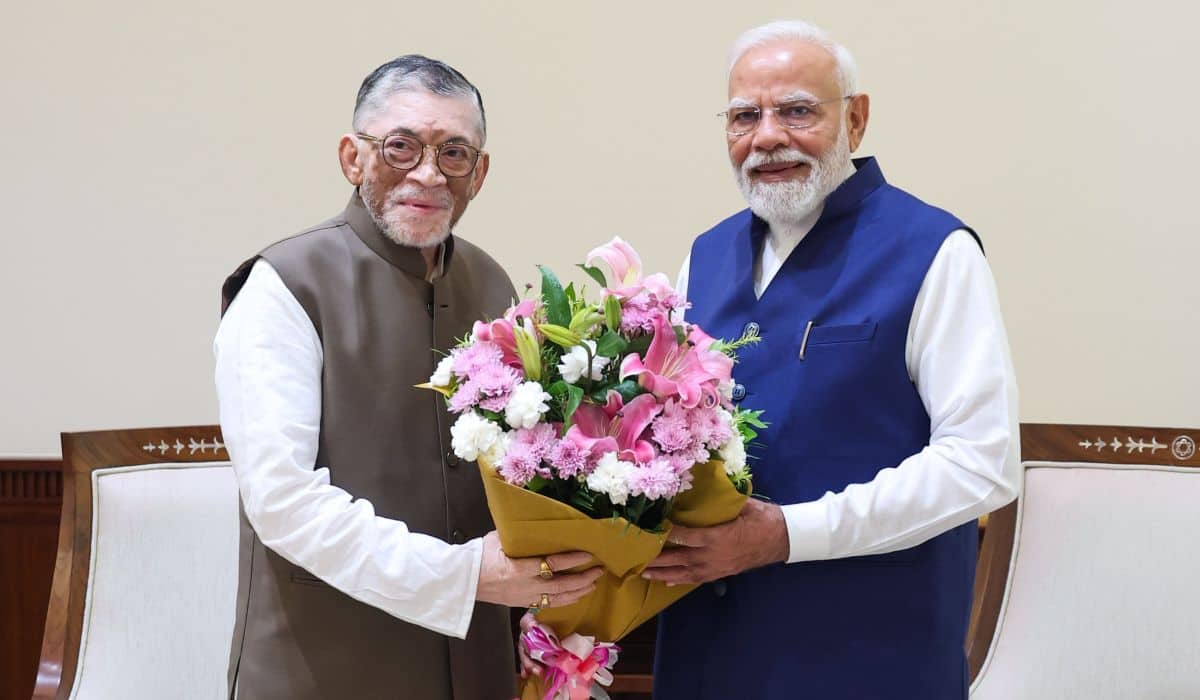
President of the United Arab Emirates, His Highness Sheikh Mohamed bin Zayed Al Nahyan and Prime Minister of India Shri Narendra Modi met in Abu Dhabi on February 13, 2024. President His Highness Sheikh Mohamed bin Zayed Al Nahyan welcomed Prime Minister Narendra Modi to the UAE and expressed his appreciation for accepting the invitation to speak at the World Government Summit 2024 in Dubai on February 14, 2024.
The two leaders underlined that this was the seventh visit of Prime Minister Shri Narendra Modi to the UAE in the last nine years. The Prime Minister last visited the UAE on December 1, 2023, to participate in the UNFCCC COP28 conference in Dubai, where he met with UAE President His Highness Sheikh Mohamed bin Zayed Al Nahyan on the sidelines. During that visit, India applauded the COP28 presidency for guiding the "COP for Action” and arriving at "The UAE Consensus.” The Prime Minister participated in the COP28 Presidency’s Session on "Transforming Climate Finance”, and together with the UAE President, co-hosted the high-level event on the ‘Green Credits Programme’ on the sidelines of Summit. The leaders also highlighted the four visits of President His Highness Sheikh Mohamed bin Zayed Al Nahyan to India over the past eight years, the latest of which was on January 9-10, 2024, to attend the 10th edition of the Vibrant Gujarat Global Summit, as Chief Guest, and during which he witnessed the exchange of several Memorandums of Understanding on Investment Cooperation, along with Prime Minister Shri Narendra Modi.
The two leaders discussed the India-UAE bilateral relationship, which was formally elevated to a Comprehensive Strategic Partnership during the visit of His Highness Sheikh Mohamed bin Zayed Al Nahyan to India in 2017. They expressed satisfaction on the progress achieved in various sectors, noting that the partnership between the two countries has been significantly expanding over the years.
President His Highness Sheikh Mohamed bin Zayed Al Nahyan, and Prime Minister Shri Narendra Modi witnessed the exchange of the following:
I. Bilateral Investment Treaty
II. Inter-Governmental Framework Agreement on the India-Middle East-Europe Economic Corridor (IMEEC)
III. Memorandum of Understanding for cooperation on Digital Infrastructure Projects
IV. Memorandum of Understanding in the field of Electricity Interconnection and Trade.
V. Memorandum of Understanding for cooperation with the National Maritime Heritage Complex, Lothal at Gujarat.
VI. Cooperation Protocol between the National Library and Archives of the UAE and the National Archives of India.
VII. Agreement on interlinking of the instant payment platforms – UPI (India) and AANI (UAE).
VIII. Agreement on inter-linking domestic debit/credit cards - RuPay (India) with JAYWAN (UAE).
Ahead of the visit , RITES Limited signed agreement with Abu Dhabi Ports Company and Gujarat Maritime Board with Abu Dhabi Ports Company. These would help in building port infrastructure and further enhance connectivity between the two countries.
The two leaders endorsed the efforts from both sides to strengthen the strong economic and commercial cooperation and explore new areas of collaboration. They welcomed the strong growth witnessed in the UAE-India trade relations since the entry into force of the Comprehensive Economic Partnership Agreement (CEPA) on May 1, 2022. As a result, the UAE is India’s third-largest trading partner for the year 2022-23 and India’s second-largest export destination. India is the UAE’s second largest trading partner, with the bilateral trade rising to USD 85 billion in 2022-23. In this regard, the leaders expressed optimism regarding elevating the bilateral trade to USD 100 billion well ahead of the target year 2030. The two leaders also acknowledged the formal unveiling of the UAE-India CEPA Council (UICC), which stands as an important development in the bilateral trade partnership.
The leaders noted that the Bilateral Investment Treaty will be a key enabler for further promoting investments in both countries across sectors. The UAE was also the fourth largest investor in India in 2023 and the seventh largest source of Foreign Direct Investment overall. They highlighted that India has signed both the Bilateral Investment Treaty and a Comprehensive Economic Partnership Agreement with the UAE, reflecting the uniqueness and depth of the bilateral economic engagement between the two countries.
The leaders underscored the importance of a well-functioning and equitable multilateral trading system in fostering global economic prosperity and resilience, and stressed the importance for the 13th WTO Ministerial Conference, taking place in Abu Dhabi from 26 to 29 February 2024, to achieve a meaningful outcome that serves the interests of all WTO Members and strengthens the rules-based trade order.
The leaders welcomed the decision to create Bharat Mart at Jebel Ali, which will further promote bilateral trade and serve as a platform for enhancing the utilization of CEPA by leveraging the strategic location of Jebel Ali port. They noted that Bharat Mart would support micro, small and medium sector enterprises from India by providing them an effective platform to reach out to international buyers and promote their products across Middle East, Africa, and Eurasia.
The leaders appreciated the deepening of economic engagement in the financial sector. Prime Minister Shri Narendra Modi congratulated His Highness Sheikh Mohamed bin Zayed Al Nahyan for the launch of the UAE’s domestic card scheme JAYWAN, leveraging on the digital RuPay stack shared by the National Payments Corporation of India (NPCI) with the Central Bank of the UAE. They also welcomed the Agreement on interlinking the national payment platforms – UPI (India) and AANI (UAE), which will facilitate seamless cross-border transactions between the two countries.
The two leaders discussed ways to enhance their bilateral partnership in the energy sector, which includes oil, gas, and renewable energy. They acknowledged the recent signing of two new long-term LNG supply agreements between ADNOC Gas and Indian Oil Corporation Ltd and Gas Authority of India Ltd (GAIL) for 1.2 MMTPA and 0.5 MMTPA, respectively. These agreements mark the beginning of a new era in the energy partnership between the two countries, and both leaders encouraged the companies to explore more such opportunities. Furthermore, the two sides agreed to advance their cooperation in hydrogen, solar energy, and grid connectivity.
The leaders acknowledged that the Memorandum of Understanding in the field of Electricity Interconnection and Trade signed today opens a new area of energy cooperation between the two countries, which will also bring to life the Green Grids – One Sun One World One Grid (OSOWOG) initiative launched during by Prime Minister Shri Narendra Modi during COP26. . They expressed confidence that the MoU would further boost energy cooperation and connectivity between both countries.
Prime Minister Shri Narendra Modi thanked President His Highness Sheikh Mohamed bin Zayed Al Nahyan for his personal support and for his graciousness in granting the land for the construction of the BAPS Temple in Abu Dhabi. Both sides noted that the BAPS Temple is a celebration of UAE-India friendship, deep-rooted cultural bonds uniting the two nations, and also an embodiment of the UAE’s global commitment to harmony, tolerance and peaceful coexistence.
Both leaders noted that the cooperation protocol between the National Archives of the two countries and the MoU for cooperation with National Maritime Heritage Complex at Lothal, Gujarat will help in restoring the centuries old roots of India-UAE relationship and preserving the treasures of shared history.
The two leaders appreciated the commencement of the first Master’s program in Energy Transition and Sustainability by the Indian Institute of Technology (IIT) Delhi in Abu Dhabi, the first IIT in the Middle East. They reiterated the shared commitment of both countries for cooperation in education and research with a focus on advanced technologies, Artificial Intelligence, and sustainable energy.
The two leaders reviewed the progress of establishing the UAE-India Culture Council Forum and the membership of the council from both sides. The two leaders also emphasized the role of cultural and knowledge diplomacy in shaping a deeper mutual understanding that benefits both nations.
The leaders welcomed the MoU for creation of an intergovernmental framework between India and UAE on the India-Middle East-Europe Economic Corridor IMEEC, which reflected the lead taken by the UAE and India in furthering regional connectivity. The main elements of the Framework include development and management of a logistics platform, including a digital ecosystem, and provision of supply chain services to handle all types of general cargo, bulk, containers and liquid bulk in order to enable IMEEC. This will be the first agreement under the IMEEC initiative, launched on the side-lines of G20 Leaders’ Summit in New Delhi.
The leaders welcomed the MoU to jointly explore, assess and evaluate investment cooperation in the digital infrastructure sector. This MoU was signed by the Ministry of Investment of the UAE and the Ministry of Electronics & Information Technology of the Republic of India and focuses on creating strong and effective collaboration by building relationships between public and private organisations in the UAE and India. It aims to explore and evaluate the possibility of establishing a supercomputer cluster in India and data centre projects in India.
Prime Minister Shri Narendra Modi thanked President His Highness Sheikh Mohamed bin Zayed Al Nahyan for the warm hospitality extended to him and the Indian delegation.