Prime Minister Shri Narendra Modi participated in the Grand Finale marking the culmination of ‘Ujjwal Bharat Ujjwal Bhavishya – Power @2047’ today via video conferencing. During the programme, he launched the Revamped Distribution Sector Scheme. He also dedicated and laid the foundation stone of various green energy projects of NTPC. He launched the National Solar rooftop portal.
The Prime Minister interacted with the beneficiaries of various schemes. Shri Hansraj from Mandi informed the Prime Minister about his experience with the KUSUM scheme. The Prime Minister enquired how other farmers are getting interested in the scheme. Shri Hansraj also thanked the Prime Minister for the scheme and elaborated on how this scheme helped him and his family.
Shri Kalaha Reang from Khowai, Tripura informed the Prime Minister about the changes brought about by the arrival of electricity in his village. He informed that after Solar Power, dependence on kerosene has reduced. The Prime Minister further asked about other changes brought in by the arrival of electricity. Shri Reang said that now they are able to charge the mobile phones for which they used to travel long distances. Solar power has improved the education of children, and local industries and evening life has undergone a change. The Prime Minister asked him to utilize educational tv channels run by the government on TV. The Prime Minister also asked him to save electricity.

Shri Kagu Kranti Kumar of Visakhapatnam, a beneficiary of Deendayal Upadhyaya Gram Jyoti Yojna, also detailed the positive impact of electricity in his life. The Prime Minister said that the country will progress only when every citizen progresses and expressed satisfaction that facilities of electricity are reaching all the villages of the country.
Smt Pramila Devi of Varanasi, a beneficiary of the Integrated Power Development Scheme was greeted by Har Har Mahadev by the Prime Minister. The Prime Minister, a Member of Parliament from Varanasi, asked her to pay respect to Baba Vishwanath on his behalf. The Prime Minister also expressed happiness that overhead wires are gradually being phased out leading to better safety and aesthetic outcomes.
Shri Dhiren Sureshbahi Patel from Ahmedabad talked about his experience installing solar panels. The Prime Minister said that by installing rooftop panels Dhirenbhai became an electricity seller. The Prime Minister said that in the last year many steps have been taken to ensure a confident position of the country in the energy sector by 2047. He said people’s participation has been the greatest strength in this regard.
Addressing the gathering, the Prime Minister said Energy and power sectors have a huge role to play in accelerating India's progress in the next 25 years. The strength of the energy sector is also important for Ease of Doing Business and is equally important for Ease of Living. He said that the projects launched today are significant steps in the direction of green energy and energy security for the county. These projects will strengthen India’s renewable energy goals, commitment and aspirations of its green mobility, he said. The Prime Minister announced that work on two big green hydrogen projects in Ladakh and Gujarat is starting today. The plant being set up in Ladakh will produce green hydrogen for vehicles in the country. This will be the first project in the country which will make commercial use of green hydrogen-based transport possible. Ladakh very soon will be the first place in the country where fuel cell electric vehicles will start to ply. This will help in making Ladakh a carbon-neutral region, he said.

The Prime Minister also informed that after blending ethanol in petrol and aviation fuel, now the country is moving towards blending green hydrogen in piped natural gas pipelines. Which will reduce import dependence on natural gas.
Remembering the poor state of power scenario before 2014, The Prime Minister reminded that eight years ago, the Government took the initiative to transform every part of the country's power sector. Four different directions were worked together to improve the power system - Generation, Transmission, Distribution and Connection.
The Prime Minister informed that in the last 8 years, about 1,70,000 MW of electricity generation capacity has been added in the country. One Nation One Power Grid has become the strength of the country today. About 1,70,000 circuit kilometre transmission lines have been laid to connect the entire country. Furthermore, by giving 3 crore connections under the Saubhagya Scheme, we are also nearing the saturation goal, he added.
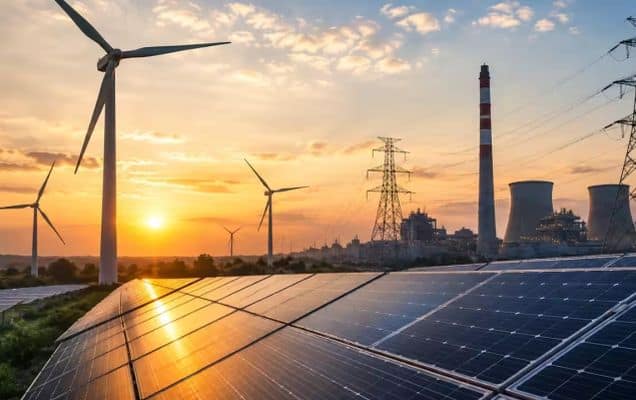
The Prime Minister said ‘we had resolved to create 175 GW of renewable energy capacity by the completion of 75 years of independence. Today we have come close to this goal. So far, about 170 GW capacity has been installed from non-fossil sources. He added that today, India is in the top 4-5 countries of the world in terms of installed solar capacity. Many of the world's largest solar power plants are in India today. The country has got two more big solar plants today. These plants built in Telangana and Kerala are the first and second largest floating solar plants in the country. The Prime Minister said that solar panels are being encouraged in households.

The Prime Minister said that along with increasing the production of electricity, the emphasis of the government is also on saving electricity. “Saving electricity means enriching the future. PM Kusum Yojana is a great example of this. We are providing solar pump facility to farmers, helping to install solar panels on the side of the fields”, he said.
The Prime Minister said that the UJALA scheme has also played a big role in reducing electricity consumption and bills in the country. Every year 50 thousand crore rupees are saved from the electricity bills of poor and middle-class households.
The Prime Minister noted that with the passage of time, a serious disorder has come into our politics. In politics, people should have the courage, to tell the truth, but we see that some states try to avoid it. This strategy may sound like good politics in the short term. But it is like postponing today's truth, today's challenges, for tomorrow, for our children, and for our future generations. This thinking of avoiding solutions to today's problems and leaving them for the future is not good for the country, he said. This thought process has pushed the power sector in many states into huge problems.
The Prime Minister said losses in our distribution sector are in double digits. Whereas in the developed countries of the world it is in single digit. This means that we have a lot of wastage of electricity and therefore we have to generate more electricity than we need to meet the demand for electricity. He said there is a lack of investment in reducing distribution and transmission losses in many states. The Prime Minister remarked that people will be surprised to know that different states have outstanding dues of more than Rs 1 lakh crore. They have to give this money to power generation companies. Power distribution companies are owed more than 60 thousand crore rupees from many government departments, and local bodies. He said that these companies are not able to get even the money that has been committed for subsidy on electricity in different states on time and in full. This arrear is also more than Rs 75,000 crore. Those responsible for activities ranging from the generation of electricity to the door-to-door delivery, their about two and a half lakh crore rupees are trapped.
The Prime Minister requested the states whose dues are pending, to clear them as soon as possible. Also, honestly consider the reasons that even when the countrymen pay their electricity bills honestly, why do some states have arrears again and again? He said this is not a matter of ‘Rajniti’ (politics) but pertains to 'Rashtra Niti’ and nation building, he said
He ended by reminding the stakeholders that the health of the electricity sector is everyone’s responsibility .

Background
Under the leadership of the Prime Minister, the government has taken multiple path-breaking initiatives in the power sector. These reforms have transformed the sector, with the focus being on making affordable power available for all. Electrification of about 18,000 villages which did not have access to power earlier signified the commitment of the government towards ensuring last mile outreach.
The Ministry of Power’s flagship Revamped Distribution Sector Scheme is aimed at improving the operational efficiencies and financial sustainability of the DISCOMs and Power Departments. With an outlay of over Rs. 3 lakh crore over a period of five years from FY 2021-22 to FY 2025-26, the scheme aims to provide financial assistance to DISCOMs for modernization and strengthening of distribution infrastructure, focussing on the improvement of the reliability and quality of supply to end consumers. It also aims to reduce the AT&C (Aggregate Technical and Commercial) losses to pan-India levels of 12-15% and the ACS-ARR (Average Cost of Supply-Average Revenue Realized) gap to zero by 2024-25 by improving the operational efficiencies and financial sustainability of all state-sector DISCOMs and Power Departments.
During the programme, the Prime Minister also dedicated and laid the foundation stone of various green energy projects of NTPC worth over Rs 5200 crore. He inaugurated the 100 MW Ramagundam Floating Solar Project in Telangana and the 92 MW Kayamkulam Floating Solar Project in Kerala. He laid the foundation stone of the 735 MW Nokh Solar Project in Rajasthan, Green Hydrogen Mobility Project in Leh and Kawas Green Hydrogen Blending with Natural Gas project in Gujarat.
The Ramagundam project is India’s largest floating solar PV project with 4.5 lakh ‘Made in India’ solar PV modules. Kayamkulam project is the second largest floating solar PV project consisting of 3 lakh ‘Made in India’ solar PV panels floating on water.
The 735 MW Solar PV Project at Nokh, in Jaisalmer, Rajasthan is India’s largest Domestic Content Requirement based Solar project with 1000 MWp at a single location, deploying high-wattage bifacial PV Modules with a tracker system. The Green Hydrogen Mobility Project at Leh, Ladakh is a pilot project and aims for five Fuel Cell Buses to be run in and around Leh. This pilot project would be the first deployment of Fuel Cell Electric Vehicles for public use in India. The Green Hydrogen Blending Pilot Project at NTPC Kawas Township will be India’s first Green Hydrogen Blending Project helping in reducing the usage of natural gas.
The Prime Minister also launched a national solar rooftop portal, which will enable online tracking of the process of installation of rooftop solar plants, starting from registering the applications to release of subsidies in residential consumers’ bank accounts after installation and inspection of the plant.
‘Ujjwal Bharat Ujjwal Bhavishya – Power @2047’ is taking place from 25th to 30th July, as part of the ongoing ‘Azadi Ka Amrit Mahotsav’. Organised across the country, it showcases the transformation in the power sector achieved in the last eight years. It aims to empower citizens by improving their awareness and participation in various power-related initiatives, schemes and programmes of government.
अगले 25 वर्षों में भारत की प्रगति को गति देने में एनर्जी सेक्टर, पावर सेक्टर की बहुत बड़ी भूमिका है।
— PMO India (@PMOIndia) July 30, 2022
एनर्जी सेक्टर की मजबूती Ease of Doing Business के लिए भी जरूरी है और Ease of Living के लिए भी उतनी ही अहम है: PM @narendramodi
लद्दाख और गुजरात में ग्रीन हाइड्रोजन के दो बड़े projects पर आज से काम शुरु हो रहा है।
— PMO India (@PMOIndia) July 30, 2022
लद्दाख में लग रहा प्लांट देश में गाड़ियों के लिए ग्रीन हाईड्रोजन का उत्पादन करेगा।
ये देश का पहला project होगा जो ग्रीन हाइड्रोजन आधारित ट्रांसपोर्ट के कमर्शियल इस्तेमाल को संभव बनाएगा: PM
8 साल पहले हमने देश के पावर सेक्टर के हर अंग को ट्रांसफॉर्म करने का बीड़ा उठाया।
— PMO India (@PMOIndia) July 30, 2022
बिजली व्यवस्था सुधारने के लिए चार अलग-अलग दिशाओं में एक साथ काम किया गया- Generation, Transmission, Distribution और Connection: PM @narendramodi
पिछले 8 वर्षों में देश में लगभग 1 लाख 70 हज़ार मेगावाट बिजली उत्पादन की क्षमता जोड़ी गई है।
— PMO India (@PMOIndia) July 30, 2022
वन नेशन वन पावर ग्रिड आज देश की ताकत बन चुका है।
पूरे देश को जोड़ने के लिए लगभग 1 लाख 70 हज़ार सर्किट किलोमीटर ट्रांसमिशन लाइन्स बिछाई गईं हैं: PM @narendramodi
हमने आज़ादी के 75 साल पूरे होने तक 175 गीगावॉट रीन्युएबल एनर्जी कैपेसिटी तैयार करने का संकल्प लिया था।
— PMO India (@PMOIndia) July 30, 2022
आज हम इस लक्ष्य के करीब पहुँच चुके हैं।
अभी तक non fossil sources से लगभग 170 गीगावॉट कैपेसिटी install की जा चुकी है: PM @narendramodi
इसी कड़ी में आज दो और बड़े सोलर प्लांट्स देश को मिले हैं।
— PMO India (@PMOIndia) July 30, 2022
तेलंगाना और केरला में बने ये प्लांट्स देश के पहले और दूसरे नंबर के सबसे बड़े फ्लोटिंग सोलर प्लांट्स हैं: PM @narendramodi
आज installed solar capacity के मामले में भारत, दुनिया के टॉप 4-5 देशों में है।
— PMO India (@PMOIndia) July 30, 2022
दुनिया के सबसे बड़े सोलर पावर प्लांट्स में से अनेक आज भारत में हैं: PM @narendramodi
सरकार का जोर बिजली का उत्पादन बढ़ाने के साथ ही, बिजली की बचत करने पर भी है।
— PMO India (@PMOIndia) July 30, 2022
बिजली बचाना यानि भविष्य सजाना।
पीएम कुसुम योजना इसका एक बेहतरीन उदाहरण है।
हम किसानों को सोलर पंप की सुविधा दे रहे हैं, खेतों के किनारे सोलर पैनल लगाने में मदद कर रहे हैं: PM @narendramodi
ये रणनीति तात्कालिक रूप से अच्छी राजनीति लग सकती है।
— PMO India (@PMOIndia) July 30, 2022
लेकिन ये आज के सच को, आज की चुनौतियों को, कल के लिए, अपने बच्चों के लिए, अपनी भावी पीढ़ियों के लिए टालने जैसा है: PM @narendramodi
समय के साथ हमारी राजनीति में एक गंभीर विकार आता गया है।
— PMO India (@PMOIndia) July 30, 2022
राजनीति में जनता को सच बताने का साहस होना चाहिए, लेकिन हम देखतें हैं कि कुछ राज्यों में इससे बचने की कोशिश होती है: PM @narendramodi
हमारे Distribution Sector के Losses डबल डिजिट में हैं। जबकि दुनिया के विकसित देशों में ये सिंगल डिजिट में है।
— PMO India (@PMOIndia) July 30, 2022
इसका मतलब ये है कि हमारे यहां बिजली की बर्बादी बहुत है और इसलिए बिजली की डिमांड पूरी करने के लिए हमें ज़रूरत से कहीं अधिक बिजली पैदा करनी पड़ती है: PM @narendramodi
देश को ये जानकर हैरानी होगी कि अलग-अलग राज्यों का 1 लाख करोड़ रुपए से अधिक का बकाया है।
— PMO India (@PMOIndia) July 30, 2022
ये पैसा उन्हें पावर जेनरेशन कंपनियों को देना है।
पावर डिस्ट्रिब्यूशन कंपनियों का अनेक सरकारी विभागों पर, स्थानीय निकायों पर भी 60 हज़ार करोड़ रुपए से अधिक बकाया है: PM @narendramodi
अलग-अलग राज्यों में बिजली पर सब्सिडी का जो कमिटमेंट किया गया है, वो पैसा भी इन कंपनियों को समय पर और पूरा नहीं मिल पाता।
— PMO India (@PMOIndia) July 30, 2022
ये बकाया भी 75 हज़ार करोड़ रुपए से अधिक का है।
यानि बिजली बनाने से लेकर घर-घर पहुंचाने तक का ज़िम्मा जिनका है, उनका लगभग ढाई लाख करोड़ रुपए फंसा हुआ है: PM
जिन राज्यों के dues pending हैं, मेरा उनसे आग्रह है कि वे जितना जल्दी संभव हो सके, क्लीयर करें।
— PMO India (@PMOIndia) July 30, 2022
साथ ही उन कारणों पर भी ईमानदारी से विचार करें कि जब देशवासी ईमानदारी से अपना बिजली का बिल चुकाते हैं, तब भी कुछ राज्यों का बार-बार बकाया क्यों रहता है? - PM @narendramodi