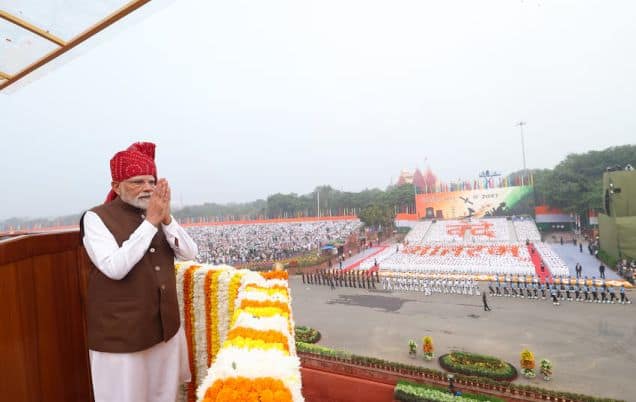
PM in Katra

Published By : Admin | April 19, 2016 | 16:40 IST
PM Modi visits Katra, inaugurates Shri Mata Vaishno Devi Narayana Super Speciality Hospital
PM Modi addresses convocation ceremony of Shri Mata Vaishno Devi University
PM Modi inaugurates Shri Mata Vaishno Devi Shrine Board Sports Complex
Sports is extremely important to build sportsman spirit in society: PM Modi

The Prime Minister, Shri Narendra Modi, visited Katra, in Jammu and Kashmir today.

He inaugurated the Shri Mata Vaishno Devi Narayana Super Speciality Hospital, and delivered the Convocation Address at the Shri Mata Vaishno Devi University.


The Prime Minister exhorted the students to always remember that one of the sources of funding for this University, was the donation made by poor pilgrims at the shrine of Mata Vaishno Devi. He said that the students should also take a pledge to do something for the poor.

He said that the nation is scaling new heights, and with a youthful population, there is a lot that can be achieved. He said the 21st century is the century of knowledge, and whenever there has been an era of knowledge, India has shown the way.

The Prime Minister appreciated the girl students for performing exceedingly well academically. He also recalled the feat of Dipa Karmakar, who has become the first Indian woman to qualify for an Olympics gymnastics competition.

The Prime Minister later inaugurated the Shri Mata Vaishno Devi Shrine Board Sports Complex, and addressed a public meeting. He appreciated the Chief Minister of Jammu and Kashmir, Ms. Mehbooba Mufti, for her energetic leadership, and for the enthusiasm with which she spoke of the future of the State of Jammu and Kashmir. He also recalled the former Chief Minister of the State, Shri Mufti Mohammad Sayeed.

Referring to the Sports Complex, he said that sports is extremely important to build sportsman spirit in society. He also mentioned the FIFA Under-17 World Cup that will be hosted by India in 2017, and said this should be an opportunity for us to celebrate sports.

The Prime Minister recalled Shri Atal Bihari’s vision for Jammu and Kashmir – Insaniyat, Jamhooriyat, and Kashmiriyat. He said that every effort would be made to work towards the development of the State, keeping in mind this vision.

Explore More
شری رام جنم بھومی مندر دھوجاروہن اتسو کے دوران وزیر اعظم کی تقریر کا متن

Popular Speeches

شری رام جنم بھومی مندر دھوجاروہن اتسو کے دوران وزیر اعظم کی تقریر کا متن
Regional languages take precedence in Lok Sabha addresses

Media Coverage

Regional languages take precedence in Lok Sabha addresses
NM on the go

Nm on the go

Always be the first to hear from the PM. Get the App Now!
...
Cabinet approves three new corridors as part of Delhi Metro’s Phase V (A) Project
December 24, 2025

The Union Cabinet chaired by the Prime Minister, Shri Narendra Modi has approved three new corridors - 1. R.K Ashram Marg to Indraprastha (9.913 Kms), 2. Aerocity to IGD Airport T-1 (2.263 kms) 3. Tughlakabad to Kalindi Kunj (3.9 kms) as part of Delhi Metro’s Phase – V(A) project consisting of 16.076 kms which will further enhance connectivity within the national capital. Total project cost of Delhi Metro’s Phase – V(A) project is Rs.12014.91 crore, which will be sourced from Government of India, Government of Delhi, and international funding agencies.

The Central Vista corridor will provide connectivity to all the Kartavya Bhawans thereby providing door step connectivity to the office goers and visitors in this area. With this connectivity around 60,000 office goers and 2 lakh visitors will get benefitted on daily basis. These corridors will further reduce pollution and usage of fossil fuels enhancing ease of living.

Details:

The RK Ashram Marg – Indraprastha section will be an extension of the Botanical Garden-R.K. Ashram Marg corridor. It will provide Metro connectivity to the Central Vista area, which is currently under redevelopment. The Aerocity – IGD Airport Terminal 1 and Tughlakabad – Kalindi Kunj sections will be an extension of the Aerocity-Tughlakabad corridor and will boost connectivity of the airport with the southern parts of the national capital in areas such as Tughlakabad, Saket, Kalindi Kunj etc. These extensions will comprise of 13 stations. Out of these 10 stations will be underground and 03 stations will be elevated.

After completion, the corridor-1 namely R.K Ashram Marg to Indraprastha (9.913 Kms), will improve the connectivity of West, North and old Delhi with Central Delhi and the other two corridors namely Aerocity to IGD Airport T-1 (2.263 kms) and Tughlakabad to Kalindi Kunj (3.9 kms) corridors will connect south Delhi with the domestic Airport Terminal-1 via Saket, Chattarpur etc which will tremendously boost connectivity within National Capital.

These metro extensions of the Phase – V (A) project will expand the reach of Delhi Metro network in Central Delhi and Domestic Airport thereby further boosting the economy. These extensions of the Magenta Line and Golden Line will reduce congestion on the roads; thus, will help in reducing the pollution caused by motor vehicles.

The stations, which shall come up on the RK Ashram Marg - Indraprastha section are: R.K Ashram Marg, Shivaji Stadium, Central Secretariat, Kartavya Bhawan, India Gate, War Memorial - High Court, Baroda House, Bharat Mandapam, and Indraprastha.

The stations on the Tughlakabad – Kalindi Kunj section will be Sarita Vihar Depot, Madanpur Khadar, and Kalindi Kunj, while the Aerocity station will be connected further with the IGD T-1 station.

Construction of Phase-IV consisting of 111 km and 83 stations are underway, and as of today, about 80.43% of civil construction of Phase-IV (3 Priority) corridors has been completed. The Phase-IV (3 Priority) corridors are likely to be completed in stages by December 2026.

Today, the Delhi Metro caters to an average of 65 lakh passenger journeys per day. The maximum passenger journey recorded so far is 81.87 lakh on August 08, 2025. Delhi Metro has become the lifeline of the city by setting the epitome of excellence in the core parameters of MRTS, i.e. punctuality, reliability, and safety.

A total of 12 metro lines of about 395 km with 289 stations are being operated by DMRC in Delhi and NCR at present. Today, Delhi Metro has the largest Metro network in India and is also one of the largest Metros in the world.