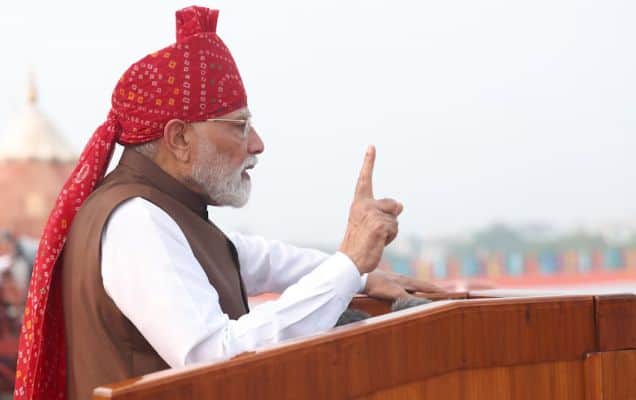
PM chairs Combined Commanders Conference on board INS Vikramaditya at Sea

Published By : Admin | December 15, 2015 | 16:00 IST
PM Narendra Modi presides over Combined Commanders' Conference on board INS Vikramaditya
PM Modi inspects Tri-services Guard of Honour at INS Garuda at Kochi
PM Modi witnesses an operational demonstration of India’s naval and maritime air capabilities
PM Narendra Modi interatcs with soldiers, sailors and airmen on board INS Vikramaditya
Kochi is at the head of the Indian Ocean and at the crossroads of our maritime history: PM Modi
INS Vikramaditya is the instrument of our maritime power and a symbol of our maritime responsibility: PM Modi
Indian Armed Forces are known not just for power they represent, but by the maturity & responsibility with which they wield it: PM
Our forces reflect our nation’s diversity & unity. They embody timeless culture of India & finest tradition of our military: PM
India is at an exciting moment of change. There is a new level of international confidence and interest in India: PM
Our factories are humming with activity again. We are building next-gen infrastructure at higher pace & with an eye to the future: PM
Across the world, India is seen not just as a new bright spot of the global economy: PM Narendra Modi
Armed Forces will be crucial to the success of #MakeInIndia Mission: PM
We need forces that are agile, mobile and driven by technology, not just human valour, says Prime Minister Modi

The Prime Minister, Shri Narendra Modi, today chaired the Combined Commanders Conference on board INS Vikramaditya at Sea, off the coast of Kochi.

This is the first time that the Combined Commanders Conference has been held on board an aircraft carrier.

The Prime Minister inspected a Tri-services Guard of Honour this morning at INS Garuda at Kochi, before arriving on board INS Vikramaditya, where he was received by the three Service Chiefs.

After the Conference, the Prime Minister witnessed an operational demonstration of India’s naval and maritime air capabilities. The operational demonstration included take-offs and landings of naval fighter aircraft from INS Vikramaditya, missile firing from a warship, flypast of helicopters and fighter aircraft, marine commando operations, and steam-past of warships, including INS Virat. The Prime Minister interacted with soldiers, sailors and airmen on board INS Vikramaditya.

Following are extracts of the Prime Minister’s speech:

Raksha Mantri, Shri Manohar Parrikarji,
The Chiefs of the Air Force, Army and Navy,
Our commanders,

It is a great pleasure and privilege to join our military leaders again. I am delighted that we are meeting at a base outside Delhi. 

I am sure you can feel a difference, and not just because of Indian Navy’s hospitality.

Kochi is at the head of the Indian Ocean and at the crossroads of our maritime history.

India’s history has been influenced by the seas. And, the passage to our future prosperity and security also lies on this ocean.

It also holds the key to the fortunes of the world.

This aircraft carrier is the instrument of our maritime power and a symbol of our maritime responsibility.

The Indian Armed Forces have always been known not just for the power they represent, but by the maturity and responsibility with which they wield it.

They defend our seas and protect our borders. They keep our nation secure and our citizens safe.

And, in calamity and conflicts, they do more than just bring relief and hope to our people. They lift the spirit of the nation and win the trust of the world.

In Chennai, you battled the fury of rain and the river to save lives. In Nepal, you served with courage, humility and compassion. And, as in Nepal, in Yemen’s conflict, you held out your hand to every human in distress, not just fellow citizens.

Our forces reflect our nation’s diversity and its unity. They embody the timeless culture of India and the finest tradition of our military. And, their success comes from the leadership that you provide.

Today, I express our nation's gratitude to our military.

I pay homage to those who made the supreme sacrifice, in silence and service, so that India marches ahead. 

Our thoughts are with the soldiers keeping vigil on the harshest frontiers of the world; with their families that say uncertain farewells when they leave home; and, their loved ones who must sometimes bear their coffins.

I know how an officer, in the prime of his youth, feels when he does not make the next grade, not because he was not outstanding or was less deserving, but because the room above was small.

So, to honour your service and uphold your welfare will always be our solemn duty.

For this reason, we have moved with speed to implement the One Rank One Pension promise that had remained unfulfilled for decades. And, we will build the National War Memorial and Museum that you so richly deserve in the heart of our nation’s capital.

We will also improve skills and opportunities for our ex-servicemen, so that when they leave the Service, they can still serve the nation with pride and dignity.

I also pay tribute to our internal security forces. Their valour and sacrifices defeat terrorism in Jammu and Kashmir, reduce the violence of Left Wing Extremism and keep our Northeast more peaceful.

I complement our negotiators for bringing new hope in the long standing Naga problem.

India is at an exciting moment of change. There is a high tide of hope and optimism in the country. There is a new level of international confidence and interest in India. We have become the fastest growing major economy in the world. And, our economy is on a more stable path.

Our factories are humming with activity again. We are building the next generation infrastructure at a higher pace and with an eye to the future. Foreign Investments are rising sharply and so is India’s ranking as a place to do business in.

Every citizen can see a future of opportunities and fulfilled basic needs with confidence. This is important for India’s prosperity, and also our security.

In an inter-dependent world, India’s transformation is closely linked with our international partnerships. And, so is our security.

So, there is new intensity and purpose in our foreign policy. In the East, we have strengthened our traditional partnerships with Japan, Korea and ASEAN. We have made new openings in the region, including with Australia, Mongolia and Pacific Islands.

We have extended our reach in the Indian Ocean Region, and for the first time articulated a clear strategy for our maritime region. We have raised our engagement with Africa to a new level.

We have retraced our ancient links to Central Asia. We have established closer relations and security cooperation in West Asia and Gulf, even as we have revived our close relations with Iran.

Russia has always been a source of strength for us. It remains important for our future, too.

With the United States, we have advanced our partnership in a comprehensive manner, including in defence. Our strategic partnerships in Europe have deepened.

Across the world, India is seen not just as a new bright spot of the global economy. It is also seen as an anchor for regional and global peace, security and stability.

And, as the world seeks to deal with rising threat of terrorism and radicalism, countries across all regions, including in the Islamic world, have reached out to seek cooperation with India.

Above all, it is our neighbourhood that is most critical for our future and for our place in the world.

But, ours is a difficult neighbourhood with the full spectrum of security challenges.

We see terrorism and ceasefire violations; reckless nuclear build up and threats; border transgressions; and, continuing military modernization and expansion. The shadow of West Asian instability is becoming longer. 

Beyond that, our region is marked by uncertain political transitions, weak institutions and internal conflicts. And, major powers have also increased their engagement in our land and maritime neighbourhood.

From Maldives and Sri Lanka in the seas to Nepal and Bhutan in the mountains, we are working to safeguard our interests and our relationships.

The Land Boundary Agreement has boosted our growing relationship and security cooperation with Bangladesh.

We are engaging Pakistan to try and turn the course of history, bring an end to terrorism, build peaceful relations, advance cooperation and promote stability and prosperity in our region.

There are many challenges and barriers on the path. But, the effort is worth it, because the peace dividends are huge and the future of our children is at stake.

So, we will test their intentions to define the path ahead. For this, we have started a new NSA-level dialogue to bring security experts face to face with each other.

But, we will never drop our guard on security and we will continue to judge progress on their commitments on terrorism.

We remain committed to help the great Afghan people build a united, peaceful, prosperous and democratic nation.

We are also pursuing closer relations with China to harness the full potential of our economic partnership. We will aim to address outstanding issues, maintain stability on the border, and develop greater mutual understanding and trust in our overlapping neighbourhood. 

I believe that India and China can engage constructively across the complexity of their relationship as two self-assured and confident nations, aware of their interests and responsibilities.

We will continue to strengthen our defence capabilities and infrastructure, engage our neighbours more closely and strengthen our regional and global partnerships, including in maritime security.

In a world of rapid changes, India faces familiar threats and new ones. Our challenges cover land, sea and air at the same time. It includes the full range, from terrorism to conventional threat to a nuclear environment.

Our responsibilities are no longer confined to our borders and coastlines. They extend to our interests and citizens, spread across a world of widespread and unpredictable risks.

As our world gets transformed, the character of economies change and technology evolves, the nature of conflicts and the objectives of war will also change.

We know that old rivalries can play out in new theatres such as space and cyber. And, new technologies offer us new ways to be more effective against both traditional and new challenges.

So, we in India must be ready for the present and prepare for the future. 

India is confident that our defence forces are prepared to deter and defeat any misadventure.

Our strategic deterrence is robust and reliable, in accordance with our nuclear doctrine, and our political will is clear.

We have speeded up the process of defence procurements. We have approved many long pending acquisitions.

We are taking firm steps to address shortages and cater for replacements.

We are advancing the pace of expansion of border infrastructure and improve the mobility of our forces and equipment. This includes the strategic railways to the border region.

We are transforming defence manufacturing in India through radically new policies and initiatives.

Our public sector is gearing up to the challenge. The private sector has responded with great enthusiasm.

And, foreign defence companies are coming here with ambitious new proposals for Make in India, from fighter jets and helicopters to transport aircraft and UAVs; from avionics to advanced material.

We can never call ourselves a secure nation and a strong military power unless we develop domestic capabilities. This will also reduce capital costs and inventories. In addition, it will be a huge catalyst for industry, employment and economic growth in India.

We will soon reform our procurement policies and process. And, our offsets policy will become a strategic tool for improving our capabilities in defence technologies. Defence technology will now be a national endeavour that taps the potential of all institutions in our country.

Armed Forces will be crucial to the success of Make in India Mission. I am encouraged by your localization plans, especially in the capital intensive Navy and Air Force.

We want to see clear targets and goals on domestic acquisition; more clarity on specifications; and, greater involvement of our forces in innovation, design and development, especially from those who wield the weapons in the field.

Above all, we look to our Armed Forces to prepare for the future. And, it cannot be achieved by doing more of the same, or preparing perspective plans based on outdated doctrines and disconnected from financial realities.

In the course of the past year, I have seen progress, but I also feel that our forces and our government need to do more to reform their beliefs, doctrines, objectives and strategies. We must define our aims and our instruments for the changing world.

At a time when major powers are reducing their forces and rely more on technology, we are still constantly seeking to expand the size of our forces.

Modernisation and expansion of forces at the same time is a difficult and unnecessary goal.

We need forces that are agile, mobile and driven by technology, not just human valour.

We need capabilities to win swift wars, for we will not have the luxury of long drawn battles. We must re-examine our assumptions that keep massive funds locked up in inventories.

As our security horizons and responsibilities extend beyond our shores and borders, we must prepare our forces for range and mobility.

We must fully incorporate the power of digital networks and space assets into our capabilities. Equally, we must be prepared to defend them, for they will be the first targets of our adversaries.

And, networks must be seamless and integrated across agencies and forces, and are precise, clear and quick in response.

We have been slow to reform the structures of our Armed Forces. We should shorten the tooth-to-tail ratio.

And, we should promote jointness across every level of our Armed Forces. We wear different colours, but we serve the same cause and bear the same flag. Jointness at the top is a need that is long overdue.

Senior military leaders must have experience of tri-service commands, experience in technology-driven environment and exposure to the full spectrum of challenges – from terrorism to strategic.

We need military commanders who not only lead brilliantly in the field, but are also thought leaders who guide our forces and security systems into the future.

We should learn from the experience of the others, but we must frame our systems and commands on our own genius. Our National Defence University will be a reality soon.

We also need reforms in senior defence management. It is sad that many defence reform measures proposed in the past have not been implemented. This is an area of priority for me.

We must also have a comprehensive strategy for external defence engagement, to develop our capabilities and fulfill our responsibilities to advance peace and stability, including in our extended maritime region.

We have kept peace in the blue helmet of the UN. And, our forces can be messengers of peace and hope, for example, by taking medical ships to remote island nations, and building relations with other militaries.

In conclusion, to transform our country, every institution must reform itself. Our nation will progress when we all move forward in step.

And, we expect you to lead from the front in expenditure reforms or in clean energy and energy efficiency.

As you reform, we will do our best to meet your needs and keep you prepared.

As our economy grows, we will be able to secure ourselves better.

In turn, India pursues its dreams in the comfort that it is secure in your hands.

Our military leaders,

This is a year of anniversaries of the end of two World Wars and our 1965 conflict.

This is also a year when humanity has come together in the United Nations to combat poverty and climate change.

In the memories of the great tragedies of the past and in our united efforts for a better world, we are reminded of the enduring human story of progress and peril.

And, of the responsibilities that men and women in uniform bear. To serve the cause of peace. To become the sentinels of progress.

I know that our forces live by that creed. For our nation, for our friends, and our world.

And, you will help India rise to its promise and its place in the world.

Thank you.

Explore More
شری رام جنم بھومی مندر دھوجاروہن اتسو کے دوران وزیر اعظم کی تقریر کا متن

Popular Speeches

شری رام جنم بھومی مندر دھوجاروہن اتسو کے دوران وزیر اعظم کی تقریر کا متن
How NPS transformed in 2025: 80% withdrawals, 100% equity, and everything else that made it a future ready retirement planning tool

Media Coverage

How NPS transformed in 2025: 80% withdrawals, 100% equity, and everything else that made it a future ready retirement planning tool
NM on the go

Nm on the go

Always be the first to hear from the PM. Get the App Now!
...
PM Modi inaugurates New Terminal Building of Lokapriya Gopinath Bardoloi International Airport in Guwahati, Assam
December 20, 2025
Modern airports and advanced connectivity infrastructure serve as gateways to new possibilities and new opportunities for any state: PM
Today, Assam and the entire North East are emerging as the new gateway to India's development: PM
The North East will lead India's future growth: PM

Marking a transformative milestone in Assam’s connectivity, economic expansion and global engagement, Prime Minister Shri Narendra Modi inaugurated the New Terminal Building of Lokapriya Gopinath Bardoloi International Airport in Guwahati today. Addressing the gathering on the occasion, Shri Modi said that today marks the festival of development and progress of Assam and the North East. He highlighted that when the light of progress reaches people, every path in life begins to touch new heights. The Prime Minister further remarked that his deep attachment to the land of Assam, the love and affection of its people, and especially the warmth and belongingness of the mothers and sisters of Assam and the Northeast continuously inspire him and strengthen the collective resolve for the development of the region. He highlighted that today once again a new chapter is being added in Assam’s development. Referring to Bharat Ratna Bhupen Hazarika’s lines, Shri Modi emphasized that this means the banks of the mighty Brahmaputra river will shine, every wall of darkness will be broken, and this will certainly happen as it is the nation’s resolve and solemn pledge.

Highlighting that Bhupen Hazarika’s lines were not merely a song but a solemn resolve of every great soul who loved Assam, and today this resolve is being fulfilled, Shri Modi remarked that just as the mighty currents of the Brahmaputra never stop, similarly under their governments at the Union and State, the stream of development in Assam continues uninterrupted. He stated that the inauguration of the new terminal at the Lokapriya Gopinath Bardoloi Airport stands as proof of this commitment, and extended congratulations to the people of Assam and the nation for this new terminal building.

The Prime Minister further remarked that a short while ago he had the privilege of unveiling the statue of Gopinath Bardoloi, Assam’s first Chief Minister and a source of pride for the state. He emphasized that Shri Bardoloi never compromised on Assam’s identity, future, and interests, and his statue will continue to inspire future generations, instilling in them a deep sense of pride for Assam.

“Modern airport facilities and advanced connectivity infrastructure serve as gateways to new possibilities and opportunities for any state, and stand as pillars of growing confidence and trust among the people”, exclaimed the Prime Minister. He remarked that when people witness the construction of magnificent highways and airports in Assam, they themselves acknowledge that true justice for Assam has finally begun. He contrasted this with the past, stating that for the previous governments, the development of Assam and the Northeast was never on their agenda. He noted that leaders in those governments used to say, “Who even goes to Assam and the Northeast?” and questioned the need for modern airports, highways, and better railways in the region. The Prime Minister emphasized that this mindset led the opposition to neglect the entire region for decades.

Pointing out that the mistakes committed by the opposition over six to seven decades are being corrected one by one under his leadership, Shri Modi stated that whether opposition leaders visit the Northeast or not, he himself feels a sense of belonging among his own people whenever he comes to Assam and the region. He emphasized that for him, the development of Assam is not only a necessity but also a responsibility and an accountability. The Prime Minister highlighted that in the past eleven years, development projects worth lakhs of crores of rupees have been initiated for Assam and the Northeast. He noted that Assam is progressing further and creating new milestones, mentioning with satisfaction that Assam has become the number one state in the country to implement the Bharatiya Nyaya Sanhita. He added that Assam has also set a record by installing more than 50 lakh smart prepaid meters. He contrasted this with the previous dispensation era, when obtaining a government job without bribes or recommendations was impossible, and underlined that today thousands of youth are getting jobs without such practices. Shri Modi further highlighted that under their government, Assam’s culture is being promoted on every platform. He recalled the historic event of 13 April 2023, when more than 11,000 artists performed the Bihu dance together at the Guwahati stadium, an achievement that was recorded in the Guinness World Records. He remarked that by creating such new records, Assam is moving forward rapidly.

Underlining that with this new terminal building, the capacity of Guwahati and Assam will increase significantly, enabling more than 1.25 crore passengers to travel annually, Shri Modi highlighted that this will also allow a large number of tourists to visit Assam and make it easier for devotees to have darshan of Maa Kamakhya. He stated that stepping into this new airport terminal clearly reflects the true meaning of the mantra of development along with heritage. The Prime Minister emphasized that the airport has been designed keeping in mind Assam’s nature and culture, with greenery inside and arrangements resembling an indoor forest. He noted that the design is connected to nature all around so that every passenger feels peace and comfort. He further highlighted the special use of bamboo in the construction, underscoring that bamboo is an integral part of life in Assam, symbolizing both strength and beauty. Shri Modi also recalled that their government in a landmark move in 2017, amended the Indian Forest Act, 1927, to legally reclassify bamboo grown in non-forest areas as a "grass" instead of a "tree". This move, he said, has led to the creation of a wonderful structure in the form of a new Terminal today.

Underscoring the development of infrastructure carries a very significant message, the Prime Minister highlighted that it boosts industries, gives investors confidence in connectivity, and opens pathways for local products to reach global markets. He emphasized that the greatest assurance is given to the youth, for whom new opportunities are created. “Today, Assam is seen advancing on this very flight of limitless possibilities”, stated the Prime Minister.

Shri Modi remarked that today the world’s perspective towards India has changed, and India’s role has also transformed. He highlighted that India is now on the path to becoming the world’s third-largest economy. He questioned how this was achieved within just 11 years and emphasized that the development of modern infrastructure has played a major role. The Prime Minister stated that India is preparing for 2047, focusing on infrastructure to fulfill the resolve of a developed nation. He underlined that the most important aspect of this grand development campaign is the participation of every state and every region. He noted that the government is prioritizing the underprivileged, ensuring that every state progresses together and contributes to the mission of a developed India. He expressed happiness that Assam and the Northeast are leading this mission. Shri Modi highlighted that through the Act East Policy, the Northeast has been given priority, and today Assam is emerging as India’s Eastern Gateway. He remarked that Assam is playing the role of a bridge connecting India with ASEAN countries. He affirmed that this beginning will go much further, and Assam will become an engine of developed India in many sectors.

“Assam and the entire Northeast are becoming the new gateway of India’s development,” emphasised Shri Modi, highlighting that the vision of multi-modal connectivity has transformed both the condition and direction of this region. He stated that the pace of building new bridges in Assam, the speed of installing new mobile towers, and the momentum of every development project are turning dreams into reality. He emphasized that the bridges built over the Brahmaputra have given Assam new strength and confidence in connectivity. The Prime Minister pointed out that in the six to seven decades after independence, only three major bridges were built here, but in the last decade four new mega bridges have been completed, along with several historic projects taking shape. He noted that the longest bridges such as Bogibeel and Dhola-Sadiya have made Assam strategically stronger. He underlined that railway connectivity has also undergone a revolutionary change, with the Bogibeel Bridge reducing the distance between Upper Assam and the rest of the country. He remarked that the Vande Bharat Express running from Guwahati to New Jalpaiguri has reduced travel time. Shri Modi further highlighted that Assam is also benefiting from the development of waterways, with cargo traffic increasing by 140 percent, proving that the Brahmaputra is not just a river but a flow of economic power. He stated that the first ship repair facility is being developed at Pandu, and the enthusiasm around the Ganga Vilas Cruise from Varanasi to Dibrugarh has placed the Northeast firmly on the global cruise tourism map.

Criticizing the previous governments for keeping Assam and the Northeast away from development, Shri Modi said the nation had to pay a heavy price in terms of security, unity, and integrity. He highlighted that under opposition rule, violence thrived for decades, whereas in the last 10–11 years efforts are being made to end it. He stated that where once violence and bloodshed prevailed in the Northeast, today digital connectivity through 4G and 5G technology is reaching these areas. The Prime Minister emphasized that districts once considered violence-affected are now developing as aspirational districts, and in the coming times these very regions will become industrial corridors. He underlined that a new confidence has arisen regarding the Northeast, and stressed the need to strengthen it further.

The Prime Minister remarked that success in the development of Assam and the Northeast is also being achieved because the government is safeguarding the identity and culture of the region. He highlighted that the opposition by conspiring to erase this identity, and this conspiracy was not limited to just a few years. He stated that the roots of this wrongdoing go back to the pre-independence era, when the Muslim League and the British government were preparing the ground for India’s partition, and at that time there was also a plan to make Assam a part of undivided Bengal, that is, East Pakistan. Shri Modi noted that Congress was going to be part of this conspiracy, but Shri Bardoloi ji stood against his own party, opposed this plot to destroy Assam’s identity, and saved Assam from being separated from the country. He emphasized that their party rises above party lines to honor every patriot, and under the leadership of Shri Atal Bihari Vajpayee ji, when their government came to power, Bardoloi ji was conferred the Bharat Ratna.

The Prime Minister remarked that while Shri Bardoloi ji had saved Assam before independence, the first ruling dispensation in the post- independence era once again began anti-Assam and anti-national activities thereafter. He highlighted that they conspired to expand their vote bank through religious appeasement, giving free rein to infiltrators in Bengal and Assam. He stated that the region’s demography was altered, and these infiltrators encroached upon forests and lands. The Prime Minister emphasized that as a result, the security and identity of the entire state of Assam were put at risk.

Shri Modi remarked that the government under Shri Himanta Biswa Sarma is working diligently to free Assam’s resources from illegal and anti-national encroachments. He highlighted that efforts are being made at every level to ensure Assam’s resources benefit the people of Assam. He stated that the Union government has also taken strict measures to stop infiltration, with identification processes underway to remove illegal infiltrators.

The Prime Minister emphasized that the Opposition and their alliance have openly adopted anti-national agendas, even as the Supreme Court has spoken about removing infiltrators. He noted that these parties are issuing statements in defense of infiltrators, and their lawyers are pleading in court to settle them. He remarked that when the Election Commission is conducting the SIR process to ensure fair elections, these groups are opposing it. The Prime Minister underlined that such people will not protect the interests of Assamese brothers and sisters, and will allow others to occupy their land and forests. He warned that their anti-national mindset could recreate the violence and unrest of earlier times. He stressed that it is therefore essential to remain vigilant, for the people of Assam to stay united, and to continue defeating the Opposition's conspiracies to prevent Assam’s development from being derailed.

“Today the world is looking towards India with hope, and the new sunrise of India’s future is to begin from the Northeast’, affirmed Shri Modi. He highlighted that for this, collective efforts are required to work towards shared dreams, with Assam’s development kept at the forefront. He expressed confidence that these joint endeavors will take Assam to new heights and fulfill the vision of a developed India. Concluding his remarks, the Prime Minister once again extended congratulations on the inauguration of the new terminal.

Governor of Assam, Shri Lakshman Prasad Acharya, Chief Minister of Assam, Shri Himanta Biswa Sarma, Union Ministers, Shri Sarbananda Sonowal, Shri K Rammohan Naidu, Shri Murlidhar Mohol, Shri Pabitra Margherita were present among other dignitaries at the event.

Background

The newly completed Integrated New Terminal Building Of Lokapriya Gopinath Bardoloi International Airport in Guwahati, spread over nearly 1.4 lakh square metres, is designed to handle up to 1.3 crore passengers annually, supported by major upgrades to the runway, airfield systems, aprons and taxiways.

India’s first nature-themed airport terminal, the airport’s design draws inspiration from Assam’s biodiversity and cultural heritage under the theme “Bamboo Orchids”. The terminal makes pioneering use of about 140 metric tonnes of locally sourced Northeast bamboo, complemented by Kaziranga-inspired green landscapes, japi motifs, the iconic rhino symbol and 57 orchid-inspired columns reflecting the Kopou flower. A unique “Sky Forest”, featuring nearly one lakh plants of indigenous species, offers arriving passengers an immersive, forest-like experience.

The terminal sets new benchmarks in passenger convenience and digital innovation. Features such as full-body scanners for fast, non-intrusive security screening, DigiYatra-enabled contactless travel, automated baggage handling, fast-track immigration and AI-driven airport operations ensure seamless, secure and efficient journeys.