Shri Narendra Modi addressed BJP Minority Cell 

BJP different from other parties, it is not ‘family Raj’ and it does not believe in votebank politics: Shri Modi 

I challenge ‘secular’ political pundits to weigh the development of Muslims in Gujarat and other states, Gujarat will emerge on top: Shri Modi 

Muslims in Government jobs in Gujarat at 9% more than other states like West Bengal, Maharashtra or Delhi: Shri Modi 

Bharuch and Kutch, with heavy Muslim populations seeing unprecedented fruits of development: Shri Modi 

Sagar Khedu Yojana benefitting Muslim fishermen: Shri Modi 

Addressing workers and leaders from BJP Minority Cell on Wednesday, 30th May 2012, Gujarat Chief Minister Shri Narendra Modi strongly rejected votebank politics and politics of appeasement, saying in reality it benefits nobody.

Speaking on the Bharatiya Janata Party (BJP), Shri Modi affirmed that this is a party that is truly different from the rest. In the BJP, organization work goes on round the clock… poll or no poll. Shri Modi said in the entire nation, it is unlikely there would be such a political organization. While other political parties are ‘family Raj’, this is the only party where organization is respected, internal democracy is maintained and decision-making is collective where views of all are taken, the Chief Minister spoke, adding this is what gives the BJP fresh air and some quality fresh ideas. Shri Modi said that the BJP is not a membership driven party but one that builds strong relationships between its workers with a determination to serve Bharat Mata.

Shri Modi welcomed friends from Salaya village, from where the entire Nagar Palika along with most members of the village from Muslim community joined the BJP. 

On the occasion, the Chief Minister stated that he was fully aware that the Minority Morcha workers might have a tough time due to the lies spread by others. He recalled Jana Sangh days when the party had it difficult to engage the Dalit communities as a product of lies spread by a select group of people. Then some pointed out that the BJP is anti-women party but Shri Modi again remembered an episode from 1997-1998 when a woman rights group from USA hailed the BJP manifesto saying no party is so forward looking on women issues as the BJP. Shri Modi expressed pride that most women MPs and MLAs from Gujarat belonged to the BJP only. Still the lies go on.

In addition, Shri Modi shared another myth on the BJP- that it is a north India, cow belt, Hindi-speaking party when the truth is that the BJP is in every nook and corner of the country infact in some parts where even the Congress is not. Shri Modi asked whether Gujarat, Maharashtra, Goa be considered cow belt? Can Orissa where the BJP had been part of the Government be considered cow belt? The party has a sizeable workforce in Kerala, Tamil Nadu but surely they aren’t Hindi-speaking states. Shri Modi spoke of how BJP was deliberately shown was a Brahmin- Bania party when the party has most Dalit and ST MPs in India.

Likewise, Shri Modi spoke of the other canard of minority relations with BJP. The Chief Minister pointed out that the country has seen 50 years of Congress rule, they have Communists rule West Bengal, Kerala, Tripura and the people have also seen the rule of regional parties such as the DMK and they have seen Governments of the BJP. He challenged the ‘secular’ political pundits to decide a criterion and see themselves, which Governments are working for minorities and he expressed confidence that if there is any party under whom minorities have progressed it is BJP. Shri Modi made it clear that the BJP was not a party that believed in any form of exclusion. This party is determined to bring a person, irrespective of ones religion to come into the mainstream and participate in the journey of development.

Shri Modi cited instances of many parties and vested interests that do not want to do development but instead take the ‘easier’ route of defaming others. He held that these parties had only instigated minorities and tried to take them on the wrong path. Shri Modi asked have any of their Chief Ministers gone to the homes of the poor, asking parents to educate the girl child? He asked who are the people we mean when we say poor? Many of them are minorities. In Gujarat, if there is 100% school enrollment, doesn’t it include minorities, Shri Modi further asked. He pointed that the difference between the Congress and his Government is that the Congress says we did this for minorities but we say we did it for Gujarat! 

Talking on appeasement politics, Shri Modi believed they only serve leader but not the country or society. Eventually, votebank politics will fail.


Accusing the Congress of creating votebanks, Shri Modi said despite all this, the most suffering in BPL are minorities. Raising the issue of 20 Point Programmes for the poor, the Chief Minister stated that this had been on since the time of Smt. Indira Gandhi and every 3 months the Government does an audit. He expressed joy that Gujarat has consistently topped the list in its implementation of which the top 5 states are BJP or NDA ruled. In addition the PM have a 15 point programme for minorities that was rated by the Centre as Good, Fair or Poor in which 18 (most Congress ruled) states fell in ‘Poor’. Gujarat is in the ‘Good’ category. Shri Modi credited this to lack of politics of appeasement. 

Shri Modi talked about how the poor are the worst hit when politics of appeasement be it when there are curfews, or when rickshaws stop running on the roads. He said that the peace seen in Gujarat in the last decade has not been seen in the last century or so and gone are the days when no decade would pass without heads rolling and the poor missing out on his daily bread. The Chief Minister pointed out that if the country has to be kept one, the path Gujarat has shown would be extremely useful.

Sharing some facts, the Chief Minister brought out how Gujarat’s Muslims were progressing much more than their counterparts elsewhere. Gujarat has spent Rs. 140 crore for scholarships to 63 lakh Muslims students in the last 10 years. While rate of Muslim education in India is at 43%, in Gujarat it is 57%. 

On the front of Per Capita Income (PCI), Gujarat outshines the rest. While nationally the per capita income of Muslims is Rs 804, in Gujarat it is Rs 875 compare to Rs 748 in WB, Rs 662 in UP and Rs 559 in Bihar. In Andhra Pradesh it is Rs. 803. These states, led at one point by champions of secularism such as Lalu Yadav show dismal figures still they defame Gujarat, spoke Shri Modi. When most Muslims going on Haj are from Gujarat, can anyone say they there is no prosperity? If not, how can they go?

Similarly, on Muslims in the Government jobs, Gujarat has as many job for Muslims as their population in the state, 9%. In West Bengal there are 2% Muslims in Government jobs, in Delhi it is 3%, in Bihar 7% and in Maharashtra 4%, still they anti-Gujarat elements find it fashionable to pontificate to Gujarat, Shri Modi declared. Furthermore, Gujarat is the only state extending Baxi Panch benefits to as many as 30 Muslim communities.

Shri Modi left no issue un-raised. He talked about fishermen in Gujarat’s coasts, most of who are Muslims. For them the Sagar Khedu Yojana to the tune of Rs. 21,000 crore was brought out, which has greatly helped Muslim fishermen. In addition, aware of the fact that fishermen may not enjoy a steady income 12 months in a year, Sakhi Mandals have been strengthened and women have been taught sea weed farming, an initiative that would add up to Rs. 15,000 in their kitty. 

The Chief Minister asked the people to remember the plight of Bharuch and Kutch, to districts with heavy Muslim populations in the yesteryears. Today, Muslims from these districts are tasting the fruits of development. In four major cities of Bharuch, 40% businessmen are Muslims. Muslims purchase 25% new vehicles. Muslims form 30% of total property deals. In land N.A. applications, Muslims form 47% part. Surely, this didn’t happen with cheques from Delhi, Shri Modi said. In Kutch, 45% of shipyard business is under Muslims while in Congress times this industry had totally shut down.

Concluding his speech, Shri Modi declared that leaders had safeguarded their chairs but Muslims had stayed behind. He urged the workers to go out and spread the efforts of the Gujarat government to ensure the development of 6 crore Gujaratis with the mantra of ‘Sauno Saath, Sauno Vikas’ and congratulated Muslims voters for voting for BJP.

BJP National Vice President and former Union Minister Mukhtar Abbas Naqvi was present on the occasion along with leaders and workers of the BJP Minority Cell.

Explore More
شری رام جنم بھومی مندر دھوجاروہن اتسو کے دوران وزیر اعظم کی تقریر کا متن

Popular Speeches

شری رام جنم بھومی مندر دھوجاروہن اتسو کے دوران وزیر اعظم کی تقریر کا متن
Year Ender 2025: Major Income Tax And GST Reforms Redefine India's Tax Landscape

Media Coverage

Year Ender 2025: Major Income Tax And GST Reforms Redefine India's Tax Landscape
NM on the go

Nm on the go

Always be the first to hear from the PM. Get the App Now!
...
PM chairs Fifth National Conference of Chief Secretaries in Delhi
December 28, 2025
Viksit Bharat is synonymous with quality and excellence in governance, delivery and manufacturing: PM
PM says India has boarded the ‘Reform Express’, powered by the strength of its youth
PM highlights that India's demographic advantage can significantly accelerate the journey towards Viksit Bharat
‘Made in India’ must become a symbol of global excellence and competitiveness: PM
PM emphasises the need to strengthen Aatmanirbharta and strengthen our commitment to 'Zero Effect, Zero Defect’
PM suggests identifying 100 products for domestic manufacturing to reduce import dependence and strengthen economic resilience
PM urges every State must to give top priority to soon to be launched National Manufacturing Mission
PM calls upon states to encourage manufacturing, boost ‘Ease of Doing Business’ and make India a Global Services Giant
PM emphasises on shifting to high value agriculture to make India the food basket of the world
PM directs States to prepare roadmap for creating a global level tourism destination

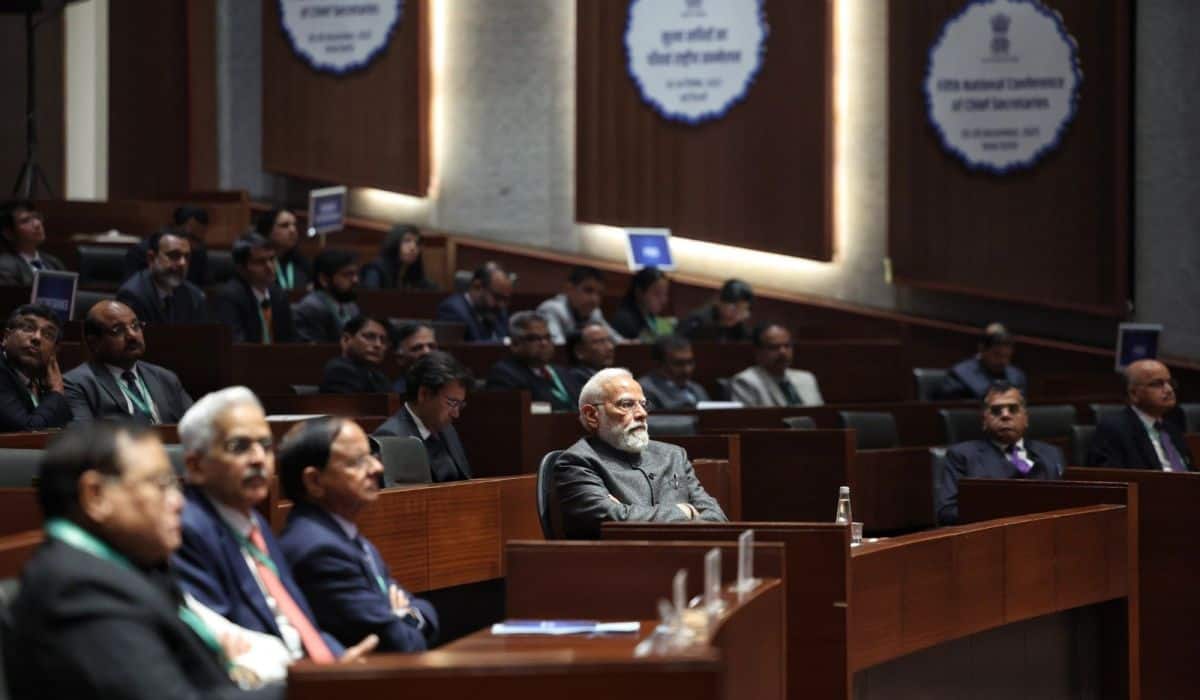
Prime Minister Narendra Modi addressed the 5th National Conference of Chief Secretaries in Delhi, earlier today. The three-day Conference was held in Pusa, Delhi from 26 to 28 December, 2025.

Prime Minister observed that this conference marks another decisive step in strengthening the spirit of cooperative federalism and deepening Centre-State partnership to achieve the vision of Viksit Bharat.

Prime Minister emphasised that Human Capital comprising knowledge, skills, health and capabilities is the fundamental driver of economic growth and social progress and must be developed through a coordinated Whole-of-Government approach.

The Conference included discussions around the overarching theme of ‘Human Capital for Viksit Bharat’. Highlighting India's demographic advantage, the Prime Minister stated that nearly 70 percent of the population is in the working-age group, creating a unique historical opportunity which, when combined with economic progress, can significantly accelerate India's journey towards Viksit Bharat.

Prime Minister said that India has boarded the “Reform Express”, driven primarily by the strength of its young population, and empowering this demographic remains the government’s key priority. Prime Minister noted that the Conference is being held at a time when the country is witnessing next-generation reforms and moving steadily towards becoming a major global economic power.

He further observed that Viksit Bharat is synonymous with quality and excellence and urged all stakeholders to move beyond average outcomes. Emphasising quality in governance, service delivery and manufacturing, the Prime Minister stated that the label "Made in India' must become a symbol of excellence and global competitiveness.

Prime Minister emphasised the need to strengthen Aatmanirbharta, stating that India must pursue self-reliance with zero defect in products and minimal environmental impact, making the label 'Made in India' synonymous with quality and strengthen our commitment to 'Zero Effect, Zero Defect.’ He urged the Centre and States to jointly identify 100 products for domestic manufacturing to reduce import dependence and strengthen economic resilience in line with the vision of Viksit Bharat.

Prime Minister emphasised the need to map skill demand at the State and global levels to better design skill development strategies. In higher education too, he suggested that there is a need for academia and industry to work together to create high quality talent.

For livelihoods of youth, Prime Minister observed that tourism can play a huge role. He highlighted that India has a rich heritage and history with a potential to be among the top global tourist destinations. He urged the States to prepare a roadmap for creating at least one global level tourist destination and nourishing an entire tourist ecosystem.

PM Modi said that it is important to align the Indian national sports calendar with the global sports calendar. India is working to host the 2036 Olympics. India needs to prepare infrastructure and sports ecosystem at par with global standards. He observed that young kids should be identified, nurtured and trained to compete at that time. He urged the States that the next 10 years must be invested in them, only then will India get desired results in such sports events. Organising and promoting sports events and tournaments at local and district level and keeping data of players will create a vibrant sports environment.

PM Modi said that soon India would be launching the National Manufacturing Mission (NMM). Every State must give this top priority and create infrastructure to attract global companies. He further said that it included Ease of Doing Business, especially with respect to land, utilities and social infrastructure. He also called upon states to encourage manufacturing, boost ‘Ease of Doing Business’ and strengthen the services sector. In the services sector, PM Modi said that there should be greater emphasis on other areas like Healthcare, education, transport, tourism, professional services, AI, etc. to make India a Global Services Giant.

Prime Minister also emphasized that as India aspires to be the food basket of the world, we need to shift to high value agriculture, dairy, fisheries, with a focus on exports. He pointed out that the PM Dhan Dhanya Scheme has identified 100 districts with lower productivity. Similarly, in learning outcomes States must identify the lowest 100 districts and must work on addressing the issues around the low indicators.

PM also urged the States to use Gyan Bharatam Mission for digitization of manuscripts. He said that States may start a Abhiyan to digitize such manuscripts available in States. Once these manuscripts are digitized, Al can be used for synthesizing the wisdom and knowledge available.

Prime Minister noted that the Conference reflects India’s tradition of collective thinking and constructive policy dialogue, and that the Chief Secretaries Conference, institutionalised by the Government of India, has become an effective platform for collective deliberation.

Prime Minister emphasised that States should work in tandem with the discussions and decisions emerging from both the Chief Secretaries and the DGPs Conferences to strengthen governance and implementation.

Prime Minister suggested that similar conferences could be replicated at the departmental level to promote a national perspective among officers and improve governance outcomes in pursuit of Viksit Bharat.

Prime Minister also said that all States and UTs must prepare capacity building plan along with the Capacity Building Commission. He said that use of Al in governance and awareness on cyber security is need of the hour. States and Centre have to put emphasis on cyber security for the security of every citizen.

Prime Minister said that the technology can provide secure and stable solutions through our entire life cycle. There is a need to utilise technology to bring about quality in governance.

In the conclusion, Prime Minister said that every State must create 10-year actionable plans based on the discussions of this Conference with 1, 2, 5 and 10 year target timelines wherein technology can be utilised for regular monitoring.

The three-day Conference emphasised on special themes which included Early Childhood Education; Schooling; Skilling; Higher Education; and Sports and Extracurricular Activities recognising their role in building a resilient, inclusive and future-ready workforce.

Discussion during the Conference

The discussions during the Conference reflected the spirit of Team India, where the Centre and States came together with a shared commitment to transform ideas into action. The deliberations emphasised the importance of ensuring time-bound implementation of agreed outcomes so that the vision of Viksit Bharat translates into tangible improvements in citizens’ lives. The sessions provided a comprehensive assessment of the current situation, key challenges and possible solutions across priority areas related to human capital development.

The Conference also facilitated focused deliberations over meals on Heritage & Manuscript Preservation and Digitisation; and Ayush for All with emphasis on integrating knowledge in primary healthcare delivery.

The deliberations also emphasised the importance of effective delivery, citizen-centric governance and outcome-oriented implementation to ensure that development initiatives translate into measurable on-ground impact. The discussions highlighted the need to strengthen institutional capacity, improve inter-departmental coordination and adopt data-driven monitoring frameworks to enhance service delivery. Focus was placed on simplifying processes, leveraging technology and ensuring last-mile reach so that benefits of development reach every citizen in a timely, transparent and inclusive manner, in alignment with the vision of Viksit Bharat.

The Conference featured a series of special sessions that enabled focused deliberations on cross-cutting and emerging priorities. These sessions examined policy pathways and best practices on Deregulation in States, Technology in Governance: Opportunities, Risks & Mitigation; AgriStack for Smart Supply Chain & Market Linkages; One State, One World Class Tourist Destination; Aatmanirbhar Bharat & Swadeshi; and Plans for a post-Left Wing Extremism future. The discussions highlighted the importance of cooperative federalism, replication of successful State-level initiatives and time-bound implementation to translate deliberations into measurable outcomes.

The Conference was attended by Chief Secretaries, senior officials of all States/Union Territories, domain experts and senior officers in the centre.